EOA Wallets vs Smart Wallets: DeFi Guide
— By Whatsertrade in Tutorials

EOA wallets vs smart wallets compared for DeFi: security, gas payments, recovery, automation, and account abstraction to pick the right one for trading.
This guide compares EOA wallets vs smart wallets for DeFi traders. If you first need wallet basics, start with What Is a Crypto Wallet?.
Key Takeaways
- What Is an EOA Wallet?
- What Is a Smart Wallet?
- EOA Wallets vs Smart Wallets: The Key Difference
- Why Wallet Design Matters for DeFi Traders
- The Main Weakness of EOA Wallets
- How Smart Wallets Improve User Experience
Crypto wallets are changing. For years, most users interacted with DeFi through externally owned accounts, also known as EOA wallets. These wallets are simple, widely supported and controlled by private keys.
Smart wallets are a newer model that can add more flexibility, security and automation. They are often connected to account abstraction, a design that can make crypto wallets feel more like modern financial apps.
For DeFi traders, the difference between EOA wallets and smart wallets can affect security, gas payments, recovery, automation and trading experience.
Wallet design is no longer just a technical detail. It can influence how traders interact with markets.
What Is an EOA Wallet?
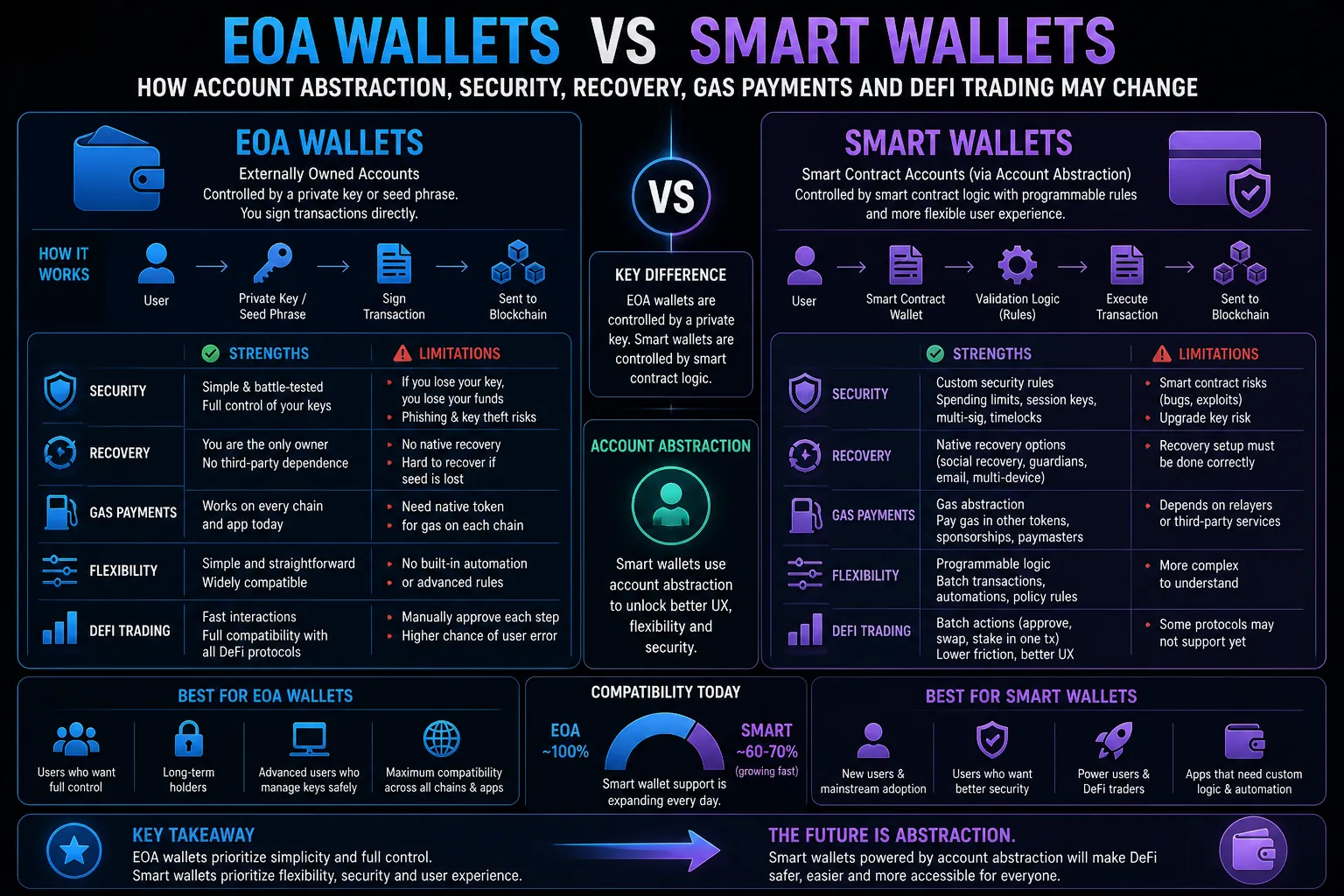
An EOA wallet is a standard crypto wallet controlled by a private key or seed phrase.
With an EOA wallet, the user signs transactions directly. If the user controls the private key, they control the wallet. If they lose the key, they may lose access permanently.
EOA wallets are simple and widely compatible. This is one reason they became the default wallet model for many crypto users.
However, simplicity comes with limitations.
What Is a Smart Wallet?
A smart wallet is controlled by smart contract logic. Instead of relying only on a private key, the wallet can include programmable features.
Smart wallets may support social recovery, spending limits, session keys, gas sponsorship, batch transactions and custom security rules.
This can make DeFi easier and safer for some users.
However, smart wallets also introduce new technical considerations. Users need to understand contract security, upgrade permissions and recovery design.
EOA Wallets vs Smart Wallets: The Key Difference
The key difference is programmability.
EOA wallets are controlled directly by private keys. Smart wallets are controlled by smart contracts that define how transactions are approved and executed.
This gives smart wallets more flexibility. It also means users need to trust the wallet’s contract design.
EOA wallets are simple. Smart wallets are flexible.
Why Wallet Design Matters for DeFi Traders
Many traders focus on token selection, chart patterns and liquidity. But wallet design can also affect trading performance.
A slow, unsafe or limited wallet can turn a good opportunity into a bad experience.
Wallets influence transaction approvals, gas payments, account recovery, permissions and security.
As DeFi becomes more complex, wallet functionality becomes more important.
The Main Weakness of EOA Wallets
EOA wallets depend heavily on private key security. If a user loses the seed phrase, access may be gone forever. If someone steals the private key, the wallet can be drained.
This creates a difficult user experience.
Beginners often fear losing access. Advanced users must build their own security systems through hardware wallets, multisigs and careful operational habits.
EOA wallets also usually require users to hold the native gas token of each chain. This can be inconvenient for traders moving across multiple networks.
How Smart Wallets Improve User Experience
Smart wallets can make DeFi easier by adding programmable features.
A user may be able to recover access through trusted methods, set transaction limits or use gas sponsorship.
Smart wallets can also batch actions. Instead of approving a token, swapping it and staking it through separate transactions, the wallet may combine several steps.
This can reduce friction and improve execution.
For active DeFi users, fewer manual steps can also reduce mistakes.
Gas Payments Can Become More Flexible
With traditional EOA wallets, users usually need the network’s native token to pay gas.
This creates friction. A trader may have USDC on a chain but no native gas token to move it.
Smart wallets can support gas abstraction. This may allow users to pay gas in different tokens or use sponsored transactions.
For DeFi traders, this can make cross chain activity smoother.
Security Rules Can Be Customized
Smart wallets can add advanced security features.
Users may set spending limits, require multiple approvals, restrict risky actions or create temporary session keys.
This can help protect traders from phishing, mistakes and unauthorized activity.
EOA wallets depend more heavily on private key protection. If the key is compromised, funds can be at serious risk.
Smart wallets can reduce some risks, but they introduce others.
Security Trade Offs of Smart Wallets
Smart wallets add features, but they also add complexity.
Since the wallet is controlled by smart contract logic, the contract must be secure. If the wallet contract has a vulnerability, users may be exposed.
If the wallet has upgrade permissions, users should understand who controls upgrades.
EOA risk is mostly private key risk. Smart wallet risk includes contract logic, recovery design and permission structure.
Neither model is risk free.
Account Abstraction and the Future of Wallets
Account abstraction is one of the biggest trends behind smart wallets. It allows wallets to become more flexible and user friendly.
With account abstraction, users may interact with DeFi without thinking as much about gas tokens, seed phrases or manual transaction steps.
For traders, this may enable better automation, safer permissions and smoother cross chain activity.
Wallets may become more like customizable trading accounts rather than simple key holders.
Which Wallet Type Is Better for Beginners?
Smart wallets may become better for beginners because they reduce friction. Recovery tools, gas abstraction and safer transaction flows can make DeFi less intimidating.
However, beginners still need to understand wallet permissions, approvals and phishing risk.
A better wallet experience does not remove the need for caution.
Which Wallet Type Is Better for Advanced Traders?
Advanced traders may use both.
EOA wallets can be useful for direct control and broad compatibility. Smart wallets can be useful for batching, automation and custom security rules.
The best setup depends on trading style, risk tolerance and the chains being used.
How DEXTools Users Can Think About Wallet Choice
DEXTools helps traders analyze markets, but wallet choice affects execution. A good market setup can still become a bad trade if wallet friction causes delays, failed transactions or security mistakes.
As smart wallets become more common, traders may need to think not only about what they trade, but also how their wallet handles execution.
Final Thoughts
EOA wallets and smart wallets represent two different stages of crypto usability.
EOA wallets are simple, direct and widely supported. Smart wallets are programmable, flexible and potentially more user friendly.
For DeFi traders, smart wallets may improve gas payments, security, recovery and transaction flow. But they also require trust in smart contract design.
The future of crypto wallets may not be EOA wallets or smart wallets only. It may be a combination where users choose the model that fits their needs.
How to Bridge Crypto Between Chains: Complete Cross-Chain Tutorial 2026 How to Use 1inch: Complete DEX Aggregator Swap Tutorial (2026) How to Use OKX Web3 Wallet: Multi-Chain DeFi Hub Guide (2026)Related Guides
- DeBank Tutorial: Track DeFi Portfolios and Smart Money Wallets (2026)
- What Is thirdweb: Smart Contracts, Wallets and Web3 Developer Tools (2026)
- What Is Safe: Multisig Wallets, Smart Accounts and Treasury Control (2026)
- What is a Smart Account? Account Abstraction Wallets Guide
- Track Smart Wallets for Memecoin Entries (Full Guide)
Frequently Asked Questions
What is the difference between an EOA wallet and a smart wallet?
An EOA, or externally owned account, is a standard wallet controlled by a single private key. A smart wallet is controlled by a smart contract, which can add features like custom rules, automation, and flexible recovery.
Are smart wallets safer than EOA wallets?
Smart wallets can offer extra safety features such as social recovery, spending limits, and multiple signers, which EOAs do not have natively. However, they rely on contract code, so their security also depends on that code being sound.
What is account abstraction?
Account abstraction is the concept that lets wallets behave like programmable accounts rather than being limited to a single key. It is what enables smart wallet features like paying gas in different ways, batching actions, and custom authorization logic.
Should I use an EOA or a smart wallet for DeFi?
EOAs are simple, widely supported, and familiar, while smart wallets add convenience and safety features at the cost of more complexity. The right choice depends on how much you value recovery, automation, and customization versus simplicity.