New Pairs vs Trending Pairs: Signal Timing on DEXTools
— By Whatsertrade in Tutorials

Discover how new pairs and trending pairs on DEXTools guide crypto trading strategies. Learn which emerges first and why timing is critical.
Every crypto trader wants to discover the next big token before the crowd arrives. In decentralized markets, timing can make a huge difference. A token that appears unknown in the morning can become one of the most traded pairs by the end of the day.
This is why traders use tools like DEXTools to monitor early market activity. Two of the most important signals for token discovery are new pairs and trending pairs.
At first, they may seem similar. Both can help traders find tokens that are gaining attention. Both can show movement before a token reaches major exchanges. Both are useful for spotting market momentum.
However, they are not the same.
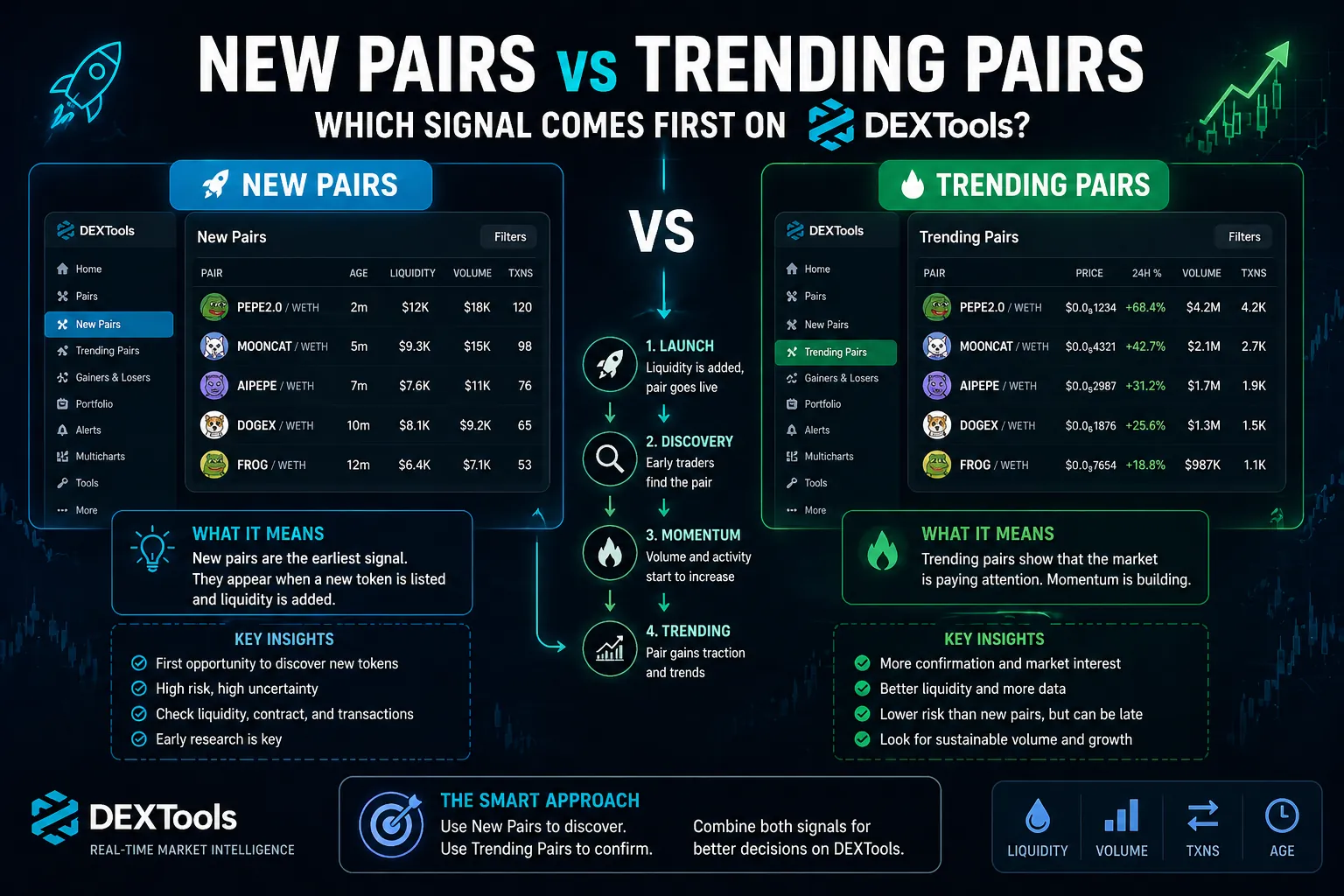
New pairs show what has just become tradable. Trending pairs show what the market is already reacting to.
The difference matters because each signal belongs to a different stage of the token lifecycle. New pairs usually appear first, but they are also riskier. Trending pairs usually come later, but they often provide more confirmation.
Understanding how to use both can help traders identify opportunities earlier, filter noise and avoid chasing weak tokens after the move is already over.
What Are New Pairs on DEXTools?
New pairs are recently created trading pairs on decentralized exchanges. A pair appears when liquidity is added between two assets, such as a new token and ETH, SOL, BNB, USDC or another base asset.
For traders, the new pairs section is one of the earliest places to discover tokens that have just entered the market.
A new pair can represent many different things. It might be a legitimate project launch, a community token, a memecoin, a relaunch, a migrated pool, a test token or a copycat asset using the name of a trending project.
This is why new pairs are powerful but dangerous.
They give traders early visibility, but they also contain a lot of noise. Many new tokens never gain traction. Some launch with very low liquidity. Others are created only to take advantage of hype around a popular narrative.
The main advantage of new pairs is speed. Traders can see assets before they become widely discussed.
The main risk is uncertainty. At the new pair stage, there may not be enough data to know whether the token has real demand, safe liquidity or sustainable trading activity.
What Are Trending Pairs on DEXTools?
Trending pairs are tokens that are already receiving market attention. A pair may trend because of rising volume, strong price movement, growing transactions, increasing liquidity or intense trader interest.
Trending pairs usually offer more confirmation than new pairs. If a token reaches the trending section, it means the market has started to notice it.
This does not always mean the token is safe or early. It only means activity has increased enough to stand out.
A trending pair can be a strong opportunity when the move is still developing. It can also be dangerous if the token is already overextended and early buyers are preparing to sell.
The main advantage of trending pairs is confirmation. Traders can see that volume and attention are already present.
The main risk is timing. By the time a token becomes trending, part of the move may have already happened.
Which Signal Comes First?
New pairs usually come first.
Before a token can trend, it must first become tradable. That usually begins with a liquidity pool. Once the pool exists, the token can appear as a new pair. If buyers arrive, volume increases and liquidity grows, that token may later become a trending pair.
The typical sequence looks like this:
- Liquidity is added to a decentralized exchange.
- The token appears as a new pair.
- Early traders discover the token.
- Transactions and volume begin to grow.
- Liquidity either strengthens or weakens.
- The token may enter trending pairs if activity becomes strong enough.
- More traders notice the token and momentum accelerates.
This sequence shows why new pairs are earlier than trending pairs. But earlier does not always mean better.
A new pair can be early and still fail. A trending pair can be later and still have more upside if the trend is just beginning.
The best traders do not treat one signal as automatically superior. They understand what each signal is telling them.
New Pairs Are About Discovery
New pairs are best used for discovery. They help traders answer one question:
What just launched?
This is useful because decentralized markets move fast. Many tokens begin trading long before they appear on major tracking sites, social media feeds or centralized exchanges.
By monitoring new pairs on DEXTools, traders can see fresh launches in real time and identify early market patterns.
However, discovery is not the same as confirmation. A new pair is only the beginning of the research process.
When a token appears as a new pair, traders should check whether it has enough liquidity, whether buying and selling are possible, whether the contract looks safe, whether the holder distribution is reasonable and whether the token has any real community or narrative behind it.
A new pair should never be treated as a buy signal by itself.
It is a signal to investigate.
Trending Pairs Are About Confirmation
Trending pairs are best used for confirmation. They help traders answer a different question:
What is the market already paying attention to?
A trending pair has usually shown stronger activity than a random new launch. This can make it more useful for traders who prefer to wait for evidence before entering.
Trending pairs may show that volume is rising, buyers are active and the token is gaining visibility. This can reduce some uncertainty, especially compared with unknown new pairs.
However, confirmation comes at a cost. The more obvious the token becomes, the more likely it is that early buyers are already in profit.
A trending pair can be a great signal when the market is still early in the move. It can be a poor signal when the price has already gone vertical and liquidity is not improving.
The Main Difference Between New Pairs and Trending Pairs
The core difference is timing.
New pairs show the earliest tradable stage. Trending pairs show the attention stage.
New pairs are closer to launch. Trending pairs are closer to market validation.
New pairs offer more upside potential but also more risk. Trending pairs offer more confirmation but can be later.
A trader watching new pairs is usually trying to detect opportunity before momentum becomes obvious. A trader watching trending pairs is usually trying to confirm that momentum already exists.
Both approaches can work, but they require different risk management.
Why New Pairs Are Riskier
New pairs are risky because information is limited. At launch, a token may have only a few trades, very low liquidity and little visible history.
Some new pairs are legitimate early opportunities. Many others are low quality launches, copycats or tokens designed to exploit attention.
Common risks in new pairs include low liquidity, high slippage, suspicious contracts, concentrated holders, fake project names, unlocked liquidity, poor token distribution and sudden sell pressure from early wallets.
The biggest danger is that traders may enter before there is enough evidence of real demand.
A token can look exciting simply because it is new. But new does not mean strong. New only means early.
Why Trending Pairs Can Still Be Dangerous
Trending pairs feel safer because they have more activity, but they can also be risky.
A token may become trending after a large price move. At that point, late buyers may be entering while early holders are selling.
This is one of the most common traps in DEX trading. A token appears on trending lists, more traders rush in, price rises quickly, then liquidity weakens and large wallets begin to exit.
A trending pair should be analyzed carefully. Traders need to know whether the trend is still building or already exhausted.
Important signs include volume growth, liquidity stability, transaction count, holder behavior, buy and sell balance and whether price is consolidating or moving too aggressively.
A trending token is not automatically a good entry. It is a signal that attention is present.
How to Use New Pairs on DEXTools
A smart new pairs strategy begins with filtering.
The goal is not to buy every new token. The goal is to find the small number of launches that show early signs of quality.
When using DEXTools new pairs, traders should look at the following areas.
Liquidity
Liquidity is one of the most important filters. A token with extremely low liquidity can move sharply on small trades, which increases risk.
Check whether liquidity is large enough to support your position size. Also watch whether liquidity is increasing or disappearing after launch.
If liquidity is removed quickly, that is a serious warning sign.
Volume
Early volume can show interest, but it must be interpreted carefully.
A new pair with rising volume and growing transactions may be worth watching. A new pair with sudden volume from only a few wallets may be less reliable.
Volume should be compared with liquidity. Very high volume and very low liquidity can suggest unstable trading conditions.
Transactions
Transaction count helps show whether activity is broad or concentrated.
A token with many small buyers may have broader participation. A token with only a few large transactions may be controlled by a small group of wallets.
This does not guarantee safety, but it adds context.
Contract and Token Details
Before trading a new pair, check the token contract. Make sure you are looking at the correct token and not a fake version using a similar name.
Copycat tokens often appear around trending narratives. A fake token can use familiar branding to attract quick buyers.
Holder Distribution
Holder distribution matters because concentrated supply can create sell pressure. If a few wallets control most of the supply, they can strongly affect price.
This is especially important in low liquidity tokens.
Price Structure
A healthy new pair does not always go straight up. In many cases, a stronger launch shows price discovery, pullbacks and renewed buying.
A vertical candle followed by heavy selling can be a warning sign.
How to Use Trending Pairs on DEXTools
Trending pairs should be used to evaluate momentum. The key question is whether the token is still building or already overcrowded.
When analyzing DEXTools trending pairs, traders should focus on quality of movement.
Volume Growth
Look for volume that is increasing steadily rather than appearing in one isolated spike.
Sustained volume suggests continued interest. A single spike may only reflect a short burst of speculation.
Liquidity Growth
A strong trend is healthier when liquidity grows with volume. If price and volume rise but liquidity stays weak, the market may become unstable.
Liquidity is especially important when many traders are trying to enter and exit quickly.
Buy and Sell Balance
A trending token with strong buying and controlled selling may still have momentum. A token with large sells into every pump may be facing distribution.
This is where traders need to look beyond the headline trend.
Pair Age
A very young trending pair can be explosive but risky. An older pair that returns to trending status may have a more established market.
Both can be interesting, but they require different expectations.
Chart Extension
If a token is already up dramatically, the risk of a pullback increases. Chasing a vertical chart can be dangerous, especially if liquidity is thin.
A trending pair may offer better setups after consolidation rather than during the most emotional part of the move.
New Pairs vs Trending Pairs: Which Is Better?
Neither is better in every situation.
New pairs are better for early discovery. Trending pairs are better for market confirmation.
New pairs are useful when traders want to find tokens before broad attention arrives. Trending pairs are useful when traders want to see which tokens are already attracting volume.
The best approach is to use both together.
A trader can monitor new pairs to identify fresh launches, then track which of those tokens begin to show the qualities of a future trending pair.
This creates a more complete workflow.
A Practical DEXTools Workflow
A strong workflow combines early discovery with confirmation.
First, scan new pairs to identify recently launched tokens.
Second, remove obvious risks. Avoid tokens with extremely low liquidity, suspicious contract behavior, fake branding or concentrated supply.
Third, create a watchlist of tokens that show early promise.
Fourth, monitor whether volume and transactions increase over time.
Fifth, check whether liquidity is growing or staying stable.
Sixth, compare those tokens with trending pairs.
Seventh, only consider a trade when the market structure supports the idea.
This workflow helps traders avoid buying only because a token is new or only because it is trending.
The goal is to find tokens that move from early discovery into real momentum.
What Makes a New Pair Promising?
A promising new pair usually has several positive signs at the same time.
It may show enough liquidity for normal trading, steady transaction growth, balanced buying and selling, an active community, clear branding, a relevant narrative and improving chart structure.
No single factor is enough. A token with strong branding but weak liquidity is still risky. A token with high volume but suspicious holder distribution is also risky.
The strongest new pair signals come from alignment across multiple areas.
What Makes a Trending Pair Promising?
A promising trending pair is one where momentum still looks healthy.
This may include rising volume, stable or increasing liquidity, repeated buyer interest, controlled pullbacks, growing holders and a narrative that is still active.
The best trending opportunities often appear before the move becomes too obvious. If the token is already everywhere on social media and the chart is extremely extended, risk may be higher.
A trending pair should be judged by whether the trend has room to continue.
Common Mistakes Traders Make
One common mistake is buying a new pair only because it launched recently. Early entry is not useful if the token has no real demand.
Another mistake is buying a trending pair only because it appears on a popular list. Trending status does not guarantee upside.
A third mistake is ignoring liquidity. Liquidity affects entry, exit and slippage. A good idea can become a bad trade if the market is too thin.
A fourth mistake is ignoring sell pressure. If large holders are selling into every move, the trend may be weaker than it looks.
A fifth mistake is using signals without a plan. Traders should know their entry, invalidation and exit before opening a position.
How Beginners Should Use These Signals
Beginners should be careful with new pairs. They are early, but they require fast analysis and strong risk control.
A better approach for beginners is to observe new pairs first. Track tokens without trading them. Watch which ones survive, which ones fail and which signals mattered.
Trending pairs may be easier for beginners because they provide more confirmation. Still, beginners should avoid chasing tokens after extreme price moves.
For new traders, the safest lesson is this: use DEXTools signals to research, not to react emotionally.
How Advanced Traders Use Both Signals
Advanced traders often use new pairs for early scouting and trending pairs for confirmation.
They may identify a token shortly after launch, watch early liquidity and transactions, then wait to see whether it begins to attract broader market interest.
Some traders may enter early with small size, then add only if confirmation improves. Others may wait until the token appears in trending pairs but avoid entries if the price is already too extended.
The exact strategy depends on risk tolerance. But the principle is the same: early discovery plus confirmation is stronger than either signal alone.
The Role of Narratives
Narratives can make both signals more powerful.
A new pair related to an active market narrative may attract attention faster. A trending pair inside a hot sector may continue longer if multiple tokens in the same category are also moving.
For example, if AI tokens are gaining volume across several chains, a new AI pair may deserve closer attention. If RWA tokens are trending broadly, a related pair may benefit from sector rotation.
However, narratives also attract copycats. When a theme becomes popular, many weak tokens launch with similar names.
This is why traders should combine narrative analysis with liquidity, volume and contract checks.
Final Thoughts
New pairs and trending pairs are two of the most important signals for token discovery on DEXTools.
New pairs usually come first. They show what has just become tradable. They are useful for early discovery, but they carry high risk and require careful filtering.
Trending pairs usually come later. They show what the market is already noticing. They provide more confirmation, but they can also attract traders after much of the move has already happened.
The best strategy is not to choose one signal and ignore the other. The best strategy is to understand how they work together.
New pairs help traders discover. Trending pairs help traders validate.
When a token moves from a new pair into a trending pair with growing volume, stable liquidity and healthy market structure, it becomes much more interesting.
For DEXTools users, the real edge is not simply being early. The real edge is knowing which early signals are worth following before the rest of the market catches on.
How to Bridge Crypto Between Chains: Complete Cross-Chain Tutorial 2026 How to Use 1inch: Complete DEX Aggregator Swap Tutorial (2026) How to Use OKX Web3 Wallet: Multi-Chain DeFi Hub Guide (2026)Related Guides
- How to Find Trending Crypto on DEXTools (2026)
- What Is Cliff Vesting in Crypto? Unlock Timing and Price Risk (2026)
- The Wallet Age Signal: What Fresh Wallets vs Old Wallets Reveal About a Token
- On-Chain Signal Half-Life: When Crypto Alerts Stop Working
- CEX Deposit Pressure: How Exchange Inflows Can Signal Future Selling
Frequently Asked Questions
What is the difference between new pairs and trending pairs on DEXTools?
New pairs are tokens that have recently created a trading pool, while trending pairs are those currently attracting significant attention or activity. New pairs appear first, and some of them may later become trending.
Why does signal timing matter when trading on a DEX?
Acting earlier can mean better entry prices but comes with less information and higher risk, while waiting for trending status offers more data but often a higher price. Balancing timing against risk is a core part of strategy.
Are new pairs riskier than trending pairs?
New pairs generally carry more uncertainty because they have a short history, thin liquidity, and unverified contracts. Trending pairs have more activity to evaluate but can also be later in their move.
Should I buy a token just because it is trending?
No, trending status only signals attention and does not confirm a token is safe or undervalued. You should still review liquidity, contract details, and holder distribution before deciding.