Goldman Sachs Bitcoin ETF: A Wall Street Crypto Shift Explained
— By Whatsertrade in Tutorials

Goldman Sachs aims to revolutionize institutional crypto investment with its Bitcoin ETF, integrating options for structured income amid market volatility.
Goldman Sachs has taken a major new step into crypto by filing for its first Bitcoin ETF product with the U.S. Securities and Exchange Commission. The product is designed to give investors exposure to Bitcoin while also generating income from Bitcoin options transactions, making it very different from a simple buy and hold spot Bitcoin fund. The filing was reported on April 14, 2026, and the product could launch as early as late June if it clears the regulatory process.
That alone makes it a big story, but the real reason this matters is broader. This is not just another crypto headline. It is a sign that one of Wall Street's biggest names sees a new phase of Bitcoin investing taking shape, one where investors are not only looking for price exposure, but also for structured income, downside management, and ETF strategies that fit more traditional portfolio construction. Goldman's move also comes only days after Morgan Stanley launched its own spot Bitcoin ETF, showing that large U.S. banks are pushing deeper into listed crypto products.
What Is the Goldman Sachs Bitcoin ETF?
The Goldman Sachs Bitcoin ETF is not being positioned as a plain vanilla spot product. Based on the filing details reported so far, the fund aims to combine exposure to Bitcoin's price with income generated from Bitcoin options. That puts it closer to the growing class of outcome oriented and income focused ETFs that try to offer something more tailored than simple market tracking.
This distinction matters. A traditional spot Bitcoin ETF is mainly about capturing upside when Bitcoin rises and downside when it falls. Goldman's product appears to be aimed at investors who still want Bitcoin exposure but also want a more familiar income component, especially in a market where volatility remains high. That could make the product more attractive to advisors, income focused investors, and portfolio managers who are interested in crypto but do not want pure directional exposure.
Why This Filing Is Bigger Than It Looks
At first glance, the filing may seem like a simple product launch. In reality, it signals something more important about where institutional crypto is heading.
The first phase of Bitcoin ETF adoption was about legitimacy. Investors wanted a regulated vehicle that made Bitcoin easier to access through brokerage accounts. The next phase may be about product design. Instead of stopping at basic exposure, big firms are now exploring how to wrap Bitcoin into more familiar ETF formats, including funds built around options, income strategies, and defined outcomes. Goldman's latest move fits that shift almost perfectly.
It also suggests that crypto is moving deeper into the mainstream ETF playbook. Citi said last week that U.S. ETF assets could rise from about $10.4 trillion in March 2025 to $25 trillion by 2030, and to more than $40 trillion by 2035, with active ETFs expected to gain a much larger share of that growth. Goldman's Bitcoin ETF filing lands right in the middle of that trend.
Why Goldman Sachs Entering the Bitcoin ETF Market Matters
Goldman Sachs is not a fringe name trying to ride a trend. It is one of the most influential financial institutions in the world. When a bank like Goldman files for a Bitcoin ETF, it tells the market that crypto is no longer being treated only as a speculative side asset. It is being folded into the product architecture of institutional finance. That shift can influence everything from advisor sentiment to product competition to how other asset managers position their own crypto offerings. This is an interpretation based on Goldman's filing and the broader push by major banks into crypto ETFs.
There is also an important backstory here. Goldman was already involved in the Bitcoin ETF ecosystem before this filing. In 2024, regulatory disclosures showed it had built roughly $418 million in positions across several U.S. spot Bitcoin ETFs, including a large stake in BlackRock's iShares Bitcoin Trust. That means Goldman did not arrive at this moment as an outsider. It had already been studying and participating in the market before deciding to launch its own product.
Why the Income Angle Could Generate So Much Interest
The most interesting part of the Goldman Sachs Bitcoin ETF story is the income angle.
Bitcoin has always attracted attention because of its upside potential, but that same volatility makes many traditional investors uneasy. A product that promises Bitcoin exposure plus options driven income speaks directly to that tension. It offers a way to stay involved in the asset class while trying to make the ride feel more manageable or more productive in flat or choppy markets.
That makes the product more than a crypto story. It is also an ETF innovation story. In the past few years, investors have shown growing interest in funds that do more than track an index. Products built around buffers, covered calls, and defined outcomes have become increasingly relevant because they try to solve a clear problem: how to stay exposed to markets without taking raw, unmanaged risk. Goldman's filing suggests that the same logic is now being applied to Bitcoin.
The Innovator Acquisition Is a Big Clue
One of the most revealing details in this story is timing. Goldman's filing is the first ETF product it has submitted since completing its $2 billion acquisition of Innovator Capital Management earlier this month. Innovator is known for pioneering buffer ETFs and building options based ETF strategies.
That makes the strategy behind this new Bitcoin ETF easier to understand. Goldman is not simply launching a crypto fund. It appears to be combining its distribution power and brand with a recently acquired ETF platform that specializes in options based outcomes. In other words, this may be less about Goldman finally catching up to Bitcoin and more about Goldman building a more sophisticated crypto ETF category from the start. This is an inference supported by the filing details and the Innovator acquisition.
Why Timing Matters Right Now
Goldman's filing comes during a difficult period for crypto markets. Reuters reported that Bitcoin had fallen nearly 15 percent so far in 2026 and was trading around 40 percent below its October high of $126,223 when the filing was reported. At the same time, broader risk sentiment has been pressured by tech stock weakness, volatility in precious metals, and geopolitical conflict involving the United States, Israel, and Iran.
That timing could turn out to be more important than it seems. Launching an income oriented Bitcoin ETF during a weak or unstable market is a way of telling investors that the product is not only for euphoric bull runs. It is being framed as something that may still have a role when investors want exposure but also care more about yield, structure, and risk framing. That positioning could resonate with a much wider audience than a pure momentum product. This is an inference based on the product design and the market backdrop.
How This Could Affect the Bitcoin ETF Market
The Bitcoin ETF market is already crowded, but Goldman's entry could still matter because it changes the competitive conversation.
Until now, much of the focus has been on fees, liquidity, and brand strength in spot Bitcoin ETFs. Goldman may be trying to compete on something else entirely: strategy. If investors respond well to a Bitcoin product that also generates options income, other issuers may feel pressure to launch more specialized Bitcoin ETFs rather than relying only on basic exposure products.
That could create a second wave of competition in crypto ETFs. The first wave was about getting institutions comfortable with Bitcoin in ETF form. The next wave may be about segmentation, with products aimed at income seekers, risk managed investors, tactical allocators, and advisors building more complex model portfolios. Goldman's filing increases the odds of that happening. This is an inference based on current ETF industry trends and the structure of Goldman's product.
What Investors Should Watch Next
The next major detail investors will want is the fee. Goldman's filing did not disclose the proposed expense ratio, and that matters because fees are still a major battleground in the ETF market.
Investors should also watch how the fund explains its options strategy in practice. The key question is whether the income feature is compelling enough to offset the reality that investors would still face downside exposure if Bitcoin weakens. Morningstar's Bryan Armour said that while the income feature may sound appealing, the product could still be a hard sell because of Bitcoin's volatility and the fact that it does not eliminate downside risk.
Another important issue is investor education. Products that combine Bitcoin exposure with options are naturally more complex than standard spot ETFs. That means marketing, advisor adoption, and product clarity will be critical. A simpler product can be easier to explain, but a more complex one can stand out if it solves a real portfolio problem. This is an inference based on the structure of outcome oriented ETFs and Goldman's proposed design.
Why This Story Can Generate Strong Search Traffic
From a search perspective, this topic has everything needed for high interest traffic.
It combines one of the strongest finance brands in the world with one of the most searched crypto assets and one of the most popular investment vehicles. It also sits at the intersection of several high demand themes: Bitcoin ETF, Goldman Sachs crypto, institutional adoption, active ETFs, and Wall Street's next move in digital assets. The freshness of the filing makes it timely, while the bigger questions around institutional crypto adoption make it relevant beyond the news cycle. This is an inference grounded in the subject matter and current ETF market growth trends.
That is why this is not just a breaking news article topic. It also has evergreen potential. People will keep searching for variations of the same questions: What is the Goldman Sachs Bitcoin ETF? Is Goldman launching a Bitcoin ETF? How is it different from a spot Bitcoin ETF? Why are big banks getting deeper into crypto ETFs? The article angle works both for immediate clicks and for longer term SEO. This is an editorial inference based on the nature of the search topic.
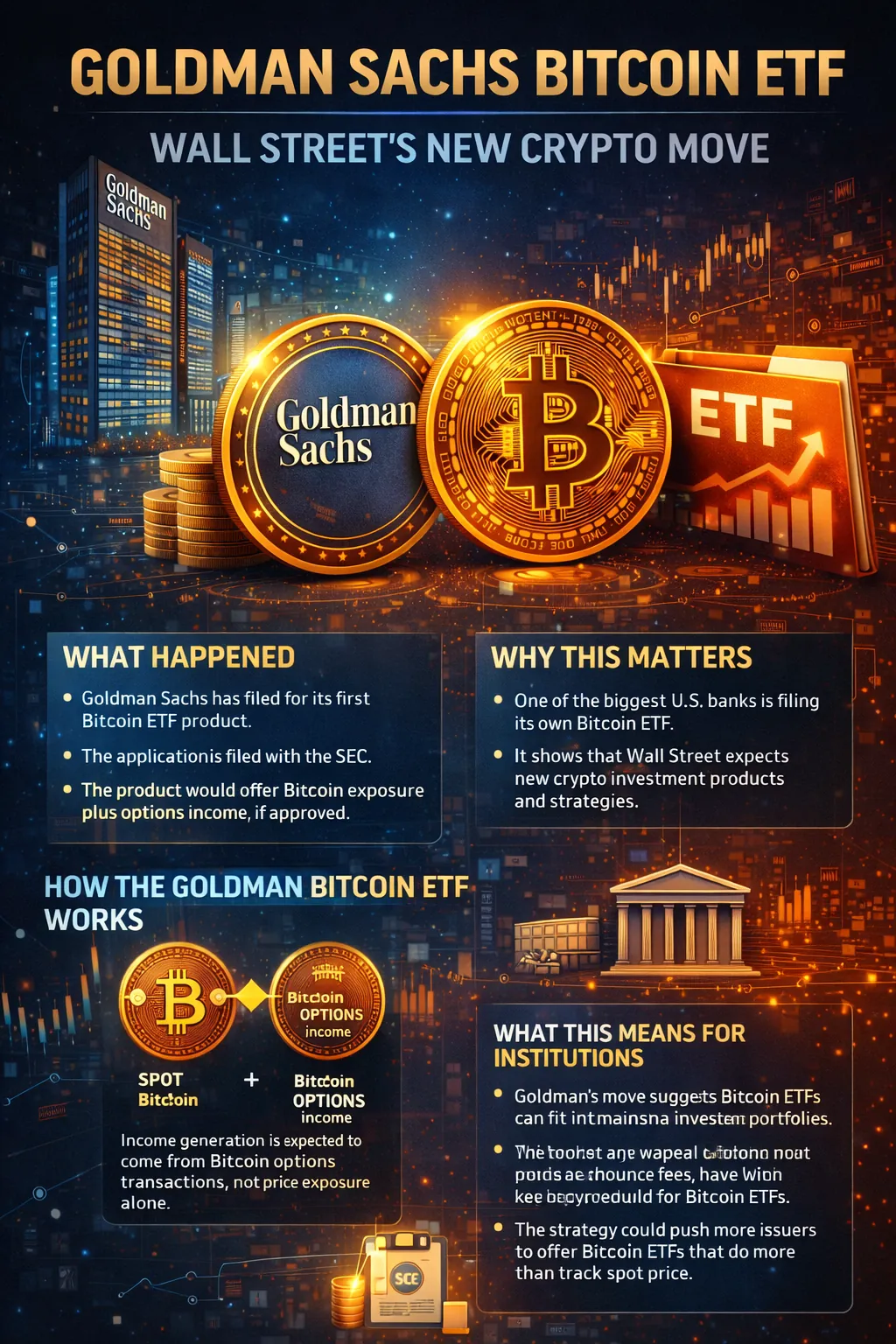
The Goldman Sachs Bitcoin ETF filing matters because it shows how fast the institutional crypto conversation is evolving.
Wall Street is no longer only asking whether Bitcoin belongs in an ETF. It is now asking what kind of Bitcoin ETF belongs in a modern portfolio. Goldman's answer appears to be a product that combines crypto exposure with options driven income, launched at a time when investors are more sensitive to volatility and more open to structured strategies.
If the product succeeds, it could do more than expand Goldman's crypto footprint. It could help define the next stage of Bitcoin ETF competition, one where product design matters as much as access. And if that happens, this filing may end up being remembered not as Goldman's first Bitcoin ETF, but as the moment the crypto ETF market began to mature into something far more sophisticated. This is an inference supported by Goldman's filing, peer bank activity, and broader ETF industry trends
Bitcoin Halving and Why It Matters Crypto Order Types Is ETHE an ETF? What Grayscale ETHE Actually Is Crypto Trading Strategies Tokenized Treasuries and RWAsFrequently Asked Questions
What is Goldman Sachs' stance on a Bitcoin ETF?
Goldman Sachs has not filed for its own Bitcoin ETF. However, its executives have expressed interest in the underlying technology and potential for regulated crypto products.
Has Goldman Sachs invested in Bitcoin?
Goldman Sachs offers some Bitcoin-related services to its clients, such as trading Bitcoin futures and non-deliverable forwards. The firm itself does not hold Bitcoin as a primary asset on its balance sheet.
Why is a Goldman Sachs Bitcoin ETF significant?
A Bitcoin ETF from a major financial institution like Goldman Sachs could signal broader institutional acceptance and provide a regulated, accessible investment vehicle for a wider range of investors.
What challenges might Goldman Sachs face in launching a Bitcoin ETF?
Challenges include navigating regulatory uncertainty, addressing concerns about market manipulation, and ensuring robust custody solutions for the underlying Bitcoin assets.
How does Goldman Sachs view the future of cryptocurrency?
Goldman Sachs generally views blockchain technology and digital assets as having significant potential. The firm is exploring various applications, including tokenization and central bank digital currencies.