Euro Stablecoins and MiCA: A Guide for EU Traders (2026)
— By Whatsertrade in Tutorials

Euro stablecoins and MiCA explained: how the rules affect liquidity, trading pairs, compliance, and DeFi access for European crypto traders in 2026.
This page explains euro stablecoins under MiCA from a trader-liquidity angle. It is about European market structure, not general stablecoin market cap metrics.
Stablecoins have always been one of the most important tools in crypto trading. They help traders move between tokens, protect capital during volatility, access DeFi protocols and settle trades without going back to traditional banking rails. For years, however, the stablecoin market has been overwhelmingly dominated by dollar-pegged assets.
That is starting to matter more in Europe.
As MiCA reshapes the regulatory landscape and crypto platforms adapt to new compliance requirements, euro stablecoins are becoming more than a niche alternative. They are turning into a strategic battleground between issuers, exchanges, banks, payment companies and on-chain traders who want exposure to crypto markets without constantly converting between euros and dollars.
For European traders, this shift is not just regulatory noise. It can affect liquidity, spreads, available trading pairs, exchange listings, DeFi access and even how easily capital moves between bank accounts and on-chain wallets.
This article explains why euro stablecoins are gaining attention, how MiCA changes the rules and what traders should look at before using a euro-denominated stablecoin on-chain.
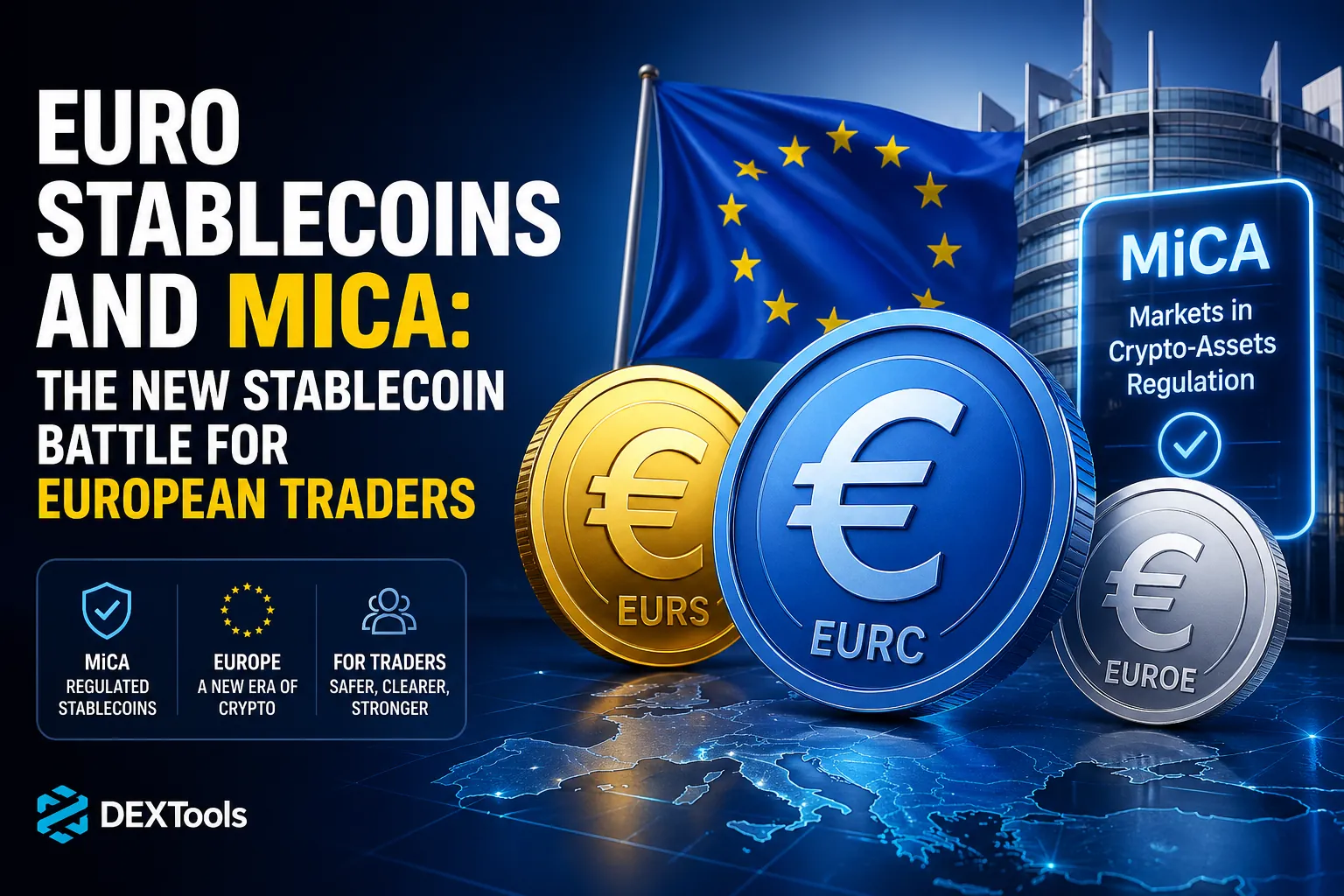
What Are Euro Stablecoins?
Euro stablecoins are crypto assets designed to track the value of the euro. In most cases, one token aims to stay close to one euro. They are used in a similar way to dollar stablecoins, but with a different reference currency.
A trader might use a euro stablecoin to:
- Keep funds on-chain without taking direct exposure to crypto volatility
- Trade euro-denominated pairs
- Move capital between exchanges and wallets
- Access DeFi protocols while staying in a euro unit of account
- Reduce repeated conversions between EUR and USD
- Build a more natural portfolio for European tax and accounting needs
The concept is simple, but the market structure is not. A stablecoin is only useful if it has enough liquidity, strong backing, reliable redemption, trusted issuance and broad integration across exchanges and decentralized applications.
That is where the euro stablecoin market still faces a challenge.
Why Dollar Stablecoins Still Dominate Crypto
Crypto markets grew around the US dollar because the dollar is the main reference currency for global finance, commodities, foreign exchange markets and most centralized crypto exchanges. Bitcoin, Ethereum and altcoins are usually quoted against dollar stablecoins. The deepest liquidity pools are often built around USDT, USDC or other dollar-pegged assets.
This creates a network effect. Traders use dollar stablecoins because liquidity is there. Exchanges list dollar pairs because traders demand them. DeFi protocols integrate dollar stablecoins because they have deep pools and strong demand.
Euro stablecoins have to compete against that existing infrastructure.
For a European user, holding euro stablecoins might feel more intuitive. But if the token has thin liquidity, limited exchange support or wide spreads, it becomes less useful in practice. Traders care about execution, not only denomination.
The question is no longer whether euro stablecoins make sense. They clearly do. The real question is whether they can reach enough liquidity to become a serious trading asset.
How MiCA Changes the Stablecoin Market
MiCA, the Markets in Crypto-Assets regulation, is one of the most important crypto regulatory frameworks in Europe. For stablecoins, it creates clearer rules around issuance, reserves, transparency, authorization and supervision.
For traders, MiCA can have three major effects.
First, it can increase demand for regulated stablecoins. If exchanges, brokers and payment companies need compliant assets, they may prefer issuers that fit the European regulatory framework.
Second, it can pressure non-compliant stablecoins. If a stablecoin does not meet local requirements, platforms operating in the European Economic Area may restrict access, reduce support or avoid adding new pairs.
Third, it can encourage banks and regulated financial institutions to enter the market. A clearer rulebook makes it easier for traditional players to launch tokenized money products, payment tools and settlement assets.
This does not automatically mean every euro stablecoin will succeed. Regulation can create trust, but it does not create liquidity by itself.
Why Euro Stablecoins Matter for Traders
For a long time, euro stablecoins were treated as a secondary product. They were useful for European users, but not essential for global crypto liquidity. That may change as on-chain finance becomes more regulated and more connected to real-world payment systems.
European traders should pay attention for several reasons.
1. Easier Portfolio Accounting
Many European investors think in euros. Their salary, bank balance, tax obligations and expenses are euro-denominated. When every trade runs through dollar stablecoins, the trader is exposed to an extra currency layer.
A euro stablecoin can make portfolio tracking cleaner. It can also make profit and loss easier to understand for users who do not want to mentally convert everything into USD.
2. More Relevant Stable Pairing
If euro stablecoin liquidity improves, traders may get more direct access to pairs such as ETH/EUR stablecoin, BTC/EUR stablecoin or major altcoins against euro-denominated assets.
That would reduce friction for users entering and exiting positions from European banking rails.
3. Better Alignment With Local Regulation
Regulated platforms in Europe may increasingly prioritize stablecoins that meet MiCA standards. Traders who use those platforms may see changes in available markets, supported assets and deposit or withdrawal options.
4. New DeFi Opportunities
Euro stablecoins could support new lending markets, yield products, liquidity pools and payment applications. If more real-world assets and tokenized funds move on-chain in Europe, euro settlement assets may become more important.
The Main Challenge: Liquidity
The biggest problem for euro stablecoins is not branding. It is liquidity.
A stablecoin can be compliant, well-designed and fully backed, but traders will avoid it if execution is poor. Thin liquidity creates slippage. Slippage creates worse entries and exits. Worse execution pushes traders back to deeper dollar-denominated markets.
Before using any euro stablecoin in a trading strategy, check:
- Pair liquidity
- Daily volume
- Spread between buy and sell prices
- Number of active pools
- Supported chains
- Exchange listings
- Redemption options
- Issuer transparency
- Historical peg stability
A euro stablecoin with strong regulation but weak liquidity may be good for holding, but not ideal for active trading. A token with strong volume on one chain may still be risky on another chain if liquidity is fragmented.
How to Analyze Euro Stablecoin Pairs on DEXTools
DEXTools can help traders evaluate whether a euro stablecoin pair is actually tradable or just listed.
Start with the pair chart. Look for consistent trading activity instead of isolated spikes. A pair with one large candle and no follow-through may not have sustainable market interest.
Next, check liquidity. For stablecoin pairs, liquidity depth is critical. A pool may show volume, but if liquidity is shallow, even a moderate trade can move the price.
Then compare volume against liquidity. Healthy markets usually show a realistic relationship between both. Extremely high volume on very low liquidity can be a red flag, especially if activity looks repetitive or artificial.
Also review the number of transactions. A pair with volume generated by a few transactions behaves differently from a pair with broad participation across many buyers and sellers.
Finally, check the token contract and holder distribution. Even stablecoins should be evaluated carefully, especially when interacting with wrapped, bridged or less established versions.
Euro Stablecoins vs Dollar Stablecoins
Dollar stablecoins are still the main liquidity layer in crypto. That is unlikely to disappear quickly. The deeper question is whether euro stablecoins can build a parallel market for European users.
Dollar stablecoins offer:
- Deeper liquidity
- More trading pairs
- Broader DeFi integration
- Better global exchange support
- Stronger network effects
Euro stablecoins can offer:
- Better currency alignment for European traders
- Easier accounting in euros
- Potential MiCA compliance advantages
- Better fit for euro-denominated payments
- A natural settlement asset for European tokenized finance
The most realistic outcome is not that euro stablecoins replace dollar stablecoins. It is that they become more important in specific use cases, especially regulated European trading, payments, tokenized assets and local DeFi liquidity.
Risks Traders Should Not Ignore
Euro stablecoins may sound safer because they are stable and regulated, but risk still exists.
Peg risk is the first issue. A stablecoin can trade below or above its intended value during stress, especially if liquidity is thin.
Issuer risk also matters. Traders need to understand who issues the token, how reserves are managed and whether redemption is clear.
Chain risk is another factor. A stablecoin may be issued on multiple networks, but liquidity and smart contract risk can differ across chains.
Regulatory risk can also move quickly. Compliance status, exchange support and regional availability can change as rules are interpreted and enforced.
Finally, liquidity fragmentation can create hidden execution problems. A euro stablecoin may look strong in total supply, but if that supply is spread across too many venues, actual tradable depth may be limited.
What Comes Next for Euro Stablecoins?
The euro stablecoin market is still early compared with dollar stablecoins, but the direction is clear. Europe wants regulated digital settlement assets. Crypto traders want faster movement between fiat and on-chain markets. Institutions want tokenized cash that fits compliance requirements.
That creates an opening for euro stablecoins.
The winners will not simply be the tokens with the best regulatory story. They will be the assets that combine trust, liquidity, integrations, low friction and real usage.
For traders, the best approach is practical. Do not choose a stablecoin only because it is denominated in euros. Choose it because it has the liquidity, transparency and market structure needed for your strategy.
Final Thoughts
Euro stablecoins are becoming one of the most important crypto trends for European traders. MiCA is pushing the market toward clearer rules, but liquidity will decide which assets actually matter on-chain.
For DEX traders, the opportunity is to watch this shift early. New euro pairs, new liquidity pools, new regulated issuers and new DeFi integrations can all create useful market signals.
The stablecoin battle in Europe is not only about USDT vs USDC. It is about whether the euro can become a serious on-chain trading currency.
For European crypto traders, that battle has already started.
How to Bridge Crypto Between Chains: Complete Cross-Chain Tutorial 2026 How to Use 1inch: Complete DEX Aggregator Swap Tutorial (2026) How to Use OKX Web3 Wallet: Multi-Chain DeFi Hub Guide (2026)What MiCA Changes for Everyday Traders
For a European trader, the most visible effect of a clearer regulatory framework is the way it shapes which assets remain easily accessible. When rules define what a compliant stablecoin must look like, exchanges and platforms tend to favor issuers that meet those standards. The result is a gradual shift in available trading pairs, with some tokens gaining prominence and others becoming harder to find on regulated venues serving the region.
This shift influences liquidity. Pairs built around compliant euro denominated stablecoins can attract more activity over time, which generally means tighter spreads and smoother execution for the trader. Conversely, assets that fall outside the favored set may see thinner books, making large orders more costly to fill. Understanding where liquidity is concentrating helps a trader plan entries and exits with fewer surprises.
There are practical habits that help while a framework matures:
- Confirm asset availability on your chosen platform rather than assuming continuity.
- Watch trading pairs, since the most liquid quote asset can change.
- Understand redemption, meaning how and whether a stablecoin can be exchanged for its underlying value.
- Keep records for tax and reporting purposes, which compliance frameworks tend to emphasize.
None of this is investment advice, and rules continue to evolve. The reasonable stance is to stay informed, prefer transparency over opacity, and treat regulatory clarity as something that can reduce uncertainty rather than only restrict choice.
Frequently Asked Questions
What are euro stablecoins?
Euro stablecoins are cryptocurrencies designed to maintain a stable value pegged to the euro. They aim to combine the stability of traditional fiat currency with the benefits of blockchain technology.
What is MiCA?
MiCA (Markets in Crypto-Assets Regulation) is a comprehensive regulatory framework established by the European Union to regulate crypto-assets, including stablecoins, within the EU.
How does MiCA impact euro stablecoins?
MiCA introduces specific requirements for euro stablecoins, including authorization, operational standards, capital requirements, and investor protection measures for issuers.
When does MiCA become applicable to stablecoins?
The rules for stablecoins under MiCA are expected to become fully applicable in June 2024. Issuers need to prepare for compliance well in advance of this date.
What are the benefits of MiCA for euro stablecoins?
MiCA aims to foster market integrity, consumer protection, and financial stability by providing a clear legal framework. This can increase trust and adoption of regulated euro stablecoins.
Related Guides
- Why Real Time Data Matters for DEX Traders
- Centralized vs Shared Sequencers: What Layer 2 Traders Should Know
- How Stablecoins Keep Their Peg: Collateral Models, Depeg Risk and On-Chain Checks
- How to Use DefiLlama: Track TVL, Stablecoins and Protocol Revenue (2026)
- How to Earn Yield on Stablecoins Safely.
- Post