How to Earn Yield on Stablecoins Safely.
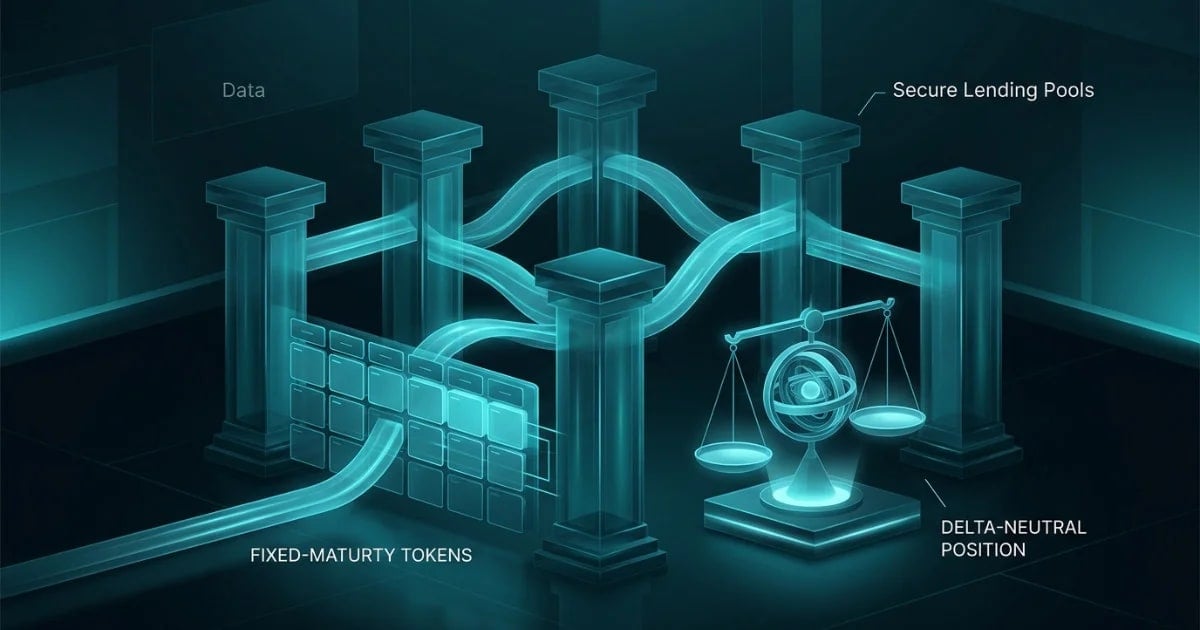
Generating yield on stablecoins requires deep risk awareness. We break down the technical realities of Aave pools, Pendle PT structures, and synthetic dollars.
A Risk-Adjusted Guide
- The decentralized finance (DeFi) environment has shifted from speculative, inflationary token rewards to a mature financial ecosystem centered on capital preservation and sustainable yield. For market participants holding stablecoins like USDC, USDT, or USDS, generating passive income is no longer about chasing triple-digit percentages in unaudited liquidity pools. Instead, it requires a clear, forensic evaluation of where the yield originates and the structural risks underlying the protocol.
- Earning yield safely means balancing target returns against smart contract complexity, liquidation conditions, and liquidity lockups. This guide analyzes the primary infrastructure models for stablecoin yields, maps out their technical trade-offs, and details how to avoid systemic asset mismatches.
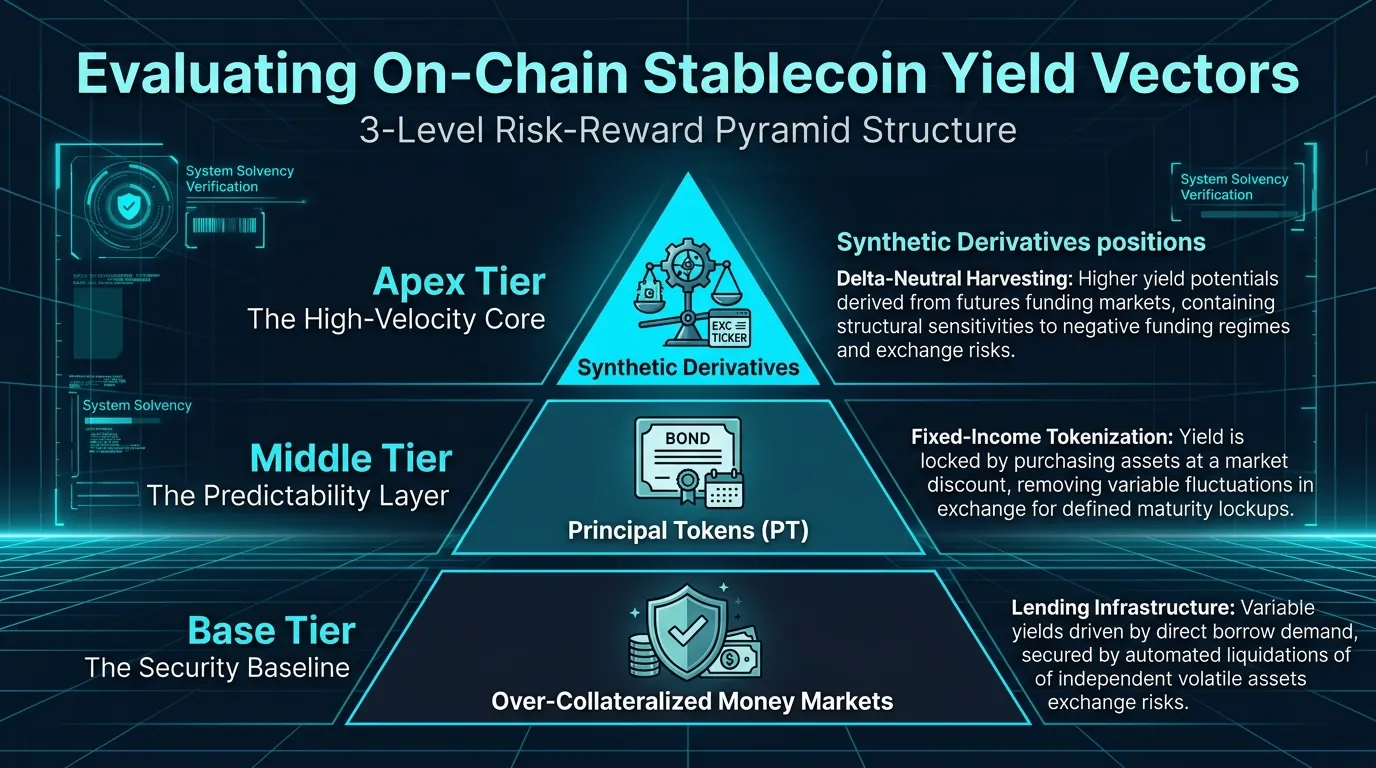
1. The Lending Benchmark: Over-Collateralized Money Markets (Aave)
The foundational and historically safest method to earn yield on-chain is through decentralized lending marketplaces like Aave.
The Mechanism
- When you deposit stablecoins into a lending pool, you act as a decentralized bank. Other market participants borrow your stablecoins to execute leveraged trades or access liquidity without selling their long positions.
- To protect your principal, the protocol mandates that all borrowers over-collateralize their positions. For example, a borrower must deposit more value in an independent, volatile asset like Ethereum or Bitcoin than the amount of stablecoins they withdraw.
The Yield and Risk Profile
The APY Dynamics: Yields are purely variable and driven by utilization rates. If borrowing demand for USDC spikes, the interest rate paid by borrowers automatically increases, passing a higher yield down to lenders. Normal baseline returns hover between 2.5% and 5.0%, though sudden market liquidity shocks can cause temporary spikes above 13%.
The Safety Layer: If the value of a borrower's volatile collateral drops below a strict mathematical threshold, the protocol's automated liquidation bots sell the collateral to repay the lenders, ensuring the pool remains solvent. The primary risk is limited to smart contract vulnerabilities or extreme market gaps where liquidations fail to keep pace with price drops.
2. The Fixed Income Model: Yield Tokenization (Pendle PT)
For users who prioritize predictability over variable market rates, yield tokenization platforms have introduced corporate bond-style structures to Web3.
The Mechanism
Platforms like Pendle allow users to split a standard yield-bearing asset into two separate, tradable components: the Principal Token (PT) and the Yield Token (YT).
[Yield-Bearing Asset] ---> [Principal Token (PT): Core Capital Claim] ---> [Yield Token (YT): Future Yield Claim]
Principal Token (PT): Represents the ownership claim on the underlying deposit, redeemable at a 1:1 ratio upon a specified maturity date.
Yield Token (YT): Captures the variable yield generated by that asset over the same time horizon.
Locking in Fixed Returns
- By purchasing a Principal Token (PT) for a stablecoin pool or a regulated real-world asset (RWA) strategy, you are buying the asset at a market discount. For instance, if you buy 10,000 USDC worth of a PT asset for 9,500 USDC, you simply hold that token until the maturity date, at which point it becomes redeemable for the full 10,000 USDC. The gap between your entry price and the redemption value translates into a guaranteed, fixed annualized percentage yield (APY).
The Safety Layer: As a PT holder, you have zero exposure to liquidation risk or yield fluctuations. Your return profile is fixed at the moment of purchase, though your capital remains illiquid until maturity unless you choose to exit early at prevailing market rates through the protocol's automated market maker.
3. The Synthetic Framework: Delta-Neutral Yields (sUSDe)
As the market matured, developers introduced synthetic asset designs to harvest yields from funding rates and derivatives markets rather than traditional credit demand.
The Mechanism
Ethena's Staked USDe (sUSDe) serves as the primary implementation of a synthetic, delta-neutral dollar strategy. It does not operate like a traditional fiat stablecoin backed by cash in a bank, nor does it function like an over-collateralized loan. Instead, it achieves stability through a balanced market position:
The protocol holds spot crypto assets (such as Ethereum or Bitcoin) as long positions.
It simultaneously opens an equal and opposite short perpetual futures position on centralized derivatives exchanges.
This dual-legged position is delta-neutral, meaning the total dollar value of the backing collateral remains constant regardless of whether the broader crypto market moves up or down.
Where the Yield Comes From
- The yield passed down to sUSDe holders originates from two native sources: the consensus layer staking rewards generated by the spot crypto assets, and the funding rates paid by short-term speculators in the derivatives markets. In prolonged bull markets, funding rates are highly positive, allowing sUSDe to generate double-digit yields.
The Structural Risks: Because the yield is tied to derivatives markets, it is highly reflexive. During prolonged market downturns, funding rates can invert and become negative, compressing the protocol's revenue to zero. Furthermore, this model introduces exchange counterparty risks and execution risks during sudden depegging events, placing synthetic assets into a significantly higher risk tier than standard lending pools.
4. The Asset Mismatch Danger: Why Lido stETH Is Not a Stablecoin Strategy
A common pitfall for conservative market participants is failing to differentiate between a yield-bearing stablecoin strategy and a liquid staking token (LST) deployment.
Many automated protocols and yield aggregators pair stablecoins with Lido’s Staked ETH (stETH) or list stETH within standard earning dashboards due to its reliable yield mechanics. However, categorizing stETH as a stablecoin alternative represents a fundamental misunderstanding of asset allocation and risk management.
The Volatility Profile
- stETH is a tokenized receipt representing Ethereum locked in the consensus layer. While it generates rewards from securing the Ethereum network, stETH maintains 100% directional exposure to the price volatility of Ether. If the broader market drops significantly, the value of your stETH principal drops by the exact same margin relative to the US dollar.
- Using an asset like stETH for capital preservation invalidates the primary thesis of holding stablecoins. A true stablecoin strategy protects the nominal dollar value of the principal; an LST exposes that principal to severe market drawdowns.
Technical Trade-offs and Market Realities
Risk-Adjusted Execution Matrix
| Yield Strategy | Primary Mechanism | Target Yield Horizon | Capital Liquidity | Core Structural Risk |
| Over-Collateralized Lending | Direct peer-to-peer credit utilization | 2.5% - 5.0% (Variable) | Instant Withdrawals | Low smart contract risk; pool utilization constraints. |
| Yield Tokenization (PT) | Discount asset purchase to maturity | 5.0% - 10.0% (Fixed) | Locked until maturity (or AMM exit) | Protocol architecture risk; opportunity cost locks. |
| Synthetic Delta-Neutral | Arbitrage harvesting of futures funding | 8.0% - 15.0%+ (Highly Variable) | Standard cooldown windows | Negative funding rate compression; exchange custody risk. |
5. Analytical Verificationvia DEXTools
In a multi-chain DeFi environment where protocols continuously deploy wrapped tokens, cross-chain variants, and custom yield-bearing integrations, independent security auditing is a prerequisite for safety. Interacting with unverified pool wrappers or secondary liquidity routing contracts can expose your stablecoin principal to avoidable vulnerabilities.
Market participants leverage the raw data feeds on www.dextools.io to conduct real-time liquidity audits before deploying assets:
Auditing Pool Depth: Verify the absolute depth of the specific automated market maker pool you are utilizing to deposit or exit your positions, ensuring minimal slippage.
Evaluating Contract Provenance: Review the integrated smart contract evaluations to ensure that wrapped stablecoin versions or pool-specific tokens do not retain unrenounced mint or freeze permissions.
Tracking Velocity and Volume: Monitor real-time transaction streams during market corrections to verify how cleanly the underlying assets maintain their peg under stress.
Disclaimer: This article is for informational purposes only and does not constitute investment advice, financial advice, trading advice, or any other kind of advice. DEXTools does not recommend buying, selling, or holding any cryptocurrency or token. Users should conduct their own research and consult with a qualified financial advisor before making any investment decisions. Cryptocurrency investments are volatile and high-risk. DEXTools is not responsible for any losses incurred.
Related Guides
- Best DeFi Yield Strategies for 2026 (Beyond Stablecoins)
- Best Ways to Earn Yield on ETH in 2026: Guide
- How Stablecoins Keep Their Peg: Collateral Models, Depeg Risk and On-Chain Checks
- How to Use DefiLlama: Track TVL, Stablecoins and Protocol Revenue (2026)
- Euro Stablecoins and MiCA: A Guide for EU Traders (2026)
Frequently Asked Questions
How can you earn yield on stablecoins?
Common ways to earn yield on stablecoins include lending them through DeFi protocols or using yield-focused strategies that pay a return. Each method carries its own risks that should be understood before depositing funds.
Is earning yield on stablecoins risk-free?
No, even stablecoin yield carries risks such as smart contract vulnerabilities, the stablecoin losing its peg, and platform or counterparty risk. Higher advertised yields often come with higher risk.
What does it mean for a stablecoin to lose its peg?
Losing the peg means the stablecoin's market price moves away from its intended value, such as one US dollar. This can cause losses even when you are simply holding or earning yield on the asset.
How can I reduce risk when earning stablecoin yield?
Reducing risk can involve researching the protocol, understanding where the yield comes from, diversifying and being cautious of unusually high returns. Only deposit amounts you can afford to put at risk.