Centralized vs Shared Sequencers: What Layer 2 Traders Should Know
— By Whatsertrade in Tutorials
Compare centralized vs shared sequencers in Layer 2 networks and learn how they affect execution, censorship risk, reliability, and trading quality.
This guide compares centralized vs shared sequencers from a trader-execution perspective. For the basic definition first, read What Is a Sequencer?.
Layer 2 networks have become a major part of crypto trading. They offer lower fees, faster transactions and access to growing DeFi ecosystems.
But many traders do not understand one of the most important parts of Layer 2 infrastructure: the sequencer.
Sequencers affect how transactions are ordered, confirmed and submitted. This can influence trading speed, execution quality, reliability and user risk.
The comparison between centralized sequencers and shared sequencers is becoming more important as Layer 2 activity grows.
What Is a Sequencer?
A sequencer is responsible for ordering transactions on a Layer 2 network. When users submit transactions, the sequencer decides the order in which those transactions are included.
For traders, this matters because transaction order can affect execution.
In fast markets, ordering can influence swaps, liquidations, arbitrage and price movement.
A sequencer does not replace the blockchain itself, but it plays a major role in how users experience the network.
What Is a Centralized Sequencer?
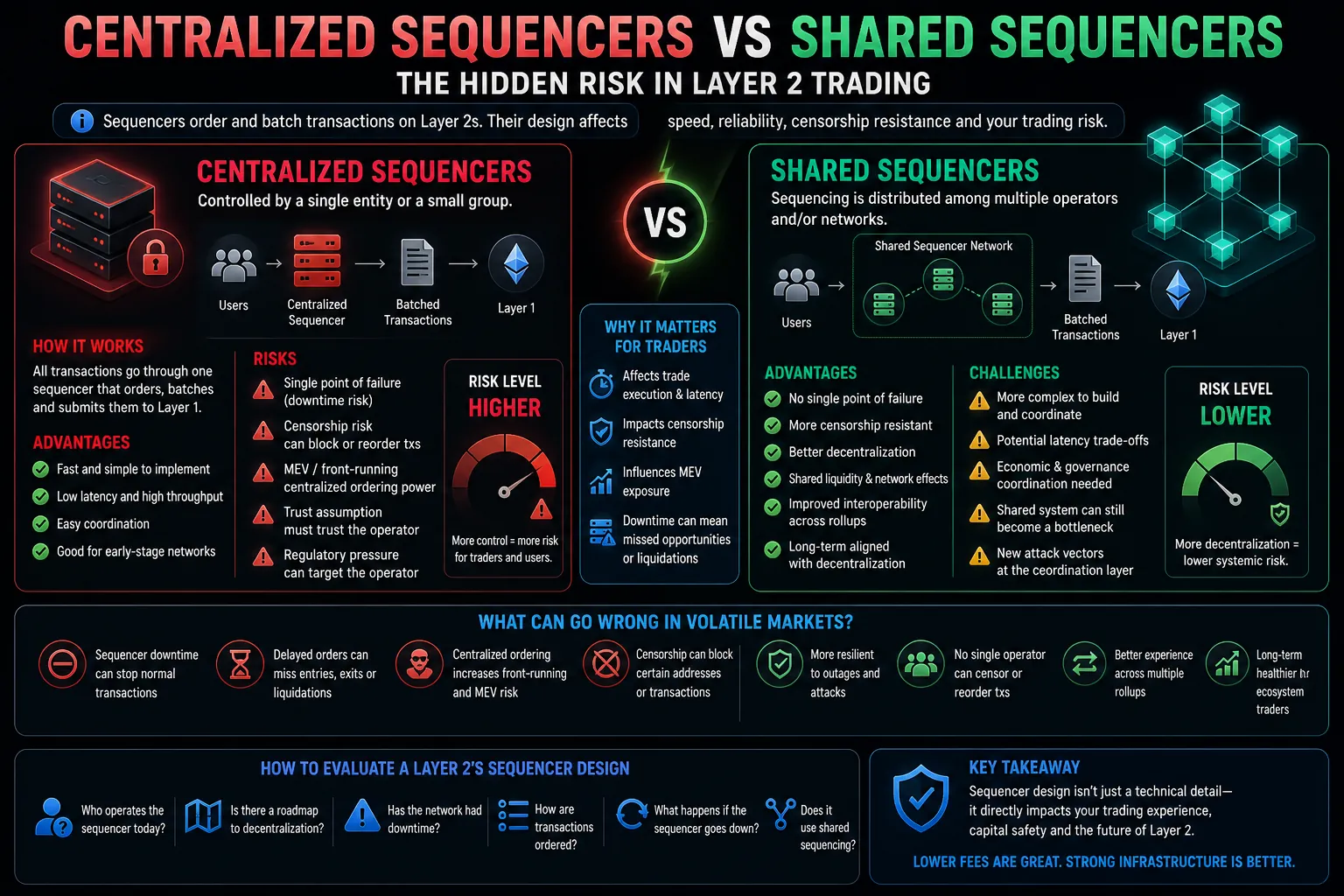
A centralized sequencer is controlled by one entity or a small group. Many Layer 2 networks begin with a centralized sequencer because it is easier to manage and faster to deploy.
Centralized sequencers can provide fast confirmations and smooth user experience.
However, centralization creates risk. If the sequencer goes down, users may experience delays or reduced network functionality. If one operator has too much control, users may worry about censorship, transaction ordering and infrastructure dependency.
A centralized sequencer can make a network efficient, but it can also create a single point of failure.
What Is a Shared Sequencer?
A shared sequencer is a sequencing system used by multiple rollups or networks. Instead of each Layer 2 relying on its own isolated sequencer, several networks can use shared sequencing infrastructure.
The goal is to improve decentralization, interoperability and reliability.
Shared sequencing may also help reduce fragmentation between rollups by creating more coordinated transaction ordering across ecosystems.
This model is still developing, but it is becoming an important topic in Layer 2 infrastructure.
Centralized Sequencers vs Shared Sequencers: The Key Difference
The key difference is control.
A centralized sequencer is controlled by one network operator or a limited group. A shared sequencer distributes sequencing across broader infrastructure that can serve multiple networks.
Centralized sequencers can be efficient and simple. Shared sequencers aim to reduce dependency and improve coordination.
Both models have trade offs.
Why Sequencers Are Important for DeFi Execution
Sequencers may sound technical, but they can affect real trading outcomes.
In DeFi, timing matters. A few seconds can change the result of a swap, liquidation or arbitrage opportunity.
If a sequencer delays transactions or orders them in a way that affects execution, traders may receive worse results than expected.
This becomes especially important during volatile markets, when many users are trying to trade at the same time.
For traders, infrastructure is part of execution quality.
Centralized Sequencers and Single Point of Failure Risk
A centralized sequencer can make a Layer 2 fast and efficient, but it can also create a single point of failure.
If the sequencer goes offline, users may have difficulty submitting transactions normally.
This can be dangerous during market stress. If prices are moving quickly and users cannot close positions, swap assets or manage collateral, the risk becomes more than technical.
A fast network is useful only if it stays reliable when activity spikes.
Censorship and Transaction Ordering Concerns
Centralized sequencers may raise concerns about censorship and transaction ordering.
If one operator controls ordering, users may worry that certain transactions could be delayed, excluded or prioritized unfairly.
This does not mean every centralized sequencer behaves badly. Many networks use centralized sequencers as a temporary step before decentralization.
Still, traders should understand the trust assumptions behind the networks they use.
A Layer 2 can be cheap and fast while still depending on centralized infrastructure.
How Shared Sequencers Could Improve Rollup Markets
Shared sequencers may reduce dependence on isolated sequencing systems. If multiple rollups use shared sequencing infrastructure, transaction ordering could become more decentralized and coordinated.
This may improve interoperability between rollups. It may also support smoother cross rollup trading in the future.
For DeFi users, this could mean better execution and less fragmentation.
However, shared sequencers must be designed carefully. If the shared system becomes too complex or too concentrated, it may introduce new risks.
How Sequencers Affect Traders
Sequencer design can affect:
Transaction delays.
Failed trades.
Swap timing.
Liquidation risk.
Arbitrage opportunities.
Bridge activity.
Network reliability.
User confidence.
During normal market conditions, sequencer risk may not be obvious. During volatile conditions, it can become much more visible.
What Traders Should Watch During Market Stress
Sequencer risk often appears during high activity periods.
Traders should pay attention to transaction delays, failed swaps, network downtime, bridge delays, sudden fee spikes and large differences between expected and final execution.
If these problems happen repeatedly, the network may carry higher trading risk than users realize.
Questions Traders Should Ask
Before trading heavily on a Layer 2, users should ask:
Who operates the sequencer?
Has the network experienced downtime?
Is there a decentralization roadmap?
How are transactions ordered?
Can users exit if the sequencer fails?
Is shared sequencing planned?
Does the network remain reliable during volatility?
These questions help reveal hidden infrastructure risk.
How DEXTools Fits Into Layer 2 Analysis
DEXTools helps traders monitor live token activity across DeFi markets. When trading on Layer 2 ecosystems, users can review price movement, liquidity, volume and pair behavior.
If a Layer 2 ecosystem token shows unusual movement, traders should consider both market data and infrastructure context.
Centralized sequencers and shared sequencers represent two different approaches to Layer 2 transaction ordering.
Centralized sequencers can be fast and efficient, but they create dependency risk. Shared sequencers may improve decentralization and interoperability, but they are still evolving.
For traders, sequencers are not just technical details. They can affect execution, reliability and market confidence.
In Layer 2 trading, lower fees matter. But infrastructure quality matters too.
How to Bridge Crypto Between Chains: Complete Cross-Chain Tutorial 2026 How to Use 1inch: Complete DEX Aggregator Swap Tutorial (2026) How to Use OKX Web3 Wallet: Multi-Chain DeFi Hub Guide (2026)