Ethereum Roadmap: Beyond 10k TPS and Invisible Infra

Ethereum's path beyond 10,000 TPS: scaling upgrades, invisible infrastructure, and what faster, cheaper blockspace means for DeFi and onchain apps.
Ethereum’s ‘Strawmap’: Breaking the 10k TPS Barrier
- As of May 4, 2026, the digital asset landscape has undergone a profound structural transformation. The era of high gas fees on the Ethereum Layer 1 (L1) has transitioned into a historical footnote. Today, the conversation is dominated by the “Strawmap,” the latest phase in Ethereum’s multi-year evolution toward massive, industrial-grade scalability.
- By moving beyond the successful Pectra and Fusaka upgrades, the network has finally achieved what was once considered a distant dream: a unified, high-speed backend where the technical friction of the blockchain is entirely hidden from the end user.
- This shift is not merely a technical milestone; it is a cultural and economic pivot. In 2026, the blockchain is no longer a destination users "visit." It is the invisible plumbing that powers the global economy. From high-frequency trading of institutional assets to the viral movements of selective memecoins, the Strawmap provides the throughput necessary to sustain a hyper-connected world.
The Core Technology: PeerDAS and the Road to 10k TPS
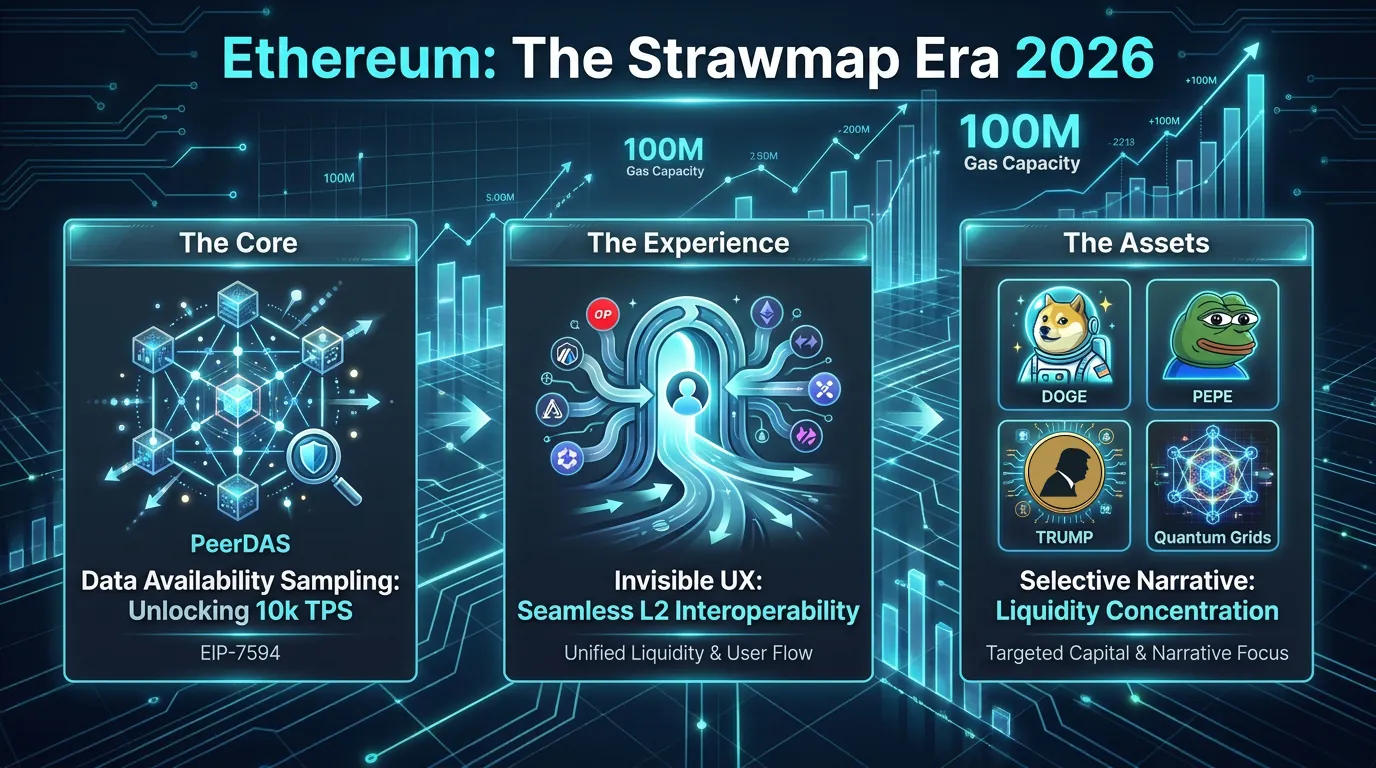
- The technical foundation of the Strawmap era is the implementation of PeerDAS (EIP-7594). Following the groundwork laid by the Pectra and Fusaka upgrades, PeerDAS introduces sophisticated Peer Data Availability Sampling. This allows the network to distribute the burden of data verification across many participants without requiring every node to store the entire dataset.
- By optimizing how data blobs are handled, Ethereum has finally broken the 10,000 Transactions Per Second (TPS) barrier across its integrated ecosystem. Furthermore, the network’s gas capacity has reached a consistent 100 million, providing a massive runway for the deployment of complex, logic-heavy smart contracts. For the professional trader, this means that even during periods of extreme volatility (such as a major political event or an AI-driven market rotation) the cost of execution remains negligible and the speed remains near-instant.
The "Invisible" User Experience: Ending Fragmentation
- Perhaps the most significant achievement of the Strawmap phase is the death of "bridging." In 2024 and 2025, moving assets between networks like Arbitrum, Optimism, and Base was a headache involving manual transactions, waiting periods, and cognitive load.
- In May 2026, Native L2 Interoperability has made the ecosystem feel like a single, unified entity. Users no longer need to check which network they are on. A transaction initiated on a Base-hosted social application can seamlessly utilize liquidity from an Arbitrum-based lending pool. This "Invisible UX" has removed the final barrier to mass adoption, allowing the average person to use decentralized applications with the same ease as a legacy banking app.
The Selective Meme Economy: DOGE, SHIB, and PEPE
Despite the institutionalization of the network, the "Meme Narrative" remains a vital part of market liquidity. However, the market in 2026 is highly selective. Only a few "Blue Chip" memes have survived the transition into the Strawmap era.
Dogecoin (DOGE): As of today, DOGE remains the sovereign of social currency. Its integration into global payment rails -particularly through X (formerly Twitter- has turned it from a joke into a functional utility. Traders watch the $0.12 support level as a proxy for social media sentiment.
Shiba Inu (SHIB): SHIB has matured through the Shibarium ecosystem. Its aggressive token-burning mechanisms and transition into a specialized L2 for community governance have kept it relevant for long-term holders.
Pepe (PEPE): PEPE continues to act as the "Institutional Beta" for Ethereum. When the Strawmap achieves a new TPS milestone, PEPE often leads the rally, serving as a high-volatility play for traders looking to capitalize on Ethereum’s ecosystem growth.
PolitiFi: The High-Beta Proxies of TRUMP and MELANIA
As we approach the heat of the 2026 political cycle, the PolitiFi sector has become a mandatory part of any high-frequency strategy. These tokens serve as real-time, decentralized sentiment indices for global events.
TRUMP: The primary political token remains a massive liquidity magnet. It is used by traders to hedge against or bet on political shifts in the United States. Its price action is often decoupled from the broader market, moving instead in synchronization with headlines and polling data.
MELANIA: This token serves as the higher-delta counterpart to the primary political plays. It attracts scalpers looking for quick gains during specific media cycles. In the Strawmap environment, these tokens can be traded with sub-cent fees, allowing for the first truly frictionless "Political Betting" in history.
Prototypical Framework: Comparing Memecoins A, B, and C
To understand how the market evaluates new assets in 2026, we can use a comparative schematic model using hypothetical prototypes.
| Feature | Memecoin A (The Classic) | Memecoin B (The AI-Hybrid) | Memecoin C (Post-Quantum) |
| Era | 2021-2023 Style | 2024-2025 Style | 2026 Future-Proof |
| Origin | Community / Viral Hype | AI-Agent Generated | Cryptographic Precision |
| Logic | Social Sentiment | Autonomous Content / Burns | Post-Quantum Security |
| Risk | High (Human Churn) | Medium (Bot Liquidity) | Low (Tech Reliability) |
Memecoin A represents the legacy model: human-driven, reliant on memes and social raiding.
Memecoin B reflects the current 2026 "Meta." It is a token where the marketing, supply management, and burns are controlled by an AI Agent. This removes human error and creates a 24/7 engagement loop.
Memecoin C is the new gold standard. Built with Post-Quantum Cryptography (PQC), it is designed to survive the transition into the era of quantum computing, attracting "Safety-First" capital that seeks to preserve value for the 2030s.
Technological Frontiers: AI Agents and the Quantum Threat
- The most significant shift in 2026 is that the "User" of the Ethereum network is no longer exclusively human. There aren’t many Ethereums (there’s only one), but there are plenty of trading agents at work. AI Agents now account for a significant portion of on-chain volume. These agents utilize the 10k TPS of the Strawmap to execute "Intents" for their ownersm rebalancing portfolios, finding yield, and scalping memes with millisecond precision.
- Furthermore, the industry is beginning to price in the future of Quantum Computing. While a relevant quantum computer does not yet exist to threaten Bitcoin or Ethereum’s base layer, the Strawmap has introduced "Quantum-Resistant Anchors." Traders are increasingly looking for assets (like our Memecoin C prototype) that utilize NIST-standardized lattice-based cryptography to ensure their wealth remains unhackable in the coming decade.
Bitcoin: The Anchor of the Galaxy
Throughout the scaling of Ethereum, Bitcoin (BTC) remains the undisputed "Sun" of the digital asset solar system. Consolidating around the $75,000 mark in May 2026, Bitcoin serves as the primary hedge against global debasement. While Ethereum scales the utility of the world, Bitcoin secures its value. The relationship between BTC stability and the "Selective Meme" rallies (DOGE, PEPE) remains the most important correlation for any portfolio manager to track.
Verification and Security via DEXTools
In an era where AI agents can deploy thousands of tokens per minute, the risk of technical exploits is constant. DEXTools is the optimal tool for analyzing the market, finding early crypto gems, and avoiding scams.
Before interacting with any asset (whether it is an established pillar like SHIB or a high-beta PolitiFi play) professional traders verify:
The DEXTscore: A 90+ score ensures verified contract integrity.
Liquidity Locks: Verifying that liquidity is burned or locked in a 2026-standard vault.
Audit Transparency: Ensuring the contract does not contain hidden "Mint" or "Freeze" authorities that could be exploited by malicious actors.
To monitor the DeFi market in an agile and secure way in real-time and trade Ethereum-based assets with the help of the best crypto tools, you can access Ethereum on DEXTools here.
Disclaimer: This article is for informational purposes only and does not constitute investment advice, financial advice, trading advice, or any other kind of advice. DEXTools does not recommend buying, selling, or holding any cryptocurrency or token. Users should conduct their own research and consult with a qualified financial advisor before making any investment decisions. Cryptocurrency investments are volatile and high-risk. DEXTools is not responsible for any losses incurred.
Related Guides
- NEAR Chain Abstraction Explained: Nightshade, Signatures and AI Infra (2026)
- What is FLOKI memecoin? Tokenomics and Roadmap Explained
- The Invisible Blockchain: Why 2026 Ends the L1 vs. L2 War
- What is Ronin Network? Axie L1 and Beyond
- Tap-to-Earn Games on TON: Notcoin, Hamster Kombat and Beyond (2026)
Frequently Asked Questions
What is Ethereum's Strawmap?
Ethereum's Strawmap represents a significant evolution in the network's scalability, achieving over 10,000 transactions per second (TPS) and creating an 'invisible infrastructure' that enhances user experience by hiding technical complexities.
How does PeerDAS contribute to Ethereum's performance?
PeerDAS, introduced through EIP-7594, enhances Ethereum's data verification process by allowing multiple participants to share the burden, enabling the network to achieve high TPS and improved gas capacity.
What changes have occurred in Ethereum's user experience?
The Strawmap phase has eliminated the need for users to manually bridge assets between networks, creating a seamless and unified experience that allows transactions across different platforms without user intervention.
What role do meme coins play in Ethereum's ecosystem in 2026?
Meme coins like Dogecoin, Shiba Inu, and Pepe continue to influence market liquidity, with Dogecoin serving as a social currency and others adapting to maintain relevance in the evolving landscape.
What is the significance of the 10k TPS milestone for Ethereum?
Breaking the 10,000 TPS barrier marks a major technical achievement for Ethereum, allowing it to support complex smart contracts and maintain low execution costs even during market volatility.