What is a Smart Account? Account Abstraction Wallets Guide
Upgrading Web3 accounts from rigid private keys to programmable contracts changes everything. We analyze ERC-4337 structures, paymasters, and social recovery.
The Wallet Shift: Upgrading from Rigid Keys to Programmable Accounts
- Traditional web3 user accounts have long been held back by structural friction inherited from early blockchain development. Known as Externally Owned Accounts (EOAs), traditional wallets (such as legacy MetaMask browser extensions or standalone hardware cold storage units) are bound entirely to a single cryptographic private key.
- If an individual leaks their recovery phrase or loses their physical backup, their entire capital repository vanishes permanently. Furthermore, an EOA cannot execute conditional logic natively; every trivial transaction requires manual sign-off, individual network gas payments, and separate token approval steps.
- Smart Accounts eliminate these design flaws. Developed through the structural implementation of Account Abstraction, this architecture detaches asset ownership from the execution layer by transforming user wallets into interactive, programmable smart contracts.
- This comprehensive guide breaks down the core mechanics of the ERC-4337 standard, the functionality of gas paymasters, temporary session key authorization, decentralized social recovery, and the modular ecosystems reshaping the modern web3 consumer experience.
1. Core Infrastructure: The ERC-4337 Architecture
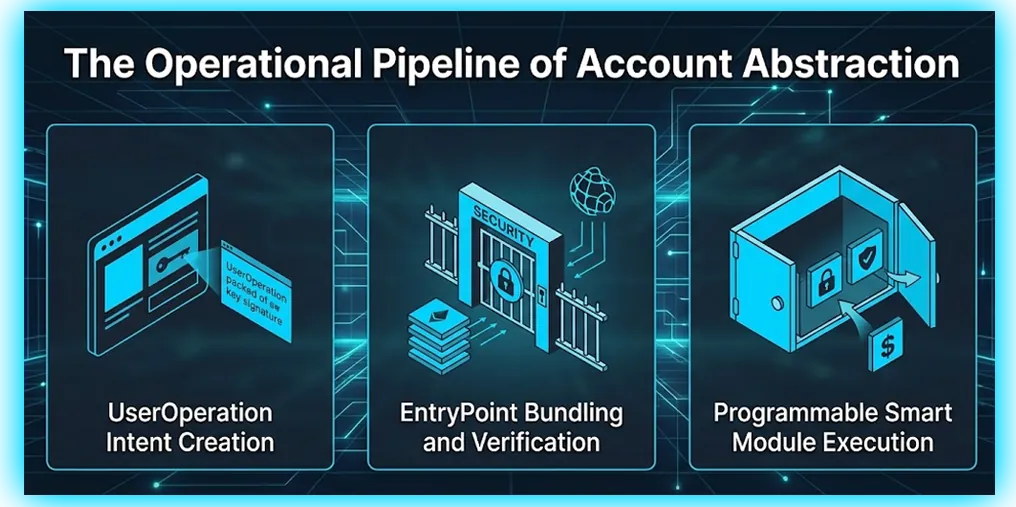
- Account Abstraction historically required fundamental, network-wide blockchain hard forks to implement. The deployment of the ERC-4337 standard bypassed this constraint by building an alternate transaction framework entirely at the application layer, allowing smart contract wallets to run seamlessly on top of any existing Ethereum Virtual Machine (EVM) compatible chain.
- Instead of sending standard transactions to a traditional node mempool, a Smart Account creates a data structure known as a UserOperation. This object represents the user's explicit transaction intent rather than a rigid private key signature. These intents are collected in a specialized alternative mempool, where off-chain relayers called Bundlers scan, verify, and group multiple UserOperations into a single batched transaction.
- The Bundler submits this combined batch directly to a global, singleton smart contract called the EntryPoint. The EntryPoint acts as the central security and verification clearinghouse for the entire network. It calls the Smart Account to verify the parameters, confirms that the Bundler is properly reimbursed for advancing the initial network fees, and subsequently executes the transactions on-chain.
- Additionally, with the activation of the EIP-7702 standard, legacy EOA wallets can temporarily delegate their account logic to these smart contracts for the duration of a transaction, granting older accounts instant access to advanced programmability without forcing users to migrate to an entirely new wallet address.
2. Paymasters: Sponsoring Fees and Multi-Token Gas Abstraction
One of the largest hurdles for mainstream web3 onboarding is the strict requirement to hold a blockchain's native token to settle transaction fees. ERC-4337 addresses this barrier through a specialized component known as a Paymaster.
A Paymaster is a dedicated smart contract that intercepts transaction verification loops to handle custom gas payment policies flexibly. This architecture unlocks two primary consumer experiences:
Gas Sponsorship: Developers or decentralized applications can pay for transaction costs on behalf of their users. A gaming platform or DeFi application can sponsor a new user's initial interactions entirely behind the scenes, creating a completely gasless application experience that mirrors traditional web interfaces.
Alternative Token Settlements: If an application does not sponsor the fees, Paymasters allow users to settle network gas costs using alternative tokens, such as popular stablecoins or wrapped assets, instead of the native token. The Paymaster acts as an automated conversion gate, taking the user's stablecoin fee and advancing the required native gas token to the EntryPoint contract automatically.
3. Session Keys: Automating Frictionless Web3 Experiences
- Traditional wallets require an explicit, manual cryptographic signature for every single on-chain action. This design fragments user engagement across interactive systems, such as web3 gaming, high-frequency decentralized trading, or automated portfolio rebalancing. Smart Accounts introduce Session Keys to establish a middle ground between security and automation.
Session Keys are temporary, limited-access sub-keys generated by a Smart Account to delegate restricted execution permissions to an external application or automated agent. Instead of giving an app full access to your funds, you configure precise on-chain guardrails for the session key, specifying parameters such as:
Time Expiration: The key automatically deletes and becomes invalid after a set duration, such as 24 hours.
Value Thresholds: The sub-key can only authorize trades or moves under a strict maximum dollar limit per transaction.
Whitelisted Targets: The automated agent is structurally blocked from moving assets anywhere except to specific, approved destination smart contracts.
Once activated, the application can execute seamless, consecutive background micro-transactions without triggering repetitive pop-up approval requests, creating a frictionless user experience while keeping the master vault protected.
4. Social Recovery: Eliminating the Seed Phrase Single Point of Failure
The traditional obligation to safeguard a 12-to-24-word paper seed phrase represents a significant vulnerability for mainstream consumers. If a user suffers a physical disaster or falls victim to a phishing link, their recovery path is obliterated. Smart Accounts introduce Social Recovery to replace physical backup sheets with dynamic, cryptographic social consensus rules.
Under a social recovery framework, the account owner designates a trusted network of individuals, institutional entities, or secondary devices to serve as Guardians. If the user loses their primary device or device access credentials, the core private key can be programmatically rotated out and replaced:
The Quorum Mechanism: The account owner contacts their guardians to initialize an access reset.
Democratic Authorization: A pre-configured majority of guardians must submit individual cryptographic signatures to authorize the reset contract.
Key Rotation: Once the threshold is met, the underlying Smart Account contract overwrites the old compromised key and links to a new, clean public key provided by the user, recovering full portfolio access without exposing any seed phrases.
Operational Architecture Matrix: Smart Accounts vs. Traditional EOAs
| Parameter | Traditional Key Wallets (EOAs) | Programmable Smart Accounts |
| Account Logic | Fixed private key signature verification | Programmable, fully customizable smart contract |
| Gas Payment Options | Must pay explicitly in the native network token | Gas sponsorship or alternative ERC-20 payment tokens |
| Transaction Structure | Single isolated transaction per signature | Atomically batches multiple operations into one click |
| Recovery Mechanism | Single point of failure via a written seed phrase | Multi-guardian social recovery and key rotation |
| Automation Vectors | Manual confirmation required for every step | Automated session keys running on custom guardrails |
| Extension Modularity | Static, immutable wallet characteristics | Flexible plug-and-play modules via ERC-7579 |
5. Universal On-Chain Forensics and Trading Telemetry via DEXTools
- Navigating technical smart contract wallets and tracking asset velocity requires access to independent, real-time market telemetry to analyze pool compositions, evaluate transaction paths, and monitor contract health. Advanced charting ecosystems like DEXTools serve as an essential universal environment for modern web3 participants, operating seamlessly as an agnostic diagnostic layer across all public execution networks. By leveraging core features like the Pair Explorer, Live New Pairs dashboard, Trade Story or Top Traders.
- Technical analysts can instantly evaluate localized liquidity distributions, audit newly deployed smart account factories, and track high-volume block transactions executed by automated aggregation engines, generating the cryptographic transparency needed to manage capital risk safely.
You can access DEXTools here and start trading today!
How to Bridge Crypto Between Chains: Complete Cross-Chain Tutorial 2026 How to Use 1inch for Swaps: Classic, Fusion and Limit Orders (2026) How to Use OKX Web3 Wallet: Multi-Chain DeFi Hub Guide (2026)Disclaimer: This article is for informational purposes only and does not constitute investment advice, financial advice, trading advice, or any other kind of advice. DEXTools does not recommend buying, selling, or holding any cryptocurrency or token. Users should conduct their own research and consult with a qualified financial advisor before making any investment decisions. Cryptocurrency investments are volatile and high-risk. DEXTools is not responsible for any losses incurred.
Related Guides
- What Is Biconomy: Account Abstraction, Gasless UX and Smart Account Infrastructure (2026)
- What Is Safe: Multisig Wallets, Smart Accounts and Treasury Control (2026)
- What Is zkSync Era? Account Abstraction L2
- What Is Biconomy: Account Abstraction, Gasless UX and Cross-Chain Execution (2026)
- What Is Account Abstraction: ERC-4337 Explained Simply (2026)
- ERC
Frequently Asked Questions
What is a smart account?
A smart account is a wallet controlled by a smart contract rather than a single private key, enabling programmable rules and features. This is a core idea behind account abstraction.
How is a smart account different from a regular wallet?
A traditional externally owned account is controlled directly by one private key, while a smart account can include custom logic such as multiple signers or spending limits. This flexibility allows features that ordinary wallets cannot offer.
What is social recovery in a smart account?
Social recovery lets a user regain access to their account through trusted parties or guardians instead of relying solely on a seed phrase. It aims to reduce the risk of permanently losing access if a key is lost.
What is ERC-4337?
ERC-4337 is a standard that enables account abstraction on Ethereum without changing the core protocol. It allows smart accounts to work through a separate system of user operations and supporting infrastructure.