DEX Volume Race 2026: Solana, Ethereum, BNB, and Base
— By Whatsertrade in Tutorials
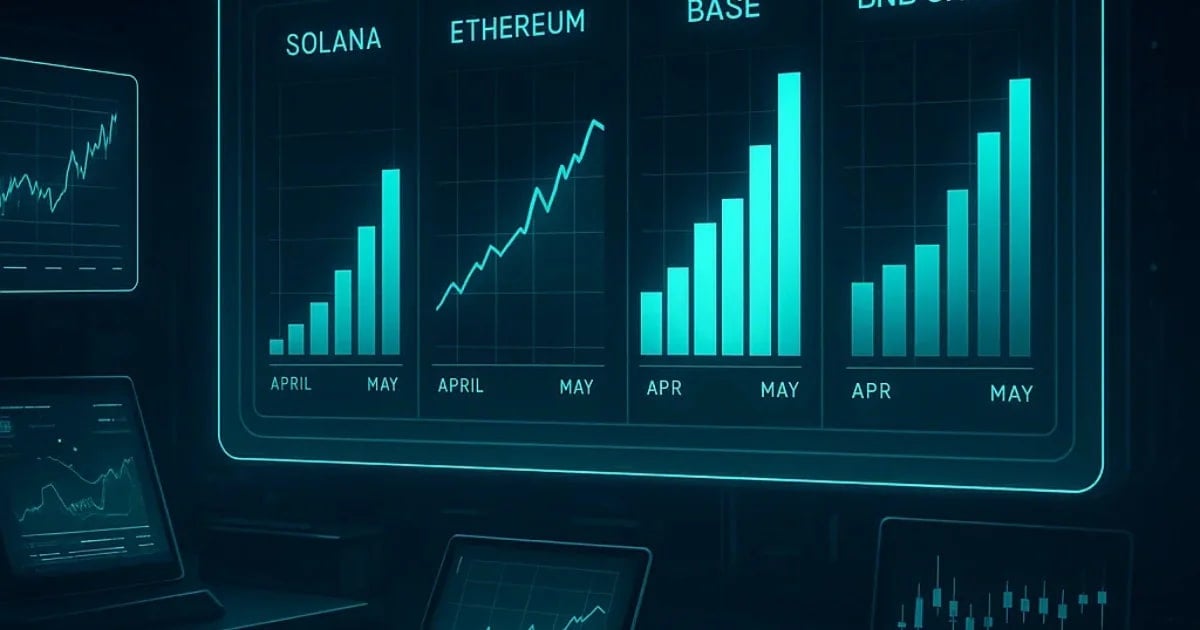
Discover the dynamics of the 2026 DEX volume race among Solana, Ethereum, Base, and BNB Chain, and what this means for traders.
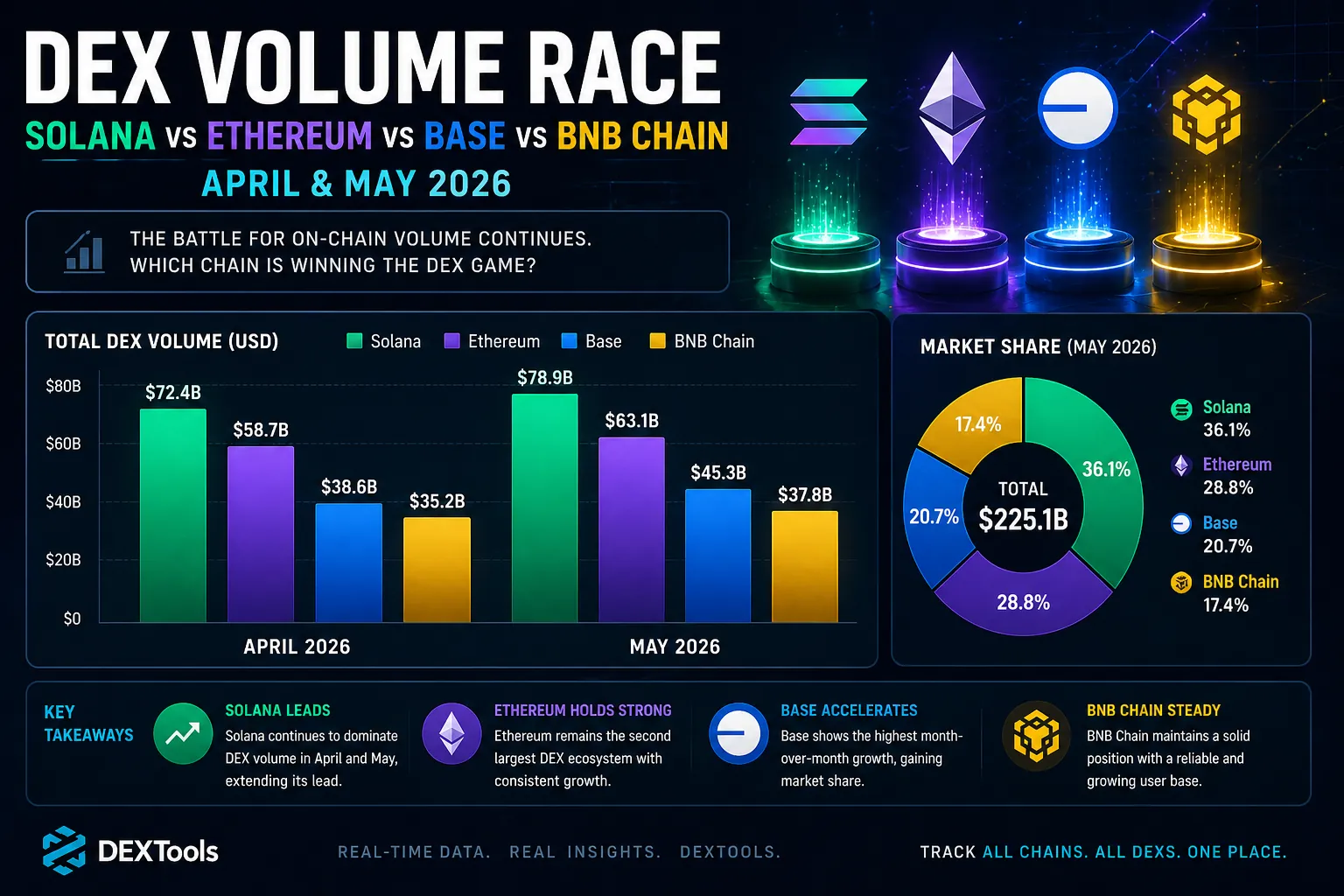
The battle for decentralized exchange volume is one of the clearest ways to understand where crypto traders are actually active. Narratives can move quickly, but volume shows where capital is rotating, where new tokens are launching and which chains are attracting real trading activity.
In 2026, the DEX volume race is no longer only about Ethereum. Solana, Base and BNB Chain have become major competitors, each with a different market structure and user profile. Some chains dominate memecoin trading. Others lead in blue-chip DeFi liquidity. Some attract retail flows, while others are stronger for low-cost experimentation and fast token launches.
For traders using DEXTools, this matters because chain selection can shape opportunity. The same token narrative may behave differently on Solana, Ethereum, Base or BNB Chain depending on liquidity, gas costs, wallet behavior and trader psychology.
This article breaks down how to think about the DEX volume race between Solana, Ethereum, Base and BNB Chain, and how to use on-chain tools to identify where momentum is building.
Why DEX Volume Matters
DEX volume measures trading activity on decentralized exchanges. It shows how much value is being swapped directly on-chain through liquidity pools, automated market makers or other decentralized trading systems.
High DEX volume can signal:
- Strong trader participation
- Active token launches
- Deep liquidity pools
- Higher market confidence
- Narrative rotation
- More opportunities for short-term traders
- More competition between chains
Low volume can signal weaker interest, reduced liquidity or a cooling market.
However, volume should never be read alone. Traders also need to consider liquidity, transaction count, number of active pairs, price impact and whether activity is organic or inflated.
A chain with high volume but poor liquidity quality can still be difficult to trade. A chain with lower total volume but stronger niche activity can still offer excellent opportunities.
Ethereum: The Liquidity Anchor
Ethereum remains the historical center of DeFi. It has the deepest institutional memory, the most mature DeFi protocols and some of the strongest liquidity for major assets.
Ethereum is often the preferred chain for:
- Blue-chip DeFi assets
- Large liquidity pools
- Established tokens
- Institutional DeFi activity
- High-value swaps
- Long-running protocols
The main weakness is cost. Even with improvements across the ecosystem, Ethereum mainnet can still be less attractive for smaller retail trades when fees rise. That makes it less dominant for very low-cap, high-frequency speculation.
For DEXTools users, Ethereum pairs often deserve special attention when liquidity quality matters more than speed. If a token has meaningful liquidity on Ethereum, it may signal a more mature market than a thin pool on a cheaper chain.
But traders should not assume Ethereum volume always means better opportunity. Many early-stage tokens now launch elsewhere first, especially when they depend on low fees and fast retail participation.
Solana: Speed, Retail Flow and Token Discovery
Solana has become one of the most important chains for fast-moving DEX activity. Its low fees and high throughput make it attractive for memecoins, new launches and retail speculation.
Solana is especially strong when traders want:
- Fast execution
- Low transaction costs
- High-frequency token discovery
- Memecoin rotation
- New pair scanning
- Retail-driven momentum
The chain can produce intense bursts of activity. Tokens may trend quickly, attract sudden liquidity and experience extreme volatility in short periods.
This is why Solana volume should be analyzed carefully. A rapid spike can mean real momentum, but it can also mean short-lived hype. Traders need to check whether volume is supported by growing liquidity and repeated participation or whether it is simply a temporary launch event.
On DEXTools, Solana traders should pay close attention to new pairs, trending pairs, transaction count and liquidity changes. The earlier the market cycle, the more important it becomes to filter noise.
Base: The Layer 2 Growth Story
Base has become one of the most important Ethereum layer 2 networks for retail-friendly on-chain activity. It benefits from Ethereum alignment while offering cheaper transactions and a growing application ecosystem.
Base is interesting because it sits between Ethereum and more speculative high-speed chains. It can attract serious DeFi builders, but it also supports retail token launches and social trading activity.
Traders often watch Base for:
- Layer 2 token launches
- Lower-cost Ethereum ecosystem trading
- Social and consumer crypto experiments
- Emerging DeFi applications
- Retail-friendly liquidity pools
The key question for Base is whether volume growth is broad or concentrated. If activity is concentrated in a few tokens, the ecosystem may be experiencing a short-term narrative. If volume spreads across multiple sectors, it may signal healthier growth.
For DEXTools users, Base can be valuable for finding earlier rotations before they reach wider attention. Watch whether pairs gain liquidity steadily or rely on short bursts of hype.
BNB Chain: Retail Scale and High Transaction Activity
BNB Chain has long been a major network for retail crypto trading. It offers low fees, broad exchange awareness and a large user base. It has also been one of the most active chains for token launches, gaming tokens, memecoins and speculative DeFi.
BNB Chain is often associated with:
- High retail participation
- Low transaction costs
- Frequent token launches
- Strong activity from emerging markets
- Large token holder communities
- Fast-moving speculative cycles
The advantage of BNB Chain is accessibility. The risk is quality control. A large number of launches can create opportunity, but it also increases the need for filtering scams, weak liquidity and copycat tokens.
On DEXTools, BNB Chain analysis should focus on liquidity locks, holder distribution, contract behavior, transaction patterns and whether volume is sustainable after the first wave of trading.
Comparing the Four Chains
Each chain has a different DEX identity.
Ethereum is the liquidity anchor. It is where major assets and established DeFi protocols often maintain deeper pools.
Solana is the speed and speculation engine. It is especially important for new launches, memecoins and fast retail rotation.
Base is the layer 2 growth candidate. It combines Ethereum ecosystem familiarity with lower transaction costs.
BNB Chain is the retail scale network. It offers high activity, low fees and a large base of speculative traders.
The best chain depends on the strategy.
A trader looking for early memecoin momentum may focus on Solana or BNB Chain. A trader looking for deeper liquidity and established assets may prefer Ethereum. A trader looking for layer 2 growth and new consumer crypto narratives may focus on Base.
How to Track DEX Volume on DEXTools
DEXTools helps traders move beyond broad market commentary and into actual pair-level analysis.
Start by selecting the chain you want to monitor. Then compare trending pairs, new pairs and active tokens. Instead of looking only at price movement, evaluate whether volume confirms the move.
A useful workflow looks like this:
- Check trending pairs by chain
- Identify sectors appearing repeatedly
- Compare volume growth against liquidity growth
- Review transaction count and buyer behavior
- Check whether the token has sustained activity beyond launch
- Confirm contract and pool safety indicators
- Compare similar narratives across different chains
For example, if AI tokens are trending on Base but memecoins dominate Solana, that tells you where different types of capital are flowing. If BNB Chain shows many new pairs but few maintain liquidity after the first day, that suggests a high-noise market.
Volume Alone Can Be Misleading
High volume does not automatically mean a token is strong. It can be created by wash trading, bot activity, launch volatility or repeated short-term speculation.
To avoid being misled, compare volume with:
- Liquidity depth
- Price stability
- Holder growth
- Buy and sell balance
- Number of transactions
- Time since pair creation
- Pool changes
- Contract risk signals
A healthy token usually shows a more balanced relationship between these factors. A risky token may show huge volume with weak liquidity, extreme candle behavior and concentrated holders.
What Traders Should Watch in April and May 2026
The next phase of the DEX volume race will likely depend on several factors.
First, liquidity rotation. If capital moves from major assets into speculative tokens, Solana and BNB Chain may benefit. If traders become more defensive, Ethereum liquidity may become more important.
Second, layer 2 adoption. Base can gain share if more applications, wallets and retail platforms bring users into its ecosystem.
Third, memecoin activity. Memecoins can dramatically shift chain-level volume, especially when retail interest returns.
Fourth, stablecoin access. Chains with better stablecoin liquidity can support stronger trading flows.
Fifth, new narratives. AI, RWA, gaming, social finance and tokenized assets can all influence where DEX volume appears.
Final Thoughts
The DEX volume race is not about declaring one chain the permanent winner. It is about understanding where different types of trading activity are happening right now.
Ethereum, Solana, Base and BNB Chain each offer a different opportunity set. Ethereum provides depth. Solana provides speed. Base provides layer 2 growth. BNB Chain provides retail scale.
For traders, the edge comes from watching volume before the broader market notices. DEXTools makes that possible by showing pair-level activity, liquidity, price action and trend signals across multiple chains.
In 2026, the smartest traders will not only ask which token is moving. They will ask which chain is attracting the strongest on-chain flow.
How to Bridge Crypto Between Chains: Complete Cross-Chain Tutorial 2026 How to Use 1inch: Complete DEX Aggregator Swap Tutorial (2026) How to Use OKX Web3 Wallet: Multi-Chain DeFi Hub Guide (2026)Frequently Asked Questions
Q: How does Solana's DEX volume compare to Ethereum's?
A: Solana's DEX volume is generally lower than Ethereum's, though it has seen periods of significant growth and market share capture, particularly during bull markets.
Q: What factors contribute to the difference in DEX volume between these chains?
A: Factors include transaction speeds, gas fees, network security, developer activity, user base size, and the number and liquidity of decentralized applications (dApps) on each chain.
Q: Is BNB Chain's DEX volume primarily from PancakeSwap?
A: Yes, PancakeSwap is the dominant decentralized exchange on BNB Chain and accounts for a significant portion of its overall DEX volume.
Q: What is Base's current position in the DEX volume race?
A: Base, as a newer Layer 2 solution, is rapidly growing its DEX volume but still trails the established leaders like Ethereum and BNB Chain.
Q: How might future technological upgrades impact DEX volume distribution?
A: Upgrades like Ethereum's sharding, Solana's Firedancer, or improved Layer 2 scaling solutions could enhance network capacity and potentially shift DEX volume distribution among these chains.