Healthy vs Toxic DEX Volume Explained
— By Whatsertrade in Tutorials

Healthy vs toxic DEX volume explained: learn to tell real trading activity from misleading signals by analyzing volume quality and supporting data.
Trading volume is one of the first metrics traders check before entering a token. At first glance, high volume looks like a strong signal. It suggests that people are interested, the market is active, and the token has momentum. In decentralized markets, however, volume can be misleading. A token can show impressive activity while the real market structure underneath is weak, manipulated, or driven by short term hype.
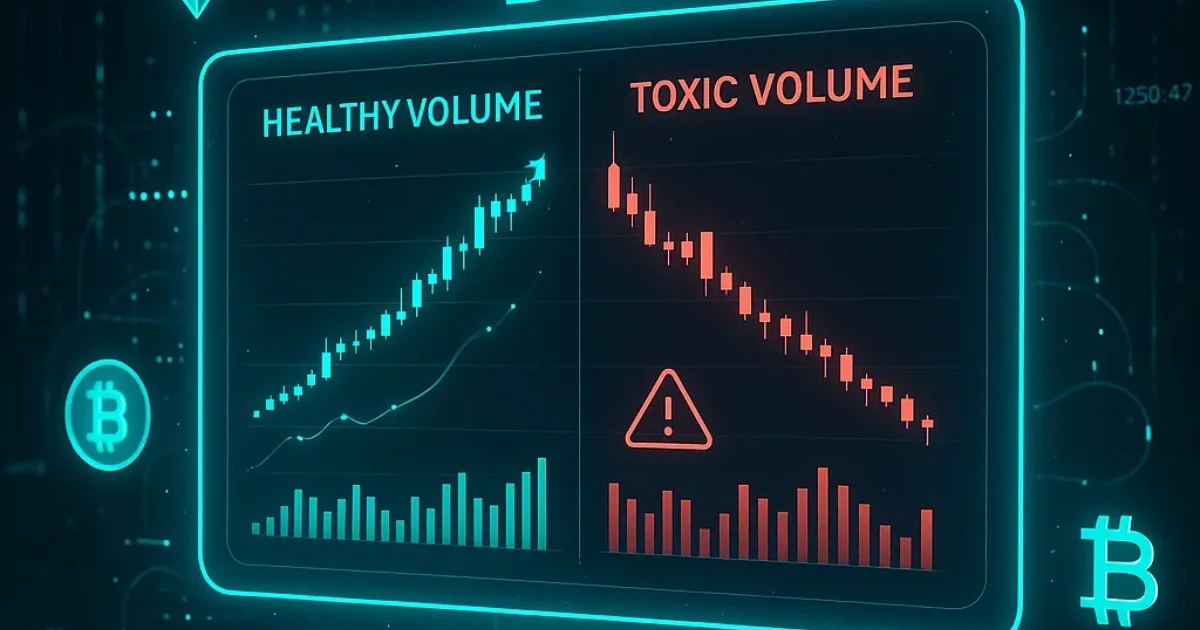
This is why traders need to understand the difference between healthy volume and toxic volume. Healthy volume supports a market. It confirms price action, attracts real participants, and helps create more reliable trading conditions. Toxic volume does the opposite. It creates the appearance of demand while hiding risks such as wash trading, bot activity, insider selling, low liquidity, or late stage FOMO.
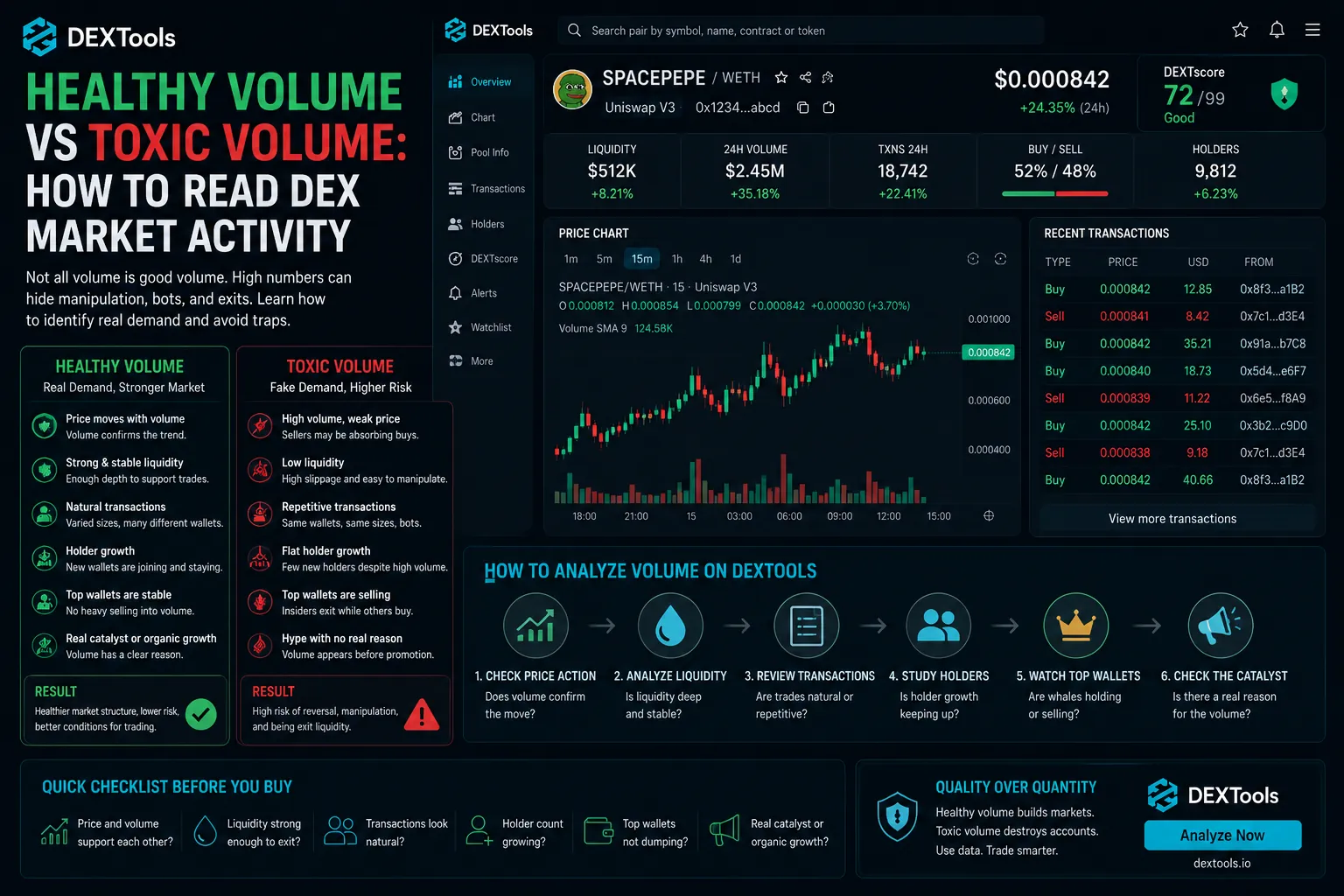
Reading DEX market activity correctly is not about looking at one number. It is about understanding the story behind the number. On DEXTools, traders can compare volume with liquidity, price movement, transactions, holder growth, and wallet behavior. When these signals support each other, volume becomes more reliable. When they contradict each other, traders should be careful.
What Trading Volume Really Means in DEX Markets
In DEX markets, trading volume represents the value of swaps executed through decentralized liquidity pools. Every buy and sell contributes to the total volume shown on a token pair. Traders often use this number to measure attention, momentum, and market participation.
The problem is that volume does not explain who is trading, why they are trading, or whether the activity is organic. A token may have high volume because real buyers are entering the market. It may also have high volume because bots are trading repeatedly, early holders are selling into new demand, or coordinated wallets are trying to make the token look more active than it really is.
This makes context essential. A token with moderate but consistent volume, stable liquidity, and natural holder growth may be healthier than a token with massive volume, thin liquidity, and repetitive transactions. The size of the volume matters, but the quality of the volume matters more.
What Is Healthy Volume?
Healthy volume is trading activity that supports real market growth. It usually appears when price action makes sense, liquidity is stable, and market participation comes from a diverse group of wallets. In a healthy market, volume helps confirm that buyers and sellers are creating real price discovery.
For example, if a token breaks above an important resistance level and volume rises at the same time, that may show that buyers are entering with conviction. If the token later pulls back on lower volume and holds support, that may suggest that selling pressure is limited. This type of behavior gives the chart structure and makes the price movement easier to trust.
Healthy volume also tends to appear with organic holder growth. Not every buyer will hold long term, but real trading activity usually brings new participants into the market. Over time, this can reduce dependence on a few early wallets and create a stronger holder base.
What Is Toxic Volume?
Toxic volume is trading activity that looks strong on the surface but creates risk underneath. It can make a token appear popular, liquid, and active even when real demand is weak. This type of volume often appears in new launches, microcaps, meme coins, and highly speculative markets where attention can be manipulated quickly.
A common example is a token with a sudden volume spike but very little price movement. If buyers are truly entering with strength, price should usually respond. When volume rises and price stalls, it may mean that sellers are absorbing the demand. In that situation, new buyers are not pushing the market higher. They are giving earlier holders the liquidity they need to exit.
Toxic volume can also come from repetitive transactions. If the same wallets appear again and again, if trade sizes look unusually similar, or if buys and sells happen in a mechanical rhythm, the activity may not represent natural market behavior. Organic trading usually looks irregular. Toxic volume often feels engineered.
Why High Volume Can Be Misleading
Many traders make the mistake of treating high volume as proof of strength. This is especially dangerous in DEX trading because tokens can trend quickly and attract attention before traders have checked the quality of the market.
High volume can be a strong signal when it confirms a clean breakout, appears with growing liquidity, and brings in new holders. But high volume can also be a warning sign when price struggles to move higher, liquidity remains thin, or top wallets begin selling into the demand.
The better question is not simply whether volume is high. The better question is whether the volume is healthy. A large number means very little if it is created by bots, short term flippers, or insiders distributing supply.
Volume and Price Action Should Tell the Same Story
Price action is one of the clearest ways to judge volume quality. In a healthy market, volume and price usually support the same story. Strong buying volume should create upward pressure. Heavy selling volume should create downward pressure. Calm consolidation should often come with lower activity.
When volume and price action disagree, traders should pay attention. If volume rises sharply but price does not move, something may be wrong. Buyers may be entering, but sellers may be using that demand to unload tokens. The chart may show long upper wicks, repeated failed breakouts, or large buys that fail to create momentum.
This does not always mean manipulation, but it does mean the market is not as strong as the headline volume suggests. A healthy move should not need constant volume just to stay in place. If a token requires heavy buying simply to avoid falling, the risk may be higher than it appears.
Liquidity Gives Volume Its Real Meaning
Liquidity is one of the most important factors in volume analysis. A token with deep liquidity can support larger trading activity without extreme price impact. Traders can enter and exit more efficiently, and price movements are usually harder to manipulate.
A token with weak liquidity is very different. Even small trades can move the chart aggressively, and exits can become dangerous when the market turns. High volume with low liquidity is one of the clearest warning signs in DEX trading. It can create the illusion of a busy market, but that activity may not be safe or sustainable.
If liquidity is too thin, a few sellers can erase a large part of the chart. Slippage can increase, bots can become more aggressive, and late buyers may struggle to exit without taking a major loss. Before trusting any volume spike, traders should compare it with the available liquidity.
Transactions Reveal What Volume Hides
The transaction feed can reveal what the volume number does not show. Healthy markets usually show varied trade sizes, different wallets, and a natural rhythm between buys and sells. The activity does not look perfect because real traders behave differently from each other.
Toxic markets often show the opposite. The same wallet clusters may appear repeatedly. Buys and sells may alternate too quickly. Trade sizes may repeat in patterns that feel artificial. A token may show a large number of transactions, but if those transactions come from a limited group of wallets, the activity may not represent broad demand.
This is especially important for trending tokens. A trending token can attract traders because the volume looks exciting. But if the transaction feed shows mostly repetitive activity or a few wallets dominating the market, the volume should not be treated as a clean bullish signal.
Holder Growth Helps Confirm Real Demand
Holder growth is another important part of reading DEX market activity. When real buyers enter a token and decide to stay, holder count should usually reflect that over time. The growth does not need to be explosive, but it should make sense compared with the amount of trading activity.
If a token has high volume but holder count remains flat, traders should ask why. It may mean that most participants are flipping quickly. It may also mean that the same wallets are trading repeatedly. In some cases, it can point to wash trading or bot driven activity.
A healthier market often shows gradual holder expansion after major volume events. New participants enter, some stay, and the token becomes less dependent on early buyers. This does not guarantee that the price will continue rising, but it does make the market structure more credible.
Top Wallets Can Change the Meaning of Volume
Top wallet behavior can turn apparently bullish volume into a warning sign. If large holders remain stable while new buyers enter, the market may be in a healthier accumulation phase. But if top wallets are selling into every volume spike, the activity may represent distribution rather than demand.
This is where many late traders get trapped. Social media becomes bullish, the token appears active, and volume rises. At the same time, early wallets begin reducing their positions. New buyers think they are joining momentum, but they may actually be providing exit liquidity for earlier holders.
Volume should always be read alongside wallet behavior. If large holders are selling while the crowd is getting excited, the risk of a reversal increases. A market can look alive while supply is quietly moving from informed holders to emotional buyers.
When Volume Appears Before the Hype
Sudden volume before a promotional push can also be a warning sign. Sometimes early market activity appears because traders are positioning before news or a real catalyst. But in speculative markets, volume can also be used to create a more attractive chart before influencers, communities, or paid campaigns begin promoting the token.
This pattern is common in weak markets. First, volume appears. Then the token starts trending. Then social media begins pushing the narrative. By the time most retail traders notice, early buyers may already be in profit.
The key is to understand whether the volume has a real reason. A product update, liquidity improvement, exchange listing, or strong community milestone can support organic volume. Unexplained activity followed by aggressive promotion should be treated more carefully.
Healthy Volume vs Toxic Volume in Practice
Imagine two tokens with similar daily volume. The first token has stable liquidity, a clean breakout, growing holders, varied transactions, and top wallets that are not aggressively selling. The second token has low liquidity, flat holder growth, repetitive trades, rising social hype, and large wallets reducing exposure.
Both tokens may show the same volume number, but they are not the same market. The first token has signs of healthy activity. The second token may be using volume to attract attention while risk builds underneath.
This is why volume should never be interpreted in isolation. The goal is not to find the biggest number. The goal is to find activity that is supported by market quality.
How to Read DEX Market Activity More Carefully
A stronger approach begins with the chart. Look at whether price is trending naturally, breaking out with strength, or stalling near resistance. Then compare the volume with liquidity. If liquidity is too thin, the volume may be less useful than it appears.
After that, review the transaction flow. Natural variety is usually healthier than mechanical repetition. Then study holder growth. If activity is real, some new participants should remain in the market. Finally, watch top wallets. If whales or insiders are selling into volume, the market may be weaker than the chart suggests.
This process does not need to take long, but it can help traders avoid obvious traps. DEXTools gives traders the information needed to compare these signals before entering a position.
Why Volume Quality Matters More Than Volume Size
The quality of volume matters more than the size of volume because DEX markets can be influenced by thin liquidity, bots, and hype cycles. A token can look active for a few hours and then collapse once real selling begins. Another token can build more slowly, with healthier liquidity and more reliable participation.
For short term traders, toxic volume can lead to bad entries and poor exits. For longer term traders, it can create false confidence in a token that does not have real demand. In both cases, the danger comes from trusting the headline number without reading the market behind it.
Good traders look for confirmation. They want volume that supports price, liquidity that supports exits, holders that support growth, and wallet behavior that does not contradict the narrative.
Final Thoughts
Volume is one of the most useful signals in DEX trading, but it is also one of the easiest to misunderstand. High volume can show real demand, but it can also hide manipulation, insider selling, wash trading, bot activity, or late stage FOMO.
Healthy volume strengthens the market. It confirms price action, attracts diverse participants, matches liquidity, and supports gradual holder growth. Toxic volume creates illusions. It makes a token look active while the underlying structure remains fragile.
Before entering any token, traders should look beyond the volume number. The better question is not whether a token is active. The better question is whether that activity is real, sustainable, and supported by the rest of the data.
Use DEXTools to analyze the chart, liquidity, transactions, holders, and wallet behavior before making a trade. In decentralized markets, the quality of activity matters more than the size of the number.
FAQ
What is healthy volume in crypto?
Healthy volume is trading activity that supports real market growth. It usually confirms price action, appears with stable liquidity, comes from diverse wallets, and is supported by organic holder growth.
What is toxic volume in crypto?
Toxic volume is misleading trading activity that can make a token look stronger than it really is. It may come from bots, wash trading, insider selling, weak liquidity, or artificial hype.
Is high volume always bullish?
No. High volume is only bullish when it reflects real demand and supports price action. If price stalls, liquidity is weak, or top wallets are selling, high volume can become a warning sign.
How can DEXTools help analyze volume quality?
DEXTools helps traders review charts, liquidity, transactions, holders, and market behavior. These signals can help determine whether volume is healthy or toxic.
Why does liquidity matter when reading volume?
Liquidity shows whether the market can support buying and selling without extreme price impact. High volume with low liquidity can increase slippage, manipulation risk, and exit difficulty.
How do I know if volume is fake or manipulated?
Suspicious signs include repetitive transactions, high volume with flat price action, low liquidity, little holder growth, and the same wallets trading repeatedly.
What is the best way to read DEX market activity?
The best approach is to compare volume with price action, liquidity, transaction flow, holder growth, top wallet behavior, and the reason behind the market activity.
Related Guides
- Healthy vs Toxic Token Launch: Full Guide (2026)
- DEX Net Inflows vs. Trading Volume: Capital Rotation?
- DEX Volume Race 2026: Solana, Ethereum, BNB, and Base
- Bridge Inflows vs Local DEX Volume: Does Capital Stay on the Chain?
- When DEX Liquidity Stops Representing the Main Market After a CEX Listing
Frequently Asked Questions
What is the difference between healthy and toxic DEX volume?
Healthy DEX volume reflects genuine trading by many independent participants, while toxic volume is created to look active without representing real demand. The difference lies in whether the activity is organic or artificially manufactured.
What is wash trading on a DEX?
Wash trading is when the same party buys and sells to itself to inflate trading volume artificially. It makes a token look more active and liquid than it really is, which can mislead other traders.
How can I tell if DEX volume is real?
Compare volume with supporting data such as the number of unique traders, transaction patterns, and liquidity depth. Volume that is high but driven by a few repeating wallets or perfectly balanced buys and sells can suggest it is not organic.
Why does volume quality matter?
Relying on misleading volume can lead you into tokens that look liquid but are hard to exit at fair prices. Judging volume quality, not just the raw number, helps you avoid manufactured activity and make better decisions.