DePIN vs. Traditional Cloud: Cost, Reliability, and Risks
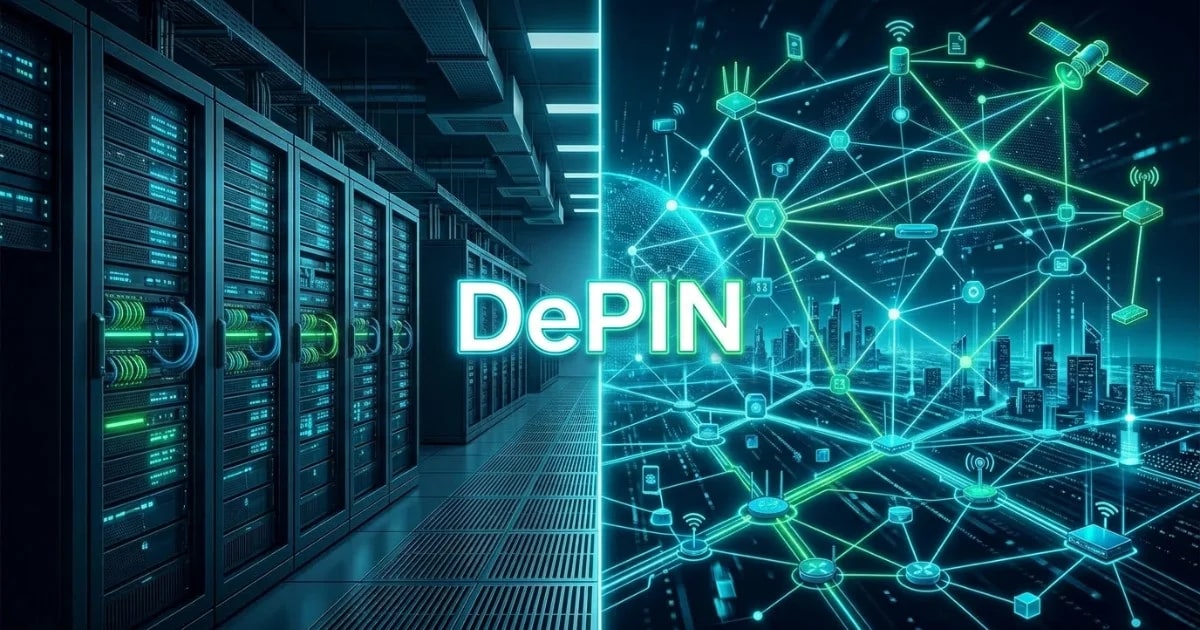
Sourcing global cloud infrastructure is undergoing an open-market transition. We break down the technical differences, performance benchmarks, and compliance trade-offs between legacy clouds and DePIN layers.
The Sourcing Paradigm: Hyperscale Monopolies Confront Tokenized Networks
- Decentralized Physical Infrastructure Networks DePIN completely invert this centralized infrastructure model. By utilizing blockchain coordination, public telemetry, and token rewards, DePIN aggregates underutilized computing resources from a global web of independent hardware operators. This breakdown compares the performance benchmarks, operational reliabilities, and regulatory trade-offs between traditional cloud ecosystems and emerging decentralized compute alternatives.
- For decades, global enterprise infrastructure has run almost entirely on centralized hyperscale cloud computing platforms like Amazon Web Services (AWS), Microsoft Azure, and Google Cloud Platform (GCP). These cloud giants spend billions of dollars annually on physical data center construction, custom real estate acquisitions, and massive engineering workforces to ensure seamless digital scale. While this model delivers elite system reliability, it places immense pricing power in the hands of a corporate oligopoly, leading to steep vendor lock-in markups that squeeze developers and enterprise budgets.
1. The Cost Equation: Capital Arbitrage vs. Legacy Margins
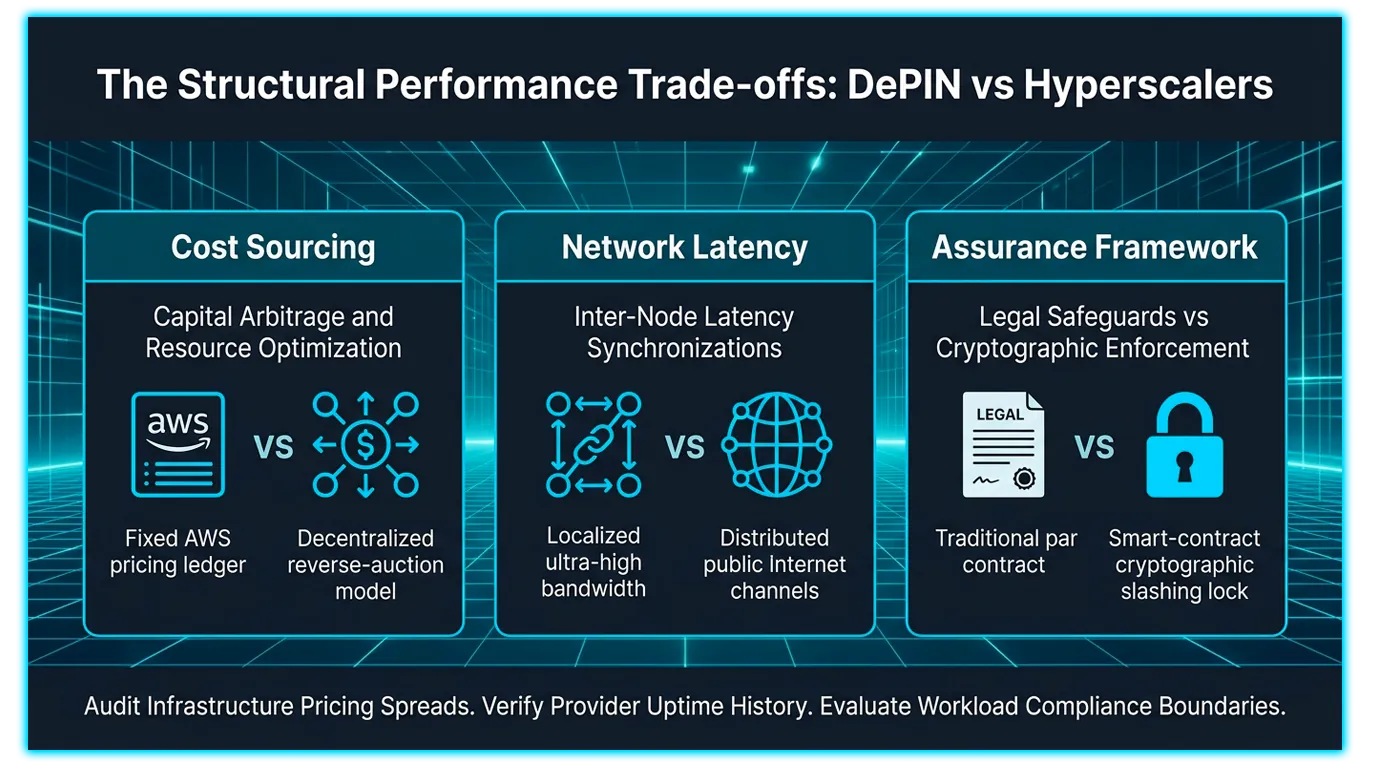
The most immediate value proposition driving the adoption of decentralized networks is the stark reduction in raw resource costs. Traditional cloud giants determine pricing based on static corporate margins, enterprise support overheads, and heavy infrastructure investments.
DePIN platforms completely eliminate these middleman markups by leveraging a global reverse-auction marketplace. Providers bid against one another in real time to secure incoming user workloads, driving resource prices down to the marginal cost of electricity and hardware depreciation.
The GPU Pricing Spread: On traditional hyperscale cloud architectures, renting a top-tier Nvidia H100 GPU costs roughly $7.90 per hour. On decentralized compute marketplaces like io.net or Akash Network, that exact same physical chip frequently rents for anywhere between $2.56 and $5.95 per hour.
The Storage Deficit: For standard archival data needs, decentralized storage layers like Filecoin offer up to 60% to 80% cost reductions compared to legacy storage structures. Startups and scaling AI operations utilize these deep arbitrage lines to survive capital-intensive validation and training phases.
2. The Reliability Gap: Corporate SLAs vs. Cryptographic Slashing
While the cost savings offered by decentralized networks are significant, the performance stability and support trade-offs require careful engineering evaluation.
Traditional Cloud Guarantees
Enterprise systems rely heavily on legally binding Service Level Agreements (SLAs). Hyperscalers routinely guarantee a strict 99.99% uptime for their core instances, which translates to less than 53 total minutes of systemic downtime per calendar year. If an outage occurs due to a localized data center failure, corporate clients have immediate recourse to automated billing credits or contract legal compensations.
The DePIN Variable
- Decentralized networks replace corporate legal contracts with cryptographic enforcement mechanisms. If an untrusted node provider misbehaves, drops offline, or fails a network check, the blockchain programmatically burns their locked token collateral via automated slashing protocols.
- However, because these networks rely on independent, geographically isolated nodes, reliability variance remains high. The average uptime for top-tier individual providers generally hovers closer to 99.7%, which equals roughly 26 hours of potential annual downtime. Furthermore, if a node unexpectedly reboots or gets evicted, users face "cold start" windows where workloads must wait 5 to 10 minutes to reload on an alternate provider, forcing developers to maintain active, warm standbys that can eat into their initial cost savings.
3. Latency Dynamics: Internal Clustering vs. Distributed Edge Networks
Evaluating transaction speeds and network latency highlights a sharp architectural divide based on the specific type of compute workload being executed.
Synchronous Training Bottlenecks
Training foundational Large Language Models (LLMs) requires thousands of high-performance chips to operate in perfect, sub-millisecond synchronization to share vast memory states continuously. Centralized data centers connect these processors together locally using physical, high-speed technologies like NVLink. DePIN networks, by contrast, must route data packets across the open public internet between geographically separated nodes. This introduces latency fluctuations that can easily disrupt complex, synchronous machine learning training loops.
Asymmetric Edge Inference Strengths
- For machine learning inference, algorithmic predictions, and asynchronous web-serving tasks, the computing landscape is vastly different. Inference tasks do not require nodes to coordinate memory states continuously; individual queries can be processed independently.
- Because DePIN aggregates consumer-tier server rooms, regional data centers, and local hardware nodes globally, it naturally functions as a high-powered edge computing architecture. This structure places processing power physically closer to regional end-users, lowering response latency for independent software queries while respecting local data residency parameters.
4. Compliance, Auditing, and Regulatory Boundaries
For mainstream corporate enterprises, the ultimate barrier to migrating core production infrastructure onto decentralized networks is the rigid world of data compliance.
- Traditional cloud hyperscalers offer fully certified development environments that comply natively with international frameworks like SOC 2 Type II, HIPAA, and GDPR. These strict compliance protocols guarantee that sensitive personal information, proprietary health records, and private corporate data are stored on verified hardware that adheres to rigorous physical and digital security boundaries.
- DePIN networks continue to navigate these structural compliance hurdles. Because the underlying hardware nodes are permissionless and can be run by anonymous operators, guaranteeing that a workload stays isolated from unauthorized data copying or meets local sovereign compliance criteria is incredibly difficult. While newer protocol additions are actively building hardware-isolated Trusted Execution Environments (TEEs) and zero-knowledge data verification bridges to secure processing paths, enterprises with strict compliance constraints typically limit their DePIN usage to non-sensitive test environments, batch-processing pipelines, and public web infrastructure layers.
Performance and Infrastructure Architecture Matrix
| Metric | Centralized Clouds | DePIN Networks |
| Pricing Model | Static / Premium | Dynamic / Auction |
| Uptime Safeties | Legal contract SLAs | Crypto slashing locks |
| Clustering Net | Intra-data center | Public internet mesh |
| Compliance | SOC 2 / HIPAA native | Emerging TEE modules |
Navigating Market Health via DEXTools Telemetry
- Analyzing the macroeconomic data behind emerging compute platforms requires deep visibility to track live liquidity shifts. Utilizing advanced decentralized charting architectures like DEXTools gives market participants an essential universal platform to monitor live token behaviors, evaluate pool depths, and inspect contract parameters across all public execution networks.
- By leveraging core features like the Pair Explorer, Live New Pairs dashboard, and the integrated Trade Story or Top Traders tracking modules, technical analysts can seamlessly audit localized volume trends, track large whale wallet capital reallocations via the Big Swap Explorer, and check automated contract safety scores before initiating any on-chain interactions, ensuring your hardened hardware setup interacts safely with verified market venues.
Disclaimer: This article is for informational purposes only and does not constitute investment advice, financial advice, trading advice, or any other kind of advice. DEXTools does not recommend buying, selling, or holding any cryptocurrency or token. Users should conduct their own research and consult with a qualified financial advisor before making any investment decisions. Cryptocurrency investments are volatile and high-risk. DEXTools is not responsible for any losses incurred.
The Unseen Costs of Centralization: Vendor Lock-in and Exit Strategies
While the initial cost analysis of traditional cloud vs. DePIN often focuses on compute, storage, and bandwidth, a deeper dive reveals significant long-term financial implications tied to vendor lock-in. Migrating from a major cloud provider is not merely a technical challenge; it is a complex, resource-intensive undertaking that can erode any perceived short-term savings. Proprietary APIs, specialized managed services, and deeply integrated tooling create a sticky ecosystem that makes switching providers exceptionally difficult and costly.
DePIN, by design, fundamentally alters this dynamic. Its decentralized, open-source nature promotes interoperability and reduces reliance on any single entity. This architectural shift empowers users with greater control over their data and infrastructure, fostering a more competitive and less restrictive market environment. Understanding these hidden costs and strategic advantages is crucial for any long-term infrastructure planning.
Mitigating Exit Barriers with DePIN
- Reduced proprietary API dependencies, favoring open standards.
- Greater portability of workloads due to containerization and standard interfaces.
- Decentralized storage solutions offer inherent data redundancy and multi-provider options.
- Community-driven development fosters tools and best practices for migration.
- Lower switching costs due to the absence of steep vendor-specific learning curves.
Related Guides
- What Is Akash Network? DePIN Cloud & AKT Guide 2026
- What Is Aethir (ATH)? The Decentralized GPU Cloud Powering AI and Gaming in 2026
- What Is Ichimoku Cloud in Crypto? 5 Lines Explained (2026)
- What is Akash Network (AKT)? Decentralized Cloud Guide
- What Is DCA in Crypto? Benefits and Limits (2026)
Frequently Asked Questions
What is the difference between DePIN and traditional cloud?
Traditional cloud relies on centralized providers operating large data centers, while DePIN distributes infrastructure across many independent participants coordinated by a network and token incentives. The two differ in control, pricing models, and reliability guarantees.
Can DePIN be cheaper than traditional cloud?
DePIN can sometimes offer lower costs by tapping into distributed, underused resources rather than centralized facilities. However, pricing varies and savings are not guaranteed across all workloads.
Is DePIN as reliable as traditional cloud?
Traditional cloud providers typically offer formal service-level agreements and centralized support, while DePIN reliability depends on a distributed set of providers. This can introduce more variability in uptime and performance.
What are the risks of using DePIN instead of cloud?
Risks can include less predictable reliability, fewer formal guarantees, token and incentive dependencies, and potential compliance or data-handling concerns. Suitability depends on the specific workload and requirements.