Akash Network Auctions, GPU Pricing and AKT Economics Guide (2026)
— By AliceOnChain in Tutorials

A focused Akash guide covering reverse auctions, GPU pricing, marketplace design and AKT economics instead of the broad beginner definition.
Where this page fits: This page is the marketplace-economics angle. It focuses on auctions, GPU pricing and AKT token mechanics. For the broader beginner explainer, read our main Akash guide.
What is Akash Network (AKT)? Decentralized Cloud Computing
The global computing industry remains largely consolidated under a handful of legacy hyperscale cloud providers. This centralized paradigm introduces notable inefficiencies, including arbitrary pricing models, vendor lock-in, and geographical data concentration. As artificial intelligence models and enterprise data needs scale, the demand for flexible server infrastructure has highlighted the limitations of traditional infrastructure. The solution has emerged in the form of Decentralized Physical Infrastructure Networks (DePIN), with pioneering protocols reshaping resource allocation.
For systemic trading groups and on-chain analysts trying to determine what is Akash Network AKT and where its true market structure resides, the protocol offers a compelling case study. It bridges real-world server utility with sovereign, Tendermint-based blockchain consensus. Evaluating the network requires examining its reverse-auction marketplace design, its advanced structural token upgrades, and the on-chain diagnostic parameters available through DEXTools to accurately track liquidity velocity.
The Structural Architecture of Akash Network
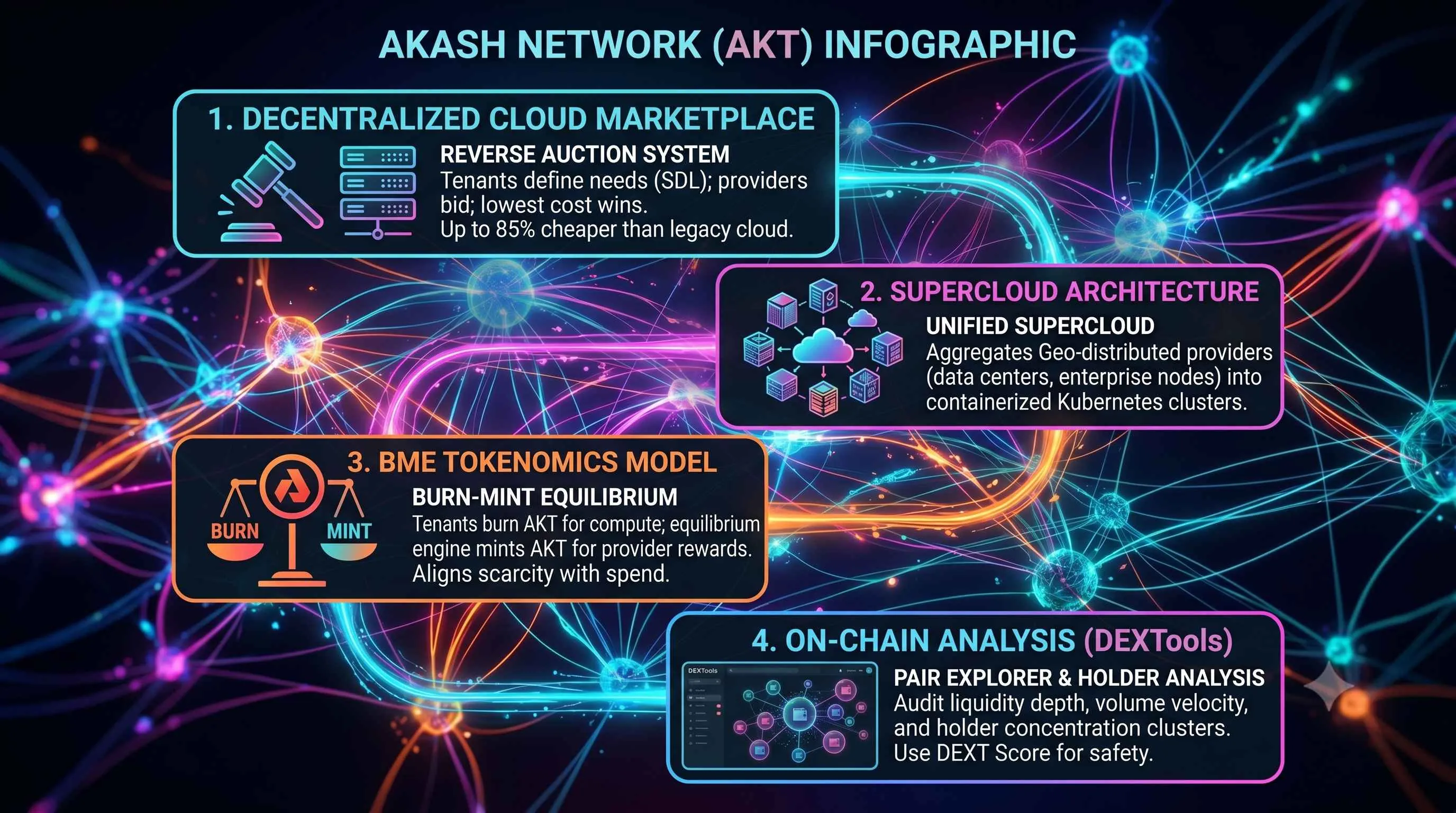
To unpack the question of what is Akash Network AKT from an operational perspective, one must view it as a decentralized "Supercloud." The protocol functions as an open-source, peer-to-peer marketplace that safely matches entities requiring raw computational power (tenants) with data centers or enterprise entities possessing underutilized server hardware (providers).
Built using the Cosmos SDK framework and powered by CometBFT consensus, the network secures high-speed transaction execution with sub-second finality. Its internal mechanics rely on a structured, programmatic workflow:
The Intent Layer (SDL): Tenants define their resource requirements (CPU cores, memory allocations, storage types, and GPU specifications) using a clean declarative language known as Stack Definition Language (SDL).
The Reverse Auction Marketplace: Once a tenant submits an order, it triggers an on-chain bidding event. Approved providers monitor these orders and submit competing bids automatically. This process drives down operational costs by up to 85% relative to legacy cloud options.
Kubernetes Orchestration: When an order lease is awarded, the workload is safely deployed across containerized Kubernetes clusters managed natively by the provider, ensuring deployment isolation and predictable uptime.
Core Economic Models and the Burn-Mint Upgrade
Understanding an infrastructure asset requires looking deeply at its core microeconomics. When investigating what is Akash Network AKT trying to accomplish with its underlying asset architecture, traders must review the core token upgrades implemented across its mainnet infrastructure.
Historically, volatile asset pricing created friction for tenants trying to predict long-term operational costs. To counteract this, recent structural milestones introduced specialized smart-contract modules alongside a programmatic Burn-Mint Equilibrium (BME) framework.
Under this model, when tenants pay for computing deployments, the necessary AKT tokens are dynamically calculated using trusted decentralized oracles and subsequently burned, removing them permanently from the circulating supply. Concurrently, an equilibrium engine mints new tokens to incentivize and compensate providers based on their verified availability and execution parameters. This model aligns token scarcity directly with actual, verifiable physical computing spend, making network utilization metrics a primary indicator for on-chain trend analysis.
On-Chain Analysis: Auditing AKT Dynamics with DEXTools
Trading utility-backed network tokens within the DePIN sector demands a structured analytical routine that looks beyond surface-level sentiment. Volatility management requires an evaluation of smart-contract transparency, pool configuration, and historical support parameters. DEXTools delivers the precise tooling necessary to monitor these variables natively.
Assessing Liquidity Depth with Pair Explorer
When analyzing the core AKT trading pools across decentralized exchange routers, the DEXTools Pair Explorer provides critical data layers that dictate execution safety.
Liquidity Depth and Volatility Mitigation: Large market orders can generate significant price slippage if the targeted pool lacks sufficient deep, locked liquidity. Active analysts evaluate the ratio between 24-hour transaction volume and total pool liquidity to determine if a specific entry point can safely absorb localized capital rotations.
DEXT Score Verification: This automated contract index checks for underlying security parameters, verified open-source routing contracts, and creator address balances. A low DEXT Score alerts market participants to potential contract deployment flaws or unlocked pool liquidity, minimizing systemic risk exposure.
Evaluating Holder Concentration and Wallet Networks
A critical vector of risk for infrastructure assets is supply distribution. If a substantial majority of the circulating supply is concentrated within a tightly knit network of legacy seed wallets or early venture allocations, the token structure remains exposed to sudden, unexpected liquidation events.
Through the DEXTools Holder Analysis panel and its native Bubblemaps graphical integration, analysts can look past superficial wallet tallies. The tool maps real-time data to illustrate relationships between disparate on-chain entities. If the map displays massive, interconnected wallet clusters routing capital in sync, it indicates heavy concentration or hidden whale networks. Conversely, a fragmented, organic chart implies broad accumulation and lower structural tail-risk.
Risk Management Parameters in High-Volatility Regimes
Executing strategies within emerging crypto categories requires strict adherence to quantitative risk rules to prevent emotional errors during sharp market fluctuations. Part of this discipline means recognizing what is Akash Network AKT doing relative to broader macroeconomic trends.
Trading RSI and Volume-Weighted Average Price Divergences
On-chain price movements frequently signal weakness before it shows on standard candles. By applying DEXTools Charts, traders look for divergences between the asset’s Volume-Weighted Average Price (VWAP) and its Relative Strength Index (RSI).
If the spot price moves to a new local high while the underlying RSI creates a distinct lower high, a bearish divergence occurs. In many cases, this signals that the immediate buying momentum is drying up, advising disciplined analysts to lock in partial profits, move stop-loss orders up, or hold off on additional entries until a key horizontal support level is retested.
Automating Profits via Price Alerts
Because decentralized markets operate continuously, sudden price expansions and subsequent liquidations can occur while traders are away from their terminals. Using the automated Price Alerts feature within DEXTools allows for hands-free risk management.
Configuring tiered alerts around key structural zones-such as macro-Fibonacci extension targets or historic support nodes-enables a mechanical profit-taking schedule. Scaling out of positions systematically at established technical thresholds ensures capital preservation and protects trading equity from sudden market reversals.
Conclusion: Combining Fundamentals with Advanced On-Chain Metrics
In summarizing what is Akash Network AKT, it stands out as a highly functional solution to the ongoing computing and GPU access crisis. By matching underutilized global server capacity with programmatic marketplace incentive models, it establishes a reliable decentralized alternative to corporate cloud monopolies.
Yet, solid structural fundamentals do not entirely eliminate short-term trading volatility. Successfully traversing these token ecosystems requires pairing long-term fundamental perspectives with precise on-chain data. By utilizing DEXTools to audit pool health, track whale wallet networks, watch for structural technical divergences, and implement price execution triggers, market participants can strip away speculative noise and trade based on verifiable market liquidity.
- Pair Explorer Data Trend Reversals: A Pro Trading Guide
- What Is Akash Network? DePIN Cloud & AKT Guide 2026
- How to Read Liquidity Pool Data Before Buying a Token (2026)
- DEXTools Pair Explorer for Early Liquidity Signals
Disclaimer: This article is for informational purposes only and does not constitute investment advice, financial advice, trading advice, or any other kind of advice. DEXTools does not recommend buying, selling, or holding any cryptocurrency or token. Users should conduct their own research and consult with a qualified financial advisor before making any investment decisions. Cryptocurrency investments are volatile and high-risk. DEXTools is not responsible for any losses incurred.
The Economic Engine: AKT's Burn-Mint Equilibrium and Supply-Side Dynamics
Beyond its utility as a medium for transaction settlement and staking, AKT's tokenomics are intricately designed to create a self-regulating economic environment for the Akash marketplace. The Burn-Mint Equilibrium (BME) model is not merely a mechanism for managing inflation; it's a dynamic feedback loop intended to align the interests of users, providers, and token holders. Understanding this equilibrium is crucial for grasping AKT's long-term value proposition and its resilience against market fluctuations.
The BME functions by burning a portion of the AKT tokens generated from marketplace fees, effectively removing them from circulation. Simultaneously, new AKT is minted to reward stakers and incentivize network security. The "equilibrium" is sought when the rate of burning approximates the rate of minting, theoretically stabilizing the token's supply over time. This design aims to counteract inflationary pressures while ensuring sufficient incentives remain for network participants.
Marketplace Fee Dynamics and AKT Value Accrual
- Demand-Side Pressure: As demand for decentralized cloud services on Akash grows, so does the volume of fees generated. A percentage of these fees are burned, directly linking network utilization to token scarcity.
- Provider Incentives: Providers offering computing resources receive payment in AKT. The stability of AKT's value, supported by the BME, makes it a more attractive and predictable form of compensation.
- Staking Rewards: Stakers secure the network and participate in governance, earning newly minted AKT. This incentivizes long-term holding and network participation, reducing circulating supply available for sale.
- Protocol Upgrades: Future protocol upgrades may introduce dynamic fee structures or burning mechanisms, further refining the BME to adapt to evolving market conditions and network growth.
- Decentralized Governance: AKT holders have a say in adjusting parameters of the BME, such as the burn rate or staking reward percentages, allowing for community-driven optimization of the token's economic model.
Related Guides
- What Is Akash Network? DePIN Cloud & AKT Guide 2026
- What Is Aethir (ATH)? The Decentralized GPU Cloud Powering AI and Gaming in 2026
- What Is Theta Network (THETA + TFUEL)? Decentralized Video Streaming Guide 2026
- What is Render (RENDER)? Decentralized GPU Network Guide
- What Is Render Network (RNDR/RENDER)? Decentralized GPU DePIN Guide 2026
Frequently Asked Questions
What is Akash Network?
Akash Network is an open source, decentralized marketplace for cloud computing where users can rent computing resources from independent providers. It aims to offer an alternative to traditional centralized cloud providers.
How does decentralized cloud computing work?
Decentralized cloud computing connects people who need computing power with providers who have spare capacity, coordinated through a protocol and token incentives. This creates an open marketplace for resources rather than a single vendor.
What is the role of the AKT token?
AKT is used within the Akash ecosystem for payments, security, and incentives that align providers and users. Token design influences how the marketplace functions and how value flows.
Why might users choose a decentralized cloud?
Some users are drawn to potential cost savings, openness, and reduced reliance on a single centralized provider. The trade offs can include differences in tooling, support, and maturity compared with established clouds.