Chain Rotation: How Traders Detect Liquidity Moving Between Ecosystems
— By Whatsertrade in Tutorials

Crypto liquidity does not stay in one place forever. At different times, traders may focus on Ethereum, Solana, Base, BNB Chain, Arbitrum, Avalanche, or other e
Crypto liquidity does not stay in one place forever.
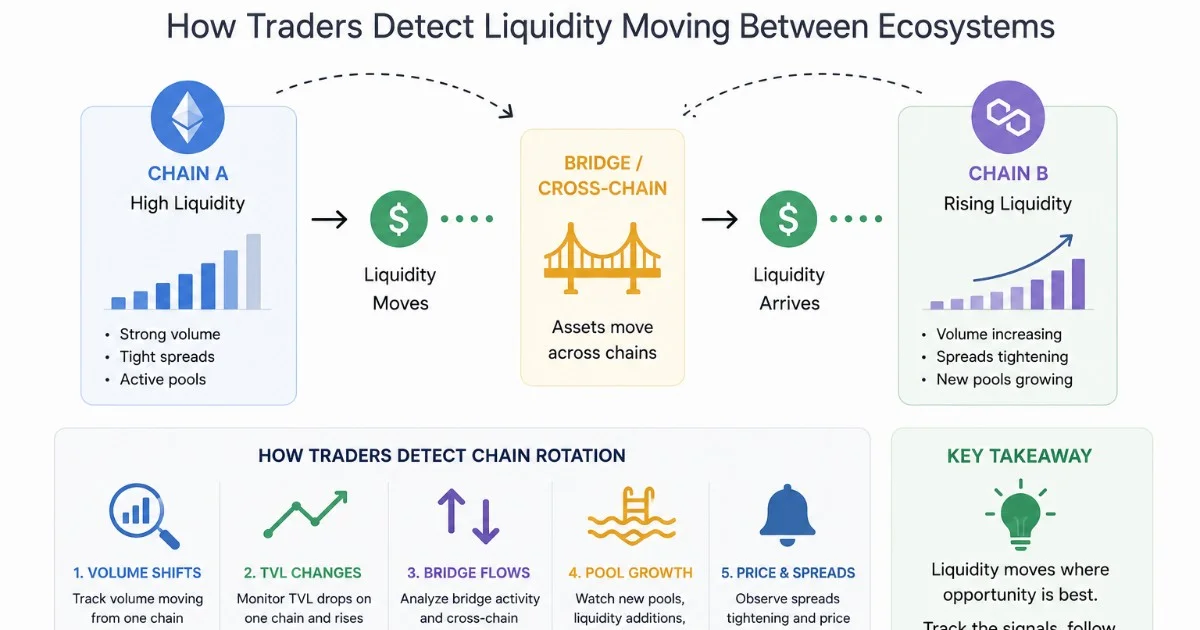
At different times, traders may focus on Ethereum, Solana, Base, BNB Chain, Arbitrum, Avalanche, or other ecosystems. When attention shifts, volume, new pairs, liquidity, and speculation can move with it.
This process is known as chain rotation.
For DEX traders, understanding chain rotation is important because some of the best opportunities appear when liquidity starts moving before the broader market notices.
What Is Chain Rotation?
Chain rotation happens when traders move capital from one blockchain ecosystem to another.
This can happen for many reasons:
- Lower fees
- Faster transactions
- New token launches
- Better meme coin activity
- Airdrop speculation
- Stronger ecosystem incentives
- New DEX growth
- Influencer attention
- Fresh narratives
- Better trading conditions
When chain rotation begins, one ecosystem may start attracting more volume, more liquidity, and more new traders than others.
Why Chain Rotation Matters
Each blockchain has its own trading culture.
Solana may attract fast memecoin trading. Base may attract consumer apps and new retail flows. Ethereum may remain important for deeper liquidity and established assets. BNB Chain may attract large retail communities. Arbitrum and other L2s may see activity around DeFi and incentives.
When liquidity rotates into a chain, the entire ecosystem can benefit.
New tokens launch. Existing tokens gain volume. DEX activity increases. Traders begin watching trending pairs. Communities become more active.
This can create strong short-term opportunities.
Early Signs of Chain Rotation
Traders can look for several signals that liquidity is moving into a new ecosystem.
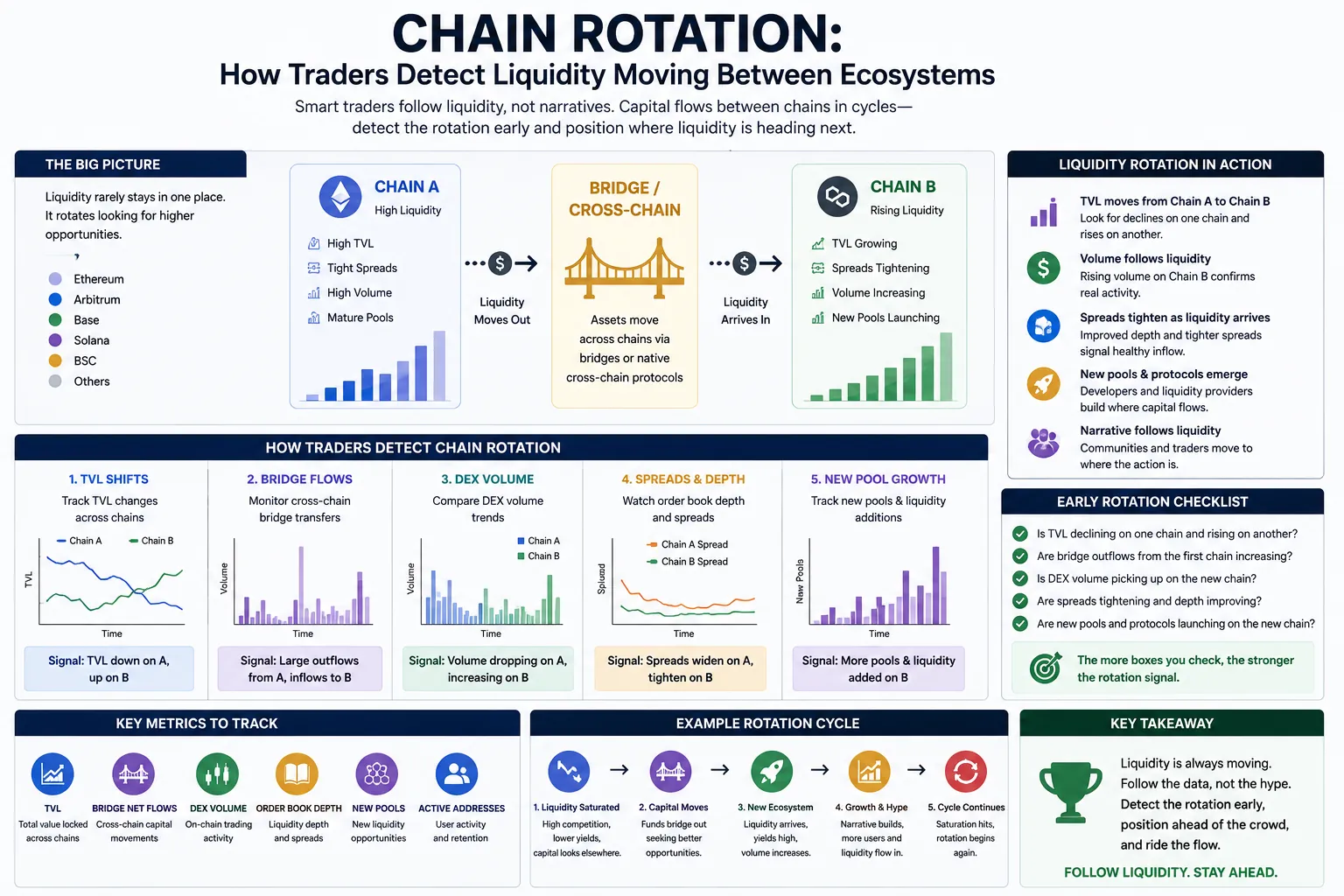
1. Rising DEX Volume
When DEX volume increases across a chain, it may show that traders are becoming more active.
One strong token is not enough. The stronger signal is when many tokens on the same chain begin trading more actively.
2. More New Pairs
A growing number of new pairs can indicate that builders and speculators are launching more tokens in that ecosystem.
This often happens when traders believe the chain has momentum.
3. Stablecoin Liquidity Growth
Stablecoins are important because they act as trading fuel.
If USDC, USDT, or other stablecoin liquidity grows on a chain, traders may have more capital available to enter new positions.
4. Stronger Native Token Performance
The native token of a chain can sometimes reflect ecosystem demand.
If the chain's native asset is gaining strength while DEX activity rises, the rotation may be more meaningful.
5. Social Attention Shifts
When traders, influencers, and communities start discussing one ecosystem more often, attention may follow liquidity.
Social attention alone is not enough, but combined with DEX data, it can be useful.
6. Better New Launch Performance
If new tokens on one chain begin performing better than launches elsewhere, it may suggest that traders are rotating into that ecosystem.
Healthy Chain Rotation vs Short-Term Hype
Not every chain rotation is sustainable.
A healthy rotation usually has:
- Rising liquidity
- Increasing volume
- Stronger active trader participation
- Multiple tokens gaining traction
- Stablecoin inflows
- Strong ecosystem narratives
- Continued activity after the first hype wave
Short-term hype usually has:
- One or two tokens pumping
- Many weak copycat launches
- Fast liquidity exits
- Volume fading quickly
- Traders rotating out after a few days
- No deeper ecosystem growth
The difference matters for risk management.
Why Traders Rotate Between Chains
Traders rotate because opportunities change.
If one chain becomes crowded, expensive, or saturated, traders may look elsewhere. If a new ecosystem offers lower fees, faster launches, or stronger community momentum, liquidity may move there.
Rotation is also driven by narratives.
For example, if one chain becomes known for memecoins, traders looking for memecoin opportunities may move there. If another chain becomes known for DeFi yields or tokenized assets, different traders may follow.
In crypto, liquidity often follows attention. Attention often follows performance.
How to Track Chain Rotation With DEX Data
Traders can build a simple workflow:
- Compare DEX volume across chains
- Watch new pair activity
- Track liquidity growth in leading pools
- Check stablecoin pair activity
- Monitor trending tokens by ecosystem
- Compare the performance of chain leaders
- Watch whether liquidity stays after the first move
- Look for repeated launches with strong demand
This approach helps traders identify whether a chain is gaining real activity or only temporary hype.
Risks of Chasing Chain Rotation Late
Chain rotation can create opportunity, but late entries are risky.
By the time everyone is talking about a chain, early traders may already be taking profits. New launches may become lower quality. Liquidity may become fragmented across too many tokens.
Late-stage chain rotation often leads to:
- Weaker launches
- More scams and copycats
- Faster pump and dump cycles
- Higher competition
- Lower quality liquidity
- Poorer risk and reward
Traders should look for early signs, not only viral narratives.
Final Thoughts
Chain rotation is one of the most important forces in crypto markets.
Liquidity moves between ecosystems as traders search for better opportunities, lower fees, stronger narratives, and higher returns.
For DEX traders, the key is to identify rotation early and confirm it with real data.
Do not only ask which token is trending. Ask which chain is gaining liquidity, volume, and active traders.
When the chain changes, the opportunity set changes with it.
What Is Chain Abstraction: The End of Bridging in Crypto (2026) How to Read On-Chain Data: Metrics, Wallet Flows and Dashboards (2026) Liquidity Incentive Traps: When Rewards Attract Farmers, Not Real BuyersFrequently Asked Questions
What is chain rotation in crypto?
Chain rotation describes the movement of capital between different blockchain ecosystems or sectors. Traders often observe this as liquidity shifts from one set of assets to another, impacting prices.
Why do traders monitor chain rotation?
Monitoring chain rotation can help traders identify emerging trends and potential shifts in market sentiment. It provides insights into which blockchain ecosystems or asset classes are gaining or losing investor interest.
What causes chain rotation?
Chain rotation can be driven by various factors, including new technological developments, changes in regulatory environments, market narratives, or the search for higher yields and growth opportunities in different sectors.
How do traders detect chain rotation?
Traders often detect chain rotation by analyzing on-chain data, trading volumes, market capitalization shifts, and the performance of different blockchain tokens or sectors. Significant increases in activity on one chain coupled with decreases on another can be an indicator.
Is chain rotation a reliable trading strategy?
While observing chain rotation can inform trading decisions, it is not a standalone strategy and involves risk. Market dynamics are complex, and past rotations do not guarantee future performance.
Related Guides
- Liquidity Rotation: How Capital Moves Between Tokens Inside the Same Narrative
- Bitcoin Dominance (BTC.D) Explained: How Traders Read Rotation (2026)
- How to Bridge Crypto Between Chains: Complete Cross-Chain Tutorial 2026
- Top 5 Multichain Wallets in 2026: Best Wallets for Cross-Chain Traders
- L1 and L2 Ecosystems 2026: Solana, BNB, Ethereum, and Base.