Liquidity Rotation: How Capital Moves Between Tokens Inside the Same Narrative
— By Whatsertrade in Tutorials

Crypto markets often move in narratives. At different times, traders may focus on AI tokens, memecoins, RWA, DePIN, gaming, Base tokens, Solana tokens, or other
Crypto markets often move in narratives.
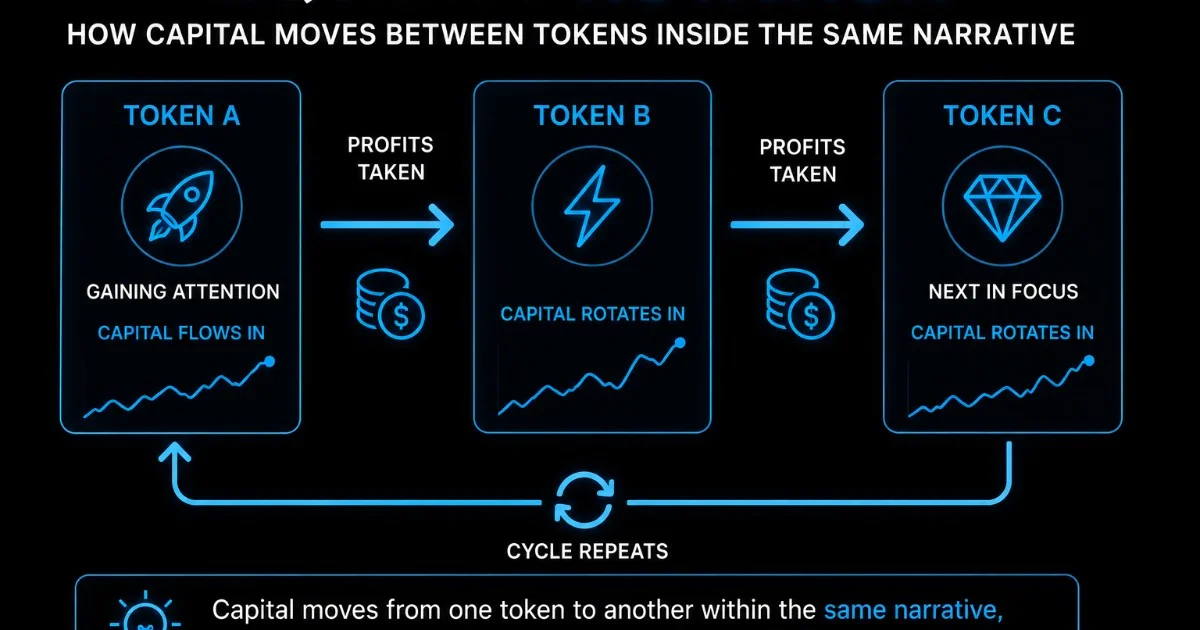
At different times, traders may focus on AI tokens, memecoins, RWA, DePIN, gaming, Base tokens, Solana tokens, or other trending sectors.
When a narrative becomes popular, capital rarely stays in one token forever. Instead, liquidity often rotates between leaders, smaller tokens, new launches, and copycat projects.
This process is called liquidity rotation.
Understanding liquidity rotation can help traders identify where attention is moving, when a trend is still healthy, and when the market may be running out of fresh buyers.
What Is Liquidity Rotation in Crypto?
Liquidity rotation happens when capital moves from one token, sector, or market segment to another.
Inside a single narrative, this can happen very quickly.
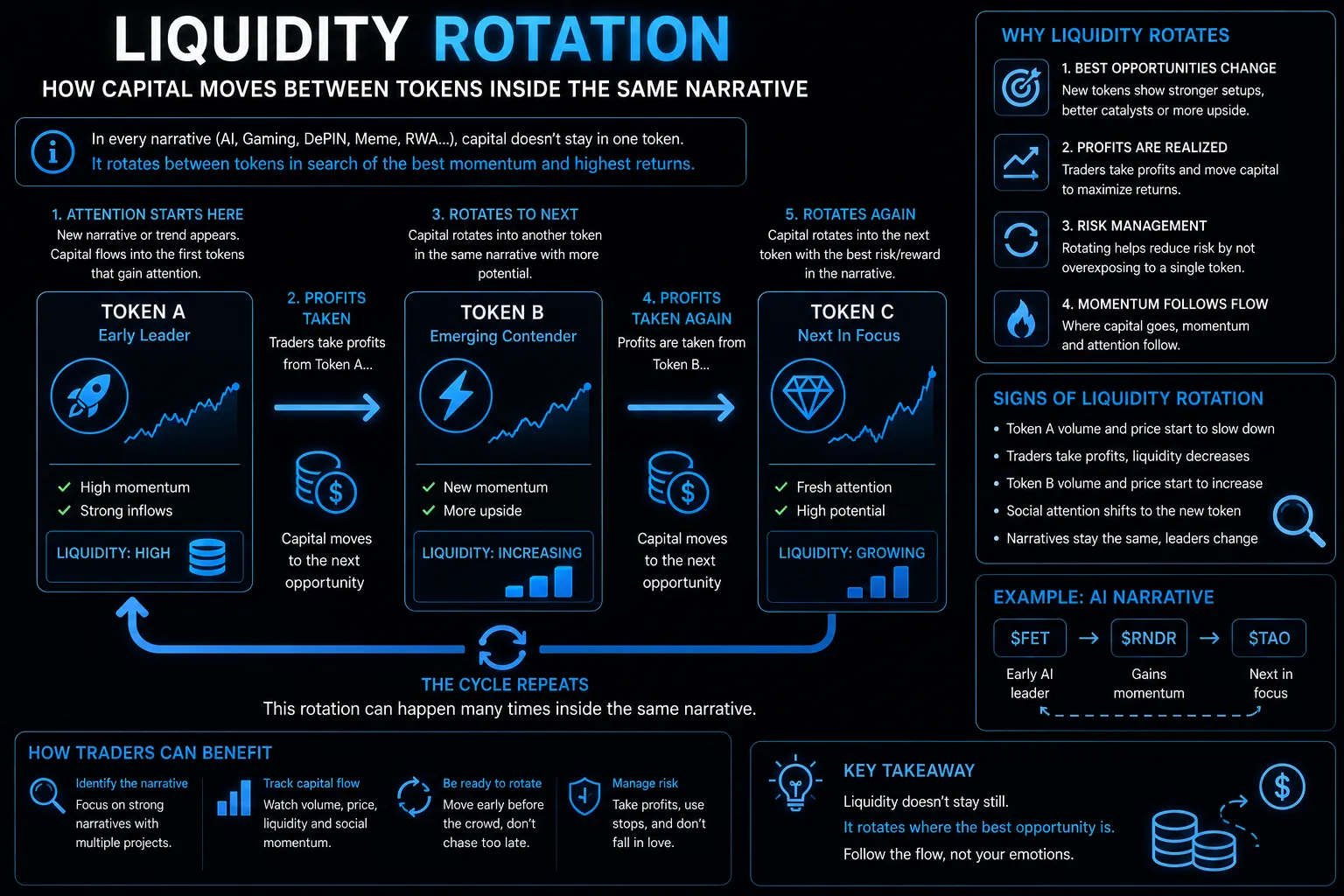
For example, traders may first buy the strongest token in an AI narrative. After that token pumps, some traders take profits and look for smaller AI tokens with more upside. Later, liquidity may move into newer launches, lower cap tokens, or related projects.
The narrative remains the same, but capital rotates inside it.
Why Liquidity Rotation Happens
Liquidity rotation happens because traders are constantly looking for better risk and reward.
When a leading token has already moved significantly, some traders may believe the easiest upside is gone. They may rotate into smaller tokens that have not yet pumped.
Other traders may rotate from risky small caps back into stronger leaders when the market becomes uncertain.
In both cases, liquidity is moving in search of opportunity.
This movement can create short term pumps, sudden reversals, and fast changes in market leadership.
The Typical Liquidity Rotation Cycle
A crypto narrative often follows a recognizable rotation cycle.
1. The Leader Moves First
The strongest or most visible token in a narrative usually attracts capital first.
This token becomes the reference point for the sector. Traders watch it to understand whether the narrative is gaining strength.
2. Mid Cap Tokens Follow
After the leader pumps, traders often look for related tokens with smaller market caps.
These tokens may benefit from the same narrative but still appear to have more upside.
3. Low Cap Tokens and New Launches Attract Speculation
As the narrative becomes more popular, liquidity may move into microcaps and new pairs.
This phase can be very volatile. Gains can be fast, but risk increases sharply.
4. Copycats Appear
When a narrative becomes crowded, many similar tokens launch with the same theme.
Some may attract short term volume, but many fail to sustain demand.
5. Capital Rotates Back or Leaves
Eventually, traders may rotate back into the strongest tokens, move into a new narrative, or exit the sector completely.
This is when weaker tokens often lose liquidity first.
Signs of Healthy Liquidity Rotation
Not all rotation is bad.
Healthy liquidity rotation can show that a narrative still has strong demand.
Signs of healthy rotation include:
- Leading tokens maintain structure
- Mid cap tokens follow with rising volume
- New buyers appear across the sector
- Liquidity grows instead of only moving around
- Pullbacks are bought quickly
- Strong tokens recover after profit taking
- The narrative continues attracting fresh attention
In this environment, capital rotation can support the overall trend.
Signs of Dangerous Liquidity Rotation
Liquidity rotation becomes dangerous when capital stops entering the narrative and only moves from one token to another.
This means the same money is being recycled.
Warning signs include:
- Leaders stop making new highs
- Low cap tokens pump and dump quickly
- Liquidity leaves older tokens to chase new launches
- Volume rises but price does not continue
- Copycat tokens dominate the sector
- Pullbacks become deeper
- Traders rotate faster and hold for shorter periods
When this happens, the narrative may still look active, but the quality of demand is weaker.
Why Liquidity Rotation Matters for DEX Traders
DEX traders often focus on individual tokens, but narratives create broader market context.
A token can look strong because the entire narrative is receiving capital. It can also look weak because liquidity is rotating away from its sector.
Understanding this helps traders avoid isolated analysis.
Before buying a token, traders should ask:
- Is liquidity entering the whole narrative?
- Is the token a leader or a late copycat?
- Are traders rotating into this token or away from it?
- Are new launches stealing attention?
- Is volume creating continuation or only short term pumps?
This broader view can improve decision making.
How to Track Liquidity Rotation
Traders can analyze liquidity rotation by comparing tokens within the same narrative.
A useful process includes:
- Identify the main tokens in the sector
- Compare their liquidity trends
- Review their volume changes
- Watch which tokens recover fastest after dips
- Check whether new pairs are attracting real buyers
- Compare leaders against smaller tokens
- Look for signs of capital leaving the narrative entirely
DEXTools can help traders observe pair activity, liquidity, volume, swaps, and market movement across tokens in the same sector.
Liquidity Rotation vs Narrative Exhaustion
Liquidity rotation and narrative exhaustion are related, but they are not the same.
Liquidity rotation means capital is moving inside a narrative.
Narrative exhaustion means the narrative is losing fresh demand.
Healthy rotation can support a trend. Exhausted rotation usually recycles the same capital until buyers disappear.
The difference is important.
A rotating market can still offer opportunities. An exhausted market often creates late entries and poor exits.
Final Thoughts
Crypto narratives are powerful, but capital inside them is always moving.
Liquidity rotation helps traders understand where money is flowing, which tokens are leading, and which tokens may be losing attention.
Before buying into a trending sector, traders should not only ask whether the narrative is strong. They should ask where liquidity is rotating right now.
That question can help traders avoid late entries, identify stronger setups, and understand the market beyond a single chart.
How to Bridge Crypto Between Chains: Complete Cross-Chain Tutorial 2026 How to Use 1inch: Complete DEX Aggregator Swap Tutorial (2026) How to Use OKX Web3 Wallet: Multi-Chain DeFi Hub Guide (2026)Frequently Asked Questions
What are tokens in cryptocurrency?
Tokens are digital assets issued on a blockchain. They represent a wide range of utilities and assets, from currencies to real estate.
How do tokens differ from coins?
Coins are native to their own blockchain, like Bitcoin or Ether. Tokens are built on existing blockchains, such as ERC-20 tokens on Ethereum.
What is the purpose of a utility token?
Utility tokens provide access to a specific product or service within a blockchain ecosystem. Holders can use them to pay fees or gain certain privileges.
What is a security token?
Security tokens are digital representations of traditional securities, like stocks or bonds. They are subject to securities regulations and represent ownership in an underlying asset.
How do tokens facilitate liquidity rotation?
Tokens enable capital to move efficiently between different projects and assets within a narrative. Their digital nature allows for quick transfers and trading on various platforms.