Protocol Owned vs Mercenary Liquidity Explained
— By Whatsertrade in Tutorials

Protocol owned vs mercenary liquidity explained: see how each type affects crypto token prices, market stability, and long-term project health.
Liquidity is one of the most important signals in DeFi. A token can have strong branding, a large community and a rising chart, but if its liquidity is weak or unstable, trading risk can increase very quickly.
For crypto traders, liquidity is not just a background metric. It directly affects slippage, execution quality, volatility and the ability to exit a position. A market with deep and stable liquidity gives traders more confidence. A market with temporary liquidity can look healthy for a short period, then become fragile when capital leaves.
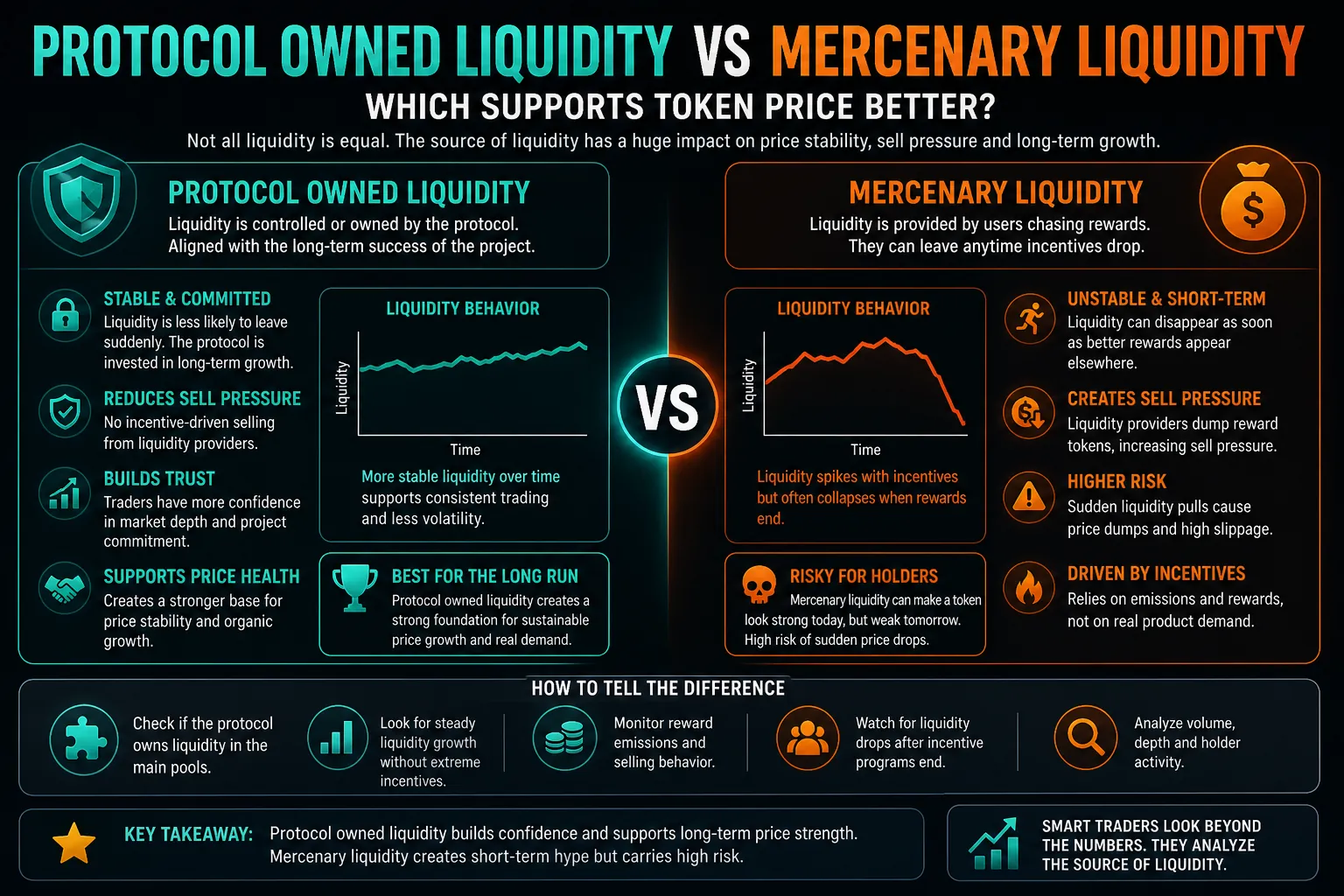
Two important concepts are protocol owned liquidity and mercenary liquidity. Both can help a token become tradable, but they support the market in very different ways.
Understanding protocol owned liquidity vs mercenary liquidity can help traders judge whether a token has durable market depth or whether its liquidity may disappear when incentives end.
What Is Protocol Owned Liquidity?
Protocol owned liquidity is liquidity controlled by the protocol itself. Instead of depending only on outside liquidity providers, the project owns part of the assets inside its liquidity pools.
This can happen when a protocol accumulates its own tokens and paired assets, such as ETH, stablecoins or other major assets. The protocol may then use those assets to support trading pools.
The main advantage is stability. If the protocol owns liquidity, that liquidity is less likely to leave suddenly. It is not controlled by short term farmers who may move their capital to the next high reward opportunity.
Protocol owned liquidity can help create a more reliable market for traders. It can reduce dependence on temporary incentives and improve confidence around token trading.
However, protocol owned liquidity is not a guarantee of success. A project still needs real users, healthy volume, strong tokenomics and transparent treasury management.
What Is Mercenary Liquidity?
Mercenary liquidity comes from users who provide capital mainly to earn rewards. These users may not be loyal to the protocol. They are often attracted by high yields, token emissions or temporary incentive programs.
This type of liquidity can be useful in early DeFi growth. New projects often need incentives to attract capital. Without initial liquidity, traders may not be able to enter or exit efficiently.
The problem is that mercenary liquidity can leave quickly. If rewards decrease or another protocol offers higher returns, liquidity providers may remove their capital and move elsewhere.
This can create sudden liquidity drops. A token that looked easy to trade can become thin, volatile and risky in a short period of time.
Protocol Owned Liquidity vs Mercenary Liquidity: The Key Difference
The key difference is commitment.
Protocol owned liquidity is usually more committed because the protocol controls it. Mercenary liquidity is temporary because external users can remove it whenever they want.
For traders, this difference matters because liquidity stability affects market quality.
A token with large but temporary liquidity can look strong today and become risky tomorrow. A token with smaller but stable liquidity may offer better long term market conditions.
The amount of liquidity matters, but the source of liquidity matters too.
Why Liquidity Source Matters More Than Liquidity Size
Many traders look only at the total liquidity number. If one token has $2 million in liquidity and another has $300,000, the first token may look safer.
But this can be misleading.
If the $2 million is mostly mercenary liquidity funded by temporary rewards, it may disappear when incentives end. If the $300,000 is stable protocol owned liquidity, it may provide a more reliable base for trading.
This is why traders should ask a better question: how likely is this liquidity to stay?
Liquidity quality can be more important than liquidity size. Stable liquidity can support healthier trading. Temporary liquidity can create a false sense of safety.
How Mercenary Liquidity Can Create Hidden Sell Pressure
Mercenary liquidity often comes with reward emissions. Users deposit capital and receive the protocol’s token as a reward.
At first, this may look positive. Liquidity increases, trading conditions improve and the token may attract more attention.
But there is a hidden risk. If liquidity providers sell their reward tokens, the market can face constant sell pressure.
This creates a difficult cycle. The project pays rewards to attract liquidity. Farmers earn the rewards. Then those rewards are sold into the market. The result can be ongoing pressure on the token price.
In this case, liquidity is not purely supportive. It is connected to emissions, and emissions can dilute the market.
When Mercenary Liquidity Can Be Useful
Mercenary liquidity is not always bad. It can help new protocols bootstrap markets and attract users.
In the early stages, a project may need to reward liquidity providers because organic demand is not strong enough yet. Incentives can create the first layer of market depth.
The key question is whether the project has a plan to move beyond mercenary liquidity.
A strong DeFi project may use temporary incentives at launch, then gradually build protocol owned liquidity, organic volume and real revenue.
A weak project may depend on high rewards forever.
Protocol Owned Liquidity and Long Term Market Confidence
Protocol owned liquidity can improve long term market confidence because traders know that part of the liquidity base is controlled by the project.
This can reduce fear of sudden liquidity exits. It can also help create more stable conditions during volatile markets.
However, transparency is important. If a protocol controls liquidity but does not explain how it manages those assets, users may still be concerned.
The best case is when protocol owned liquidity is visible, well managed and aligned with long term market health.
What Traders Should Analyze
Before trading a token, users should look beyond the liquidity number and analyze the structure behind it.
Important questions include:
Is liquidity growing naturally or only because rewards are high?
Does the protocol own part of its liquidity?
Has liquidity remained stable after incentive changes?
Is trading volume consistent?
Are liquidity providers selling reward tokens?
Can the market absorb larger trades without major slippage?
Does the token rely heavily on emissions?
These questions help traders understand whether liquidity is durable or temporary.
Warning Signs of Weak Liquidity
A token may rely too much on mercenary liquidity if rewards are extremely high compared with real demand.
Other warning signs include sharp liquidity drops after incentive changes, falling volume when campaigns end, constant selling from reward recipients and weak organic trading activity.
If liquidity depends only on emissions, the token may struggle to build sustainable price support.
How DEXTools Helps Traders Analyze Liquidity
DEXTools can help traders monitor liquidity, volume, price movement and pair activity in real time. Instead of judging a token only by its chart, traders can study whether the market has enough depth to support real trading.
Liquidity trends can reveal important changes. If liquidity is falling while price is rising, traders should be cautious. If liquidity is stable or growing alongside healthy volume, the setup may be stronger.
Protocol owned liquidity and mercenary liquidity both play important roles in DeFi. Mercenary liquidity can help a token grow quickly, especially in the early stages. Protocol owned liquidity can provide stronger long term support because it is more stable and less dependent on temporary incentives.
For traders, the best approach is to focus on liquidity quality, not just liquidity size.
In DeFi, not all liquidity is equal. The source, stability and behavior of liquidity can matter as much as the amount.
Related Guides
- What Is YieldNest (YND)? The MAX LRT Liquid Restaking Protocol Explained in 2026
- What Is Wayfinder (PROMPT)? Omnichain AI Agent Protocol Guide 2026
- What Is Walrus Protocol: WAL Decentralized Storage Guide 2026
- What Is Virtuals Protocol? AI Agents on Base Guide 2026
- What Is Vertex Protocol: Hybrid Perp DEX & Ink Move 2026
Frequently Asked Questions
What is protocol owned liquidity?
Protocol owned liquidity is when a project itself owns and controls the liquidity backing its token rather than relying entirely on outside providers. This can make the available liquidity more stable and harder to withdraw suddenly.
What is mercenary liquidity in crypto?
Mercenary liquidity refers to funds that providers supply mainly to chase high rewards and quickly move elsewhere when incentives drop. Because it can leave fast, it tends to be less stable for a project.
How does each type affect token price stability?
Protocol owned liquidity can support steadier markets because it is less likely to vanish overnight, while mercenary liquidity can disappear and increase volatility. The mix of both influences how resilient a token's market is.
Why does liquidity type matter for a project's health?
A project that depends only on incentive driven liquidity may face instability once rewards fade, whereas owned liquidity can offer a more durable foundation. Assessing this helps you judge longer term sustainability.