Ghost Chain vs Dormant Project: Spot Crypto Decay
— By Whatsertrade in Tutorials
Ghost chain vs dormant project explained: learn how traders spot weak activity, fading liquidity, and the misleading signs of life in dead crypto.
This guide compares a ghost chain vs dormant project so traders can judge real inactivity. It is about network quality, not about short-term token volatility alone.
Key Takeaways
- What Is a Ghost Chain?
- What Is a Dormant Project?
- Ghost Chain vs Dormant Project: The Main Difference
- Signal 1: Network Activity
- Signal 2: Liquidity and Trading Behavior
- Signal 3: Developer and Ecosystem Activity
Not every quiet crypto project is dead. Some networks go through slow periods before new development, new incentives or new market interest returns. Others become ghost chains, where there is little meaningful activity, weak demand and almost no real usage.
For traders and investors, the difference matters. A dormant project can recover. A ghost chain may continue losing relevance even if the token still trades.
Understanding how to compare ghost chains and dormant projects can help users avoid misleading narratives and focus on real market signals.
What Is a Ghost Chain?
A ghost chain is a blockchain or crypto network that has very low real usage compared with its valuation, token supply or previous hype. It may still have a token, a website, social channels and occasional announcements, but actual activity is weak.
A ghost chain can appear alive from the outside. The token may still trade, and the community may still post updates. But if users, developers, applications and transaction activity are missing, the network may have little real demand.
What Is a Dormant Project?
A dormant project is quiet, but not necessarily dead. Development may have slowed, volume may be low and community activity may be weaker than before. However, there may still be signs of real work, active users, treasury planning or future catalysts.
Dormancy is a condition. A ghost chain is closer to a structural problem.
The challenge is that both can look similar at first glance.
Ghost Chain vs Dormant Project: The Main Difference
The main difference is recoverability.
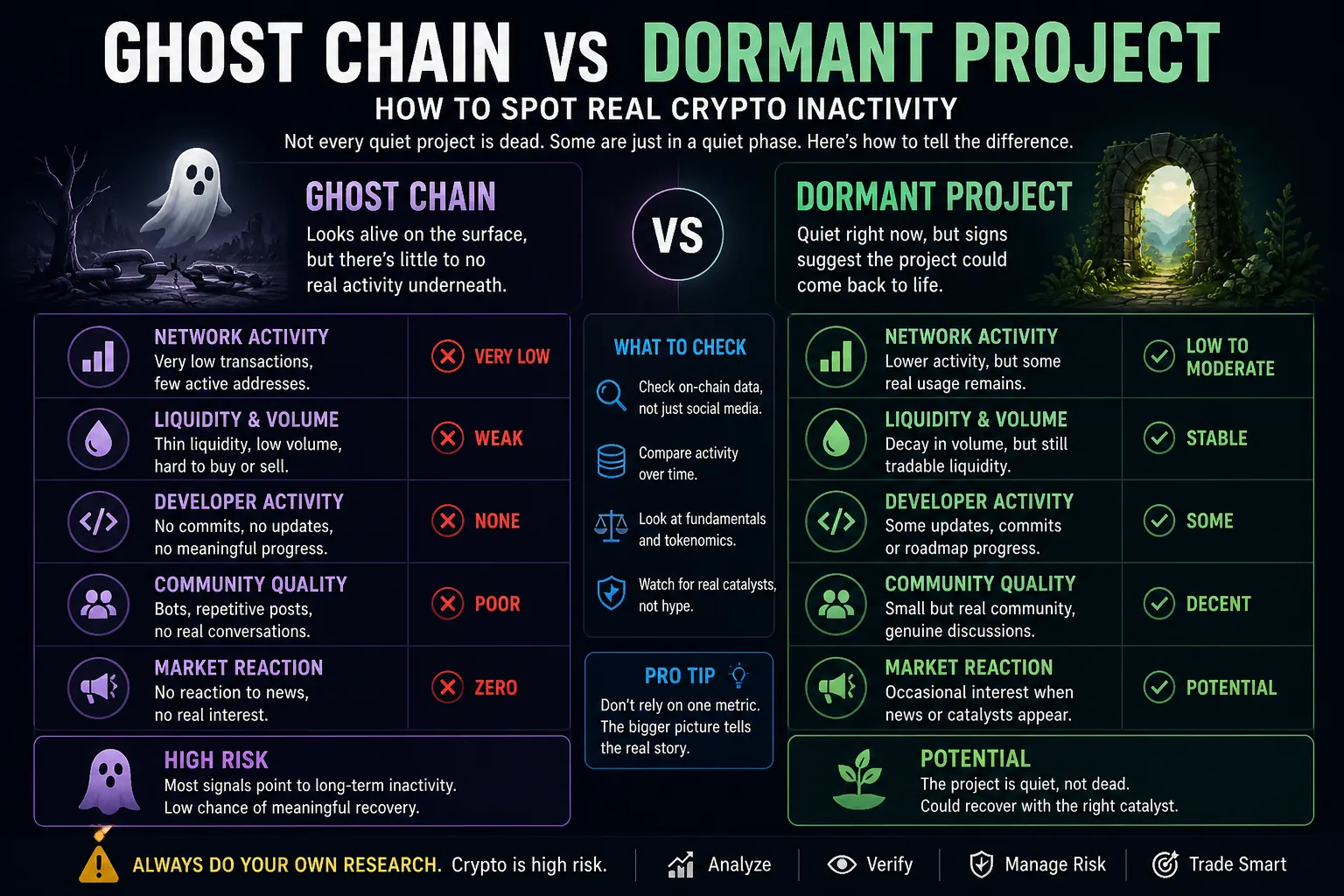
A dormant project may have low current activity, but there are still reasons to believe activity can return. A ghost chain shows deeper inactivity across multiple areas: users, developers, liquidity, applications and market demand.
One weak metric is not enough to call a project dead. The risk increases when many signals point in the same direction.
Signal 1: Network Activity
A healthy network should show some level of consistent activity. This may include transactions, smart contract interactions, active wallets and application usage.
A dormant project may show lower activity than before, but still have real usage. A ghost chain often shows activity that is extremely low, irregular or mostly artificial.
Traders should be careful with headline numbers. High transaction counts can be misleading if they come from low value activity, bots or internal transfers.
Signal 2: Liquidity and Trading Behavior
Liquidity is one of the clearest market signals. If a project has weak liquidity across its main trading pairs, it may be difficult for buyers and sellers to enter or exit without moving the price.
A dormant project can have low volume but still maintain reasonable liquidity. A ghost chain may show both low volume and fragile liquidity, making the token vulnerable to sharp moves.
Using DEXTools to review token pairs, liquidity and trading activity can help traders see whether there is still real market participation.
Signal 3: Developer and Ecosystem Activity
A dormant project may still have developers building, even if the market is not paying attention. A ghost chain often lacks meaningful ecosystem growth.
Questions to ask include: Are new applications launching? Are existing applications used? Are developers still active? Are upgrades happening? Is there a reason for users to return?
Without ecosystem activity, a network token can become purely speculative.
Signal 4: Community Quality
A project with a quiet but informed community may be dormant. A project with repetitive hype, little discussion and no real product usage may be closer to a ghost chain.
Community size alone is not enough. Traders should focus on quality: Are people discussing products, governance, integrations and usage, or only price?
Signal 5: Market Reaction to News
One useful test is how the market reacts to positive announcements. If a project releases news and the market barely responds, it may suggest that traders have lost interest.
A dormant project can still attract attention when a real catalyst appears. A ghost chain may struggle to generate demand even during promotional periods.
Ghost chains and dormant projects can look similar, but they are not the same. A dormant project may be overlooked. A ghost chain may be structurally weak.
The best approach is to compare multiple signals: network activity, liquidity, trading volume, developer activity, community quality and market reaction. When all of these are weak, the risk is much higher.
For traders using DEXTools, the goal is not only to find tokens that move. The goal is to understand whether market activity reflects real demand or only leftover speculation.
How to Bridge Crypto Between Chains: Complete Cross-Chain Tutorial 2026 How to Use 1inch: Complete DEX Aggregator Swap Tutorial (2026) How to Use OKX Web3 Wallet: Multi-Chain DeFi Hub Guide (2026)Related Guides
- How to Bridge Crypto Between Chains: Complete Cross-Chain Tutorial 2026
- Spot Real Demand vs Frenzy With On-Chain Metrics
- The Attention Decay Curve: How to Know When a Trending Token Is Losing Power
- DEXTools for Project Teams: A Pre Launch Visibility Checklist for New Tokens
- Top 5 DePIN Projects in 2026: Decentralized Physical Infrastructure Leading the Way
Frequently Asked Questions
What is a ghost chain in crypto?
A ghost chain is a blockchain that still technically runs but has very little real usage, with few active users, transactions, or developers. It may look alive on the surface while having almost no genuine activity.
What is the difference between a ghost chain and a dormant project?
A ghost chain usually refers to an entire network with faded activity, while a dormant project is a specific token or application that has gone quiet. Both can show decay, but they describe different scopes of inactivity.
How do you spot a dead or decaying crypto project?
Look for fading on-chain activity, shrinking liquidity, stalled development, and silent communication channels over time. Misleading signs of life, such as artificial volume, can mask underlying decay, so it helps to cross-check several signals.
Why does spotting crypto inactivity matter?
Trading or holding assets on a network or project with no real activity can mean thin liquidity and difficulty exiting positions. Recognizing decay early helps you avoid getting stuck in markets that may keep declining.