RFQ vs AMM: Better Crypto Trade Execution?
— By Whatsertrade in Tutorials

RFQ vs AMM execution compared: learn when each model gives better quotes, lower slippage, and stronger execution quality for your crypto trades.
This guide compares RFQ vs AMM from an execution-quality angle. It is about routing and slippage, not about order-book exchanges in general.
Key Takeaways
- What Is an AMM Swap?
- What Is an RFQ Swap?
- RFQ vs AMM Swaps: The Key Difference
- Why Execution Quality Matters
- Which Model Is Better for Large Trades?
- When AMM Swaps Work Best
Execution quality matters in crypto trading. A trader may choose the right token and the right market direction, but still receive a poor result if the trade is executed through the wrong liquidity model.
Two important models are RFQ swaps and AMM swaps.
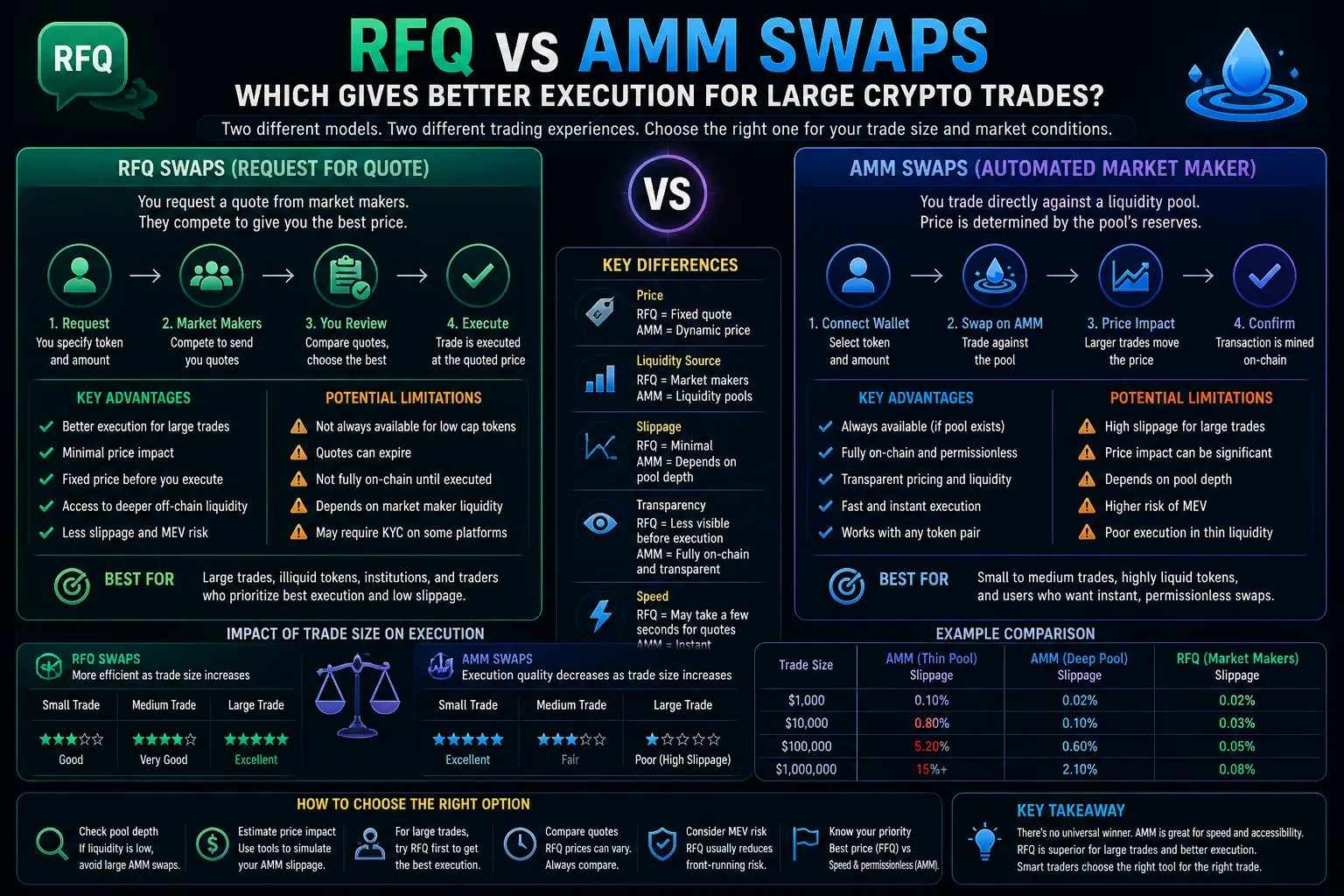
AMMs are common across DeFi and allow users to trade against liquidity pools. RFQ systems allow users to request quotes from market makers or liquidity providers before executing a trade.
Both models can work well, but they are not equal in every situation. For large crypto trades, the difference can be significant.
Understanding RFQ vs AMM swaps can help traders reduce slippage, improve execution and avoid unnecessary price impact.
What Is an AMM Swap?
An AMM swap uses an automated market maker. Instead of matching buyers and sellers through an order book, the trade happens against a liquidity pool.
The pool holds two or more assets. The price changes depending on the size of the trade and the balance of assets in the pool.
AMMs are popular because they make tokens easy to trade, especially in DeFi. A token can become tradable as long as there is a pool with liquidity.
The main advantage is accessibility. The main risk is price impact when liquidity is thin.
What Is an RFQ Swap?
RFQ stands for request for quote.
In an RFQ swap, a trader requests a price for a specific trade size. Market makers or liquidity providers respond with quotes. The trader can accept a quote if the price is attractive.
RFQ systems can be useful for larger orders because they may offer more predictable execution.
Instead of pushing a large trade through a pool and moving the price, the trader receives a quoted price before confirming.
RFQ vs AMM Swaps: The Key Difference
The key difference is how price is determined.
In an AMM, price is calculated by the pool and changes as the trade interacts with liquidity.
In an RFQ system, price is quoted by a liquidity provider before the trade is executed.
This difference affects slippage, price impact, transparency and execution certainty.
Why Execution Quality Matters
Execution quality determines the actual price a trader receives.
A trader may see a token trading at one price, but the final execution can be worse if the trade is too large for available liquidity.
This difference can be costly. In volatile or illiquid markets, poor execution can reduce profits or increase losses.
For large crypto trades, execution can be just as important as timing.
Which Model Is Better for Large Trades?
RFQ can often be better for large trades when strong market makers are available.
A large order through an AMM can create high price impact if the pool is not deep enough. With RFQ, the trader may receive a firm quote that reflects available liquidity outside the visible pool.
This can reduce uncertainty and improve execution.
However, RFQ is not always better. Quote quality depends on liquidity providers, asset availability and competition between market makers.
When AMM Swaps Work Best
AMM swaps work well when the trade size is small or medium, the liquidity pool is deep and the token is actively traded.
AMMs are also useful when traders want open, direct on chain execution.
They are especially important for long tail DeFi tokens that may not have strong market maker coverage.
If a token only trades through AMM pools, traders need to analyze pool depth carefully before entering.
When RFQ Swaps Work Best
RFQ swaps can work well when the trade size is large, AMM price impact would be high and the asset has professional liquidity support.
RFQ can also be useful when the trader wants more certainty before execution.
For large orders, even a small improvement in price can make a significant difference.
Slippage in AMM Swaps
Slippage is one of the biggest risks in AMM trading.
If a pool is not deep enough, a large order can move the price during execution. The larger the order relative to the pool, the greater the price impact.
Traders can set slippage limits, but tight limits may cause failed transactions. Loose limits may result in worse execution.
This makes AMM trading highly sensitive to liquidity depth.
Slippage in RFQ Swaps
RFQ swaps can reduce slippage because the trader receives a quote before execution.
However, quotes can expire. If markets move quickly, a quote may become unavailable or less attractive.
RFQ can improve certainty, but it does not remove market risk.
The quality of an RFQ system depends on the quality of its liquidity providers.
Transparency vs Efficiency
AMMs are highly transparent. Traders can inspect pools, liquidity, volume and price impact. This makes AMMs useful for public DeFi markets.
RFQ can be more efficient for large trades, but some liquidity may be less visible before the quote process.
The choice depends on whether the trader values public pool transparency or execution efficiency.
Common Mistakes Traders Make
One common mistake is using an AMM for a large order without checking price impact.
Another mistake is assuming RFQ always gives the best price. If market maker competition is weak, the quote may not be attractive.
Traders should compare routes, liquidity depth and expected execution before confirming a trade.
How DEXTools Helps AMM Traders
DEXTools is especially useful for analyzing AMM based markets. Traders can review liquidity, price charts, transaction history and pair activity before entering a trade.
This helps users estimate whether a pool can support their order size or whether price impact may be too high.
Before placing a large trade, traders should study liquidity depth and recent transaction behavior.
RFQ and AMM swaps serve different trading needs.
AMMs are open, accessible and ideal for many DeFi tokens. RFQ swaps can offer better execution for larger trades when quality market makers are available.
For traders, the best choice depends on order size, liquidity depth and execution goals.
A small trade may work perfectly through an AMM. A large trade may need RFQ style execution to avoid unnecessary price impact.
In crypto trading, how you execute can matter as much as what you trade.
How to Bridge Crypto Between Chains: Complete Cross-Chain Tutorial 2026 How to Use 1inch: Complete DEX Aggregator Swap Tutorial (2026) How to Use OKX Web3 Wallet: Multi-Chain DeFi Hub Guide (2026)Related Guides
- AMM vs Order Book DEXs: Crypto Trade Dynamics
- How to Trade on Raydium: Solana Swaps, Entries and Execution Guide (2026)
- Appchains vs Rollups: Which Gives Projects Control?
- What Is Uniswap V4 (Hooks): Complete Customizable AMM Guide (2026)
- What Is Uniswap? AMM, Liquidity Pools, Fees and UNI Token Explained (2026)
Frequently Asked Questions
What is the difference between RFQ and AMM execution?
An AMM (automated market maker) executes trades against a liquidity pool using a pricing formula, while RFQ (request for quote) lets you get a price directly from market makers. AMMs are always available on-chain, whereas RFQ relies on quotes from counterparties.
When does RFQ give better execution than an AMM?
RFQ can offer better pricing and lower slippage on larger trades because a market maker quotes a firm price rather than moving along a pool curve. This advantage is most noticeable when AMM liquidity is thin relative to your order size.
What are the advantages of AMM execution?
AMMs are permissionless, always on, and do not depend on a counterparty being willing to quote, which makes them reliable for many tokens. They work well for smaller trades in pools with sufficient liquidity.
How do I choose between RFQ and AMM for a trade?
Consider your trade size, the available liquidity, and the slippage you would face, since larger trades often favor RFQ while smaller ones may be fine on an AMM. Comparing the effective price from each method for your specific trade is the most reliable approach.