Jupiter on Solana: Routing Engine, JLP and JUP Token Explained (2026)

A technical explainer on Jupiter routing, liquidity aggregation, JLP yield design, and the role of JUP across the Solana trading stack.
Intent check: This page is the protocol deep dive into Jupiter routing, JLP, and JUP. If you want the product walkthrough for swaps, limit orders, DCA, and perp execution, read How to Use Jupiter DEX on Solana: Complete Swap, Limit Order and DCA Tutorial (2026).
The Layered Core: Navigating Solana's Unified Liquidity Engine
- High-performance blockchains like Solana require specialized routing architectures to combat fragmented capital markets. On networks like Solana, where low transaction fees and fast execution block times permit thousands of micro-liquidity pools to operate simultaneously, retail traders encounter severe execution friction. Executing large trades across isolated decentralized exchanges (DEXs) often triggers severe price slippage, degrading capital efficiency. Jupiter Exchange solves this fundamental structural bottleneck.
- Launched in late 2021 and maturing into the dominant financial coordination layer of the Solana ecosystem by 2026, Jupiter has evolved from a simple swap routing script into a comprehensive "DeFi superapp." Processing a significant portion of all organic on-chain transaction volume, the protocol provides an open marketplace for token aggregation, advanced perpetual derivatives, automated capital deployment, and launchpad governance. This guide breaks down Jupiter's underlying smart order routing, the mechanics of its real-yield liquidity framework, and the utility of the JUP token.
1. Smart Order Routing: High-Frequency Aggregation Mechanics
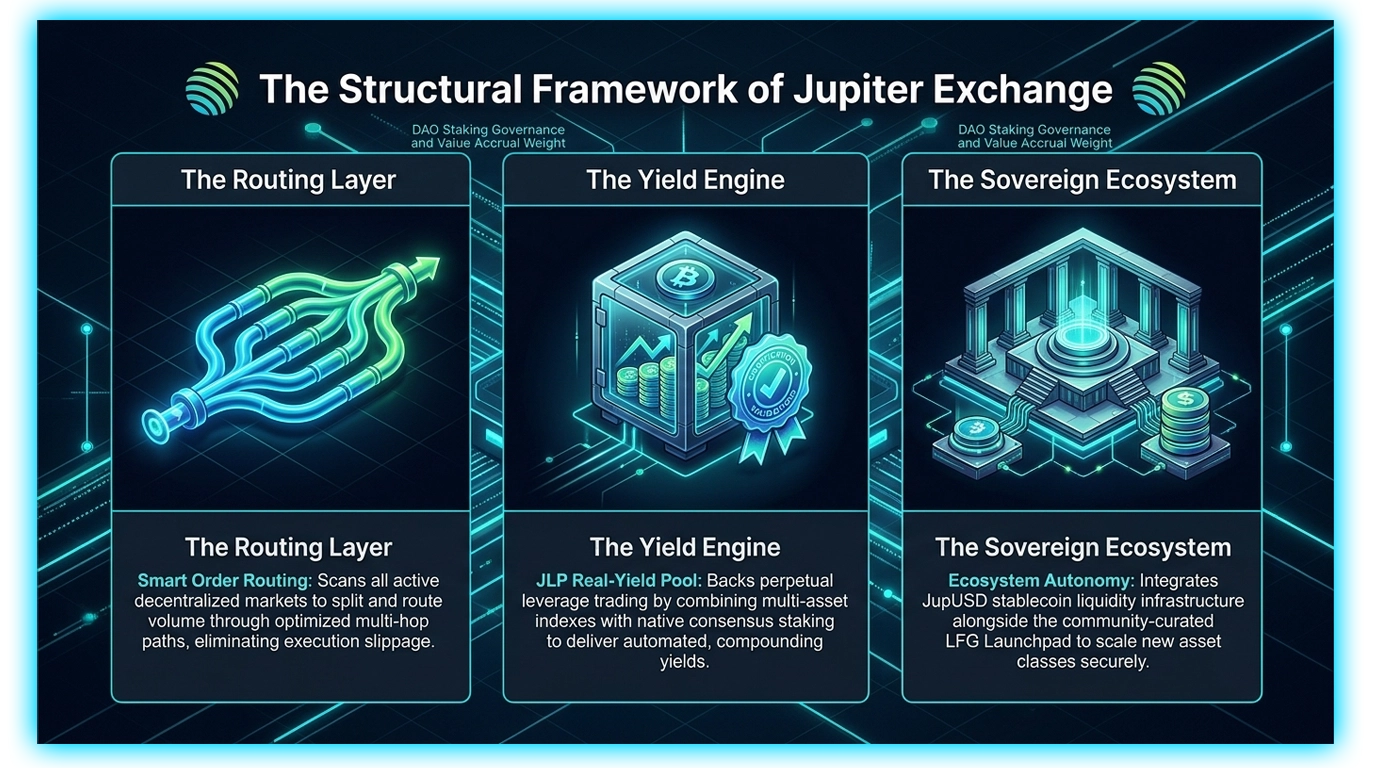
Jupiter does not operate a standalone monolithic liquidity reserve for its spot exchange. Instead, it functions as an intelligent infrastructural overlay that queries every active liquidity venue on the host network (including Raydium, Orca, Meteora, and Lifinity) to reconstruct optimized settlement paths.
Multi-Hop Routing and Path Splitting
- When a market participant requests a high-volume token swap, Jupiter's algorithm splits the transaction into smaller fractional components. Instead of routing the entire trade through a single pool, it executes simultaneous parallel transactions across distinct execution paths.
- For example, a large trade could have 60% of its volume routed directly through a premier stablecoin pool, while the remaining 40% is programmatically directed through an alternative multi-hop route to minimize price impact.
The Dual Execution Environment
The interface splits its processing capabilities into two separate user modalities tailored to distinct trading styles:
Ultra Mode: An automated execution module designed for retail efficiency. It calculates priority fees, manages slippage tolerance windows, and dynamic transaction routing internally. The system charges a nominal fee ranging from 0% to 0.1%, which is typically offset by the price optimizations achieved through the multi-hop framework.
Manual Mode: Engineered for advanced institutional or algorithmic traders. It grants absolute control over maximal extractable value (MEV) protection shields, single-pool lockouts, direct protocol exclusions, and custom slippage thresholds, operating at a zero platform-fee baseline.
2. Jupiter Perpetuals and the JLP Real-Yield Architecture
Beyond spot aggregation, Jupiter operates an advanced on-chain derivatives marketplace supporting leveraged perpetual futures contracts. Traders can open up to 100x leverage on major macro digital assets like SOL, Bitcoin, and Ethereum, backed entirely by a decentralized liquidity repository.
The Jupiter Liquidity Provider (JLP) Pool
The counterparty infrastructure backing all leveraged positions is the JLP Pool. This multi-asset index contains strict weight ratios of premium collateral assets, typically balanced between Solana (SOL), ETH, WBTC, USDC, and USDT. When leverage traders open long or short positions, they lease liquidity directly from the JLP vault, paying variable borrowing fees and hourly funding premiums.
The Real-Yield Capital Loop
The JLP token functions as a prominent real-yield asset within contemporary decentralized finance. The protocol directs 75% of all revenues generated from perpetual trading fees, liquidation events, and borrowing interest directly back into the JLP pool value.
The value accrual mechanism is advanced through two key architectural integrations implemented in recent product iterations:
Native Consensus Staking: The protocol automatically routes the Solana (SOL) portion of the JLP index into native liquid staking networks. This introduces a passive consensus yield layer of roughly 7% on top of the trading fees collected by the pool, accelerating capital compounding for depositors.
Collateral Efficiency Optimization: Vault parameters allow JLP token holders to utilize their yield-bearing tokens as borrowing collateral. Participants can draw up to an 80% Loan-to-Value (LTV) credit line in stablecoins against their active JLP positions, unlocking liquidity without forcing a sell event on their yield positions.
3. Ecosystem Expansion: JupUSD and the LFG Launchpad
Jupiter's expansion framework aims to establish full-stack financial autonomy, achieved through structural stablecoin integrations and token issuance infrastructure.
The JupUSD Stablecoin Framework
To decrease platform reliance on third-party centralized issuers, Jupiter deployed JupUSD, its native ecosystem stablecoin. Developed using robust smart contract infrastructure in collaboration with prominent real-world asset (RWA) partners, JupUSD is backed by highly liquid reserves, including blackrock-affiliated institutional funds and yield-bearing stable balances. This coin acts as a primary, non-custodial capital rail embedded across Jupiter's lending venues, perpetual contracts, and margin settlement accounts.
The LFG Launchpad Protocol
The LFG (Let's Find Growth) Launchpad represents the primary capital generation framework for emerging infrastructure projects on Solana. Rather than allowing centralized market makers to dictate initial token allocations, the LFG engine utilizes an automated customized price-curve auction model:
DAO Curation: Prospective launch projects must present technical whitepapers and economic distribution schedules directly to the Jupiter DAO.
Democratic Voting: JUP token holders stake their assets to vote on which projects receive launch prioritization.
Slippage-Protected Price Discovery: Approved launches deploy liquidity through specialized vaults designed to absorb sudden launchpad volume without triggering market manipulation gaps or order front-running.
4. The JUP Token and Tokenomics Governance
The native JUP token is engineered to align long-term platform growth with decentralized community oversight. Boasting a fixed total supply cap of 10 billion tokens, the asset functions as the primary economic engine of the Jupiter DAO.
The Staking and Voting Loop
JUP utility is structurally tied to active platform participation. Users lock their JUP tokens within governance contracts to receive individualized voting weight.
This governance loop directly influences the platform's financial mechanics, as stakers vote on project launch selections, determine the distribution parameters of future community airdrop rounds, and control the allocation vectors of the multi-million-dollar DAO ecosystem treasury.
Technical Design Matrix: Jupiter Product Suite Architecture
| Product Module | Primary Underlaying Mechanism | Target Audience Profile | Fee & Risk Configuration |
| Spot Aggregator | Smart Path Splitting & Multi-Hop Routing | Universal Swappers & Retail Traders | 0% - 0.1% Platform Fee; Minimal Slippage |
| Perpetuals Market | Multi-Asset JLP Collateral Index | Leveraged Traders & Speculators | Variable Borrowing Interest & Funding Rates |
| JLP Liquidity Pool | Integrated Staking Fees & Real-Yield Accrual | Passive Yield Farmers & LPs | Absolute Exposure to Trader Profit/Loss |
| LFG Launchpad | Elastic Launch Auction Curves | Early-Stage Project Backers & DAO Voters | Volatile Price Discovery Profiles |
5. Universal On-Chain Forensics and Trading Telemetry via DEXTools
- Navigating decentralized markets requires specialized external telemetry to audit live order flows, track volume velocity, and identify macro market shifts. Advanced analytical platforms like DEXTools serve as an essential universal environment for modern digital asset traders.
- By utilizing core features like the Pair Explorer, market participants can inspect real-time chart data, check automated smart contract safety scores, and evaluate liquidity depth across an array of independent token deployments.
- The Big Swap Explorer provides complete clarity into high-volume block transactions, allowing users to separate organic retail market momentum from coordinated institutional wallet maneuvers.
- Additionally, tools like the Live New Pairs dashboard offer instant visibility into newly initialized liquidity pools the exact moment they are deployed on-chain, giving traders the raw telemetry required to run comprehensive due diligence and manage portfolio exposure before executing any decentralized transaction.
Disclaimer: This article is for informational purposes only and does not constitute investment advice, financial advice, trading advice, or any other kind of advice. DEXTools does not recommend buying, selling, or holding any cryptocurrency or token. Users should conduct their own research and consult with a qualified financial advisor before making any investment decisions. Cryptocurrency investments are volatile and high-risk. DEXTools is not responsible for any losses incurred.
Related Guides
- What Is a DEX Aggregator: Complete Guide to 1inch, Jupiter and ParaSwap (2026)
- How to Use Jupiter DEX on Solana: Complete Swap, Limit Order and DCA Tutorial (2026)
- What Is a Swap Router in Crypto? DEX Routing Explained
- Uniswap vs Jupiter vs PancakeSwap: Best DEX Comparison 2026
- What Is Jupiter Perps? Solana Perpetuals Guide 2026
- What Is Griffain? Solana's No
Frequently Asked Questions
What is a DEX aggregator?
A DEX aggregator searches across multiple decentralized exchanges and liquidity sources to find an efficient route for a trade. This can help users get a better effective price than using a single venue.
How does Jupiter routing work?
Jupiter splits and routes a swap across various liquidity pools on Solana to find a favorable execution path. The goal is to minimize price impact and give the trader a better overall result.
What is the JUP token used for?
JUP is the governance token associated with the Jupiter ecosystem, used for participating in decisions about the protocol. Its specific roles can evolve as the project's governance develops.
What does JLP represent?
JLP refers to a liquidity provider position tied to Jupiter's products, where holders supply assets and can earn a share of fees. As with any liquidity provision, it carries exposure to the underlying assets and market risk.