What Is Matcha? The 0x-Powered DEX Aggregator Explained (2026 Guide)
— By Tony Rabbit in Tutorials
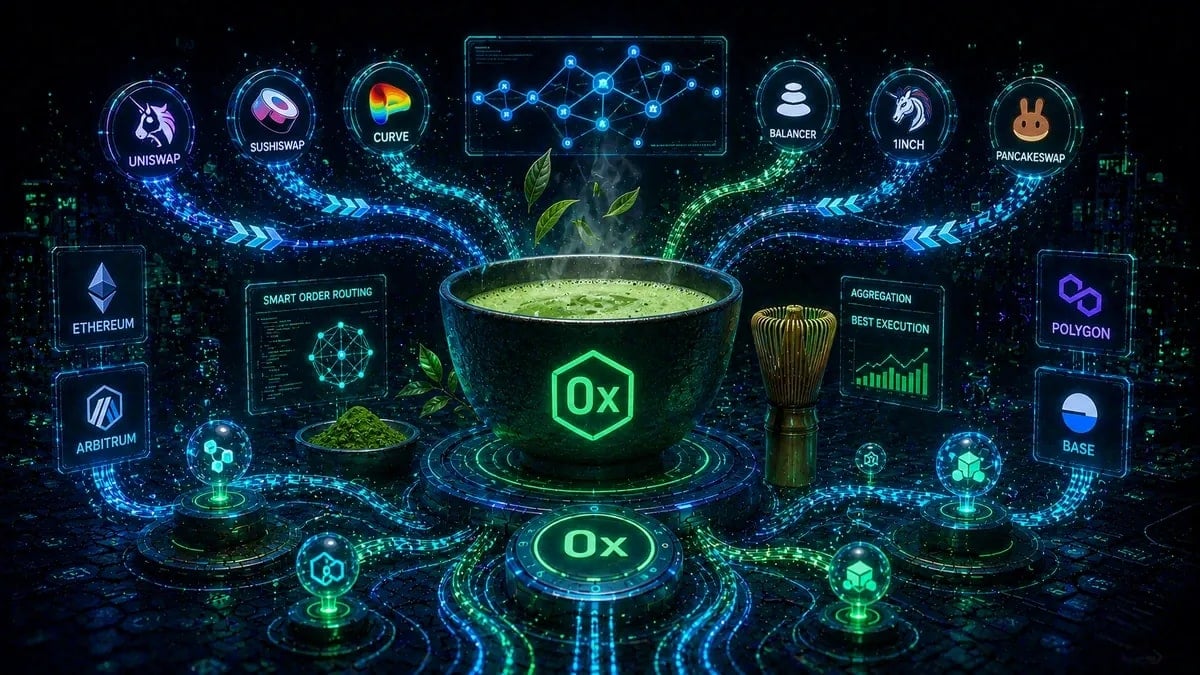
Complete 2026 guide to Matcha, the DEX aggregator built by 0x Labs that routes swaps across 9M plus tokens on 100 plus exchanges spread over 16 chains. Smart order routing, Matcha Auto mode with MEV protection and 2x next block inclusion, gas free limit orders, ZRX governance, and full comparison vs 1inch, CoW Swap and Paraswap.
What Is Matcha? The 0x-Powered DEX Aggregator Explained in 2026
Every DeFi user has lived the same uncomfortable moment. You open a decentralized exchange, type the amount you want to swap, see a price that looks fine, click confirm, and discover after the fact that you could have gotten a noticeably better rate on a different venue, a different route, or with a slightly different transaction shape. The liquidity for any given token pair is fragmented across dozens of pools on dozens of chains, and no single trader can manually compare all of them in the seconds before submitting a trade. Matcha exists to solve that exact problem.
Matcha is the consumer facing DEX aggregator built by 0x Labs, the team behind the 0x Protocol that has been routing trades across Ethereum decentralized exchanges since 2017. Where rivals like 1inch and Paraswap built their own routing engines, Matcha sits on top of the production grade 0x infrastructure that already powers swap features inside MetaMask, Coinbase Wallet, Phantom, Robinhood Wallet, Zerion and dozens of other consumer apps. When you swap on Matcha, you are tapping the same routing brain that handles billions of dollars of order flow across the broader 0x ecosystem.
This 2026 guide walks through Matcha in full: how the aggregator splits trades across more than nine million tokens on sixteen chains, why the rebuilt Matcha Auto mode is changing how power users execute swaps, how MEV protection actually works under the hood, where Matcha sits relative to 1inch, CoW Swap and Paraswap, and what the ZRX governance token does in the post V2 architecture.
Featured snippet: Matcha is a non custodial DEX aggregator developed by 0x Labs that routes swaps across more than nine million tokens spread over one hundred plus decentralized exchanges on sixteen blockchains. It uses smart order routing to split a single trade across multiple liquidity sources for the best possible price, offers an Auto mode with MEV protection and roughly two times higher next block inclusion odds, supports gas free limit orders, and is governed by the ZRX token. Matcha competes with 1inch, CoW Swap and Paraswap, and powers swap functionality inside MetaMask, Coinbase Wallet, Phantom and many other consumer wallets through the underlying 0x API.
What Is Matcha Exactly?
Matcha is the retail trading interface for the 0x protocol stack. The product itself is a clean web app at matcha.xyz that lets a user connect a wallet, pick two tokens, and execute a swap with no custodial intermediary in between. Behind the simple interface is one of the most sophisticated routing engines in DeFi, capable of breaking a single user order into multiple parallel sub trades that hit different pools simultaneously to extract the best aggregate execution price.
The aggregator is non custodial in the strictest sense. Matcha never holds user funds. The smart contracts that execute swaps are deployed by 0x Labs and have been audited and battle tested across many years of production volume. When you sign a Matcha swap, you authorize a one shot interaction with the 0x exchange proxy contract, which routes through whichever combination of venues the router has selected. The token movements settle atomically inside a single transaction, so either you get the quoted output or the entire transaction reverts.
What separates Matcha from a typical single venue DeFi exchange is the breadth of liquidity it can access. A trader using only Uniswap can only access Uniswap pools. A trader on Matcha taps the entire union of liquidity across Uniswap V2 and V3, SushiSwap, Balancer, Curve, PancakeSwap, KyberSwap, Maverick, Aerodrome, Velodrome, BaseSwap, Camelot, professional market makers and RFQ liquidity in one transaction. That breadth is what lets Matcha consistently find prices that beat any individual DEX in isolation.
Who Built Matcha? The 0x Labs Story
To understand Matcha you need to understand 0x. 0x Labs was founded in 2017 by Will Warren and Amir Bandeali with the explicit goal of building open infrastructure for token trading on Ethereum. The original 0x protocol was a system for off chain order books with on chain settlement, allowing relayers to host order matching cheaply while still settling trades through trustless smart contracts. Over time the team realized that the most valuable application of that infrastructure was not a single exchange but a meta layer that could aggregate liquidity from every venue at once.
Matcha launched in 2020 as a flagship demonstration of the 0x API, the developer facing product that aggregates DEX liquidity and returns optimal swap quotes. The bet was that if 0x Labs could prove the API was the best routing engine in DeFi by building a great consumer product on top of it, wallets and dApps would license the same backend for their own swap features. That bet paid off. By 2026, the 0x API powers swap functionality inside Coinbase Wallet, MetaMask Swaps, Phantom, Robinhood Wallet, Zerion, Zapper, Trust Wallet, Polygon Portal, Shapeshift and many more, while Matcha itself continues to grow as a destination for traders who want the cleanest possible standalone interface.
0x Labs has raised over one hundred million dollars from investors including Greylock Partners, Pantera Capital, Polychain Capital, Coinbase Ventures, Jared Leto and Reid Hoffman. The company is one of the longest tenured infrastructure teams in DeFi, with a unique vantage point on cross venue order flow.
Matcha Timeline: From 0x API to Auto Mode
2017: Will Warren and Amir Bandeali found 0x Labs. The original 0x protocol launches with off chain order books and on chain settlement, becoming early infrastructure for token trading on Ethereum.
2018: The ZRX governance token launches. Early relayers like Radar Relay, Paradex and ERC dEX build the first wave of decentralized exchanges on top of the protocol.
2019: 0x v3 introduces the exchange proxy architecture that becomes the foundation for cross venue aggregation. The team begins building the 0x API to expose aggregated DEX liquidity to wallets and applications.
2020: Matcha launches as the consumer facing front end for the 0x API, offering aggregated swaps across Ethereum DEXes in a clean web interface. Limit orders ship shortly after launch.
2021: Matcha expands beyond Ethereum to Polygon, Binance Smart Chain, Avalanche, Fantom, Optimism and Arbitrum. The 0x API begins to dominate the wallet swap integration market.
2022: 0x raises a seventy million dollar Series B led by Greylock to scale the API across more chains and asset classes. Matcha integrates RFQ liquidity from professional market makers alongside on chain pool liquidity.
2023: Matcha V2 launches with a redesigned interface, expanded chain support, integrated portfolio view, and significantly faster quote generation. The Auto mode begins development under the codename project that becomes the MEV protected execution layer.
2024: 0x acquires the Phantom swap integration and deepens partnerships with Coinbase Wallet and MetaMask. Matcha rolls out support for sixteen chains in production.
2025: Matcha Auto launches publicly with MEV aware execution, roughly two times higher next block inclusion probability and integrated sandwich protection. Gas free limit orders become a standard feature across all supported networks.
2026: Matcha is now one of the top three DEX aggregators by volume, indexing more than nine million tokens across one hundred plus exchanges on sixteen chains, and serves as the public benchmark for the 0x API that powers swap functionality across most major consumer wallets.

Inside the Matcha Routing Engine
The heart of Matcha is the smart order routing system. When you request a quote, the 0x API does not pick a single pool and execute against it. Instead, the router builds a graph of every relevant liquidity venue across the destination chain, calculates execution prices for many different split combinations, and returns the route that minimizes the total cost including gas, price impact and aggregator fees.
The result is typically a multi hop, multi venue swap impossible to construct manually. For a mid sized ERC 20 to ERC 20 trade, Matcha might route thirty percent through Uniswap V3, twenty percent through a Curve stable pool, fifteen percent through a private RFQ market maker quoting a tighter spread for that size, and the remaining thirty five percent across SushiSwap and Balancer pools that each supply marginal liquidity. The entire combined route settles atomically through the 0x exchange proxy contract.
This is the same problem that AMMs like Uniswap solve at the pool level, scaled up to the aggregator level. Each pool has its own price impact curve. The router solves an optimization problem in real time: how should the order be split so that the marginal execution price across all venues is equal at the moment the trade settles. Because every additional unit of liquidity comes from the cheapest remaining source, the aggregated execution is provably better than any single venue route. The math behind it has been refined inside 0x Labs for years, and it is one of the reasons Matcha consistently ranks at or near the top of cross aggregator price comparisons.
Critically, the router accounts for gas. A theoretically better route requiring ten on chain interactions might cost more in total than a slightly worse route needing only three. The 0x API simulates gas costs in real time and folds them into the optimization, so the output shown in the Matcha quote panel is the actual amount you will receive after gas and fees.
Matcha Auto vs Standard Mode
One of the biggest changes in the Matcha experience over the past year is the split between Auto mode and Standard mode. They look almost identical at a glance, but the execution logic underneath is meaningfully different.
Standard mode is the familiar DEX aggregator experience. You set the slippage tolerance, the gas price tier, and any custom routing preferences manually. The transaction goes to the public mempool like any other Ethereum transaction. You get full control, you see every parameter, and you accept the standard tradeoffs that come with submitting a transaction publicly. For traders who want to manage their own execution or who need specific behaviors, this is the right mode.
Auto mode is the new default for most users. Matcha Auto routes the transaction through a private order flow channel and a network of professional searchers and builders. The result is roughly two times higher next block inclusion probability compared to a standard public mempool submission, automatic sandwich protection, and execution prices that match or beat what you would have gotten in Standard mode. The trade is sent to specialized infrastructure rather than the public mempool, which means it cannot be front run, back run, or sandwiched by predatory MEV bots.
The catch with Auto is that it is not always available for every token pair on every chain. Long tail pairs sometimes lack the private liquidity needed to execute through the Auto channel, and in those cases Matcha will recommend reverting to Standard. But for the major pairs that account for most retail volume, Auto is now the recommended default and the experience is notably cleaner than the historical DeFi norm.
MEV Protection: What It Actually Means
MEV, or maximal extractable value, refers to the profit that block builders, searchers and validators can extract by reordering, inserting or censoring transactions inside a block. In a normal DeFi swap, your transaction sits in the public mempool while it waits to be included. Searchers scan that mempool, and when they spot a swap large enough to move a pool's price, they can construct a sandwich: a front running buy that pushes the price up, your swap that executes at the worse price, and a back running sell that captures the difference. Over a year of swapping, sandwich attacks can quietly eat hundreds of dollars from an active trader who never realized what was happening.
Matcha Auto defends against this by changing where the transaction travels before it lands on chain. Instead of broadcasting to the public mempool, the transaction is signed by the user and sent to a private order flow auction. Block builders bid to include the transaction, and the winning builder is contractually obligated not to extract value at the user's expense. The builder still earns fees through legitimate channels, but cannot run sandwich attacks because the transaction was never visible until it was already in a block.
This is conceptually similar to what KyberSwap and CoW Swap offer through different mechanisms, and to what Flashbots Protect provides directly to wallet users. Matcha integrates the protection at the aggregator level so users get it by default without having to configure custom RPC endpoints or understand the underlying market structure. The combination of private order flow plus the multi venue routing is what gives Matcha Auto its quoted advantage in next block inclusion odds.
It is important to understand what MEV protection does not do. It does not eliminate slippage entirely. Pool prices still move while your transaction is in flight, so a sensible slippage tolerance is still required. What it does eliminate is the predatory subset of slippage caused by adversarial transaction ordering.

Limit Orders: Gas Free and Slippage Free
Beyond instant swaps, Matcha supports a robust limit order system that is one of the most usable in DeFi. A limit order lets you set the exact price at which you want to buy or sell a token, and the order will only execute if and when the market reaches that price. On a centralized exchange this is routine. On a decentralized exchange it requires careful engineering, because the order has to sit somewhere off chain while it waits for execution.
Matcha solves this through the 0x off chain order book. When you create a limit order, you sign a message that authorizes a future swap at the price you specified. The signature is stored off chain by the 0x relayer infrastructure. You do not pay any gas to create or cancel the order, because nothing has touched the blockchain yet. When the market price reaches your trigger, a professional taker network broadcasts the order on chain and pays the gas to fill it. You receive exactly the amount of output token you signed for, with zero slippage by construction.
This design has several practical advantages. Limit orders cost nothing to place or cancel, letting traders ladder dozens of orders without worrying about gas burn. There is no slippage on execution because the order is filled at exactly the price you signed. And because the orders are signed in the user's wallet and remain non custodial throughout, you can revoke them at any time.
Limit orders work especially well alongside Matcha's broad chain support. Traders who use limit orders heavily often pair them with on chain analytics on DEXTools to identify the levels they want to ladder around.
Chain Support: Where Matcha Routes Liquidity
Matcha is multichain in a way that few aggregators truly are. The current production list spans sixteen chains as of 2026, including Ethereum mainnet, Polygon, BNB Smart Chain, Avalanche, Fantom, Optimism, Arbitrum, Base, Linea, Scroll, Mantle, zkSync Era, Blast, Mode, Celo and Polygon zkEVM. Each chain has its own routing graph built from the local DEX ecosystem, so a swap on Base routes through Aerodrome, Uniswap V3 on Base, BaseSwap and the local RFQ providers, while a swap on Arbitrum routes through Camelot, Uniswap V3 on Arbitrum, Curve and the Arbitrum specific market makers.
The chain selection is deliberately weighted toward EVM networks where the 0x exchange proxy contract has been deployed and audited. There is no native Solana, Bitcoin, Cosmos or Move chain support. Matcha's competitive advantage is in the EVM world, where the aggregator leverages its mature routing infrastructure across many chains at once.
Importantly, Matcha is not a cross chain bridge. Each swap happens within a single chain. To move from Ethereum to Base you still need a bridge like Across, Stargate or the canonical Base bridge. This single chain per transaction design keeps the security model simple and atomic.
Matcha vs 1inch vs CoW Swap vs Paraswap
The DEX aggregator space has matured into a four way competition between products with meaningfully different design philosophies. Understanding where Matcha sits requires comparing it directly to its three main rivals.
Matcha vs 1inch: 1inch is the volume leader in the aggregator space and controls roughly thirty one percent of the Ethereum DEX aggregator market by share. Its Pathfinder routing algorithm is well regarded, and the 1inch Fusion product offers Dutch auction style execution with MEV protection that is conceptually similar to Matcha Auto. 1inch has a stronger native token model, with the 1INCH token playing a more active role in protocol economics than ZRX does for Matcha. The choice between them often comes down to interface preference and specific token pair execution quality, since both aggregators access overlapping liquidity sources. For a typical retail trade, both will produce closely matched quotes. For larger trades, the better choice depends on which aggregator currently has the deeper RFQ market maker relationships for the specific size and pair.
Matcha vs CoW Swap: CoW Swap takes a fundamentally different approach. Rather than just routing across DEX liquidity, CoW Swap conducts batch auctions where matching orders within a batch are settled against each other at a uniform clearing price, eliminating slippage and MEV by construction for matched portions. The remaining unmatched portion routes through DEX liquidity like a traditional aggregator. CoW Swap controls roughly twenty two percent of the Ethereum aggregator market and is widely considered the best aggregator for large trades and stable pairs where coincidence of wants matching is likely. Matcha offers a more conventional aggregator UX with broader chain support and faster quote times, while CoW Swap optimizes for execution quality on Ethereum mainnet and a few L2s through its solver competition model.
Matcha vs Paraswap: Paraswap is the third major aggregator, known for its Augustus routing engine and its DELTA intent based product line. Paraswap's strengths are its routing efficiency on long tail tokens and its solid execution on Polygon and BNB Chain. Matcha generally has a cleaner consumer interface and tighter integration with major wallets through the 0x API, while Paraswap historically appeals to power users who want more visibility into routing parameters. The two aggregators are close enough in feature set that the practical difference comes down to interface preference and the specific pair being traded.
Matcha vs the rest: Beyond the big four, aggregators like KyberSwap, Odos, Bebop and OpenOcean each compete on specific dimensions. KyberSwap excels at meta aggregation, Odos at complex multi token routes, Bebop at institutional RFQ flow. Matcha's positioning is consistent: the cleanest consumer UX combined with the maturity of the underlying 0x infrastructure.

The ZRX Token: Governance Without Drama
ZRX is the governance token of the 0x ecosystem, and by extension of Matcha. The token launched in 2018 through one of the early ICOs and has played a central role in the 0x protocol upgrade process ever since. ZRX holders vote on protocol changes including new contract deployments, fee parameters, treasury allocations and ecosystem grant programs. Governance happens through the 0x Improvement Proposal system, a formal upgrade pathway modeled loosely on Ethereum's own EIP process.
The token economics are deliberately understated. Unlike many newer DeFi tokens that promise immediate yield through fee distribution or liquidity mining, ZRX has focused on long term protocol stewardship rather than aggressive emission. There is no built in fee switch routing protocol revenue to ZRX stakers as of 2026, though governance retains the authority to enable such a mechanism in the future.
For a typical Matcha user, ZRX is not required for any normal trading activity. You can swap, place limit orders and use every product feature without ever holding or interacting with the token. ZRX matters mainly to participants who want a voice in how the underlying protocol evolves.
Phantom Integration and the Wallet Ecosystem
One of the under appreciated facts about Matcha is how much of its real reach comes from being the engine inside other products rather than the product itself. The 0x API is the routing backend for swap features in DeFi wallets including Phantom on its EVM modes, Coinbase Wallet, MetaMask Swaps, Robinhood Wallet, Zerion, Zapper, Trust Wallet, Polygon Portal and Shapeshift, among others.
For Phantom specifically, when a user opens Phantom's EVM swap interface and trades a token on Ethereum, Polygon or Base, the route is computed by the same 0x engine that powers matcha.xyz. The user experience is wrapped in Phantom's branding, but the liquidity sourcing comes from 0x. This pattern recurs across the wallet ecosystem, meaning the practical question of using Matcha directly versus a wallet's built in swap is largely about interface preference rather than execution quality.
The 0x infrastructure powering all of these integrations has been hardened by years of production volume across many consumer surfaces. Bugs and edge cases get caught quickly because the same routing code is being hit from dozens of angles. Choosing Matcha or any 0x powered wallet swap is choosing a mature, well tested execution layer rather than experimental code.
Pros and Cons of Matcha in 2026
Pros
- More than nine million tokens indexed across 100 plus exchanges on 16 chains
- Smart order routing splits trades across multiple venues for best price
- Matcha Auto mode delivers MEV protection and 2x next block inclusion odds
- Gas free, slippage free limit orders that cost nothing to place or cancel
- Backed by mature 0x infrastructure that powers MetaMask, Coinbase Wallet and Phantom
- Clean, consumer grade interface with portfolio view integrated
- Non custodial throughout, funds never leave user control
- RFQ liquidity from professional market makers alongside on chain pools
- Atomic settlement: either you get the quoted output or the trade reverts
- Active governance through the ZRX token and 0x Improvement Proposals
Cons
- No native Solana, Bitcoin, Cosmos or Move chain support
- Smaller market share than 1inch on Ethereum aggregator volume
- Auto mode is not available for every long tail token pair
- Not a cross chain bridge, each swap is single chain only
- ZRX token has no direct fee distribution mechanism as of 2026
- Aggregator fees, while small, apply on top of network gas
- Smart contract risk inherent to any aggregator routing through third party DEXes
- Limit order fills depend on professional taker network being active
- Less visible routing customization than power user tools like Paraswap
- Dependence on 0x Labs continuing to operate the public infrastructure
How to Use Matcha Safely
The aggregator does excellent work on routing, but wallet level discipline still applies. Verify the URL before connecting a wallet. The legitimate Matcha domain is matcha.xyz, and phishing clones are a persistent problem across DeFi front ends. Bookmark the real site and avoid links from social media or search ads.
Before signing any swap, inspect the route in the quote details panel. Matcha shows you which DEXes will be hit and roughly what percentage of the trade will flow through each. Unusual routes that send a large portion of the trade through obscure pools should be reviewed carefully, especially for tokens you have never traded before. The aggregator's defaults are sound, but a manual sanity check costs nothing and catches the rare cases where a quoted route looks suboptimal.
Set slippage tolerance deliberately. For major pairs like ETH to USDC, a tolerance of 0.1 to 0.5 percent is usually safe in Auto mode. For long tail tokens or low liquidity pairs, tolerances of 1 to 3 percent may be necessary to get a fill, but anything above that should make you cautious about the underlying liquidity. Slippage settings that are too generous turn into a free option for adversarial counter parties, while settings that are too tight result in reverted transactions and wasted gas. The Matcha interface usually suggests a reasonable default based on the route, and that default is a good starting point.
Use scoped approvals where possible, only approving the exact amount you intend to trade. Reviewing your approvals periodically through tools like Revoke.cash is a good habit.
Watch for address poisoning. Verify the token contract address against a reliable source, not just by ticker. Our guide on how to avoid address poisoning scams covers the most common patterns.
Finally, when using Auto mode, understand what you are trusting. MEV protection works by routing through private order flow infrastructure operated by 0x Labs and a network of professional builders. This is a centralized aspect of an otherwise non custodial product, and Auto mode introduces an infrastructure dependency that Standard mode does not.
Risks and Limitations to Understand
No DeFi product is risk free, and Matcha is no exception. The first category of risk is smart contract risk. Although the 0x exchange proxy contracts have been audited extensively and have operated at scale for years, every smart contract carries some non zero probability of an undiscovered bug. Matcha routes through third party DEX contracts as well, which means a vulnerability in any of the integrated venues could in principle affect users mid trade. Atomic settlement helps because a failed sub trade reverts the whole transaction, but it does not eliminate the underlying surface area.
The second risk relates to liquidity. Matcha is only as good as the venues it can route through. For major pairs on major chains, liquidity is deep and execution is excellent. For long tail tokens, the aggregator is constrained by what actually exists on chain. If a token has thin liquidity, no aggregator can produce a great quote, and price impact will be high regardless of how clever the routing is. Users trading low liquidity tokens should accept that the limits are set by the underlying pools, not by Matcha's routing engine.
The third risk is broader systemic risk in DeFi. Aggregators amplify the importance of the underlying ecosystem. If multiple major DEXes have issues simultaneously, an aggregator that routes through all of them inherits the combined risk. The flip side is that aggregators also amplify the benefits of a healthy ecosystem: when more liquidity sources are healthy, routing improves for everyone. Matcha's broad coverage means it tends to be among the first to feel both effects.
Frequently Asked Questions
1. What is Matcha?
Matcha is a non custodial DEX aggregator built by 0x Labs that lets users swap between more than nine million tokens across one hundred plus decentralized exchanges on sixteen blockchains. It uses smart order routing to split a single trade across multiple liquidity sources for the best aggregate execution price, offers MEV protected Auto mode, supports gas free limit orders, and serves as the consumer front end for the same 0x API that powers swap functionality inside MetaMask, Coinbase Wallet, Phantom and many other wallets.
2. Who built Matcha?
Matcha was built by 0x Labs, the team behind the 0x Protocol. The company was founded in 2017 by Will Warren and Amir Bandeali and has raised over one hundred million dollars from investors including Greylock Partners, Pantera Capital, Polychain Capital and Coinbase Ventures. Matcha itself launched in 2020 as a flagship demonstration of the 0x API, the routing infrastructure that now powers swap features across most major consumer wallets.
3. How does the Matcha smart order routing work?
When a user requests a quote, the 0x API evaluates every relevant liquidity venue on the destination chain, calculates execution prices for many possible route combinations, and returns the route that maximizes the user's net output after gas, price impact and fees. The resulting trade is often split across multiple pools and venues that execute atomically through the 0x exchange proxy contract. This is the same kind of optimization problem an AMM solves at the pool level, scaled up to the aggregator level.
4. What is Matcha Auto mode?
Matcha Auto is the MEV protected execution layer launched as part of the Matcha V2 evolution. Transactions submitted through Auto are routed via private order flow infrastructure rather than the public mempool, which delivers approximately two times higher next block inclusion probability and prevents sandwich attacks. Auto is now the recommended default for most major pairs. Standard mode remains available for users who prefer to manage their own execution parameters manually.
5. How does MEV protection on Matcha work?
MEV protection works by sending the user's signed transaction to a private order flow auction instead of the public mempool. Block builders compete to include the transaction and are bound by infrastructure rules that prevent extracting value at the user's expense through front running, back running or sandwich attacks. Because the transaction is not visible until it lands on chain, predatory bots cannot construct sandwiches around it. The underlying mechanics share concepts with Flashbots Protect and the MEV economy more broadly.
6. What chains does Matcha support?
As of 2026 Matcha supports sixteen chains including Ethereum mainnet, Polygon, BNB Smart Chain, Avalanche, Fantom, Optimism, Arbitrum, Base, Linea, Scroll, Mantle, zkSync Era, Blast, Mode, Celo and Polygon zkEVM. The chain coverage is focused on EVM compatible networks where the 0x exchange proxy contracts have been deployed and audited. Matcha is not currently available on Solana, Bitcoin, Cosmos or Move chains like Aptos and Sui.
7. Are Matcha limit orders really gas free?
Yes. Placing or cancelling a limit order on Matcha costs no gas because the order is created as a signed off chain message stored by the 0x relayer infrastructure. Only when the market price reaches the trigger does the order land on chain, and the gas to fill it is paid by the professional taker network that broadcasts the fill rather than by the user who created the order. The user receives exactly the output token amount they signed for, with zero slippage on the executed portion.
8. How is Matcha different from 1inch?
Both Matcha and 1inch are DEX aggregators with smart order routing, but they have different infrastructure stacks and slightly different specialties. 1inch controls roughly thirty one percent of the Ethereum aggregator market and offers its Fusion product with Dutch auction execution. Matcha leverages the 0x API that already powers swap features inside MetaMask, Coinbase Wallet and Phantom, with Auto mode providing MEV protection and gas free limit orders as core features. Execution quality on major pairs is competitive across both platforms, and the right choice often depends on user interface preference and specific pair execution.
9. How does Matcha compare to CoW Swap?
CoW Swap uses batch auctions and coincidence of wants matching to settle orders against each other at uniform clearing prices, eliminating slippage by construction on matched portions. Matcha uses traditional smart order routing across DEX and RFQ liquidity, with MEV protection layered on through Auto mode. CoW Swap holds roughly twenty two percent of the Ethereum aggregator market and is often preferred for large trades and stable pairs. Matcha offers broader chain coverage and faster quote times, with a more conventional aggregator interface.
10. What is the ZRX token used for?
ZRX is the governance token of the 0x ecosystem and is used to vote on protocol changes through the 0x Improvement Proposal process. Holders shape parameters such as new contract deployments, treasury allocations and ecosystem grants. ZRX is not required to use Matcha or place any normal swap, and as of 2026 the token does not have a direct fee distribution mechanism. Holding ZRX is primarily a vote on the long term growth of the 0x infrastructure stack rather than a claim on aggregator cash flows.
11. Does Matcha charge fees?
Matcha applies a modest aggregator fee on top of network gas costs, which is disclosed in the quote panel before the user confirms the trade. The aggregator does not charge anything for placing or cancelling limit orders, since those activities never touch the blockchain. The total cost shown in the Matcha interface already incorporates all gas, price impact and aggregator fees, so the displayed expected output is what the user actually receives at execution.
12. Is Matcha safe to use in 2026?
Matcha is widely regarded as one of the most reliable DEX aggregators in DeFi. The 0x exchange proxy contracts that route Matcha trades have operated at scale for years with multiple top tier audits and significant production volume across many consumer wallets. The non custodial design, atomic settlement, MEV protected Auto mode and mature underlying infrastructure together make Matcha a strong choice for both occasional swaps and active trading. As with any aggregator, users should still verify the URL, inspect routes before signing, set sensible slippage tolerances and follow standard approval hygiene. For ongoing market analysis around tokens being traded, complementing Matcha with on chain tools like DEXTools is a sensible combination.
Schema.org JSON LD
Final Thoughts: Is Matcha the Right Aggregator for You?
Matcha occupies a specific and well defined position in the DEX aggregator landscape. It is not the largest aggregator by raw Ethereum market share, that title still belongs to 1inch. It is not the most aggressive on a single dimension like CoW Swap's batch auctions or Bebop's institutional RFQ flow. What Matcha offers is the cleanest consumer interface on top of one of the most production hardened routing engines in DeFi, with MEV protection, gas free limit orders and broad multichain coverage built in by default. For the user who wants to make a swap, see a clear quote, sign a single transaction and get good execution with minimal cognitive overhead, it is one of the best options available in 2026.
The deeper structural advantage Matcha enjoys is the network effect of the 0x API. The same routing infrastructure that handles your swap on matcha.xyz is battle tested every day inside MetaMask, Coinbase Wallet, Phantom, Robinhood Wallet, Zerion and dozens of other applications. Bugs get caught faster, integrations get added faster, and the entire stack benefits from a feedback loop that purely consumer facing aggregators do not enjoy.
None of this means Matcha is the right tool for every trade. Large block trades on stable pairs often execute marginally better on CoW Swap. Solana users have no equivalent and need Jupiter. Power users who want to tune every routing parameter may prefer Paraswap. And for traders who treat decentralization as an absolute good, the centralized aspects of Auto mode are a real tradeoff worth weighing.
What Matcha represents, more than any individual feature, is the maturation of DEX aggregation as a product category. The early days of DeFi forced users to manually compare pools across half a dozen interfaces, accept whatever price they found, and absorb the cost of every adversarial reorder bot taking a free option on their transaction. Matcha has compressed all of that into a single quote panel that routes across the most efficient venues, defends against value extraction, and settles atomically with no custodial intermediary. Understanding Matcha is understanding where DEX execution is going, and how to make every swap you sign work harder for you.
Related Guides
- What Is KyberSwap (KNC)? Multi-Chain DEX Aggregator Guide 2026
- Jupiter on Solana: Routing Engine, JLP and JUP Token Explained (2026)
- What Is a DEX Aggregator: Complete Guide to 1inch, Jupiter and ParaSwap (2026)
- 1inch Explained: Pathfinder, Fusion and How the DEX Aggregator Works (2026)
- How to Use 1inch for Swaps: Classic, Fusion and Limit Orders (2026)