Explore why understanding the difference between gross and net revenue in crypto protocols is crucial, especially for traders aiming for true insights.
Crypto protocols often promote revenue as a sign of growth. A project may report millions in fees, strong user activity and rising transaction volume. At first glance, this can make the protocol look profitable and healthy.
But gross revenue and net revenue are not the same. A protocol can generate large headline revenue while keeping only a small part of it after incentives, rewards, liquidity costs, operating expenses or payments to third parties.
For traders, understanding gross revenue vs net revenue in crypto is essential. A protocol with high gross revenue may still have weak profitability if most of that revenue never reaches the protocol or tokenholders.
What Is Gross Revenue in Crypto?
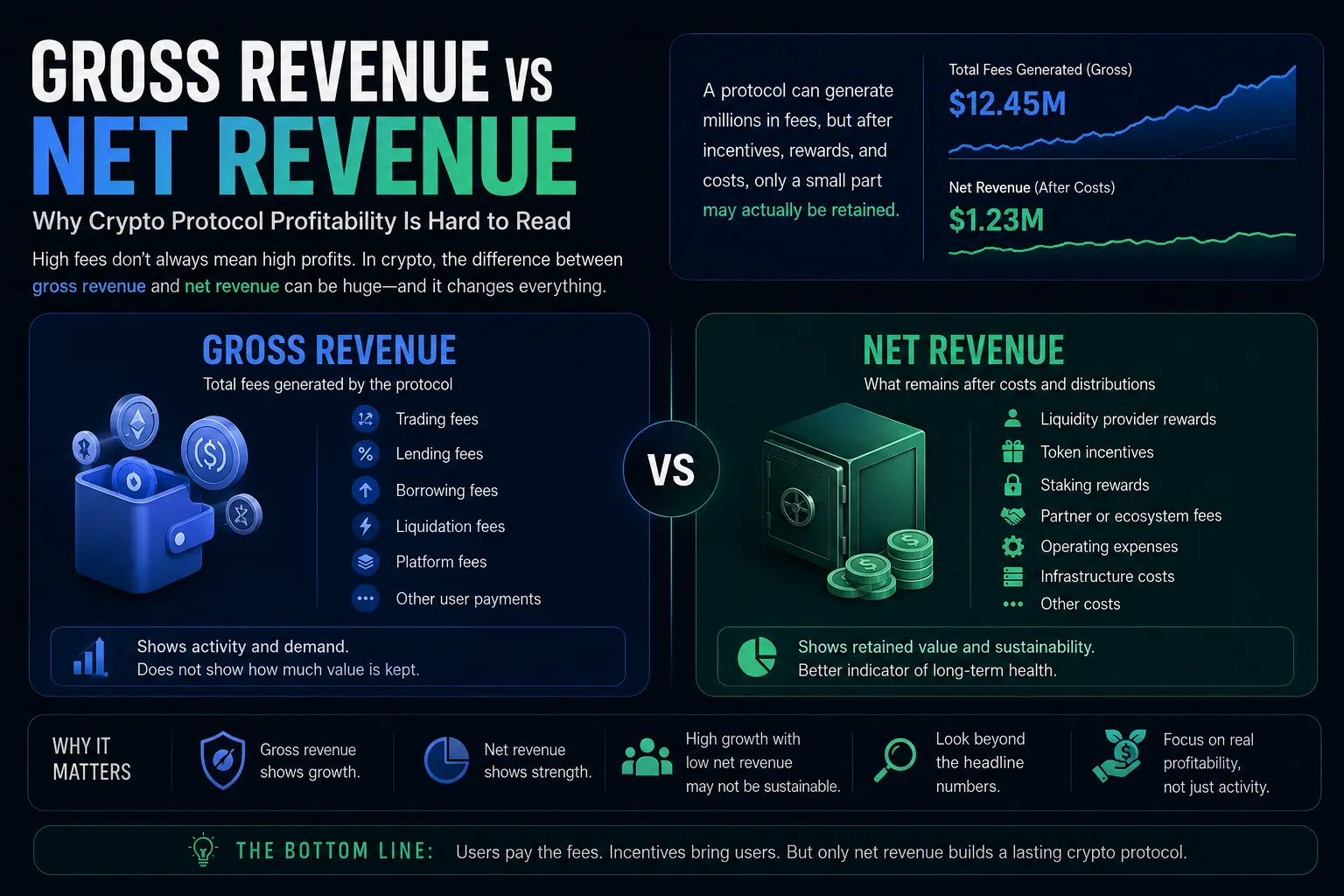
Gross revenue is the total amount of fees or income generated by a protocol before expenses or distributions.
This can include trading fees, lending fees, borrowing fees, liquidation fees, bridge fees, marketplace fees or other user payments.
Gross revenue is useful because it shows that users are paying to use the protocol. It can indicate product demand and market activity.
However, gross revenue does not show how much value the protocol actually keeps.
What Is Net Revenue in Crypto?
Net revenue is the amount of revenue left after costs, incentives, payouts or other deductions.
In crypto, these deductions can be complex. A protocol may pay rewards to liquidity providers, validators, market makers, token stakers or ecosystem partners. It may also use token incentives to attract users.
Net revenue gives a clearer view of economic sustainability because it shows what remains after the protocol supports its own activity.
Gross Revenue vs Net Revenue: The Key Difference
The key difference is that gross revenue shows activity, while net revenue shows retained value.
Gross revenue answers the question: how much money did users pay?
Net revenue answers the question: how much value did the protocol actually keep?
A protocol can look impressive based on gross revenue, but if net revenue is weak, the business model may be less sustainable than it appears.
Why Gross Revenue Can Mislead Traders
Gross revenue can be misleading because it often ignores the cost of generating that activity.
A DeFi protocol may generate high fees, but only because it pays high token incentives to users. If those incentives are larger than the revenue earned, the protocol may be growing in an expensive way.
This can create the illusion of strong demand. Users may be active because they are being rewarded, not because the product has organic traction.
When incentives decline, activity may fall.
Why Net Revenue Matters More for Sustainability
Net revenue helps traders understand whether a protocol can support itself without depending too much on emissions.
A protocol with consistent net revenue may have stronger fundamentals because it keeps part of the value created by users.
This does not automatically mean the token will perform well, but it gives traders a better starting point for analysis.
Net revenue is especially important when evaluating long term protocol health.
The Role of Token Incentives
Token incentives can help protocols grow, but they can also distort revenue analysis.
If a protocol distributes large amounts of tokens to attract users, the gross revenue may rise. But if those rewards are expensive, net revenue may remain weak.
In some cases, token incentives create temporary usage that disappears once rewards end.
Traders should ask whether users would still use the protocol without rewards.
Revenue and Tokenholder Value Are Not the Same
Even if a protocol has strong net revenue, traders must check whether tokenholders benefit from it.
Revenue may go to the treasury, developers, validators, liquidity providers or stakers. It may not directly support the token.
A protocol can be profitable while the token has weak value capture.
This is why traders should analyze both profitability and tokenomics.
What Traders Should Check
Before buying a token based on protocol revenue, traders should ask:
How much gross revenue does the protocol generate?
What costs are required to generate that revenue?
Are incentives larger than the revenue earned?
Does net revenue remain positive over time?
Does the token capture any of this value?
Is revenue consistent or based on short term hype?
Does the protocol depend on emissions to attract users?
These questions help separate real profitability from inflated activity.
How DEXTools Can Help
DEXTools can help traders review the market behavior of protocol tokens. Even when revenue data looks strong, token liquidity, volume, price action and transaction flow still matter.
A protocol may have strong numbers, but if the token is illiquid or dominated by speculative activity, trading risk remains high.
Combining protocol revenue analysis with live market data can improve decision making.
Final Thoughts
Gross revenue and net revenue tell different stories. Gross revenue shows how much activity a protocol generates. Net revenue shows how much value remains after costs.
For crypto traders, headline revenue is not enough. The better question is whether the protocol can generate sustainable income and whether that income matters for the token.
In crypto, revenue is useful. Profitability is more important.
Gross revenue in crypto refers to the total income generated from all sales of goods or services before any expenses are deducted. This includes all revenue from trading fees, transaction fees, or other services offered by a crypto platform.
How does net revenue differ from gross revenue in crypto?
Net revenue in crypto is the amount of income remaining after all operating expenses, taxes, and cost of goods sold have been deducted from gross revenue. It represents the actual profit a crypto business makes.
Why is it important for crypto businesses to track both gross and net revenue?
Tracking both gross and net revenue provides a comprehensive view of a crypto business's financial health. Gross revenue shows sales performance, while net revenue reveals profitability after accounting for operational costs.
What types of expenses are typically deducted from gross revenue to calculate net revenue in crypto?
Common expenses deducted include blockchain transaction fees, server costs, employee salaries, marketing expenses, and regulatory compliance costs. These are essential for the operation and growth of a crypto business.
How do investors use gross and net revenue figures for crypto companies?
Investors use gross revenue to assess a crypto company's market share and growth potential. Net revenue is crucial for evaluating a company's efficiency, profitability, and overall financial stability.