What Is Turbo Coin (TURBO)? AI Memecoin Created with ChatGPT in 2026
— By Tony Rabbit in Tutorials
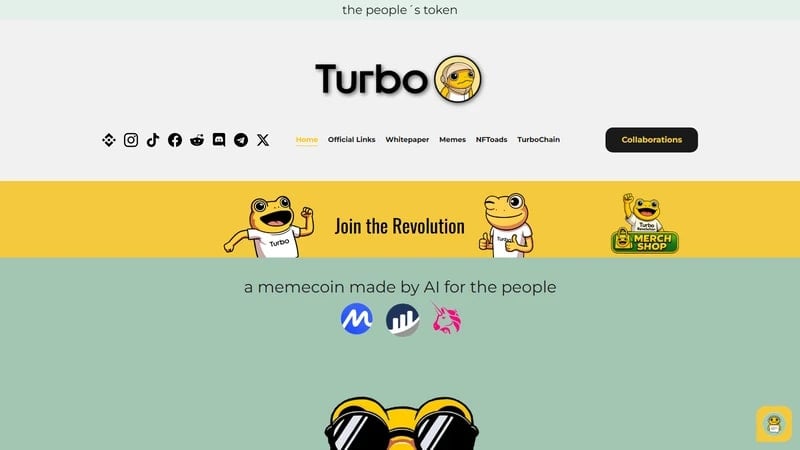
Turbo (TURBO) is the first memecoin co-created by GPT-4 in April 2023 after digital artist Rhett Mankind challenged ChatGPT to build a token on a $69 budget. Discover its origin story, tokenomics, frog mascot, exchange listings, and why this AI-born ERC-20 still matters in 2026.
What Is Turbo Coin (TURBO)? The AI-Generated Memecoin Created with ChatGPT in 2026
By 2026, crypto traders have grown used to memecoins with absurd origin stories. We have a coin born from a Solana AI bot tweeting about flatulence (Fartcoin), another launched by a digital terminal worshipping a goat (GOAT), and dozens more conjured in Telegram chats at 3 a.m. But years before the current AI memecoin tribe took over the charts, one experiment quietly opened the door for all of them. That experiment was Turbo coin, an Ethereum ERC-20 token that holds the distinction of being the first memecoin co-designed by GPT-4 itself.
Turbo did not come from a venture capital incubator, a billion-dollar foundation, or a celebrity launchpad. It came from a single digital artist named Rhett Mankind, a $69 starting budget, and a few hundred prompts typed into ChatGPT in April 2023. Three years later, the token sits in the catalog of every major exchange, has flirted with a market cap in the hundreds of millions, and is studied as the original blueprint for human plus AI collaboration in crypto. For traders and builders looking to understand how a tongue in cheek prompt evolved into a serious cultural artifact, the Turbo story is essential reading.
This guide walks through every layer of the Turbo phenomenon. We will examine the original ChatGPT conversation that sketched the tokenomics, the renounced contract that locked it in place, the frog mascot designed by AI image models, the listings on Uniswap, Coinbase, Binance and Bybit, and the comparison with newer AI memecoins like FARTCOIN, GOAT, BRETT, MOG and PEPE. By the end you will know exactly what Turbo is, why it matters, and what the honest tradeoffs look like for anyone considering buying or holding TURBO in 2026.
FEATURED SNIPPET
Turbo (TURBO) is an Ethereum ERC-20 memecoin created in April 2023 by digital artist Rhett Mankind, who challenged GPT-4 to design a viable token on a $69 budget. The frog branded asset has a renounced smart contract, zero transaction taxes, a community governed treasury, and trades on Uniswap, Coinbase, Binance and Bybit. Considered the first AI co-designed memecoin in history, Turbo reached an all time high near $0.01 in May 2024 with a market cap of several hundred million dollars before settling into a mature long tail phase by 2026.
What Is Turbo Coin in Plain English
Strip away the marketing and the hype, and Turbo is a fairly simple object. It is a fungible token deployed on the Ethereum blockchain using the standard ERC-20 interface, which means it behaves like USDT, LINK, or any other token you have already swapped on a decentralized exchange. The contract is renounced, meaning no one, not even the original deployer, can mint new tokens, change the supply, freeze wallets, or alter the fee structure. There are no buy taxes, no sell taxes, and no hidden honeypot triggers waiting to trap unwary buyers.
What makes Turbo different from a generic ERC-20 is the story that produced it. In April 2023, Rhett Mankind asked GPT-4 to act as his strategic partner in launching a viable memecoin. He fed the model a constraint that sounded more like a stand up routine than a business plan, namely a $69 budget, and asked it to handle the marketing strategy, name suggestions, tokenomics structure, mascot brief, and even the social media playbook. ChatGPT produced the bulk of those answers in long form, Rhett picked the strongest options, and a frog themed Ethereum coin called Turbo was born within days.
In essence Turbo is two things stitched together. On the surface it is a meme asset with a cute amphibian mascot, a community that buys floor art, and the usual chart watching rituals you find in any memecoin Telegram. Underneath it is a documented experiment in human plus AI creative collaboration, complete with public chat logs, a timestamped fundraising round, and a renounced contract that anyone can verify on Etherscan. The dual nature is exactly why journalists, researchers and traders keep coming back to it.
The $69 Challenge to GPT-4
The most famous detail of the Turbo origin story is the budget. Rhett Mankind did not start with a venture round, an angel cheque or a treasury of stablecoins waiting for a smart contract to consume them. He started with $69, an amount chosen partly for its meme value and partly as a self imposed handicap to force creativity. The challenge he posted to GPT-4 was straightforward in language but ambitious in scope, namely to build, brand and launch a memecoin from scratch on that single bill, with the AI doing as much of the work as possible.
In the conversation logs that Rhett later published, you can see GPT-4 approaching the brief like a junior brand consultant. It generated several rounds of name ideas, weighed in on Ethereum versus other chains, suggested a fixed supply tokenomics model with no inflation, recommended a renounced contract for trust, and produced a mascot brief calling for an absurd, smiling, slightly chaotic creature that was easy to draw and reproduce. Rhett pushed back, asked for revisions, and used the better answers. He treated the model exactly the way an art director treats a freelancer.
STEP 1
Brief and budget
Rhett opened a chat with GPT-4, framed the $69 constraint and asked the model to be his cofounder for a memecoin launch.
STEP 2
AI generated strategy
ChatGPT produced naming candidates, tokenomics options, mascot direction, marketing copy and an early roadmap, all reviewed by Rhett.
STEP 3
Deploy and launch
Rhett funded a presale, deployed the renounced ERC-20 contract, listed liquidity on Uniswap and let the community take it from there.
What surprises people who read the full transcript is how much heavy lifting the human still had to do. GPT-4 cannot deploy a contract, cannot transfer ETH, cannot register a Twitter handle and cannot answer a Telegram support ticket. Rhett did all of that. The collaboration was real but lopsided, and that honesty became part of the Turbo brand. It was never sold as fully autonomous AI like later projects pretended to be. It was, and still is, a human guided AI experiment with a transparent paper trail.
Rhett Mankind, The Artist Behind Turbo
Rhett Mankind, sometimes written as Rhett Dashwood depending on the platform, is a digital artist with a background in motion design and visual experimentation. Before Turbo he was best known among small online circles for procedural art and AI assisted visuals, the kind of work that won a few competitions but never made him a household name. Crypto was not his original world. He has explained in interviews that he came to the space the way millions of others did, namely as a curious outsider watching meme tokens like Pepe and Shiba Inu mint generational gains.
What made him different was the angle of attack. Rather than chase the next ape themed coin, he asked whether the new wave of large language models could do the heavy creative lifting if a human handled the legwork. The $69 budget made the experiment more newsworthy than another generic launch and also kept his financial exposure tiny if everything went wrong. The framing was self deprecating, the execution was disciplined, and the timing aligned perfectly with the broader 2023 conversation about what GPT-4 could and could not do.

Throughout the project Rhett has been unusually candid about his role. He has stated repeatedly that GPT-4 is not the founder, that he is the one who signs the contract on Etherscan, that he is the one who shipped the website, and that he is the human responsible for the community. The model was a powerful tool, not a sentient cofounder. That honesty has earned him goodwill in a sector where many AI branded projects exaggerate the autonomy of their bots. Even when newer AI memecoins claim that a chatbot is in charge of the treasury, Turbo holders still point to Rhett as the model for transparent attribution.
The Turbo Timeline from 2023 to 2026
Turbo has had a more interesting life cycle than most memecoins. The token has now lived through three distinct phases. The frenetic launch, the speculative ATH cycle that peaked in 2024, and the slower maturity phase that defines its 2026 existence. The timeline below captures the milestones that matter most when evaluating its history and trajectory.
Rhett opens the GPT-4 brainstorming session, deploys the ERC-20 contract, raises a tiny presale and launches Turbo on Uniswap. Trading volume in the first weeks is small but viral.
The story goes mainstream after Hacker News, Capital Brief and several tech outlets cover the AI memecoin angle. Daily volume climbs into the millions and the contract gets audited informally by independent researchers.
Centralized exchange listings begin to arrive. Gate, Bybit and several mid tier venues add TURBO pairs. The community grows past one hundred thousand wallet holders.
Turbo prints its all time high near $0.01, pushing the market cap into the hundreds of millions of dollars. Coinbase lists the asset, validating its place among major memecoins.
The broader memecoin cycle cools. Turbo drawdowns are deep but the contract integrity holds, no rug occurs and holder counts remain elevated, separating it from short lived peers.
A new wave of AI memecoins like FARTCOIN and GOAT arrives on Solana. Rather than fading, Turbo gets repositioned as the original AI memecoin, the elder statesman of the category.
Turbo trades as a mature memecoin on Uniswap, Coinbase, Binance, Bybit and Gate. Liquidity is deeper than at launch, the brand survives, and the AI memecoin narrative still anchors much of the discussion around it.
How ChatGPT Actually Designed the Token
When people imagine an AI generated token, they often picture a chatbot autonomously writing Solidity, deploying a contract and managing liquidity pools without human input. The reality of Turbo is more grounded and, in some ways, more interesting. GPT-4 acted as a strategy partner and content generator, not a deployment engineer. It produced tokenomics drafts in plain English, suggested fixed supply numbers that felt clean and meme friendly, recommended a renounced contract for credibility, and outlined a marketing roadmap that emphasized community ownership.
The model also helped with copy. Tweet drafts, website headlines, Telegram pinned messages, even fragments of the litepaper were stitched together from GPT-4 outputs that Rhett edited for tone and accuracy. Image prompts for the mascot were refined through several iterations until the now familiar frog character emerged. The contract itself was written using widely audited ERC-20 templates, the kind of boilerplate that any Ethereum developer can verify. There was no risky custom logic, no hidden mint function, no upgradable proxy waiting to surprise holders later.
The lesson is one many AI native builders have since adopted. Use the model where it shines, namely brainstorming, copywriting, brand identity and rapid iteration. Use humans for the parts where mistakes are expensive and irreversible, namely on chain deployments, treasury management and legal positioning. Turbo's clean, drama free contract record over three years is direct evidence that this division of labour works in practice.
The Frog Mascot Designed by AI
Memecoins live and die by their mascot. Pepe has the frog from Matt Furie's comics, Doge has the Shiba Inu meme photo, Brett has the Boys Club character, and Mog has the smug cat. Turbo needed a face too, and Rhett asked GPT-4 to spec one out. The model recommended an amphibian, partly because frogs are already culturally loaded in crypto, partly because they are easy to caricature and partly because the absurd, big eyed look reads well at thumbnail size on phone screens.
Image generation tools then turned that brief into the recognizable Turbo frog, a goofy, exaggerated character that is unmistakably its own design rather than a Pepe clone. The mascot has been remixed, animated, turned into stickers, plastered on hoodies and used as the basis for community art contests. Like any healthy meme, it now belongs more to its holders than to its creator, which is exactly the kind of cultural escape velocity every memecoin team secretly hopes for.
TURBO Tokenomics and Contract Mechanics
Tokenomics is where many memecoins quietly betray their holders. Hidden mint functions, owner controlled fees, blacklist powers and upgradable contracts are common red flags that turn what looks like a fun token into a slow rug. Turbo avoided all of that by design. The total supply is fixed, the contract is renounced, there are no buy or sell taxes, and the deployer wallet has no special privileges remaining on chain.
The fixed supply matters because it caps dilution. New tokens cannot be minted, so the float that traders see today is the float they will always see. The renounced contract matters because it removes the most common attack vector in memecoin land, namely a malicious or compromised owner changing the rules after liquidity is bootstrapped. The zero tax structure matters because it makes Turbo trade like a clean asset rather than a toll booth, with no surprise slippage on top of the standard Uniswap fees.

For users who care about contract level safety, the recommendation is always the same. Pull up Etherscan, paste the official Turbo contract address from the project's verified channels, and check the ownership status and source code yourself. The combination of a renounced owner, verified source code and no fee logic is exactly the profile that on chain analysts respect. It is one of the reasons Turbo continues to trade in 2026 while many of its 2023 peers have disappeared, been delisted or quietly drained by their own teams.
Community Governance and Treasury
Turbo does not have a formal on chain DAO with token weighted voting like Uniswap or Compound. What it does have is something closer to social governance, where the community decides on art collaborations, exchange listing pushes, charity initiatives and marketing campaigns through open discussion on Discord, Twitter and Telegram. The treasury, which sits in a multisignature wallet, funds these initiatives. Holders propose, vote informally, and the multisig signers execute the popular options.
This lightweight governance has its critics. Purists argue that real decentralization requires on chain voting, transparent quorums and binding execution. Pragmatists counter that most on chain DAOs have terrible voter turnout, that delegated voting concentrates power in a handful of wallets and that a smaller community can coordinate effectively with social tools and trust. Turbo sits firmly in the pragmatist camp. The model is simple, it is cheap to operate, and it has produced consistent output for three years without major drama.
Where the model shines is in cultural decisions. Picking a featured artist, choosing a charity to support during a particular campaign, deciding whether to push for a specific exchange listing, all of these benefit from rapid social consensus. Where it strains is anything that touches the treasury at scale, because trust in human multisig signers is a single point of failure. Holders who care deeply about governance should treat Turbo as a culturally rich social token rather than a full on chain organization.
Where Turbo Trades, Listed Exchanges and Liquidity
In 2026 Turbo is one of the more accessible memecoins on the market. On chain, it trades on Uniswap as the primary venue, with deep liquidity in the TURBO and ETH pair. Routers and aggregators like 1inch, Matcha and CoW Swap all surface Turbo natively, so most wallets can swap into it in a single transaction. SushiSwap and several other Ethereum DEXs also host pools, although Uniswap remains the dominant source of volume.
On the centralized side, Turbo is listed on Coinbase, Binance, Bybit, Gate and SimpleSwap among others. Each listing came with its own due diligence process, and the fact that the asset survived those reviews speaks to the cleanliness of the contract. For traders who prefer fiat onramps, the Coinbase and Binance listings in particular have removed a lot of the friction that made early memecoin participation difficult. You can now buy TURBO with a debit card in many jurisdictions without ever touching a self custodial wallet, although doing so means giving up custody of your coins to a centralized intermediary.
For traders who want the maximum control, the recommended flow remains the same. Bridge or buy ETH on a reputable exchange, withdraw to a self custodied wallet, connect to Uniswap, swap into TURBO and store the resulting tokens in the same wallet behind a hardware key. This is the workflow that respects the original ethos of the project, namely permissionless access on Ethereum with no intermediaries between the user and the contract.
Turbo vs FARTCOIN, GOAT and the AI Memecoin Tribe
Turbo no longer holds the AI memecoin spotlight alone. In 2025 a new generation arrived, most prominently FARTCOIN on Solana, which was associated with the Truth Terminal autonomous AI agent and rocketed to a multi billion dollar valuation, and GOAT, an earlier Truth Terminal experiment that became a cult favourite. BRETT, MOG, PEPE and a dozen other tokens fill out the broader memecoin landscape on both Ethereum and Solana. Understanding how Turbo compares clarifies why it still matters.
The clearest difference is generational. Turbo represents the first wave, where humans used AI as a creative tool. GPT-4 wrote brand copy, suggested tokenomics and brainstormed mascots, but Rhett deployed the contract and managed the community. FARTCOIN and GOAT represent the second wave, where AI agents were marketed as autonomous protagonists. Truth Terminal posted prompts that mentioned tokens, communities then deployed contracts inspired by those prompts, and the price action followed the bot's continued participation in the narrative.
A second difference is chain selection. Turbo is firmly an Ethereum ERC-20, which gives it the credibility of the longest running smart contract platform, deeper integration with established DeFi tooling and a more conservative user base. FARTCOIN and GOAT live on Solana, where transactions are cheap, the meme cycle is faster and the trader culture is more aggressive. Both ecosystems have produced winners, but the cultural texture is different, and traders often hold tokens from both as a portfolio of memecoin exposure.
A third difference is the level of human authorship. Turbo's story is honest about human involvement, with Rhett openly credited as the deployer and operator. FARTCOIN and GOAT lean harder into the autonomous AI narrative, which is exciting in marketing terms but more fragile if the underlying bot stops posting or the chain history undermines the autonomy claim. Pepe, Brett and Mog are not AI memecoins at all in the same sense. They are human created memes that happened to ride the same broader memecoin wave.

The Future of AI Made Crypto
Turbo is part of a much broader conversation about what AI will mean for crypto over the next decade. The narrow question of whether language models can help launch a memecoin is now answered. The harder questions are about how AI agents will hold tokens, vote in governance, execute trades, manage protocols and even create entire on chain organizations without human intermediaries. The trajectory from Rhett's 2023 ChatGPT brainstorm to fully autonomous AI agents managing crypto wallets is steep, and Turbo is the first verified data point on the curve.
In 2026, projects that integrate large language models with smart contracts have moved well beyond memecoin gimmicks. We see AI agents that run DeFi yield strategies, manage NFT collection pricing, mediate disputes in decentralized marketplaces and curate content feeds across social protocols. Each of these use cases inherits some of the cultural permission that Turbo helped establish, namely the idea that an AI involved asset can be legitimate, transparent and useful, not just a gimmick or scam.
For traders, the implication is that AI memecoins are no longer a single fleeting category. They are a permanent sub sector of the broader crypto market, with their own narratives, leaders, life cycles and risk profiles. Turbo's role in that sub sector is to remain the origin story, the conservative grandfather token that everyone references even when they are trading the latest Solana mascot. That position has tangible value for long term holders who care about cultural durability, not just short term price action.
Risks and Honest Tradeoffs of Holding TURBO
No honest guide to Turbo can skip the risk section. The asset is a memecoin, and memecoins are among the most volatile instruments in crypto. Drawdowns of 80 percent or more from local highs are routine, liquidity can thin out during stress events, and broad market sell offs hit speculative assets disproportionately hard. Anyone considering TURBO should treat it as a satellite position in a diversified crypto portfolio, not as a savings instrument, retirement vehicle or stable store of value.
There are also category specific risks. AI memecoins as a narrative can fall out of favour if the broader market shifts attention to other themes, if a high profile AI project suffers a major hack or scandal, or if new technologies like fully autonomous AI agents make 2023 era projects feel dated. Turbo's status as the original of the category is an advantage in stable times and a vulnerability when the market wants the newest, shiniest version of whatever narrative is hot.
Operational risks remain even with a renounced contract. Phishing sites mimicking the official Turbo project, fake airdrops promising free TURBO in exchange for wallet connections, address poisoning attacks that trick users into sending tokens to lookalike addresses, and counterfeit Turbo tokens with similar names and identical icons are all common. Holders should always verify the contract address from the official channels listed on the project website or a trusted aggregator like CoinMarketCap, and should follow basic operational security practices including hardware wallets for long term holdings.
PROS and CONS Grid
PROS
- First documented AI co-designed memecoin in history
- Renounced contract with no owner privileges
- Zero buy or sell taxes on transfers
- Listed on Coinbase, Binance, Bybit, Gate and Uniswap
- Transparent founder with public attribution
- Three year survival track record without rug
- Strong, durable community and recognizable mascot
- Clean Etherscan history that auditors respect
CONS
- Memecoin volatility with deep drawdowns
- No revenue, fees or cash flow backing the price
- Newer AI memecoins compete for attention
- Social governance lacks formal on chain voting
- Ethereum gas fees can hurt smaller transactions
- Treasury sits in a multisig with human signers
- Brand strength depends on continued meme relevance
- Exposed to broader macro and regulatory cycles
Best Practices for AI Meme Traders
Trading AI memecoins like Turbo, FARTCOIN, GOAT and their peers benefits from a disciplined process. The first rule is position sizing. Memecoins should occupy a slice of your portfolio that you can afford to lose entirely without affecting your financial well being. Many experienced traders cap their exposure at five to ten percent of total crypto holdings spread across multiple names, with no single memecoin representing more than two or three percent of net worth.
The second rule is contract verification. Every purchase should be preceded by a quick check that the contract address you are buying matches the verified address on the official project channels and on a reputable aggregator. Tools like DEXTools, Etherscan and CoinMarketCap make this trivial. The cost is thirty seconds, the saving is potentially your entire position to a counterfeit contract.
The third rule is custody hygiene. Long term holdings belong in a self custodial wallet, ideally behind a hardware key. Exchange balances are convenient for active trading but vulnerable to platform risk, regulatory action and operational mistakes. The convention many memecoin traders follow is to keep a small spending balance on an exchange for quick entries and exits while bulk holdings live in cold storage. This approach trades a small amount of liquidity for a large amount of resilience.
The fourth rule is narrative awareness. Memecoins live on attention, and the AI memecoin sub sector has its own attention cycle. When mainstream coverage hits a saturation point, when a celebrity tweets a token name or when a new chain hypes a new mascot, these are typical inflection points where late entrants get hurt. Following the narrative carefully through tools like Twitter, CoinDesk, Capital Brief, Hackernoon and your favourite aggregator is part of the job, not an optional extra.
The fifth rule is exit planning. Decide before entering a trade what level of profit would lead you to take some off the table and what level of loss would trigger a stop. Memecoins like Turbo have produced tens of multiples for early entrants who held through the cycle and complete drawdowns for late entrants who refused to take partial profits. Pre committing to a plan is one of the few defenses against the emotional swings the asset class produces.
A sixth rule worth adopting is information hygiene. The AI memecoin sub sector attracts a lot of low quality signal, including pump groups, paid influencers and outright disinformation. Cultivate a small list of trusted sources, lean on on chain data through tools like Etherscan, DEXTools and Dune Analytics, and treat anything that arrives through unsolicited direct messages with extreme suspicion. The information edge in memecoin trading comes from primary sources, not from the loudest voice on your timeline.
A final practical note is to keep records. Memecoin tax treatment varies by jurisdiction but almost always requires accurate cost basis tracking, transaction histories and counterparty information. Tools that automatically pull your on chain history and exchange CSVs into a unified tax view are now mature and cheap. Setting one up early avoids a stressful reconstruction project at the end of the tax year, especially if you have traded multiple memecoins across multiple wallets and exchanges.
Frequently Asked Questions
What is Turbo coin in one sentence?
Turbo is an Ethereum ERC-20 memecoin co-designed in April 2023 by digital artist Rhett Mankind and OpenAI's GPT-4 model on a $69 starting budget, widely regarded as the first AI co-created memecoin in crypto history.
Did GPT-4 really create Turbo coin?
GPT-4 generated the naming candidates, tokenomics structure, marketing copy and mascot brief through a documented chat with Rhett. The model did not deploy the contract or manage the launch, but it produced most of the creative output that defined Turbo's identity.
Who is Rhett Mankind?
Rhett Mankind is a digital artist with a background in procedural and AI assisted visual art. He is the human founder of Turbo, the deployer of the original contract and the operator who continues to coordinate the project's community and treasury alongside the wider holder base.
What was the $69 budget for?
The $69 was Rhett's self imposed constraint for the entire launch, covering early branding, domain registration, basic infrastructure and seed funding. The figure was chosen partly for meme value and partly to prove that an AI assisted launch did not require a large budget.
How does Turbo compare to Fartcoin or GOAT?
Turbo is the first generation AI memecoin on Ethereum where AI was a creative tool guided by a human. FARTCOIN and GOAT are second generation Solana memecoins associated with autonomous AI agents like Truth Terminal. Turbo emphasizes human transparency, the newer projects emphasize AI autonomy narratives.
Why is the contract renounced?
Renouncing the contract removes the owner's ability to mint new tokens, change fees, blacklist wallets or modify behaviour. It is the strongest possible signal that the token's rules are locked in and cannot be changed by the deployer, which is why serious memecoin traders look for it.
What is the total supply of TURBO?
Turbo launched with a fixed total supply in the tens of billions of tokens, with no inflationary issuance. Holders should always verify the current circulating and total supply from on chain explorers and aggregators rather than relying on third party headlines.
What is Turbo's market cap in 2026?
After peaking with a market capitalization in the hundreds of millions of dollars in May 2024, Turbo trades in 2026 within a more mature range that fluctuates with the broader memecoin cycle. CoinMarketCap and CoinGecko show the live figure at any time.
Where can I buy Turbo coin?
Turbo is available on Uniswap as the primary on chain venue and on centralized exchanges including Coinbase, Binance, Bybit, Gate and SimpleSwap. Always confirm the contract address from the official project channels before swapping or transferring.
Is Turbo still a good investment in 2026?
This guide does not give investment advice. Turbo has a clean contract, a verifiable history and an established brand, which are positive structural factors. It is also a memecoin with extreme volatility, no revenue and significant competition. Evaluate it within a diversified portfolio and a risk budget you can lose.
What are the main risks of holding TURBO?
Memecoin volatility, narrative rotation away from AI themed assets, phishing and address poisoning attacks, counterfeit token impersonators, exchange specific risks for centralized balances and the absence of underlying cash flow are the main categories holders should monitor.
Will AI keep making memecoins?
Yes. Every generation of large language model and autonomous AI agent so far has produced new memecoin experiments, from Turbo on GPT-4 to FARTCOIN and GOAT on Truth Terminal. As agent capabilities expand, expect more on chain projects where AI plays an increasingly visible role.
Related Reading on DexTools News
- What Are AI Agents in Crypto in 2026
- What Is Fartcoin, Solana AI Memecoin from Truth Terminal
- What Is Goatseus Maximus (GOAT), AI Memecoin from Truth Terminal
- What Is Ethereum, Complete Beginner Guide 2026
- Memecoin Trading Guide 2026
- What Is Pepe Coin, Ethereum Memecoin Guide 2026
- How to Use DexTools, Complete Guide 2026
- Avoid Crypto Address Poisoning Scams
- What Is the ERC-20 Token Standard in 2026
- What Is Uniswap, Decentralized Exchange Guide 2026
Closing Thoughts on the Original AI Memecoin
Turbo started as a joke. A digital artist with $69 and a chatbot, asking whether GPT-4 could spec out a viable memecoin. Three years later that joke has become a cultural artifact, a verified piece of the AI plus crypto historical record and a tradable asset on every major exchange. The original framing of Turbo as a thought experiment has matured into something more durable, namely a working example of how human plus AI collaboration can produce real, on chain outcomes that survive contact with market reality.
For traders, the practical takeaways are clear. Turbo is a clean, renounced, no tax ERC-20 with deep liquidity and multiple safe entry points. It is also a memecoin, which means volatility, narrative dependence and the usual operational risks. For builders, the lessons are about division of labour, namely that AI shines as a creative partner while humans handle the irreversible on chain decisions. For everyone watching the wider AI memecoin sub sector evolve, Turbo remains the origin story that everything else is measured against.
The next generation of AI memecoins will be wilder, more autonomous and more ambitious in their narratives. They will lean harder into agent based gimmicks, cross chain mascots and continuous AI participation in their communities. Whatever shape that future takes, the story will always start at the same place, namely with Rhett Mankind, $69 and a chat window asking GPT-4 to help build a memecoin. Turbo is that story, and in 2026 it remains worth understanding for anyone serious about where the crypto AI conversation has been and where it is going next.
Whether you ultimately decide to hold TURBO, trade it, study it from a distance or only use it as a reference point when evaluating the next AI memecoin to land on your radar, the value of the underlying lesson is the same. Memes mixed with verifiable on chain mechanics and honest human attribution produce assets that can survive multiple market cycles. The same is not true for projects that rely on hype alone, hide their teams or stack hidden contract powers behind cute mascots. Three years of public history put Turbo firmly in the first camp, and that durability is its own form of fundamental analysis in a corner of the market that often pretends to have none.
Related Guides
- Who Created ETH and When Was It Founded? Full History 2026
- How Memecoins Are Created in Minutes (and Why It Matters)
- What Is TRUMP Coin: Official Trump Memecoin Guide (2026)
- What Is Toshi (TOSHI)? Base Memecoin from Coinbase CEO's Cat Explained in 2026
- What Is SPX6900 (SPX)? Multichain Culture Memecoin Explained in 2026