What is TRON (TRX)? Complete 2026 Guide
TRON has evolved into the world's primary stablecoin rail. We analyze the 2026 ecosystem, the resource model that powers $86B in USDT, and the network's deflationary mechanics.
What is TRON (TRX)?
- Tron is a blockchain-based operating system launched by Justin Sun in 2017, designed to decentralize the internet and the digital entertainment industry. It aims to eliminate intermediaries by allowing content creators to connect directly with their audiences, using its native cryptocurrency, TRX, for transactions and governance.
- Known for its high throughput and low transaction fees, Tron has become one of the most popular networks for hosting decentralized applications (dApps) and managing stablecoins like USDT.
- As of May 5, 2026, TRON (TRX) has evolved from its early positioning as an “Ethereum killer” into a network primarily focused on high-throughput, low-cost stablecoin transfers.
- Rather than competing across every blockchain use case, TRON has found a strong niche in facilitating the movement of digital dollars (particularly USDT) at scale, especially in retail and cross-border payments. While it has become one of the leading platforms for stablecoin activity, it operates alongside other major ecosystems and remains heavily reliant on a single dominant asset.
1. Origins: From Entertainment to Settlement
- Launched in 2017 by Justin Sun, TRON was originally marketed as a decentralized storage and entertainment platform (hence the 2018 acquisition of BitTorrent).
- By 2026, the "entertainment" narrative has largely taken a backseat to remittance. TRON is now primarily a "stablecoin rail." It utilizes the TRON Virtual Machine (TVM), which is essentially a specialized fork of the Ethereum Virtual Machine (EVM), allowing developers to port Ethereum-based apps (Solidity) with minimal friction.
2. The DPoS Consensus Mechanism
TRON operates on a Delegated Proof of Stake (DPoS) model, which is the engine behind its 3-second block times and 2,000+ TPS capacity.
Super Representatives (SRs): Instead of thousands of miners, the network is secured by 27 Super Representatives.
Voting: TRX holders "freeze" (stake) their tokens to gain Voting Power. They use this power to elect the 27 SRs.
Efficiency: Because there are only 27 nodes responsible for validating, the network achieves massive throughput. However, this is the primary source of the "centralization" criticism.
3. The Resource Model: Bandwidth & Energy
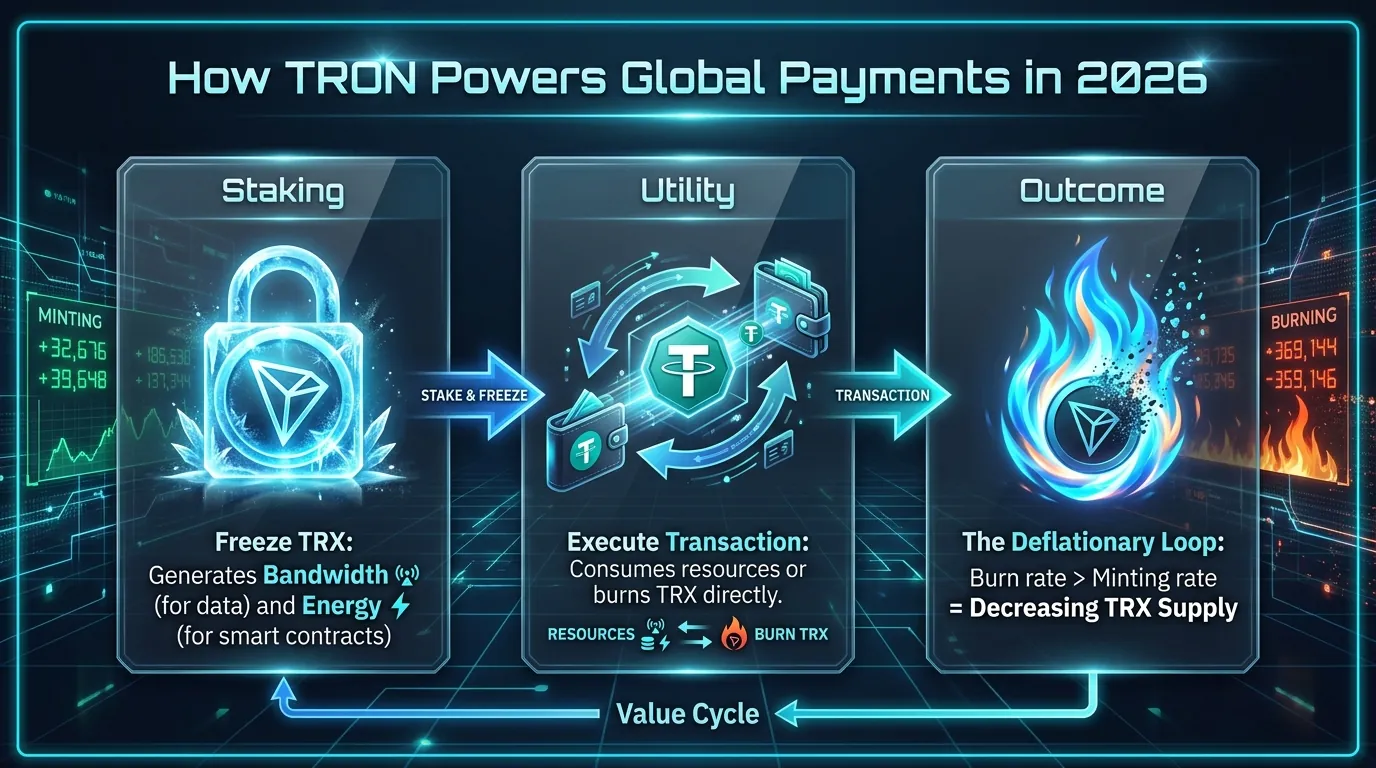
One of TRON's most unique features is that it doesn't use a "gas price" model like Ethereum. Instead, it treats transactions as a consumption of physical resources.
Bandwidth: Required for every transaction (the "size" of the data). Every account gets a daily allocation of 600 free bandwidth points, enough for a few simple TRX transfers.
Energy: Required to execute smart contracts (like moving USDT). You get Energy by staking TRX or renting it from marketplaces like JustLend.
Burning for Fees: If you have zero Bandwidth or Energy, the network "burns" TRX directly from your wallet to pay for the transaction. In 2026, a typical USDT transfer costs roughly 13.5 TRX (~$4.10) if you don't stake.
4. The Ecosystem: The USDT Powerhouse
In 2026, the TRON ecosystem is synonymous with USDT (Tether).
The Tether Dominance
TRON currently hosts over $86 billion in USDT, surpassing the supply on Ethereum. This concentration is driven by:
Emerging Markets: TRON is the de facto banking system in Nigeria, Argentina, and Turkey, where users move small amounts of USD daily.
Exchange Liquidity: Almost all Tier-1 exchanges (Binance, OKX) default to the TRON network (TRC-20) for USDT withdrawals due to its speed and predictable fees.
Key Protocols
JustLend DAO: The primary lending market where users rent Energy.
SUN.io: The hub for stablecoin swaps and yield farming.
BitTorrent Chain (BTTC): A Layer-2 solution connecting TRON to Ethereum and BNB Chain.
5. Tokenomics: The Deflationary King
In 2026, TRX is one of the few "deflationary" Layer 1 tokens. Because the amount of TRX burned from transaction fees (USDT transfers) often exceeds the amount minted as rewards to SRs, the total supply is shrinking.
The Burn Logic: If B is the amount of TRX burned daily and M is the daily minting rate, the net supply change ΔS is: ΔS = M - B
In current 2026 conditions, B > M, creating a supply crunch that supports the TRX price even during market lulls.
6. Criticisms & Risks
Despite its massive revenue ($82M+ in Q1 2026 alone), TRON remains a "love it or hate it" network.
| Criticism | The 2026 Reality |
| Centralization | The 27-SR model is seen as "too small" for true decentralization. |
| Governance | Significant token concentration remains in a few large wallets. |
| Legal Scrutiny | While 2023-era lawsuits have largely been settled or moved to the background, the network still faces "grey market" labeling by some Western regulators. |
| Eco-Hype | Critics argue that outside of USDT, the "entertainment" and "AI" promises are largely marketing fluff. |
Expert Summary
In 2026, TRON is essentially "The Global Remittance Utility." It isn't the most decentralized or the most technologically avant-garde, but it is the most used for moving actual value. As long as the world needs a cheap, fast way to move digital dollars, TRX remains the anchor of the stablecoin economy.
You can access Tron tokens on DEXTools here and start trading today!
Disclaimer: This article is for informational purposes only and does not constitute investment advice, financial advice, trading advice, or any other kind of advice. DEXTools does not recommend buying, selling, or holding any cryptocurrency or token. Users should conduct their own research and consult with a qualified financial advisor before making any investment decisions. Cryptocurrency investments are volatile and high-risk. DEXTools is not responsible for any losses incurred.
Related Guides
- What Are TRX Energy and Bandwidth? Complete TRON Gas Guide (2026)
- How to Buy TRX (TRON) in 2026: Beginner Step-by-Step
- How to Stake TRX: Step by Step Staking Guide
- TRON vs Solana: Speed, Fees and Use Cases Compared (2026)
- TRON Super Representatives: How Voting and Governance Work (2026)
Frequently Asked Questions
What is TRON (TRX)?
TRON is a blockchain network designed for high throughput and low-cost transactions, and TRX is its native token. It is widely used for transferring value, including large volumes of stablecoins.
What is TRX used for on the TRON network?
TRX is used to pay for network resources, participate in governance, and stake to obtain bandwidth and energy for transactions. It serves as the core asset that powers activity on the network.
Why is TRON popular for stablecoin transfers?
TRON is often used for stablecoin transfers because of its low fees and fast confirmation times. This makes it attractive for moving dollar-pegged tokens between users and exchanges.
What are energy and bandwidth on TRON?
Energy and bandwidth are network resources that cover the cost of executing transactions and smart contracts on TRON. Users can obtain them by staking TRX, which can reduce or avoid direct transaction fees.