Toncoin in 2026: Telegram Economy, Catchain 2.0 and USDT on TON
An analysis of Toncoin inside Telegram, TON architecture updates, validator dynamics, and the rise of USDT and Mini Apps in 2026.
Intent check: This page covers the 2026 Telegram economy angle, TON architecture shifts, and USDT-on-TON adoption. If you want the definition-first explainer for Toncoin, gas, staking, and use cases, read What Is Toncoin (TON)? TON Network, Gas, Staking and Use Cases Explained (2026).
Toncoin (TON) in 2026: The Social Web3 Infrastructure and the Telegram Economy
- As of May 7, 2026, Toncoin (TON) has completed its transition from a community-managed project to the structural backbone of Telegram's monetization and utility strategy. Following a watershed announcement on May 4, 2026, where Telegram CEO Pavel Durov confirmed that the platform would become the network's largest validator, TON has seen a significant re-rating.
- Currently trading at approximately $2.13, the network is navigating a new era of "fused infrastructure" where a messaging platform with nearly 1 billion users acts as the primary gateway to the blockchain.
What is Toncoin (TON)
- Toncoin (TON) is a decentralized Layer-1 blockchain originally developed by the Telegram team to provide a fast, secure, and scalable platform for billions of users.
- Although it is now managed by an independent community of developers known as the TON Foundation, it remains deeply integrated into the Telegram ecosystem, allowing users to send crypto as easily as sending a text message.
- With its unique architecture designed to handle millions of transactions per second, TON aims to bridge the gap between traditional social media and the decentralized future of Web3.
1. The Core Tech: Catchain 2.0 and Multi-Blockchain Architecture
Trade TON with Not.Trade, the fastest terminal on TON
Not.Trade is purpose built for TON traders: real-time on-chain charts for every jetton, insider safety scoring (Top 10 wallets, snipers, dev movement, bundlers, LP lock), MCAP-trigger limit orders, multi-wallet sniping, MEV protection and one-click swaps routed across STON.fi and DeDust. It runs natively inside Telegram and as a fast web terminal, with TON Connect non-custodial wallet support.
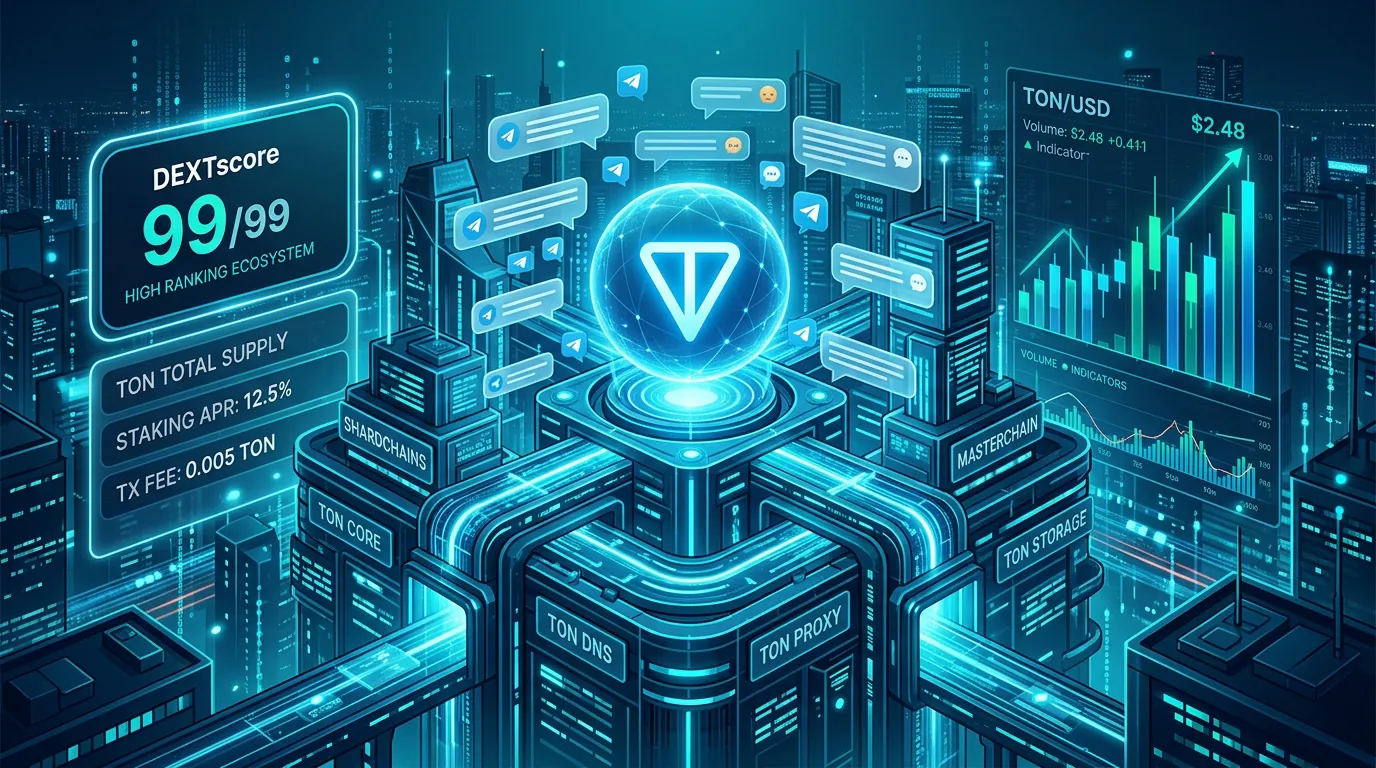
Read the full Not.Trade guide ->The Open Network is not a single blockchain but a complex, "bottomless" sharding architecture designed for global scale. In April 2026, the activation of Catchain 2.0 further refined this system, optimizing validator communication to support Telegram-scale demand.
The Trio-Chain Structure
The Masterchain: The "brain" of the network. It stores protocol parameters, validator sets, and the current state of all workchains.
Workchains: These are specialized chains that handle specific transaction types. While the network supports up to 2^32 workchains, most activity remains on the primary workchain for the sake of liquidity.
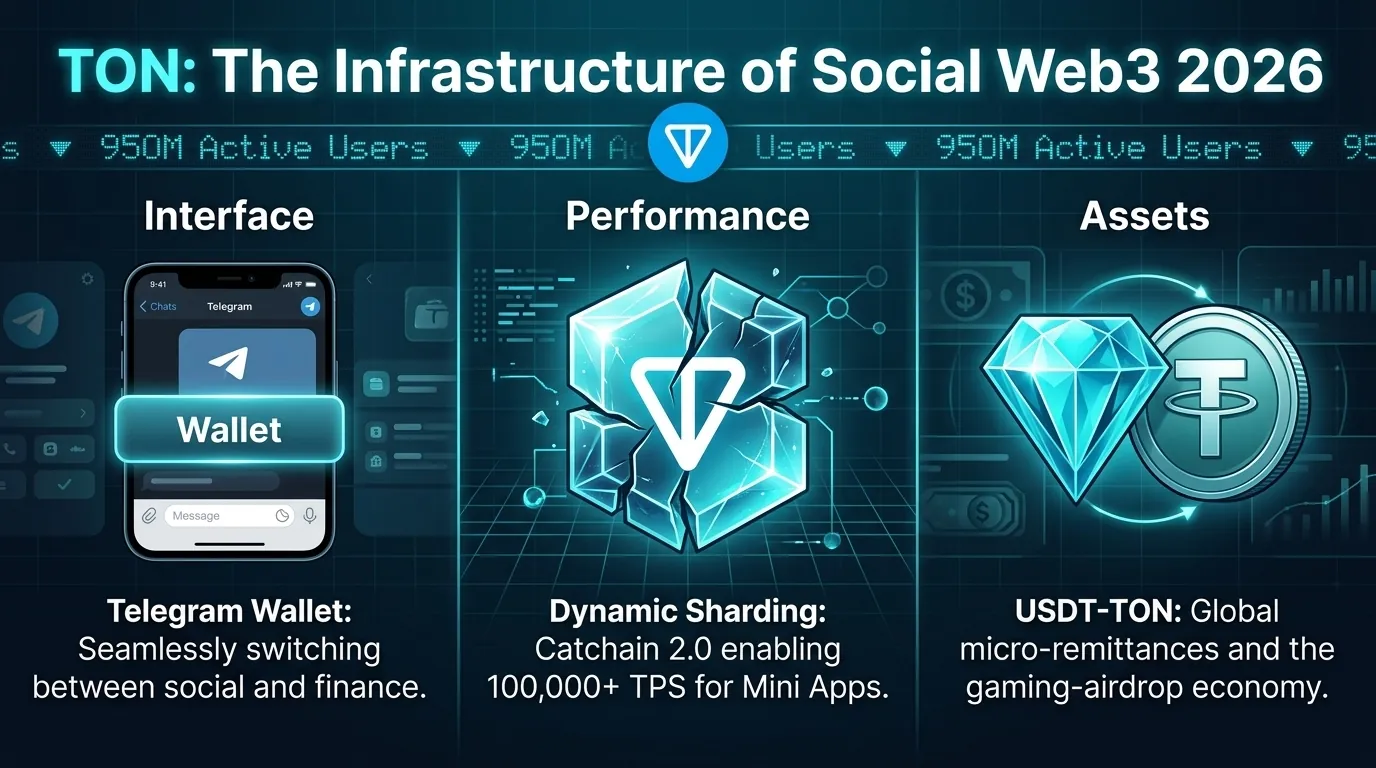
Shardchains: Workchains are subdivided into shardchains that split and merge automatically based on load.This dynamic sharding allows TON to target a theoretical capacity of over 100,000 TPS without network-wide congestion.
2. Telegram Integration: From Mini Apps to TON Space
The primary differentiator for TON in 2026 is its deep, native integration with the Telegram interface. This has effectively "hidden" the complexity of Web3 from the average user.
Telegram Mini Apps (TMAs): These are essentially decentralized websites hosted inside Telegram. With Catchain 2.0, the latency for on-chain actions in games and shops has dropped significantly, making blockchain state-sync feel instantaneous.
TON Space (Self-Custody): Telegram's native wallet now features "Vault" accounts, allowing users to switch between their spending wallet and high-security self-custodial storage with the same ease as switching chat folders.
USDT-TON Partnership: In 2026, USDT on TON has become the primary global stablecoin for micro-remittances. Users can send USDT to a friend as easily as a GIF, bypasses traditional banking hours and fees entirely.
3. The 2026 Ecosystem: Gaming and DeFi Dominance
By April 2026, the total value locked (TVL) in the Toncoin (TON) ecosystem reached $1.2 billion, driven largely by "Tap-to-Earn" evolutions and specialized DeFi.
Social Gaming: Projects like Notcoin and Catizen have evolved from simple clickers into complex social economies. They act as "on-boarding engines," converting non-crypto users into active on-chain participants through airdrops and internal marketplaces.
DeFi for the Masses: Protocols like STORM and Bemo provide liquid staking and decentralized trading within the Telegram app, allowing users to earn yield on their TON without ever leaving the messaging interface.
Technical Trade-offs and Market Realities
Strengths and Opportunities
Massive Distribution: No other L1 has a direct "hot-link" to 950 million active users. This provides a structural demand floor that is independent of general crypto market cycles.
Superior Scalability: The sharding and Catchain 2.0 upgrades make TON one of the few networks capable of handling millions of simultaneous micro-transactions.
Seamless Onboarding: The "invisible" nature of the TON wallet removes the 12-word seed phrase barrier for mainstream adoption.
Limitations and Challenges
Centralization Concerns: With Telegram becoming the largest validator as of May 2026, the line between the decentralized protocol and a corporate-controlled network has blurred. This raises censorship and governance risks.
Technical Complexity: The asynchronous nature of TON's smart contracts makes development more difficult than on synchronous chains like Ethereum or Solana, potentially slowing down the deployment of complex DeFi.
Regulatory Scrutiny: Because of its deep ties to a major social platform, Toncoin (TON) remains a high-profile target for global regulators concerned with private digital currencies and encrypted social data.
Verification and Security via DEXTools
In the fast-moving "Mini App" economy, thousands of new tokens are launched daily. While the TON infrastructure is robust, social engineering and malicious smart contracts are a reality. DEXTools is the optimal tool for analyzing the market and avoiding scams within the TON ecosystem.
Professional traders in 2026 verify:
The DEXTscore: High scores (90+) ensure that a token on a TON-native DEX like STON.fi has verified liquidity and a clean contract history.
Liquidity Depth: Using the Pool Explorer to verify that a trending gaming token has enough liquidity to prevent massive slippage during high-volatility airdrops.
Contract Sovereignty: Verifying if the token creator has revoked "Mint" permissions, which is critical for community-led projects.
To monitor the DeFi market in an agile and secure way in real-time and trade Toncoin-based assets with the help of the best crypto tools, you can access TON in DEXTools here.
Disclaimer: This article is for informational purposes only and does not constitute investment advice, financial advice, trading advice, or any other kind of advice. DEXTools does not recommend buying, selling, or holding any cryptocurrency or token. Users should conduct their own research and consult with a qualified financial advisor before making any investment decisions. Cryptocurrency investments are volatile and high-risk. DEXTools is not responsible for any losses incurred.
Related Guides
- What Is Toncoin (TON)? Beginner Guide Explained 2026
- TON Tokenomics: Toncoin Supply, Distribution and Inflation Explained (2026)
- TON to USD Converter: Toncoin Price Today (Live)
- TON Staking Calculator: Estimate Toncoin Rewards Live (2026)
- How to Buy Toncoin (TON) in 2026: Exchanges, Wallet Setup and First Purchase Guide
- USDT on TON
Frequently Asked Questions
What is Toncoin and how is it used in Telegram?
Toncoin (TON) serves as the foundational currency for Telegram's monetization strategy, enabling users to engage in various blockchain activities directly within the app.
How does the TON network handle transactions?
The TON network employs a multi-blockchain architecture with a sharding system that can theoretically support over 100,000 transactions per second.
What are Telegram Mini Apps and how do they work with TON?
Telegram Mini Apps are decentralized applications hosted within the Telegram platform, providing users with easy access to blockchain functionalities.
What challenges does Toncoin face as it grows?
Toncoin faces challenges such as centralization risks due to Telegram's role as the largest validator, which raises concerns about governance and censorship.
How can users verify the security of tokens in the TON ecosystem?
Users can utilize DEXTools to assess the security of tokens by checking metrics like DEXTscore, liquidity depth, and contract sovereignty, which help identify reliable projects and avoid scams.