What is Tangem Wallet? Cardless Cold Storage Explained
True asset security requires balancing cold storage isolation with consumer accessibility. We analyze Tangem's seedless NFC card architecture and backup systems.
The Custody Pivot: Eliminating Technical Friction in Asset Preservation
- Self-custody of digital assets historically demanded a high degree of technical tolerance. Legacy hardware configurations forced users to manage complex initial setups, execute perpetual firmware updates via desktop applications, and safeguard vulnerable 12-to-24-word paper seed phrases.
- While this traditional setup successfully isolates cryptographic private keys from network-facing malware, it introduces a major structural point of failure: human error. Misplaced backup paperwork, compromised phrases, and faulty physical storage accounts for a massive share of permanently lost decentralized wealth.
- Tangem Wallet redefines this user experience by abandoning traditional hardware conventions. Operating as a sleek, card-shaped cold storage device, Tangem replaces USB cables, internal batteries, and physical paper backups with Near Field Communication (NFC) and a physical, multi-card security architecture. This comprehensive guide details Tangem’s hardware composition, its seedless onboarding paradigm, the mechanics of its cryptographic backup system, and the practical risk vectors defining its operation.
1. Physical Architecture: The Bank-Card Form Factor
- The physical footprint of the device matches the dimensions of a standard credit card, allowing it to slip into a traditional wallet. Built with a high-durability polymer shell, the card achieves an IP69K environmental rating, rendering it completely waterproof, dustproof, and resistant to extreme temperature fluctuations.
- It contains no internal battery, charging ports, or physical buttons, eliminating the mechanical wear-and-tear vulnerabilities that cause traditional hardware units to fail over multi-year horizons.
- Internally, the device is powered by an EAL6+ certified secure element chip, developed in collaboration with premier global semiconductor manufacturers. This military-grade processor handles all cryptographic generation, transaction execution, and physical defense operations. Crucially, Tangem’s firmware is permanently flashed onto the secure element during factory production and is completely non-updatable. By stripping away remote firmware updates, the device eliminates supply chain software attacks, malicious firmware patches, or administrative access exploits.
2. Communication Protocol: NFC Tap-to-Sign Functionality
- Tangem does not connect to desktop computers via wires or link to smartphones through wireless Bluetooth protocols. Instead, it relies exclusively on Near Field Communication (NFC) to interface with the free Tangem mobile application. When you construct a transaction on your smartphone, the app acts merely as an informational canvas; it cannot view or touch your private keys.
To execute a transfer, you must physically tap your Tangem card against the back of your smartphone:
Data Transmission: The mobile app transmits the raw, unsigned transaction data to the card's secure element via a close-range radio frequency loop.
Cryptographic Signing: The secure element chip signs the transaction payload internally, completely offline, and releases only the finalized cryptographic signature back to the app.
Network Settlement: The mobile app broadcasts the signed output to the public blockchain ledger to settle the transaction.
Operational Trade-off: Because the card lacks an on-board visual display screen, users must rely entirely on their smartphone screen to verify recipient addresses and asset amounts: a structural characteristic known as blind signing that requires close visual attention.
3. The Seedless Onboarding Paradigm
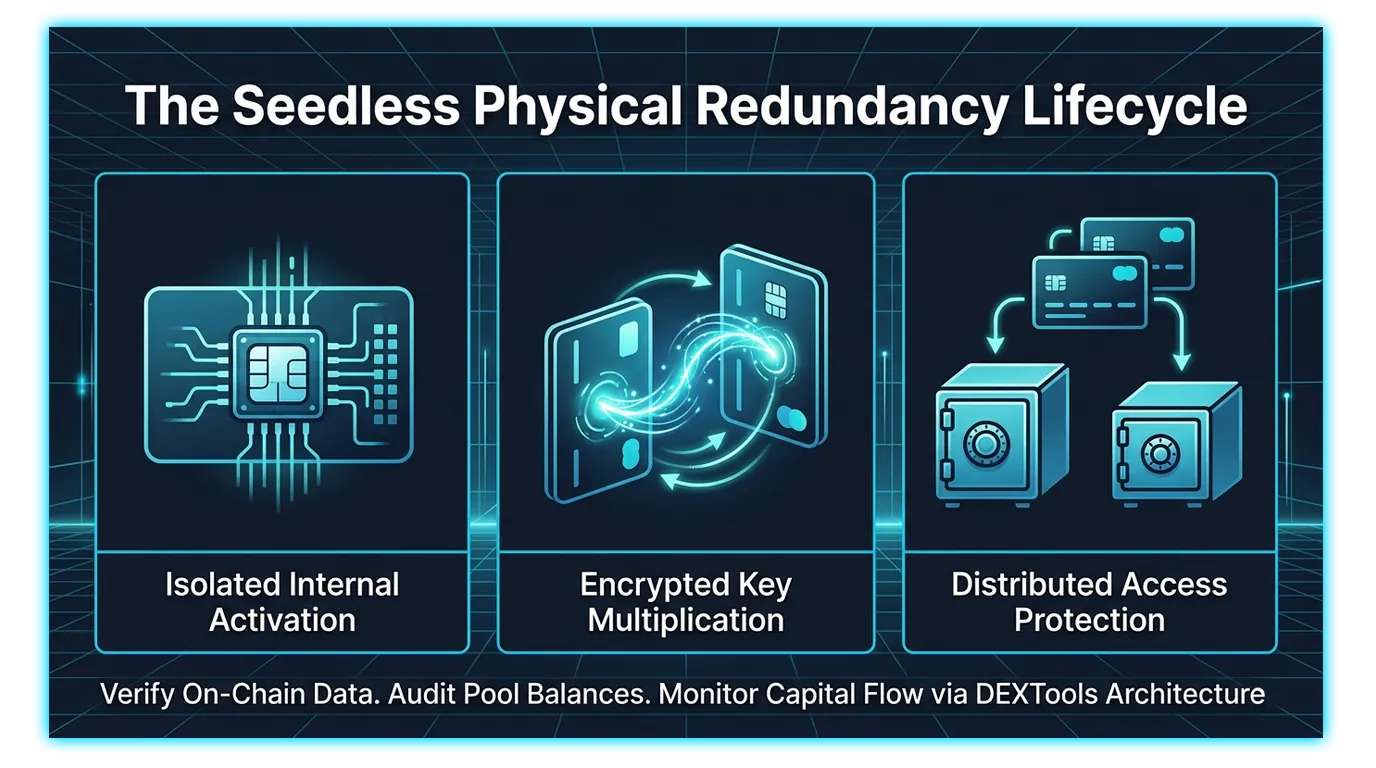
- The core design philosophy of Tangem centers on eliminating the traditional recovery phrase. During initial wallet activation, the card's internal hardware random number generator creates the private key directly inside the secure element chip. By default, the software interface does not display a 12- or 24-word seed phrase on your phone screen, and no paper copies are produced.
- This seedless approach eliminates the primary entry point for social engineering attacks, phishing scams, and physical theft of written records. If an attacker cannot trick a user into typing their recovery phrase into a malicious webpage, the vast majority of consumer wallet exploits are neutralized.
- For users who prefer legacy interoperability standards, Tangem offers an optional setup mode that supports standard recovery phrases, though using it reintroduces the exact written vulnerability the default card architecture was engineered to avoid.
4. The Multi-Card Physical Backup Framework
- Because a default Tangem setup completely lacks a written backup phrase, the protocol introduces redundancy using a physical multi-card backup system. Sold in sets of two or three, these extra cards act as identical access keys to your blockchain accounts.
- During the initial activation process, the primary card establishes an encrypted, peer-to-peer cryptographic key exchange directly with the secondary backup cards via sequential NFC taps. The private key is cloned securely into the secure elements of the backup units without ever revealing the data in a readable format. Once setup completes, the keys are locked permanently.
- Market participants are encouraged to distribute these backup cards across distinct geographical locations, such as a home safe or a secure deposit box. If a primary card is physically lost, stolen, or mechanically destroyed, any remaining backup card grants full access to the wallet, allowing users to move their assets to a new vault structure securely.
Structural Matrix: Tangem vs. Traditional Hardware Wallets
| Technical Vector | Tangem Card Architecture | Standard USB Hardware Wallets |
| Physical Form Factor | Credit Card Dimensions (No Port) | USB Token / Pocket Device Layout |
| Connectivity Interface | Close-Range NFC Tap-to-Sign | Wired USB-C Cables / Bluetooth |
| Primary Backup System | Multi-Card Physical Redundancy | 12 or 24-Word Written Seed Phrase |
| Firmware Upgrades | None (Permanently Factory Flashed) | Periodic Manual Firmware Flashes |
| Power Dependency | Passive (Powered by Phone NFC Field) | Internal Rechargeable Batteries / USB Power |
| Verification Interface | Dependent on Smartphone Display | Local On-Device Verification Screen |
5. Universal On-Chain Forensics and Trading Telemetry via DEXTools
- Navigating decentralized financial markets safely requires specialized tracking telemetry to audit live liquidity pools, evaluate transaction velocity, and identify macro capital movements. Advanced blockchain analytical environments like DEXTools serve as an essential universal toolkit for modern traders, operating independently of individual wallet ecosystems or specific network applications.
- By leveraging core features like the Pair Explorer, Big Swap Explorer, Top Traders and the Live New Pairs dashboard, market participants gain complete transparency into high-volume block transactions, shifting pool distributions, and early-stage token deployments across any public ledger, providing the critical data verification required to manage capital risk effectively.
Disclaimer: This article is for informational purposes only and does not constitute investment advice, financial advice, trading advice, or any other kind of advice. DEXTools does not recommend buying, selling, or holding any cryptocurrency or token. Users should conduct their own research and consult with a qualified financial advisor before making any investment decisions. Cryptocurrency investments are volatile and high-risk. DEXTools is not responsible for any losses incurred.
Related Guides
- How to Set Up Tangem Wallet in 2026
- Hot Wallet vs Cold Wallet: Which One to Choose
- Hot Wallet vs Cold Wallet: Complete Comparison Guide (2026)
- Best Crypto Wallet 2026: Top 10 Compared (Hot and Cold)
- 7 Best Cold Wallets 2026: Hardware Wallet Buyer's Guide
Frequently Asked Questions
What is a Tangem wallet?
Tangem is a hardware wallet built into a smart card that stores private keys offline and communicates with a phone using NFC. It is a form of cold storage in a card format rather than a traditional USB device.
How does an NFC card wallet keep crypto secure?
The private keys are generated and stored inside the card's secure chip and are never exposed to the connected phone or internet. Transactions are signed on the card, so the keys stay isolated from online threats.
What happens if I lose a card-based hardware wallet?
Card wallets often rely on backup cards or recovery methods rather than a written seed phrase, so losing one card may not mean losing access if a backup exists. It is important to understand the specific backup model before storing significant funds.
What does cold storage mean in crypto?
Cold storage means keeping the private keys that control your crypto offline, away from internet-connected devices. This reduces exposure to remote hacking compared with leaving keys on an online wallet or exchange.