Ondo Finance Tokenized Treasuries: OUSG, USDY and Yield Access (2026)
A focused Ondo guide covering OUSG, USDY and how tokenized treasury yield access works across wrappers, liquidity and distribution channels.
Where this page fits: This page is the product-structure angle. It focuses on OUSG, USDY and treasury-yield access. For the broader beginner explainer, read our main Ondo Finance guide.
The Convergence Layer: Institutional Liquidity Meets Decentralized Rails
- Ondo Finance resolves this architectural divide. Operating as a market leader in the Real-World Asset (RWA) tokenization sector, Ondo designs institutional-grade financial platforms and yield-bearing asset wrappers. Led by CEO Ian De Bode, the protocol has scaled its total on-chain assets under management (AUM) toward the $4 billion milestone. This growth includes successful cross-border tokenized treasury redemptions built in tandem with institutional giants like J.P. Morgan (Kinexys), Mastercard, and Ripple.
- Traditional capital markets operate on fragmented legacy plumbing where settlement delays drag over multiple days, access is heavily restricted by geographic or financial barriers, and billions of dollars in yield evaporate into intermediary banking layers. While early decentralized finance (DeFi) flourished on permissionless liquidity, its reliance on highly speculative, volatile crypto-native assets made it unstable for risk-averse institutional allocation.
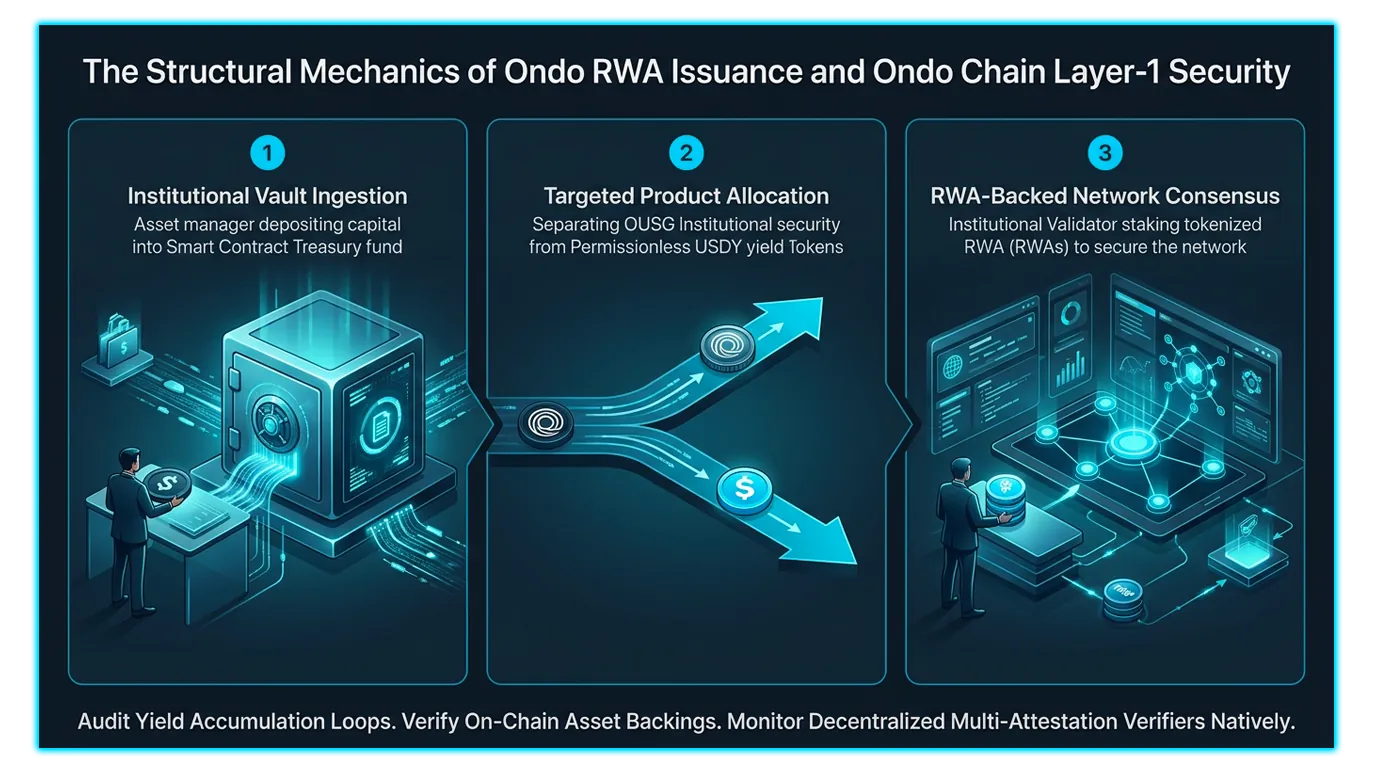
1. Core Products: OUSG vs. USDY
Ondo's tokenized issuance architecture strategically separates its product suite into two core token structures to capture both institutional scale and borderless retail capital.
OUSG: The Institutional Gold Standard
The Ondo Short-Term US Government Treasuries Fund (OUSG) is purpose-built for institutional and accredited global investors (Qualified Purchasers). Functioning as a regulatory-compliant digital security, OUSG derives its baseline value directly from institutional funds like BlackRock's USD Institutional Digital Liquidity Fund (BUIDL) along with bank demand deposits and USDC pools. It provides large cash allocators with 24/7/365 instant minting and redemption features, capping internal management fees at an ultra-lean 0.15%.
USDY: The Permissionless Yieldcoin
The Ondo Yield-Bearing US Dollar (USDY) serves as the retail-accessible counterpart designed exclusively for non-U.S. individuals and international corporate treasuries. Structured as a tokenized senior secured note backed by a ring-fenced portfolio of short-term U.S. Treasuries and bank demand deposits, USDY enables global users to capture a low-risk yield (~4% to 4.5% APY) directly inside their web3 wallets.
Multi-Chain Distribution: USDY maintains identical legal claims while natively executing across six primary public networks: Ethereum, Solana, Mantle, Aptos, Sui, and Cosmos (via Noble).
Yield Form Factors: Yield accumulates seamlessly without manual staking rewards; it flows directly to holders through automatic balance expansion (USDY) or underlying token price appreciation (rUSDY).
2. Ondo Chain: Purpose-Built L1 Architecture
To support institutional tokenized markets at scale, the protocol launched Ondo Chain, a public, proof-of-stake Layer 1 blockchain network. Rather than running as a generic smart contract network, Ondo Chain blends permissionless developer deployment with enterprise-grade consensus filters.
Ondo Chain upgrades the typical Layer 1 framework through key financial optimizations:
RWA Staking Infrastructure: Instead of forcing network validators to stake volatile native layer-1 tokens, Ondo Chain allows validators to secure the consensus layer, enshrined oracles, and cross-chain bridges by staking yield-bearing RWA tokens (like Ondo Global Markets securities). This reduces network security costs while magnifying utility for idle, asset-backed primitives.
Native Compliance Enforcement: The blockchain utilizes a permissioned validator set comprised of reputable financial institutions to completely prevent malicious front-running. Crucially, gas transaction fees on Ondo Chain can be settled directly in whitelisted RWA stable assets, letting strictly regulated institutional entities transact on-chain without holding standard volatile gas tokens.
3. The ONDO Governance Token
- The economic and structural management of the entire Ondo Finance ecosystem centers around the ONDO token. Operating as an ERC-20 token on Ethereum and natively bridged across companion scaling networks, ONDO functions strictly as a decentralized governance asset.
- Holding ONDO does not grant direct claims to underlying Treasury yields or automatic asset dividends. Instead, the token empowers its global community to steer the software development path: voting on localized fee-switch configurations, modifying asset whitelist mechanics, onboarding new yield partners (such as Franklin Templeton ETFs), and setting parameter thresholds across both Ondo Global Markets and Ondo Chain.
Ondo Product Comparison Matrix
| Product | Target User | Primary Asset Base | Yield Distribution |
| OUSG | Accredited Insto | BlackRock BUIDL | Value Accrual |
| USDY | Non-U.S. Retail | Treasuries & Deposits | Rebasing / Price Growth |
| ONDO | Ecosystem Gov | Protocol Voting Weights | None (Pure Governance) |
4. Monitoring RWA Liquidity via DEXTools Telemetry
- As Ondo continues expanding its multi-chain footprint and secondary market trading integrations across decentralized exchanges, checking on-chain liquidity depth is paramount to tracking asset stability. Utilizing advanced decentralized charting architectures like DEXTools gives market participants an essential universal platform to monitor live token behaviors, evaluate pool depths, and inspect contract parameters across all public execution networks.
- By leveraging core features like the Pair Explorer, Live New Pairs dashboard, and the integrated Trade Story or Top Traders diagnostic tools, technical traders can seamlessly audit localized volume trends, track large whale wallet capital reallocations via the Big Swap Explorer, and check automated contract safety scores before initiating any on-chain interactions, ensuring your hardened hardware setup interacts safely with verified market venues.
You can access DEXTools here and start trading today!
Top 5 Real World Asset (RWA) Tokens in 2026: Tokenized Finance Goes MainstreamFranklin Templeton Partners With Ondo Finance to Bring Tokenized Stocks to the BlockchainRWA Tokenization: A Beginner’s Guide to Real-World AssetsWhat Is Tokenization? How Real World Assets Become Onchain Claims (2026)
Disclaimer: This article is for informational purposes only and does not constitute investment advice, financial advice, trading advice, or any other kind of advice. DEXTools does not recommend buying, selling, or holding any cryptocurrency or token. Users should conduct their own research and consult with a qualified financial advisor before making any investment decisions. Cryptocurrency investments are volatile and high-risk. DEXTools is not responsible for any losses incurred.
Related Guides
- What Is Ondo Finance: Complete RWA Treasuries Guide (2026)
- Tokenized Treasuries: Complete 2026 Guide to Onchain US T-Bills
- What Is Backed Finance (bIB01)? Tokenized Stocks and Bonds RWA Guide 2026
- Top 5 Real World Asset (RWA) Tokens in 2026: Tokenized Finance Goes Mainstream
- What Is BlackRock BUIDL: Complete Tokenized Treasury Fund Guide (2026)
Frequently Asked Questions
What is Ondo Finance?
Ondo Finance is a platform focused on bringing real-world assets, such as tokenized exposure to government securities, onto blockchains. It aims to connect traditional financial instruments with on-chain markets.
What are tokenized treasuries?
Tokenized treasuries are blockchain tokens that represent exposure to short-term government debt instruments. Tokenization aims to make these assets easier to hold, transfer, and use within on-chain systems.
What is the ONDO token?
ONDO is the native token associated with the Ondo Finance ecosystem. The specific roles of a protocol token can include governance and ecosystem functions, which vary by project design.
What are real-world assets in crypto?
Real-world assets, often abbreviated RWAs, are off-chain assets like bonds, real estate, or commodities represented as tokens on a blockchain. The goal is to bring traditional value and yield sources into decentralized finance.