Hyperliquid L1 Explained: HyperBFT, On-Chain Order Book and Market Design (2026)

A Hyperliquid architecture explainer covering HyperBFT consensus, on-chain order book design, HyperCore execution, and why the L1 is optimized for perp markets.
Intent check: This page is the L1 architecture explainer for Hyperliquid. If you want the broader platform guide including HLP and HYPE, read What Is Hyperliquid?. If you want the trading walkthrough, read How to Use Hyperliquid. If you only care about the vault strategy, read What Is Hyperliquid HLP Vault?.
How Hyperliquid's L1 Architecture Works
- Hyperliquid is a high-performance Layer-1 blockchain explicitly engineered to optimize decentralized finance (DeFi), most famously recognized for its next-generation decentralized perpetual and spot exchange. Unlike traditional decentralized exchanges that rely on automated market makers (AMMs), Hyperliquid utilizes a completely on-chain central limit order book, delivering the lightning-fast speed, deep liquidity, and advanced trading tools of a centralized exchange while preserving strict user self-custody and transparency.
- Driven by its proprietary consensus mechanism, HyperBFT, the platform supports sub-second transaction finality, near-instant execution, and zero gas fees for trading. Powered by its native token, HYPE, Hyperliquid continues to evolve into a comprehensive financial super-app, bridging the performance gap between traditional trading platforms and Web3 decentralization.
The Trading Paradigm: Escaping General-Purpose Blockchain Latency
Decentralized perpetual futures platforms historically faced a structural trilemma. Building an exchange on top of a general-purpose smart contract platform or an external Layer 2 rollup forced developers to inherit the execution speeds, block latency, and gas constraints of the host infrastructure.
- When market volatility surges, high network congestion can cause slow transaction routing, severe price slippage, and delayed liquidations, rendering fully on-chain high-frequency trading exceptionally difficult.
- Hyperliquid addresses these constraints by operating on its own dedicated blockchain network. Rather than deploying as an isolated dApp, Hyperliquid is a custom, self-funded Layer 1 app-chain built from the ground up for trading and financial workloads.
- Operating a completely on-chain Central Limit Order Book (CLOB), the protocol delivers centralized exchange speed while preserving self-custody and decentralized verification. This guide breaks down Hyperliquid's custom consensus algorithm, the dual-engine architecture, its automated market-making vaults, and the native token economy.
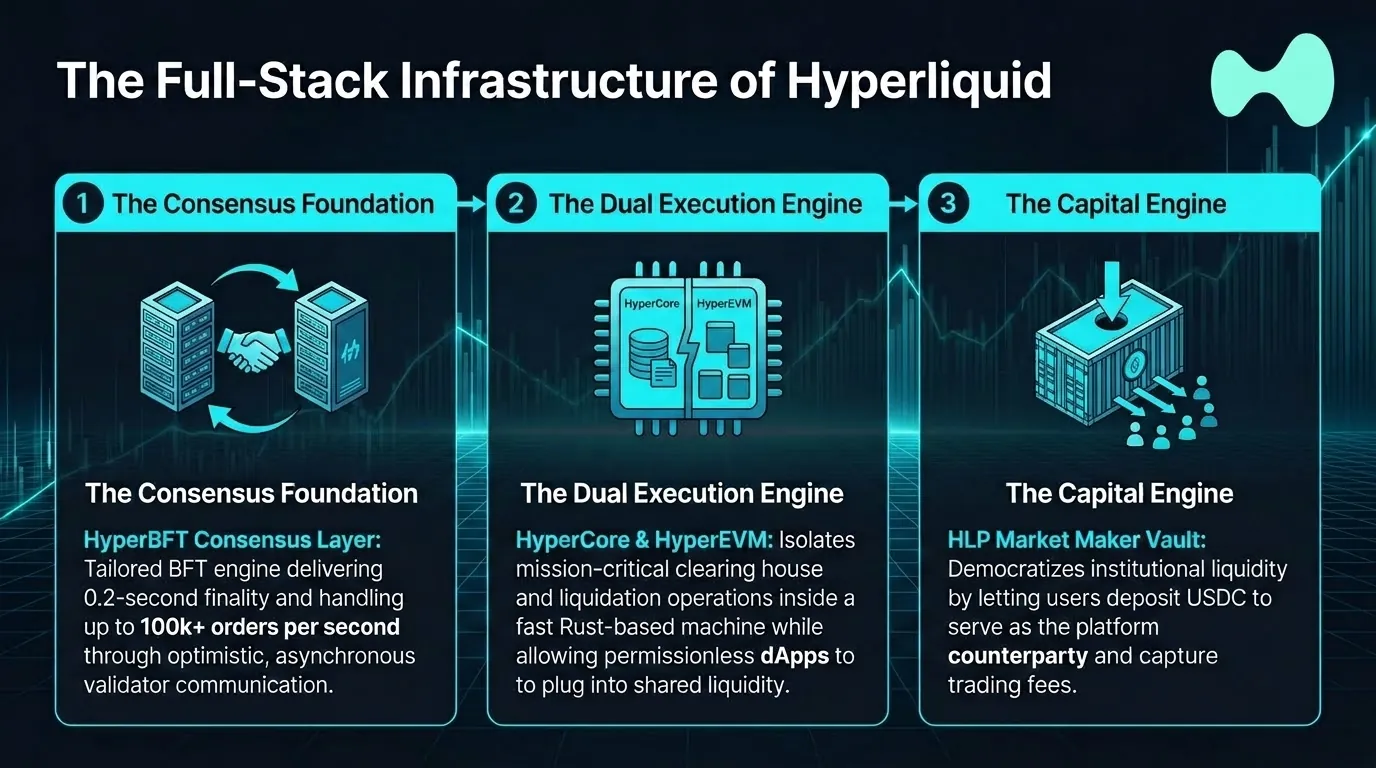
1. The Sovereign Base: HyperBFT Consensus and Architecture
At the foundation of Hyperliquid’s high-throughput architecture is its proprietary consensus layer, moving away from legacy open-source blockchain frameworks.
HyperBFT: Sub-Second Finality
The network functions using HyperBFT, a custom Byzantine Fault Tolerant consensus algorithm inspired by modern HotStuff designs. Standard proof-of-stake blockchains often operate synchronously, forcing validators to wait for discrete, fixed time windows to finalize blocks sequentially. HyperBFT uses an optimistic, responsive model: validators process and confirm transactions as fast as their network infrastructure can communicate.
The Performance Profile: This architecture enables deterministic, one-block finality in roughly 0.2 seconds.
The Throughput Scale: The core ledger handles over 100,000 orders per second, allowing high-frequency algorithmic scalpers to interact with an on-chain ledger with near-instant execution feedback.
The Central Limit Order Book (CLOB)
- Unlike decentralized exchanges that rely exclusively on passive pool algorithms, Hyperliquid runs a fully on-chain Central Limit Order Book. Every individual buy order, sell request, margin modification, and position cancellation is recorded transparently on the L1 ledger.
- This architectural decision eliminates front-running exploits or hidden execution manipulation, providing complete cryptographic visibility into the platform's matching queues.
2. Core Hyperliquid Components: HyperCore and HyperEVM
Hyperliquid segments its state execution layer into two separate but interconnected environments to isolate core financial clearing operations from general-purpose programmability.
-HyperCore: The Dedicated Matching State Machine
- HyperCore is a specialized state machine written in Rust designed to execute a single mission: managing the trading engine. It handles order matching, cross-margin calculations, funding rate balances, and liquidations.
- By stripping away general-purpose code from this layer, HyperCore operates with maximum efficiency, allowing the exchange to support trading across more than 100 digital asset and derivative pairs without experiencing network gas inflation.
-HyperEVM: The Programmability Layer for Builders
- To support a robust ecosystem of developers, the network runs the HyperEVM, a fully EVM-compatible smart contract layer built directly alongside the financial core. The HyperEVM shares the exact same validator state and consensus rules as HyperCore.
- This design allows builders to deploy decentralized applications (such as lending protocols, custom trading interfaces, or alternative yield vaults) that tap directly into the main exchange’s native liquidity index without needing to route assets across slow, risky cross-chain bridges.
3. Democratizing the House: The HLP Vault Architecture
Providing deep, continuous liquidity across a high-speed perpetual futures exchange requires complex, automated market-making support. Hyperliquid decentralizes this institutional role through the Hyperliquidity Provider (HLP) Vault.
The Automated Strategy Index
The HLP vault is a protocol-managed, USDC-denominated pool that acts as the built-in market maker and automated liquidation engine for the entire exchange. It automatically quotes real-time buy and sell spreads across all active markets, providing continuous depth for retail and institutional traders alike.
Community Capital and Profit Loops
The HLP framework democratizes access to sophisticated market-making yields. Anyone can deposit native USDC directly into the HLP vault to share in its financial performance:
- The Counterparty Position: The vault functions as "the house" inside the exchange's trading ecosystem. It takes the opposite side of open positions, meaning it scales up in value when leveraged traders experience losses or get stopped out during choppy, horizontal market action.
- The Exposure Risk: Because the vault acts as a market maker, it incurs direct market-maker risk. During sharp, sustained directional macro trends where the majority of platform traders are positioned profitably with leverage, the HLP vault functions as a net short counterparty and can experience temporary portfolio drawdowns.
4. Ecosystem Assets: The HYPE Token and Protocol Value
The native HYPE token serves as the central economic anchor and primary governance engine of the Layer 1 blockchain, distributed to the community through an extensive, point-based user airdrop program.
The tokenomics of HYPE are integrated into the network's operational security layer:
- Staking Security: HYPE functions as the primary asset used by the delegated proof-of-stake validator set to secure the HyperBFT consensus layer.
- Ecosystem Gas: While standard perpetual trading on HyperCore remains essentially gas-free for the user, interacting with custom smart contracts and decentralized applications deployed on the HyperEVM requires HYPE to settle network gas costs.
Governance Frameworks: Holders utilize HYPE to vote on core platform upgrades known as Hyperliquid Improvement Proposals (HIPs), allowing the community to democratically guide asset listings, fee allocations, and the distribution parameters of the protocol’s internal assistance funds.
Technical Comparison Matrix: Core L1 Perps Frameworks
| Technical Vector | Hyperliquid Architecture | Legacy App-Chain Models | Standard L2 Rollup Models |
| Consensus Engine | Custom HyperBFT (Optimistic) | Generic Cosmos/TenderBFT Frameworks | Derived from Ethereum Base Layer |
| Execution Speed | Sub-Second (0.2s Finality) | 1.0 - 2.0 Second Execution | Variable Layer 2 Block Delays |
| Order Book Layout | Fully On-Chain CLOB System | Mixed Off-Chain Matching / On-Chain Settlement | AMM Pool Liquidity Modules |
| Ecosystem Smart Contracts | Native Shared-State HyperEVM | Isolated Multi-Chain Modules | Unified General-Purpose EVM |
| Gas Fee Allocation | Free Core Swaps; HYPE for EVM | Local Gas Token per Transaction | Base Gas Multipliers apply |
5. Universal On-Chain Forensics and Trading Telemetry via DEXTools
- Navigating contemporary decentralized financial markets requires independent, non-custodial telemetry to track asset distribution, monitor liquidity velocity, and evaluate real-time order volume. Advanced data analytical platforms like DEXTools serve as an essential universal environment for traders, functioning independently across all public networks without anchoring to a single blockchain or project framework.
- By utilizing general diagnostic modules like the Pair Explorer, market participants can review real-time charting feeds, inspect localized order distributions, and verify automated smart contract safety metrics across an array of independent token deployments.
How to Bridge Crypto Between Chains: Complete Cross-Chain Tutorial 2026How to Use 1inch for Swaps: Classic, Fusion and Limit Orders (2026)How to Use OKX Web3 Wallet: Multi-Chain DeFi Hub Guide (2026)
Disclaimer: This article is for informational purposes only and does not constitute investment advice, financial advice, trading advice, or any other kind of advice. DEXTools does not recommend buying, selling, or holding any cryptocurrency or token. Users should conduct their own research and consult with a qualified financial advisor before making any investment decisions. Cryptocurrency investments are volatile and high-risk. DEXTools is not responsible for any losses incurred.
Related Guides
- Commodity Perps On-Chain: Gold, Oil & More on Hyperliquid
- What Is an Order Book in Crypto? Complete Guide (2026)
- AMM vs Order Book DEXs: Crypto Trade Dynamics
- What Is Hyperliquid: Complete Onchain Perps Guide (2026)
- dYdX V4 Explained: Appchain Architecture, Validators and Market Structure (2026)
Frequently Asked Questions
What is an on-chain order book?
An on-chain order book records and matches buy and sell orders directly on the blockchain rather than off-chain. This aims to make trading transparent and verifiable while keeping the familiar order book trading experience.
What are perpetual contracts?
Perpetual contracts, or perps, are derivatives that let traders bet on an asset's price without an expiry date. A funding rate is commonly used to keep the contract price close to the underlying spot price.
Why build a dedicated Layer 1 for trading?
A purpose-built Layer 1 can tune its consensus and execution for fast order matching and high throughput, which general-purpose chains may struggle to deliver. This lets the network prioritize the needs of an order book and derivatives trading.
What is a funding rate in perpetual trading?
A funding rate is a periodic payment exchanged between long and short traders that nudges the perpetual price toward the spot price. When the perp trades above spot, longs typically pay shorts, and the reverse when it trades below.