What Is Fluid Protocol? Instadapp Lending + DEX Guide 2026
— By Tony Rabbit in Tutorials
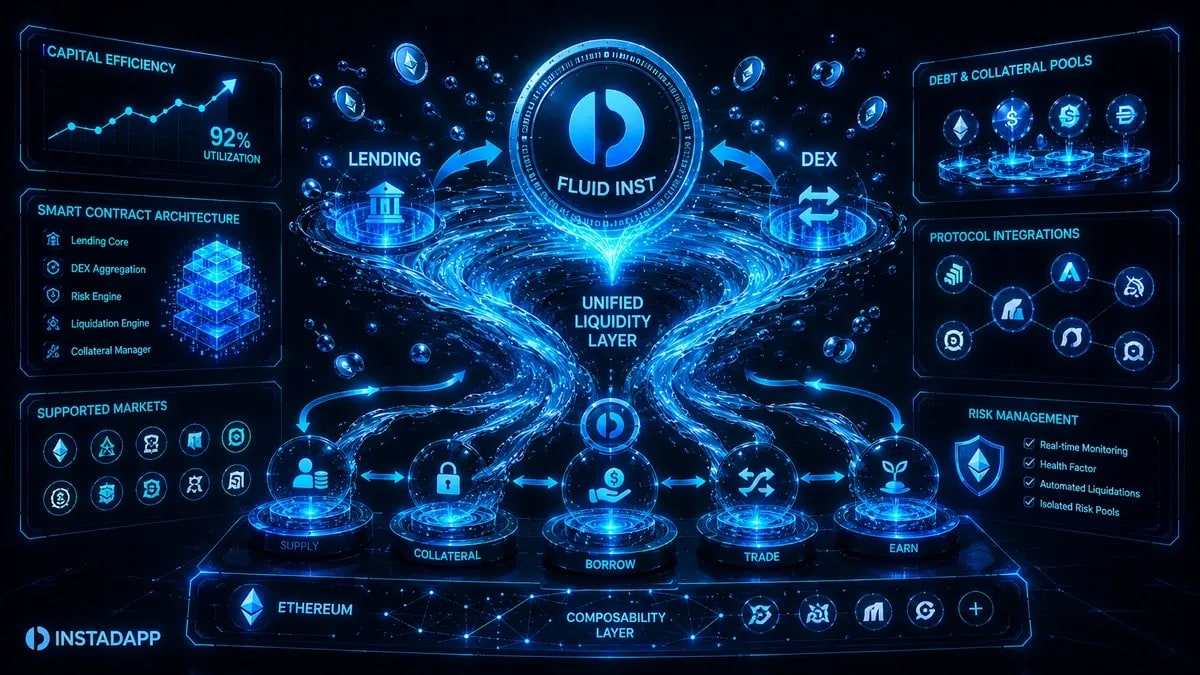
Fluid Protocol unifies lending and DEX into one liquidity layer with 3-5x capital efficiency. Smart collateral, smart debt, FLUID token explained.
Fluid Protocol is the most ambitious experiment in DeFi capital efficiency to launch since the original AMM era. Built by the team behind Instadapp, Fluid takes the two largest DeFi primitives, lending and decentralized exchange, and welds them into a single liquidity layer where the same capital can earn lending interest, collect swap fees, and back loans all at once. By May 2026, Fluid had crossed $4 billion in total value locked and become the second-largest lending protocol on Ethereum behind only Aave.
The promise sounds almost too good. Deposit ETH as collateral, borrow USDC at competitive rates, and watch your borrowed USDC quietly earn liquidity provider fees on the Fluid DEX while your ETH collateral does the same thing on the other side of the pair. Instead of capital sitting idle in a money market or stuck in a Uniswap pool, every dollar is doing three jobs simultaneously. That is the headline pitch, and it is not marketing fluff. It is a real architectural innovation that competitors are scrambling to copy.
This guide walks through what Fluid is, how the smart-collateral and smart-debt mechanisms actually function under the hood, how the INST to FLUID token migration worked, how to open a position step by step, and where the genuine risks live. Whether you are a yield farmer hunting for the best risk-adjusted returns, a developer evaluating the protocol for integrations, or a long-term DeFi believer trying to understand where the space is heading, Fluid is one of the most important protocols to understand in 2026.
What Is Fluid Protocol?
Fluid Protocol is a unified DeFi platform that combines lending, borrowing, and a decentralized exchange into a single liquidity layer. Launched in 2024 by the Instadapp team, Fluid lets the same deposited capital simultaneously serve as collateral, earn lending interest, and provide DEX liquidity, delivering capital efficiency that is three to five times higher than using Aave and Uniswap separately.
That definition is the snippet-friendly version. The longer story is that Fluid is the answer to a question DeFi builders have been asking for years: why does the same ETH sitting in a Uniswap pool have to be different ETH from the ETH backing your loan on Aave? Why does liquidity have to be siloed across protocols when the underlying token is fungible? Fluid's architecture rejects that segregation entirely. The protocol treats every deposit as multi-purpose collateral that can be referenced by lending markets, DEX trades, and vault strategies all at once, with isolated risk parameters per asset preventing contagion.
A Brief History: From Instadapp to Fluid
To understand Fluid you have to understand Instadapp. Founded in 2018 by Indian brothers Sowmay and Samyak Jain, Instadapp started as a DeFi aggregator that let users manage positions across Aave, Compound, MakerDAO, and Uniswap from a single dashboard. The product was popular, especially the smart wallet abstraction called DSA (DeFi Smart Account) that allowed complex multi-protocol strategies in one transaction.
By 2022 the team had a problem. Being an aggregator meant they were always downstream of the protocols they integrated. Margins were thin and Instadapp's INST token struggled to capture meaningful value. The Jain brothers spent 2023 quietly building something different. They were going to build the protocol that everyone else would have to integrate with.
Fluid v1 launched in late 2024 on Ethereum mainnet with a small set of ETH and stablecoin vaults. TVL grew from $50 million at launch to $1 billion by mid 2025. Then the team shipped Fluid DEX, the AMM layer that activated smart-debt yield, and TVL doubled in three months. By Q1 2026 Fluid had expanded to Arbitrum, Base, and Polygon, the INST token had migrated to FLUID, and the protocol crossed $4 billion TVL with daily DEX volume above $400 million.
The Core Innovation: Shared Liquidity Layer
Every lending protocol before Fluid worked the same way. You deposit ETH into Aave. Aave puts that ETH in a reserve. Borrowers pull USDC out of the reserve and pay interest. Your ETH sits there, earning a fraction of that interest, doing nothing else. Meanwhile if you wanted that same ETH to earn DEX fees on Uniswap, you would have to withdraw it from Aave, deposit it into a Uniswap V3 position, and now it cannot back any loan. The capital is locked into one role at a time.
Fluid breaks this assumption by making the lending layer and the DEX layer share the same vault contracts. When you deposit ETH into a Fluid vault, that ETH sits inside a unified liquidity contract. The lending market can reference it for collateralization. The DEX can reference it for liquidity. The vault can rehypothecate it within strict risk parameters. The token never moves, only the bookkeeping changes. This is why Fluid calls itself a liquidity layer rather than a lending protocol. Lending and DEX are just two views into the same underlying pool of capital.
The risk isolation is the other half of the trick. Each vault has its own collateral factor, liquidation penalty, and oracle configuration. A bad debt event in the wstETH-USDC vault cannot cascade into the ETH-USDC vault because the smart contracts treat them as separate accounting silos even though they sit on top of the same underlying liquidity. This isolated risk model is something Aave V3 partially adopted with its e-mode and isolation mode features, but Fluid takes the idea further by making isolation the default rather than the exception.
Smart Lending, Smart Collateral, and Smart Debt
Fluid has three core mechanisms that work together. Understanding them is the difference between treating Fluid as a fancy Aave clone and seeing why the protocol is genuinely different.
Smart Lending
Smart Lending is the base layer. It is a money market where suppliers deposit assets like USDC, USDT, ETH, and wstETH to earn interest, and borrowers pay that interest in exchange for borrowing. The mechanics look familiar to anyone who has used DeFi lending before. Variable interest rates respond to utilization curves. Liquidations happen when collateral falls below a threshold. What makes Smart Lending different is the isolated vault architecture. Each lending market is paired with a specific collateral type, so the wstETH-USDC market has its own liquidity, oracle, and risk parameters separate from the weETH-USDC market right next to it.
Smart Collateral
Smart Collateral is where Fluid starts diverging from traditional lending. When you deposit a collateral pair like ETH-USDC into Fluid, that pair is not just sitting there backing a loan. It is also active liquidity in the Fluid DEX for that pair. Trades that route through the ETH-USDC pool pay swap fees, and those fees accrue to your collateral position. The result is that your collateral earns yield in two ways simultaneously: it backs a loan that might be paying you nothing or even costing you a small amount, but it is also collecting LP fees from every swap in that pair.
Smart Debt
Smart Debt is the trick that pushed Fluid's TVL into the billions. Normally when you borrow money, you owe a static debt that grows with interest. Fluid takes a different approach. When you borrow a pair such as USDC-USDT through Smart Debt, the borrowed funds are immediately placed into the Fluid DEX as concentrated liquidity. The LP position is owned by you, even though the underlying tokens are debt. Every swap that routes through that USDC-USDT pool pays you fees. Those fees reduce your effective borrow rate or, when DEX volume is heavy, can flip your borrow position into a net earning position.
Picture the math. You borrow $100,000 of USDC-USDT debt at a 3% annual interest rate. That debt is automatically placed as concentrated liquidity. Daily DEX volume on that pair is $50 million and the fee tier is 0.01%. Your share of the pool's TVL gives you a pro-rata claim on those fees. If your position captures 0.5% of the pool's fee flow, that is $50 million x 0.0001 x 0.005 x 365 = $9,125 per year, or 9.1% on your $100,000 of borrowed capital. After subtracting the 3% borrow rate, your net yield is +6.1% on borrowed money. You just got paid to borrow.
Capital Efficiency Math: Fluid vs Aave Plus Uniswap
The numbers matter because Fluid's whole pitch rises or falls on whether the capital efficiency is real. Let us run a head-to-head comparison with a worked example.
Scenario: you have 100 ETH worth $300,000 at $3,000 per ETH. You want to keep ETH exposure, earn yield, and potentially borrow stablecoins for opportunistic deployment. Here is how the two approaches stack up.
This conservative example shows roughly 2x capital efficiency. When you add Smart Debt into the equation (borrowing a stablecoin pair and earning DEX fees on the debt), capital efficiency climbs to 3-5x in active strategies. The exact ratio depends on the volatility regime, fee tier, and how aggressively you stack Smart Collateral on top of Smart Debt. In a high-volume market, real-world Fluid users have reported effective yields that would be mathematically impossible on the Aave plus Uniswap path.
FLUID Tokenomics and the INST Migration
The INST to FLUID migration is one of the cleaner token rebrand stories in DeFi. The Instadapp brand had become associated with the aggregator product, which was a smaller business than the new Fluid protocol. Rather than try to drag the legacy brand forward, the team proposed a full rename and a fresh tokenomics model in a governance vote that passed with over 90% approval in January 2026.
The conversion ratio was 1:1. Every INST token became one FLUID token automatically through a migration contract that holders could call directly or wait to have called on their behalf by exchanges. The total supply remained capped, and the same vesting schedules carried over for team and investor allocations. What changed was the value accrual mechanism. INST had been a governance token with limited fee capture. FLUID introduced direct revenue sharing where a portion of protocol revenue (lending interest spread, DEX swap fees, liquidation fees) flows to FLUID stakers who lock their tokens.
By May 2026, around 35% of circulating FLUID was staked, and weekly revenue distributions had reached the equivalent of a 12-18% annualized yield depending on protocol activity. The token also retained governance rights, with FLUID stakers voting on new vault deployments, risk parameter changes, and treasury spending. This combination of fee capture and governance turned FLUID into one of the better-performing DeFi tokens of the cycle, outperforming UNI, AAVE, and MKR over a six-month window.
Top Vaults by TVL in 2026
Fluid has dozens of vaults, but a handful dominate the TVL rankings. These are the workhorses where the majority of protocol activity flows.
The flagship vault. Deepest liquidity, tightest spreads, highest DEX volume. Ideal for users who want max optionality and proven battle-tested risk parameters.
Liquid-staked ETH collateral that earns Lido staking yield on top of Fluid smart-collateral fees. Best for ETH holders who want maximum stacked yield.
EtherFi restaked ETH collateral. Adds Eigenlayer points and restaking yield to the stack. Higher complexity, higher reward, more dependency layers.
Ethena's staked USDe as collateral. Combines Ethena delta-neutral yield with Fluid smart collateral. Pure stablecoin pair, minimal IL risk, attractive for yield maximalists.
Beyond these four, additional vaults of note include cbBTC-USDC (Coinbase wrapped Bitcoin paired with USDC), the rsETH-USDC vault using KelpDAO restaked ETH, and a growing list of LST-LST vaults like wstETH-weETH that let users speculate on the LST premium curve while earning fees. Each new vault goes through a governance vote, an audit window, and a phased rollout where deposit caps increase gradually as the vault proves stable.
Fluid DEX vs Uniswap V4
The Fluid DEX is not just a side feature. It is a genuine competitor to Uniswap V4 on the dimensions that matter most: capital efficiency, gas cost, and integration with credit. Where Uniswap V4 introduced hooks to let developers customize AMM behavior, Fluid took a different path. It made the AMM tightly coupled with a lending market so that liquidity providers can simultaneously borrow against their positions, and borrowers can earn AMM fees on their debt.
Concentrated liquidity works similarly in both protocols. LPs specify a price range and their capital is concentrated within that band, earning higher fee density when prices stay in range. The differences appear in the surrounding architecture. Uniswap V4 LPs receive an NFT representing their position, and that NFT can be used as collateral in third-party protocols if those protocols decide to accept it. Fluid LPs effectively get the same benefit natively, because the LP position is the collateral position. No extra integration layer is needed.
For traders, the comparison is more nuanced. Uniswap V4 hooks enable custom logic like dynamic fees, MEV protection, and limit orders that Fluid does not currently offer. Fluid wins on raw price for the pairs it supports because Smart Debt LPs are paid extra yield by the lending side, which subsidizes tighter spreads. For high-volume stablecoin pairs especially, Fluid often beats Uniswap V4 on execution price in 2026, which is why 1inch and other aggregators route a significant share of stablecoin volume through Fluid.
The Liquidation Engine: Dutch Auctions with Rebalancing
Liquidations are the boring part of lending protocols that nobody thinks about until something breaks. Fluid's design here is one of the more underrated parts of the system. Where Aave and Compound use a flat liquidation bonus (typically 5-15%) paid to liquidators who repay debt and seize collateral, Fluid uses a Dutch auction model combined with internal rebalancing.
When a position falls below the liquidation threshold, the protocol does not immediately hand out a fat bonus to the first liquidator. Instead it starts a Dutch auction where the price the liquidator pays for the collateral starts very close to fair value and decays over a short window. Bots compete to be the first to take the trade at a price that just barely covers their costs, including gas. This pushes the liquidation penalty paid by the borrower down to near zero in active markets, often 1-2% instead of the 5-15% that other protocols charge.
The rebalancing piece is even smarter. Because liquidity in Fluid is shared between the lending layer and the DEX, partial liquidations can sometimes be handled internally by routing the collateral through the DEX rather than handing it to an external liquidator at all. This further reduces the cost of being liquidated and is particularly valuable in volatile markets where being liquidated should not be a portfolio-destroying event. Borrowers who get liquidated on Fluid typically lose 1-3% of their position rather than 10-15%, which is a meaningful improvement.
Step-by-Step: Opening Your First Fluid Position
Theory is fine, but the only way to internalize how Fluid works is to walk through opening a position. Here is the exact flow for supplying ETH as collateral and borrowing USDC against it, with smart-debt yield activated.
Step 1: Connect wallet at fluid.io. Visit the official site (always check the URL because phishing is endemic in DeFi). Click Connect and choose your wallet. The protocol supports MetaMask, Rabby, Coinbase Wallet, and most WalletConnect-compatible options. Make sure your network is set to Ethereum mainnet or whichever Fluid deployment you want to use.
Step 2: Choose a vault. Browse the available vaults and pick one that matches your asset and risk tolerance. For this walkthrough we use the ETH-USDC vault. Click into the vault detail page to see the current supply APY, borrow APY, max loan-to-value, liquidation threshold, and total TVL. Make sure you read the risk parameters before depositing.
Step 3: Approve the token. Fluid uses standard ERC-20 approval. You will need to send an approve transaction that lets the Fluid vault contract spend your ETH (or WETH wrapper). This is a one-time approval per token per vault. Consider using Permit2 if available to limit approval scope and time, which reduces your attack surface from a wallet drain perspective.
Step 4: Supply collateral. Enter the amount of ETH you want to deposit. The interface shows your projected smart-collateral yield (base lending APY plus expected DEX fee share). Confirm the deposit transaction. Ethereum gas fees for this transaction typically run $5-30 depending on network conditions.
Step 5: Borrow USDC (or activate smart debt). Once collateral is supplied, you can borrow against it. The interface shows your maximum borrow capacity, your projected liquidation price, and your health factor. For Smart Debt, choose a debt pair like USDC-USDT instead of a single asset. The borrowed funds are automatically placed in the DEX as concentrated liquidity, and the projected net yield (DEX fees minus borrow interest) is displayed.
Step 6: Monitor health factor. After borrowing, your dashboard shows the position health factor. Keep it well above 1.0 (typically above 1.5 for comfortable margin). If ETH price drops, the health factor decreases. If it hits 1.0, you become liquidatable. Set alerts and consider using liquidation zone calculators to plan your tolerance.
Multi-Chain Expansion: Where Fluid Lives
Fluid started on Ethereum mainnet because that is where the deepest liquidity and the most demanding users lived. Throughout 2025 and 2026 the team expanded carefully, prioritizing chains with real DeFi activity rather than spraying deployments across every L2 with an airdrop budget.
Ethereum mainnet remains the largest deployment by TVL, holding roughly 60% of total protocol value. Arbitrum came next and quickly became the most active deployment by transaction count, with cheap gas making the Smart Debt mechanism especially attractive for smaller positions where Ethereum gas costs would eat the yield. Base launched in mid-2025 and has grown rapidly thanks to Coinbase user inflows. Polygon was added in late 2025 with a focus on stablecoin pairs.
The team has been deliberate about not deploying to chains where they cannot guarantee oracle quality and liquidity depth. Fluid's safety model depends on accurate price feeds (it uses Pyth and Chainlink together for redundancy) and on having enough DEX liquidity to handle liquidations without cascading price impact. Chains that cannot meet that bar do not get a deployment, which is part of why Fluid avoided some of the more obscure L2 deployments that other protocols rushed into.
Fluid vs Aave V3 vs Spark vs Uniswap V4
How does Fluid actually stack up against the major alternatives users might consider? Here is the honest comparison.
Aave still wins on absolute size and battle-tested resilience. Anyone parking eight or nine figures wants the deepest liquidity and the longest security track record, both of which favor Aave. Fluid wins on capital efficiency and innovative product, which favors smaller and more active users who can extract real value from the layered yield mechanics. Spark is essentially a focused MakerDAO subsystem optimized for DAI/USDS lending, valuable in its niche but narrower than either Aave or Fluid. Uniswap V4 is a different category entirely: it is a DEX with no lending, so the comparison is really about whether you would route trades through Fluid DEX or Uniswap V4 (often you would do both via an aggregator).
The Real Risks of Fluid Protocol
No discussion of Fluid is complete without an honest look at where it can hurt you. The protocol is genuinely innovative, which is another way of saying it has more novel attack surface than the boring battle-tested alternatives.
Smart contract risk. Fluid is younger than Aave and has more complex code due to the lending-DEX integration. The protocol has been audited by multiple firms including Trail of Bits, Spearbit, and OpenZeppelin, but no audit catches everything. The first major exploit in Fluid's history, when it happens, will reveal something nobody anticipated. This is true of every DeFi protocol but the surface area on Fluid is materially larger.
Impermanent loss on smart collateral and smart debt. When your collateral or debt is actively LPing in the DEX, it is subject to impermanent loss just like any other LP position. The yield from swap fees often more than compensates for IL, but in directional markets where one asset moves sharply against the other, IL can exceed accumulated fees. Users who do not understand IL should not use Smart Debt or Smart Collateral on volatile pairs.
Multi-protocol attack surface. Fluid integrates with oracles (Pyth and Chainlink), liquid staking protocols (Lido, EtherFi, KelpDAO), and underlying token issuers (USDC, USDT, USDe). A failure or exploit at any of these dependencies can cascade into Fluid. The wstETH-USDC vault, for example, has tail risk that depends on Lido continuing to function correctly. The sUSDe-USDC vault depends on Ethena's hedging mechanism staying intact.
Liquidation cascade risk. Even with the Dutch auction model, a sudden 30-50% price crash could overwhelm the liquidation system, especially on smaller chains where liquidity is shallower. Fluid uses conservative LTV ratios to mitigate this, but tail risk is never zero. The 2022 stETH depeg episode and the 2023 USDC depeg episode both demonstrated that even "safe" assets can disconnect from their pegs and trigger cascading liquidations.
Oracle manipulation. Fluid uses dual oracles (Pyth pull and Chainlink push) with various safeguards, but oracle manipulation remains a vector. The protocol has additional protections like time-weighted averages and divergence checks, but a sophisticated attacker with enough capital might still find an angle.
Regulatory risk. Fluid is fully on-chain and non-custodial, but regulators in some jurisdictions have shown increased interest in DeFi lending and DEX trading. The protocol does not require KYC, which is a feature for users but a potential regulatory target depending on jurisdiction. Users should understand the rules in their own country before using Fluid.
Pros and Cons of Fluid Protocol
- 3-5x capital efficiency vs Aave plus Uniswap separately
- Smart Debt can flip borrowing into net yield positive
- Liquidation penalty 1-3% instead of 5-15%
- Isolated risk per vault prevents contagion
- FLUID token captures real protocol revenue
- Multi-chain on Ethereum, Arbitrum, Base, Polygon
- More complex mechanism increases mental overhead
- Smart Debt has IL risk like any LP position
- Newer protocol with less battle testing than Aave
- Larger attack surface from lending-DEX integration
- Vault selection requires understanding LST stack
- High gas costs on Ethereum mainnet
Use Cases: Who Is Fluid Actually For?
Fluid is not a one-size-fits-all protocol. Different user profiles get very different value from it.
Yield maximalists are Fluid's core audience. If you are the kind of user who optimizes APY across multiple protocols, manages LP positions, rotates between vaults, and tracks IL carefully, Fluid offers the highest sustainable yield in DeFi for blue-chip assets like ETH and stablecoins. The Smart Collateral plus Smart Debt combination is unbeatable on a per-dollar basis. Just make sure you understand what you are doing.
Stablecoin farmers use Fluid for stablecoin-stablecoin pairs that have minimal IL but still generate meaningful DEX fees on high-volume routes. The sUSDe-USDC and USDC-USDT vaults are particularly attractive here, with effective yields often beating Curve and Convex on the same underlying assets.
ETH leveragers use Fluid for the leveraged ETH staking trade. Deposit wstETH, borrow ETH, swap to wstETH, redeposit. Repeat to scale up Lido staking yield via leverage. Fluid's low liquidation penalty and competitive borrow rates make this trade more sustainable than it would be on Aave.
Protocol integrators use Fluid as a DEX backend. Aggregators like 1inch and Paraswap route a meaningful share of stablecoin volume through Fluid because the prices are often the best available, thanks to the smart-debt liquidity subsidy.
FLUID stakers are users who do not necessarily want to LP or borrow, but want exposure to protocol growth. Locking FLUID earns a share of protocol revenue, which is real cash flow tied to actual usage rather than emissions-based farming.
Best Practices for Using Fluid Safely
Some practical guidelines based on how experienced users navigate the protocol without getting burned.
First, start small. Open a position with an amount you would be comfortable losing entirely. This lets you internalize the mechanics, watch how your health factor moves, and observe the actual realized yield over a couple of weeks before scaling up.
Second, understand your vault's specific risks. A wstETH-USDC vault has different risks from a sUSDe-USDC vault. Read the documentation for the specific underlying assets, audit history, and any unusual mechanism. A protocol-wide safety statement is not the same as understanding the specific oracle and liquidation parameters of your vault.
Third, monitor your health factor actively. Set up alerts using DeFi Saver, Hypernative, or a Dune dashboard. Automated alerts pay for themselves the first time they save you from liquidation.
Fourth, do not max out leverage. A conservative 50-60% LTV gives you plenty of buffer. The marginal yield from running at maximum leverage is rarely worth the increased liquidation risk.
Fifth, separate your DeFi wallet from your main holdings. Use a fresh address for active positions so that if something goes wrong (phishing, drained approval, exploit), the blast radius is contained. The crypto wallet security best practices apply doubly when interacting with novel protocols.
Where Fluid Is Heading Next
The Fluid roadmap for 2026 includes several initiatives worth tracking. The team has signaled that tokenized real-world assets will be added as collateral types, starting with tokenized US Treasuries from issuers like Ondo Finance. This would unlock institutional capital that wants on-chain yield without crypto-native volatility.
Cross-chain Fluid is another active workstream. The team is exploring shared liquidity across chains via interoperability layers, which would let a position on Arbitrum be backed by liquidity on Ethereum.
The Fluid DEX is also expected to add features that bring it closer to parity with Uniswap V4 on flexibility, including dynamic fee tiers, native limit orders, and a hooks-equivalent system for builders.
Video: Fluid Protocol Explained
Visual walkthrough of how Fluid Protocol combines lending and DEX into a unified liquidity layer.
Frequently Asked Questions
Q What is Fluid Protocol in simple terms?
Fluid Protocol is a DeFi platform built by the Instadapp team that combines lending and a decentralized exchange into a single liquidity layer. The same capital you deposit can earn lending interest, collect DEX swap fees, and back loans simultaneously, delivering 3-5x more capital efficiency than using Aave and Uniswap separately.
Q How is Fluid different from Aave?
Aave is a pure lending protocol where deposited assets sit in reserves and earn only lending interest. Fluid integrates a native DEX so that deposited collateral can also earn swap fees through smart-collateral, and borrowed assets can be deployed as DEX liquidity through smart-debt. Fluid also has isolated per-vault risk and lower liquidation penalties (1-3% vs Aave's 5-15%).
Q What is smart debt on Fluid?
Smart debt is a Fluid feature where the assets you borrow are automatically placed in the Fluid DEX as concentrated liquidity. Every swap that routes through your debt pair pays you LP fees that offset (and sometimes exceed) your borrow interest. In high-volume markets, smart debt can flip your position into earning yield on borrowed capital.
Q What happened to the INST token?
The INST token migrated to FLUID at a 1:1 ratio in January 2026 after a governance vote with over 90% approval. Total supply and vesting schedules carried over unchanged. The new FLUID token added direct protocol revenue sharing for stakers, giving holders a claim on lending interest spread, DEX swap fees, and liquidation fees.
Q Is Fluid Protocol safe?
Fluid has been audited by Trail of Bits, Spearbit, and OpenZeppelin, uses dual oracles (Pyth and Chainlink), and operates with isolated risk per vault. However it is a newer protocol with more complex mechanics than Aave or Compound, which means more attack surface. Users should start with small positions, monitor health factors, and understand the specific risks of each vault they use.
Q What is the Fluid Protocol TVL in 2026?
As of May 2026, Fluid Protocol holds approximately $4 billion in total value locked across Ethereum, Arbitrum, Base, and Polygon. The largest vaults are ETH-USDC (~$1.2B), wstETH-USDC (~$780M), weETH-USDC (~$540M), and sUSDe-USDC (~$420M). Fluid is the second-largest lending protocol on Ethereum behind Aave.
Q Can I use Fluid Protocol on Layer 2?
Yes. Fluid is deployed on Arbitrum, Base, and Polygon in addition to Ethereum mainnet. Layer 2 deployments have lower gas costs, making smaller positions and frequent rebalancing more economical. Each chain has its own set of vaults, with Ethereum holding the deepest liquidity and Arbitrum being the most active by transaction count.
Q What is smart collateral?
Smart collateral is collateral deposited on Fluid that simultaneously serves as DEX liquidity in the Fluid AMM. Your collateral backs your loan while also earning swap fees from trades routed through the same pair. This effectively gives the same capital two yield streams: lending interest plus DEX fees, without forcing the user to split capital across protocols.
Q What is the FLUID token used for?
FLUID is the governance and revenue-share token of Fluid Protocol. Holders can stake FLUID to earn a portion of protocol revenue (lending interest spread, DEX swap fees, liquidation fees), and they can vote on governance proposals including new vault deployments, risk parameter changes, and treasury spending. By May 2026 around 35% of circulating FLUID is staked.
Q How does Fluid avoid impermanent loss?
Fluid does not eliminate impermanent loss. Smart-collateral and smart-debt positions are real LP positions and are subject to IL just like any AMM liquidity. What Fluid offers is a fee yield that is often high enough to compensate for IL in non-directional markets, plus concentrated liquidity ranges that let LPs control their exposure. Users on volatile pairs should monitor IL carefully relative to accumulated fees.
Q Can I deposit liquid staking tokens on Fluid?
Yes. Fluid supports the major liquid staking tokens as collateral, including wstETH (Lido), rETH (Rocket Pool), weETH (EtherFi), and rsETH (KelpDAO). Using LSTs as smart collateral stacks Lido or EtherFi staking yield on top of Fluid lending interest and DEX fees, creating one of the highest-yielding ETH strategies available in DeFi.
Q What is the liquidation penalty on Fluid?
Fluid uses a Dutch auction liquidation model where the price liquidators pay starts near fair value and decays. This compresses the effective liquidation penalty to roughly 1-3% in most market conditions, dramatically lower than the 5-15% on Aave or Compound. The protocol can also rebalance some positions internally via the DEX, reducing the cost of being liquidated even further.
Conclusion: Why Fluid Matters
Fluid Protocol represents one of the most important architectural shifts in DeFi since the original AMM design. By collapsing the artificial wall between lending and DEX, Fluid lets capital work harder than it can in any siloed protocol. The Smart Collateral and Smart Debt mechanisms are not marketing tricks. They are real mathematical improvements in capital efficiency that translate into higher sustainable yields, lower borrowing costs, and a more flexible toolkit for sophisticated users.
The protocol is not without risk. Newer mechanisms mean newer attack vectors. The complexity is higher than Aave's, and users need to understand impermanent loss, oracle dependencies, and vault-specific parameters before deploying meaningful capital. But for users willing to invest the time to understand the system, Fluid offers something genuinely new: a unified liquidity layer that treats every dollar of capital as multi-purpose, not single-use.
Whether Fluid catches Aave on absolute TVL is an open question. What is no longer in doubt is that Fluid has proven the unified lending-plus-DEX model works at scale. The next phase of DeFi will be shaped by which protocols figure out how to do more with less capital, and Fluid is the current state of the art. If you have not opened a small test position, you are missing the most important experiment in DeFi capital efficiency since concentrated liquidity arrived in 2021.
Related Guides
- What Is Suilend? Sui Lending Protocol & SEND Token Guide 2026
- What Is Spark Protocol? Sky, USDS & DeFi Lending Guide 2026
- What Is MakerDAO: Complete Decentralized Lending Protocol Guide (2026)
- What is Compound (COMP)? Lending Protocol Beginner Guide
- Aave Protocol Explained: V3, GHO, Risk Modes and How the Market Works (2026)