What Is Gas Price (Gwei): Complete Ethereum Fees Guide (2026)
— By Tony Rabbit in Tutorials
What is gas price in Gwei? Complete 2026 Ethereum fees guide: EIP-1559 base fee plus priority fee, gas limit vs gas price, mempool dynamics, Layer 2 fees and how to estimate gas.
Every action you take on Ethereum costs money. Sending tokens, swapping on a DEX, minting an NFT, or interacting with any smart contract requires you to pay a fee called gas. That fee is denominated in a tiny unit of ether called Gwei, and understanding how it works is the difference between paying $2 for a transaction and accidentally burning $80 on the exact same swap.
In 2026, Ethereum gas mechanics are radically different from what they were just three years ago. The old "gas price auction" model where you guessed a number and hoped your transaction got mined is dead. Today, the network uses an algorithmic base fee introduced by EIP-1559, layered with optional priority tips that fuel an entire MEV economy. Layer 2 networks have crashed transaction costs by more than 90% thanks to Dencun blobs, and Pectra has reshaped staking economics in ways that ripple back into gas demand.
This complete guide breaks down everything you need to know about Ethereum gas in 2026: what Gwei actually is, how the base fee and priority fee work after EIP-1559, why Dencun changed Layer 2 economics forever, how to set gas correctly in MetaMask, how to avoid being a victim of gas wars during memecoin launches, and exactly which tools to use to never overpay again. By the end, you will read a gas tracker like a pro and know when to wait, when to push, and when to move to Layer 2.
What Is Gas Price and What Is Gwei?
Gas is the unit of computational work on Ethereum. Every operation a smart contract performs, from a simple addition to a complex storage write, has a fixed gas cost defined by the Ethereum Virtual Machine (EVM). A standard ETH transfer costs 21,000 gas. A Uniswap swap costs roughly 150,000 gas. Minting a complex NFT can cost 300,000 gas or more. These numbers do not change based on network conditions. What changes is the price you pay for each unit of gas.
The total fee you pay is calculated by a simple formula: gas used multiplied by gas price. Gas used is determined by the EVM based on what your transaction does. Gas price is the amount you are willing to pay per unit of gas, denominated in Gwei. If your swap consumes 150,000 gas and the gas price is 30 Gwei, your fee is 150,000 multiplied by 30 Gwei, which equals 4,500,000 Gwei, or 0.0045 ETH. At a $3,500 ETH price, that is roughly $15.75.
Gwei is short for "gigawei" and it is one billion wei. Wei is the smallest indivisible unit of ether, similar to how a satoshi is the smallest unit of Bitcoin. The reason gas prices are quoted in Gwei rather than ETH is practical: gas prices are tiny fractions of an ether, and using Gwei keeps the numbers human-readable. Saying "the gas price is 25 Gwei" is far more useful than saying "the gas price is 0.000000025 ETH."
Wei, Gwei, ETH: The Denominations You Need to Know
Ether is divisible into smaller and smaller units, much like a dollar is divisible into cents. The smallest indivisible unit is the wei, named after computer scientist Wei Dai, one of the cypherpunk pioneers who inspired Bitcoin's creation. One ether is equal to 1,000,000,000,000,000,000 wei, or 10 to the 18th power wei. That is a quintillion. Working with such large numbers would be impractical, so Ethereum defines several intermediate units.
The three units you actually need to know are wei, Gwei, and ether. Wei is used internally by smart contracts and rarely displayed in user interfaces. Gwei is what you see in gas trackers, MetaMask, and Etherscan. Ether is the unit of account when you talk about balances, prices, and large amounts. There are other named units in between, like kwei, mwei, szabo, and finney, but no modern wallet or block explorer surfaces them. Stick with wei, Gwei, and ETH and you will never get confused.
To convert between units, just remember the scale. One Gwei equals one billion wei. One ether equals one billion Gwei. So if a gas tracker says the current price is 30 Gwei, that is 30,000,000,000 wei, or 0.00000003 ETH. Multiply by the gas used and you have your fee. Most wallets and explorers do this math automatically, but knowing the relationship lets you sanity-check what you are being shown and catch interface bugs that occasionally inflate displayed fees.
EIP-1559: Base Fee and Priority Fee Explained
Before August 2021, Ethereum gas was a wild auction. You would guess a gas price, submit your transaction, and hope a miner picked it up. If you guessed too low, your transaction would sit in the mempool for hours or fail entirely. If you guessed too high, you wildly overpaid. Wallets tried to help with "fast," "standard," and "slow" estimates, but the system was opaque and unpredictable, especially during high-demand events like NFT mints.
EIP-1559 changed everything. Activated in the London upgrade, it replaced the auction with an algorithmic pricing model. Now every block has a base fee that is automatically calculated by the protocol based on how full recent blocks have been. If the previous block was more than 50% full, the base fee increases by up to 12.5%. If it was less than 50% full, the base fee decreases by up to 12.5%. This creates a smooth, predictable response to demand.
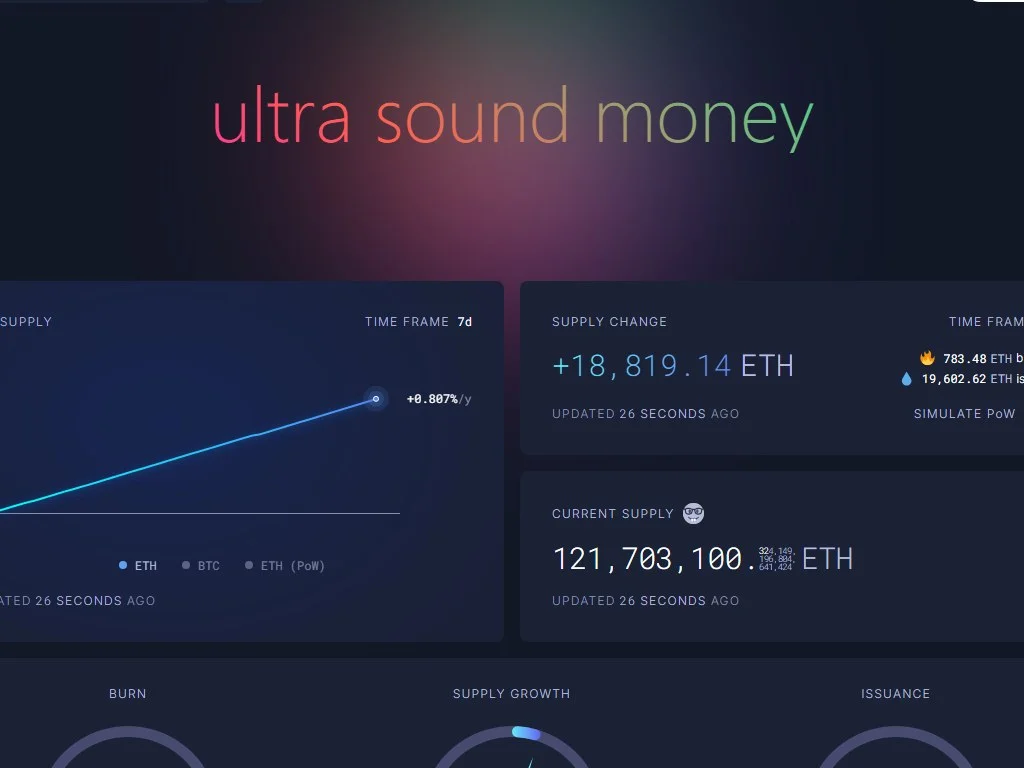
Crucially, the base fee is burned. It is not paid to validators. The ETH is permanently removed from circulation, which has destroyed millions of ETH since the upgrade and is one of the reasons ETH has become deflationary during periods of high network use. On top of the base fee, users can add an optional priority fee, also called a "tip," which goes directly to the validator who includes their transaction. This tip is what creates the priority ordering inside a block.
This is why MetaMask shows you three fields when you customize gas in 2026: max base fee, priority fee, and max fee. The max base fee is your ceiling for the burned portion. The priority fee is the tip you offer validators. The max fee is the overall ceiling for the transaction. If the base fee at inclusion time is lower than your ceiling, you only pay what is needed and the difference is refunded. This is a fundamental improvement over the pre-EIP-1559 model, where overpaying meant you actually lost that ETH.
Dencun, Blobs, and the L2 Gas Crash
The single biggest change to Ethereum economics in the last few years happened with the Dencun upgrade in March 2024, which activated EIP-4844, also known as proto-danksharding. This introduced a brand new transaction type called a blob-carrying transaction. Blobs are large chunks of data that Layer 2 rollups use to post their compressed batches back to Ethereum.
Before Dencun, rollups had to post their transaction data as expensive calldata, which competed with regular transactions for blockspace and drove L2 fees up to $1 or more during congestion. With blobs, that data is posted to a separate fee market that does not compete with normal transactions. Blob fees are typically 10 to 100 times cheaper than the equivalent calldata. The result was immediate and dramatic: Base, Arbitrum, Optimism, and other rollups saw transaction costs drop from $0.50 to $0.005 overnight.
By 2026, virtually all major rollups have optimized their batch posting to take maximum advantage of blob space. Routine L2 swaps now cost a fraction of a cent. This is the single most important development for Ethereum scaling and it directly explains why nearly all retail DeFi activity has migrated to Layer 2. The mainnet is increasingly reserved for high-value transactions, rollup settlements, and institutional flow that can absorb the higher base fees.
Pectra and What It Means for Gas
The Pectra upgrade further refined this picture. Pectra raised the target and maximum blob count per block, giving rollups even more breathing room and pushing blob fees lower during normal conditions. It also introduced max effective balance, which lets validators consolidate stakes up to 2,048 ETH per validator. While that change mainly affects staking operators, it has a knock-on effect on gas: fewer total validators reduce overhead on attestation processing, marginally freeing up execution-layer resources. The practical result for users in 2026 is that L2 fees are routinely below one cent and L1 base fees rarely spike outside of major launches or liquidations.
Pectra also bundled in EIP-7702, which introduced account abstraction features to externally-owned accounts (EOAs). In practice this means your standard MetaMask wallet can now temporarily act like a smart contract wallet for a single transaction, enabling sponsored gas payments, transaction batching, and signature-based authorization without redeploying to a new wallet. The gas implication is significant: many routine actions that used to require two or three separate transactions can now be bundled into one, cutting effective fees by 30 to 50%. Wallets like Rabby, Safe, and the latest MetaMask have already integrated EIP-7702 flows for token swaps and DeFi deposits.
It is worth flagging that all of these upgrades happen at the protocol level and require no action from end users. You do not need to "opt in" to EIP-1559, blobs, or EIP-7702. The moment they activate, every wallet, every dApp, and every transaction on the network operates under the new rules. The downside is that legacy guides, including some still-popular YouTube tutorials and Medium articles, continue to teach outdated mechanics like manual gas price auctions or gas tokens. If you read crypto content older than 2024 about gas, assume it is wrong until proven otherwise.
How to Read Gas Prices: Etherscan and Blocknative
The best way to know what you should pay is to check a gas tracker before submitting any transaction. Three tools cover 99% of what you need: Etherscan Gas Tracker, Blocknative Gas Estimator, and ultrasound.money for a longer-term view of network conditions.
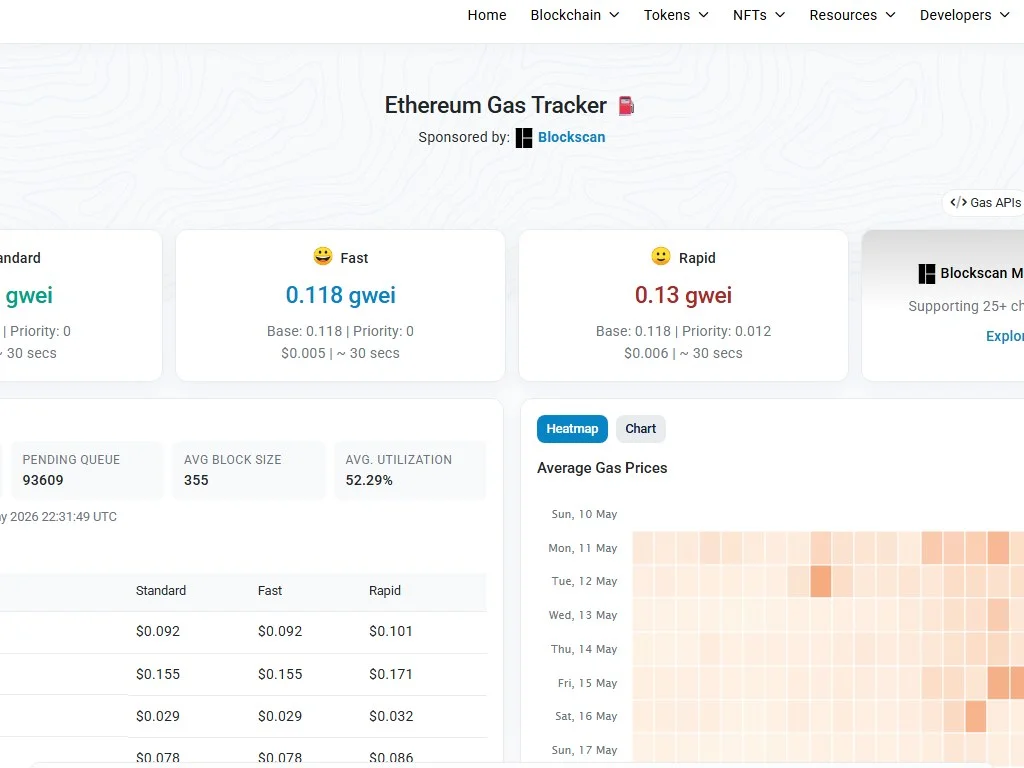
The Etherscan Gas Tracker at etherscan.io/gastracker shows three rows: low, average, and high. Each row gives a recommended gas price in Gwei, along with an estimated confirmation time. Below those rows you will find a live chart of base fee over time and a list of the most gas-guzzling contracts. If you are doing a routine transaction and do not care about being included immediately, the "low" estimate is almost always sufficient. If you are sniping a memecoin or front-running a liquidation, you need the "high" tier or even higher.
Blocknative is more sophisticated. It uses real-time mempool data and historical inclusion patterns to give probabilistic estimates. It will tell you that a 95th-percentile transaction at the current moment requires 32 Gwei, while a 70th-percentile transaction needs only 24 Gwei. This level of granularity is invaluable for power users and arbitrage bots. For most users, Etherscan is enough.
Reading the Mempool
For really granular control, advanced users monitor the mempool directly using tools like mevboost.pics, Eden Network's explorer, or self-hosted nodes running Geth or Reth with txpool inspection. Watching the mempool lets you see exactly what other users are bidding right now, before transactions are confirmed. If you see a sudden flood of high-tip transactions, that is your signal that a major event is happening, such as an NFT mint or a token launch, and you should either delay or aggressively raise your tip to compete.
Another underrated tool is the gas history view inside Dune Analytics dashboards. Several public dashboards graph base fee over the previous 30 days with hourly granularity. Reviewing these historical patterns reveals weekly cycles, holiday slowdowns, and recurring spike events like CPI release days or major liquidation cascades. If you can shift a non-urgent transaction by 6 to 12 hours into a known low-base-fee window, you routinely save 40 to 60% on fees with zero downside.
When Gas Estimates Are Wrong
Gas estimators are not perfect. They rely on recent block data and assume conditions will remain similar over the next few seconds or minutes. When a major event suddenly increases demand, like a viral memecoin launch or a chain reorg, estimates lag reality. You can submit a transaction with what looked like a healthy max fee and watch it sit in the pending queue for half an hour because the actual base fee jumped. The cure is to monitor the next-block forecast (Etherscan shows this), not just the current price, and set your max base fee at least 2x the next-block prediction during volatile periods.
Layer 2 vs Layer 1: Where to Actually Transact in 2026
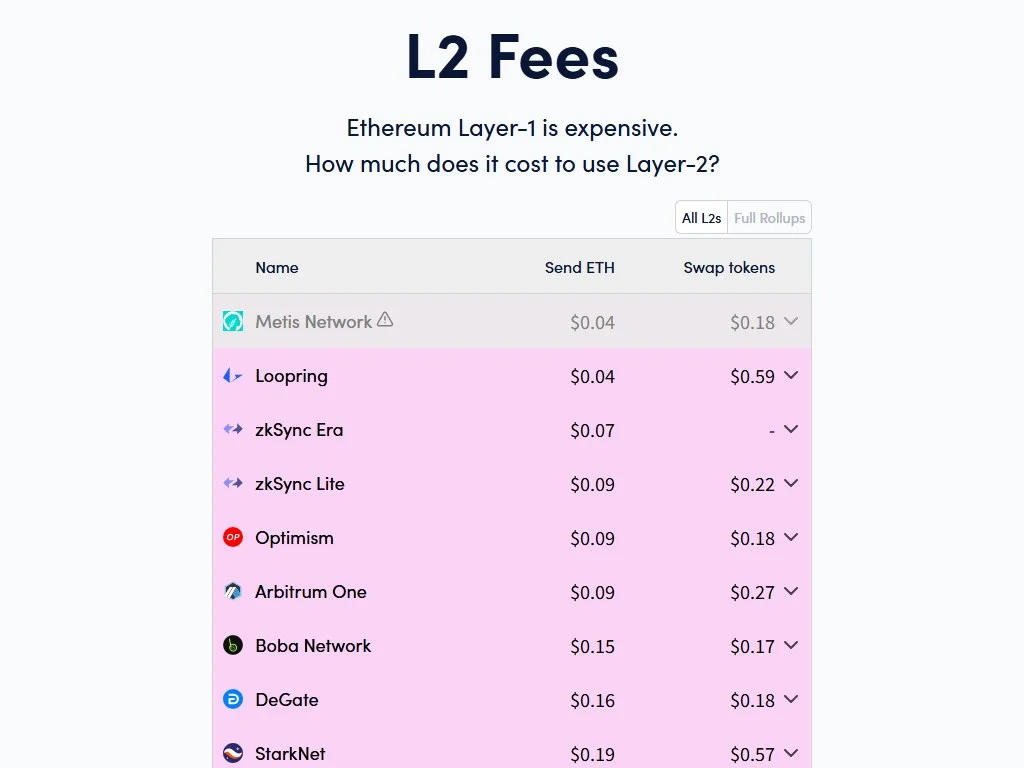
In 2026, Ethereum mainnet is the settlement layer. Almost everything retail-oriented happens on Layer 2. The gas cost difference is so extreme that paying mainnet fees for routine DeFi activity is essentially throwing money away. Here is what you can expect to pay for the same operations across the major networks.
The takeaway is brutal but simple: if you are still routinely making swaps on Ethereum L1, you are leaving money on the table. The only reasons to transact on L1 in 2026 are settlement of large-value transactions where the fee is negligible as a percentage of the trade, interactions with protocols that still only exist on mainnet, and bridging in and out of L2s. For everything else, pick a Layer 2 that matches your ecosystem and stay there.
How to Set Gas Correctly in MetaMask
Most users never touch the advanced gas settings in MetaMask. They click "Market" and pay whatever the wallet recommends. That works fine for routine transactions but can be expensive during congestion and dangerous during memecoin launches. Here is how to actually use the advanced controls.
When you are about to confirm a transaction in MetaMask, click "Market" at the top of the gas section. You will see three preset tiers: Low, Market, and Aggressive, along with an option for "Advanced." The advanced view exposes the three fields that matter: max base fee, priority fee, and gas limit. Max base fee is your ceiling for the burned portion of the fee. Set this slightly above the current base fee shown on Etherscan to give yourself a buffer in case demand spikes between submission and inclusion. A 20% buffer is typical for routine transactions, 50% or more for time-sensitive ones.
Priority fee is your tip to the validator. For ordinary transactions, 1 to 2 Gwei is plenty. For competitive transactions like memecoin sniping, you may need 20, 50, or even 100 Gwei. Gas limit is the maximum gas your transaction can consume. MetaMask estimates this automatically, but for unusual contracts you may want to bump it up by 10 to 20% to avoid an out-of-gas revert. Be aware that setting an aggressively low max base fee can result in your transaction never being included, where it just sits in the mempool until you cancel it.
Speeding Up and Cancelling Stuck Transactions
If your transaction is stuck in the mempool because you underbid, MetaMask offers two recovery options. "Speed Up" submits the same transaction with a higher gas price. "Cancel" submits a zero-value transaction with the same nonce, which voids the original. Both options cost you a small fee even if the original eventually fails. The cheaper alternative if you have time is to just wait. As long as your max fee is above zero and the base fee eventually drops, the transaction will eventually be picked up, especially during off-peak hours.
An important nuance: nonce ordering matters. If you submit transaction with nonce 50 and it gets stuck, every subsequent transaction with nonce 51, 52, and so on will be blocked behind it. You cannot cherry-pick which pending transaction to confirm. You either let the queue process in order or cancel the stuck transaction by sending a replacement with the same nonce 50 at a higher fee. This is the single most common source of confusion among intermediate users. If you accidentally submit a high-nonce transaction first, you may end up with a "phantom queue" where your wallet thinks you have spent funds that have not actually moved on-chain.
Simulating Before Confirming
In 2026, virtually every major wallet now displays a transaction simulation before you sign. This shows you exactly what tokens will leave your wallet, what you will receive, and how much gas the call is expected to consume. Pay attention to these simulations. If the predicted gas usage is dramatically higher than similar transactions you have done before, that is a red flag that something is wrong with either the contract or your gas limit setting. Catching a 3x gas anomaly before signing has saved many users from costly reverts and even outright scams.
Gas Optimization Tips That Actually Work in 2026
There is a lot of outdated gas advice floating around the internet. Old guides talk about gas tokens like GST2 and CHI, which were burned at low gas prices to be released at high gas prices. Those are dead. The London upgrade introduced EIP-3529, which slashed the gas refund for clearing storage from 24,000 to 4,800 and removed refunds for self-destruct entirely. As of Dencun, the SELFDESTRUCT opcode no longer destroys contracts at all, only transferring balances. Gas tokens have not worked since 2021. Forget them.
Here is what actually moves the needle in 2026:
- ✓ Transact off-peak. Saturdays and Sundays UTC, and weekday hours 02:00-07:00 UTC, consistently show the lowest base fees.
- ✓ Move to L2. The single biggest savings. A routine swap on Base or Arbitrum costs 1% of the same swap on L1.
- ✓ Batch transactions. Use multicall-enabled DEX aggregators like 1inch, Matcha, or CoW Swap to combine approval plus swap into one transaction.
- ✓ Use permit2. Avoid paying gas for separate ERC-20 approvals by using EIP-2612 signatures where supported.
- ✓ Simulate before submitting. Tools like Tenderly run your transaction in a forked environment so you can see exact gas cost before paying.
- ✓ Use private RPCs. Flashbots Protect and similar services hide your transaction from public mempools, avoiding sandwich attacks that effectively tax your fee.
- ✓ Set realistic priority tips. For non-urgent transactions on L1, 1 Gwei is enough. Anything more is wasted.
- ✓ Avoid token approval bloat. Periodically revoke unused approvals through Revoke.cash. Cleaner approvals reduce future gas-heavy multicall complexity.
Gas Wars in Memecoin Sniping
If you have ever tried to buy a hyped token in the first few seconds of its launch, you have experienced a gas war. This is when thousands of bots and human snipers compete for the very first transactions in a new pool. Everyone is bidding priority fees of 100, 500, or even 1,000 Gwei to land in the first block. Most lose. Some pay massive fees for failed transactions. A few get filled but immediately get dumped on by the same bots that exited at the top of the candle.
Gas wars are tightly connected to the MEV economy. MEV-Boost, the relay system that connects validators with specialized block builders, has turned priority fees into a structured marketplace. Sophisticated builders aggregate bundles of high-priority transactions and submit them to validators, who consistently choose the most profitable blocks. The result is that mainnet memecoin launches are dominated by builder-integrated bots that average users cannot realistically compete with.
The practical lesson is simple: if you are not a professional sniping operator, do not engage in mainnet memecoin gas wars. You will lose money. Either trade memecoins on Layer 2 ecosystems like Base, where the gas economics are more favorable to retail, or wait for the initial frenzy to subside and buy from a more rational price point. Better yet, use a token discovery tool to research the contract, check holder distribution, and confirm liquidity is locked before committing capital. The dopamine of a fast entry often costs more than the upside is worth.
On Layer 2, gas wars take a different shape. Most L2s use a centralized sequencer that orders transactions on a first-come-first-served basis, with no priority fee market. This means competition shifts from price bidding to latency optimization. Snipers run high-performance servers physically close to the sequencer's data center, send transactions over WebSocket connections, and use prebuilt RPC endpoints to shave milliseconds off submission time. For retail users, this is actually good news: paying more in gas does not help you, so you do not get drawn into expensive bidding wars. The downside is that the playing field is just as uneven, with professional infrastructure beating consumer setups every time.
If you do want to participate in early-stage trading on L2 ecosystems, your best edge is research speed. Tools like DEXTools allow you to monitor new pool creations, holder concentration, and liquidity locks in real time. Spotting a clean launch with locked liquidity and a fair distribution five minutes before the broader crowd is worth more than trying to land in block zero against bots. Front-loading your research and pre-funding your wallet with native ETH on the chosen L2 puts you in position to act decisively when an opportunity appears.
Common Gas Mistakes to Avoid
Even experienced users make gas mistakes, especially when context-switching between networks. Here are the most expensive ones we see repeatedly.
Setting gas limit too low. If your gas limit is below what your transaction actually needs, the transaction reverts with an "out of gas" error. You still pay for the gas used up to the failure point. On complex DeFi contracts, MetaMask sometimes underestimates by 10 to 20%. If you are doing something unusual, bump the limit manually.
Overpaying the priority fee on L2. Layer 2 networks have their own fee structures that include both L2 execution costs and L1 calldata or blob costs. Setting a high priority fee on Arbitrum or Base does almost nothing because there is no real competition for blockspace in most blocks. You are just tipping the sequencer for no reason.
Forgetting to bridge ETH for gas. When you bridge tokens to a new L2, you need ETH on that L2 to pay for gas. Many users bridge a single token and then realize they cannot transact. Always bridge a small amount of native ETH first.
Ignoring gas during airdrops and high-traffic events. When a major airdrop drops or a high-volume liquidation cascade triggers, base fees can spike to 200+ Gwei. Trying to swap right at that moment is a guaranteed way to overpay. Wait two hours and the base fee will have crashed back to normal.
Approving infinite spend on every protocol. Granting unlimited approvals everywhere is a security risk and adds future gas burden when you eventually have to revoke them. Use bounded approvals or one-time permit signatures when possible.
Using a public RPC for sensitive transactions. Public mempools are watched by sandwich bots that will extract slippage from your trade as a hidden tax. Use Flashbots Protect or a similar private relay for any swap above $1,000.
Treating L2 ETH and L1 ETH as interchangeable. They are the same asset in name but live on different networks. You cannot pay Arbitrum gas with ETH that is sitting on Optimism. Bridging takes time and costs gas. Plan your liquidity allocation across chains rather than reacting to surprises mid-transaction.
Not accounting for L1 data costs on L2. Layer 2 fees are mostly cheap, but their total includes a small L1 calldata or blob fee that fluctuates with mainnet conditions. During a major L1 spike, L2 fees can briefly jump 3 to 5x. Keep a small buffer in your gas budget for these moments rather than spending your last dollar of native ETH on a borderline transaction.
When Gas Fees Are Worth Paying
Not every gas spike is a reason to wait. There are scenarios where paying premium gas is genuinely correct. Time-sensitive arbitrage where the opportunity disappears in seconds, liquidations where the collateral bonus exceeds the gas premium by an order of magnitude, and protective transactions like withdrawing collateral to prevent liquidation of your own position. In each of these cases, the cost of waiting is far greater than the cost of paying high fees. The art is knowing the difference between an urgent transaction and a transaction that just feels urgent.
Frequently Asked Questions
Q What is Gwei in simple terms?
Q How much is 1 Gwei in USD?
Q What is a normal gas price for Ethereum in 2026?
Q What is the difference between base fee and priority fee?
Q Why does my transaction fail and still cost gas?
Q How did Dencun affect Ethereum gas fees?
Q Can I still use gas tokens to save on fees?
Q Why is my MetaMask gas estimate higher than Etherscan?
Q What is a gas war?
Q Should I use Layer 2 instead of Ethereum mainnet?
Conclusion
Ethereum gas in 2026 is a far more sophisticated and user-friendly system than it was even three years ago. EIP-1559 replaced the chaotic auction with predictable algorithmic pricing. Dencun blobs slashed Layer 2 costs by 90%, making L2 the default home for retail activity. Pectra refined validator economics. The base fee burns continue to make ETH increasingly deflationary during periods of high use, and MEV-Boost has formalized the priority fee market into something resembling a proper exchange.
The good news is that you do not need to be an expert to benefit. Move your activity to a Layer 2 that fits your ecosystem, learn to read a basic gas tracker, set realistic priority fees, and avoid the obvious traps like gas wars and infinite approvals. Doing those four things will put you ahead of 95% of users. If you go further and start simulating transactions, using private RPCs, and bridging strategically, you can transact on Ethereum more cheaply and safely than at any previous point in its history.
Whatever you do, stop treating gas like a black box. Every Gwei you understand is a Gwei you do not waste. And in a market where margins are thinner every year, the difference between knowing your fees and ignoring them is the difference between long-term profitability and slow attrition.
Related Guides
- What Are Gas Fees: Complete Guide to Blockchain Transaction Costs (2026)
- The Hidden Cost of a Round Trip Trade: Slippage, Gas, Failed Transactions and Fees
- ETH vs ETH2 Explained in 2026: Upgrades, Staking and Fees
- ETH to USD: Ethereum Price Today | Live Converter
- What Is Out of Gas in Crypto? Causes and Fixes (2026)
- Gas Limit vs Gas Price