What is Ethena (USDe)? Synthetic Dollar Explained
— By AliceOnChain in Tutorials

An analytical deep dive into Ethena (USDe), the crypto-native synthetic dollar. We explain the delta-neutral mechanics, the "Internet Bond" concept, and how to audit USDe’s peg stability using DEXTools.
What is Ethena (USDe)? Synthetic Dollar Explained
The quest for a truly decentralized, scalable, and crypto-native medium of exchange has led to the birth of one of the most talked-about protocols in recent DeFi history. If you are asking what is Ethena (USDe), you are looking at a paradigm shift that moves away from traditional fiat-backed or over-collateralized models.
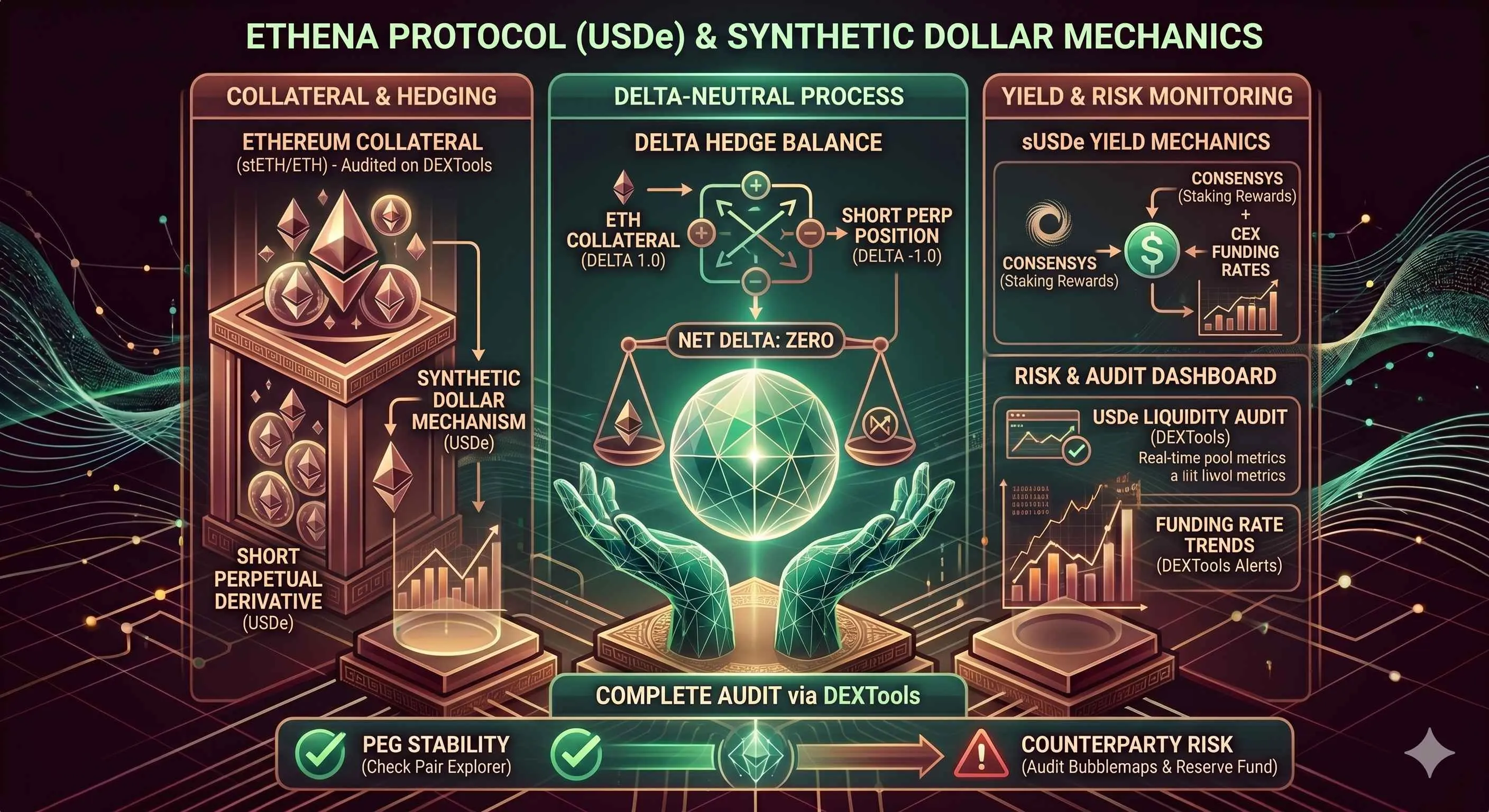
Unlike USDT or USDC, USDe does not rely on dollars in a bank. Instead, it is a synthetic dollar that achieves stability through financial engineering-specifically, a delta-neutral strategy using Ethereum and liquid staking tokens as collateral.
The Core Mechanic: How USDe Functions
To understand what is Ethena (USDe), one must first grasp the concept of "delta neutrality." In traditional finance, delta neutrality is a portfolio strategy where the overall value remains unchanged despite price fluctuations in the underlying asset.
Delta-Neutral Hedging
When a user mints USDe, the protocol performs two simultaneous actions:
It receives collateral (typically stETH).
It opens a corresponding short perpetual position for the same amount of ETH on centralized or decentralized exchanges.
This creates a hedge. If the price of ETH drops, the loss in the collateral value is offset by the gain in the short position. Conversely, if ETH rises, the gain in collateral is offset by the short position's loss. This balance is what allows USDe to function as a synthetic dollar.
The Internet Bond
A secondary answer to what is Ethena (USDe) involves its yield-generating component, often referred to as the "Internet Bond." This yield is derived from two sources:
Staking Rewards: The consensus and execution layer rewards from the staked ETH collateral.
Funding Rates: In bullish markets, "long" traders pay a funding fee to "short" traders. Since Ethena maintains a permanent short position, it collects these payments, which are then passed on to USDe stakers (sUSDe).
On-Chain Analysis: Monitoring USDe on DEXTools
Because USDe relies on derivatives markets and external exchanges for its peg, monitoring its on-chain behavior is vital for risk management. Professional traders use DEXTools to stay ahead of potential volatility.
Analyzing Liquidity and Peg Parity
Using the DEXTools Pair Explorer, you can track the USDe/USDC or USDe/USDT pools. Since USDe is synthetic, its market price should stay close to $1.00. Any prolonged deviation-either a premium or a discount-can signal shifts in market sentiment regarding funding rates or exchange counterparty risk.
Volume-to-Liquidity Ratios
One of the most effective ways to understand what is Ethena (USDe) from a market perspective is to watch its liquidity depth. If the volume on DEXTools spikes while liquidity remains stagnant or decreases, the "slippage" for large exits increases. For a synthetic asset, maintaining deep liquidity on decentralized exchanges (DEXs) is the final line of defense against depegging.
Risks and Considerations
While the innovation is significant, knowing what is Ethena (USDe) also requires a clear-eyed view of its inherent risks.
1. Funding Rate Risk
The "Internet Bond" relies on positive funding rates. Historically, longs pay shorts in crypto, but if the market turns sustainedly bearish, funding rates can turn negative. In such a scenario, the protocol must pay to keep its positions open, which can erode the reserve fund if not managed correctly.
2. LST Depeg Risk
Since the collateral is often Liquid Staking Tokens (LSTs) like stETH, any significant price decoupling between stETH and ETH could create a collateral imbalance. Checking the DEXTools Chart for stETH/ETH pairs is a secondary but necessary step for anyone heavily exposed to the Ethena ecosystem.
3. Exchange Counterparty Risk
Ethena holds its short positions on various exchanges (CEXs). While they use "Off-Exchange Settlement" solutions to mitigate the risk of an exchange failing, the protocol is still tethered to the operational stability of these third-party platforms.
The Role of the Reserve Fund
To protect against negative funding and other anomalies, Ethena maintains a Reserve Fund. This fund acts as a shock absorber. When users ask what is Ethena (USDe) in terms of safety, the size and growth of this reserve fund-often viewable via on-chain dashboards linked through DEXTools social metrics-provide the best answer.
Holder Analysis and Distribution
Using the Holder Analysis tool on DEXTools, traders can monitor the concentration of USDe. A healthy synthetic dollar should have a broad distribution. If a few large wallets (whales) hold a disproportionate amount of the circulating supply, a sudden exit could cause temporary price instability on the DEXs.
Conclusion: A New Era of Synthetic Finance
Ethena (USDe) represents a sophisticated attempt to decouple the dollar from the banking system. By asking what is Ethena (USDe), traders are exploring the frontier of "Basis Trading" at scale.
For the modern DeFi participant, the key is not just understanding the mechanics, but active monitoring. Using the DEXTools suite-from Price Alerts to Liquidity Tracking-allows you to participate in these new narratives while maintaining a data-driven approach to risk. As synthetic assets become more prevalent in 2026, the ability to audit their on-chain health will be the defining skill of a successful trader.
- How to Bridge Crypto Between Chains: Complete Cross-Chain Tutorial 2026
- How to Use 1inch: Complete DEX Aggregator Swap Tutorial (2026)
- How to Use OKX Web3 Wallet: Multi-Chain DeFi Hub Guide (2026)
Disclaimer: This article is for informational purposes only and does not constitute investment advice, financial advice, trading advice, or any other kind of advice. DEXTools does not recommend buying, selling, or holding any cryptocurrency or token. Users should conduct their own research and consult with a qualified financial advisor before making any investment decisions. Cryptocurrency investments are volatile and high-risk. DEXTools is not responsible for any losses incurred.
Frequently Asked Questions
What is Ethena USDe?
USDe is a crypto-native synthetic dollar designed to track the value of the US dollar without relying on traditional bank-held fiat reserves in the same way as classic stablecoins. It uses onchain and derivatives-based mechanisms to aim for a stable value.
What is a synthetic dollar in crypto?
A synthetic dollar is a token designed to hold a value close to one US dollar using financial mechanisms rather than simply holding fiat in a bank. These mechanisms can include collateral combined with hedging strategies.
What does delta-neutral mean for USDe?
A delta-neutral approach aims to offset the price exposure of a collateral asset by taking an opposing position, so the combined value stays relatively stable. The goal is to keep the synthetic dollar near its target value despite market moves.
Is USDe the same as a fiat-backed stablecoin?
No, fiat-backed stablecoins are typically backed by cash and cash-equivalent reserves, while USDe relies on a synthetic, derivatives-based design. The two approaches carry different risk profiles that users should understand.