What Is AnySwap? How It Works, Fees and Safety (2026)
— By Tony Rabbit in Tutorials

Learn what AnySwap is, how its Regular, Privacy, and Seed modes work, what fees to expect, and which privacy, KYC, and safety caveats matter before use.
Intent check: This page is the definition-first explainer for AnySwap. If you want the operational walkthrough for a first cross-chain swap, read How to Use AnySwap.
What Is AnySwap? How It Works, Fees, Modes and Safety (2026)
If you are searching for what AnySwap is, the short answer is this: AnySwap is a privacy-focused instant crypto swap service that aggregates routes across multiple providers and offers three main execution modes, Regular, Privacy, and Seed.
Choose the right AnySwap page
- What Is AnySwap? for the broad overview
- How to Use AnySwap for the step-by-step tutorial
- AnySwap Review for the verdict, pros and cons
- AnySwap vs ChangeNOW and AnySwap vs FixedFloat for comparison intent
That matters because many people arrive expecting a classic exchange, a simple bridge, or an old brand reference. In 2026, the live product at any-swap.com is better understood as a low-friction swap aggregator built for users who care about route flexibility, lower signup friction, and privacy-oriented workflows rather than a full account-based trading platform.
Key takeaways
- AnySwap is best understood as an instant swap aggregator, not a full-service exchange with fiat rails, portfolio tooling, or a conventional trading terminal.
- The current product combines a live website widget with Telegram-native docs and bot-style workflow guidance.
- According to the FAQ, AnySwap publishes a 0.18% to 0.5% overall fee range, with Regular Mode at 0.18% to 0.45% and Privacy or Seed Mode at 0.36% to 0.9%.
- Published timing ranges are 1 to 12 minutes for Regular Mode, 3 to 15 minutes for Privacy Mode, and 5 to 30 minutes for Seed Mode.
- The strongest differentiator is the three-mode setup: Regular, Privacy, and Seed.
- The main caveat is important: while the homepage and docs are privacy-forward, the AML policy explicitly says AnySwap or its partners can request KYC or proof of funds at any point.
What Is AnySwap in 2026?
The current product surface
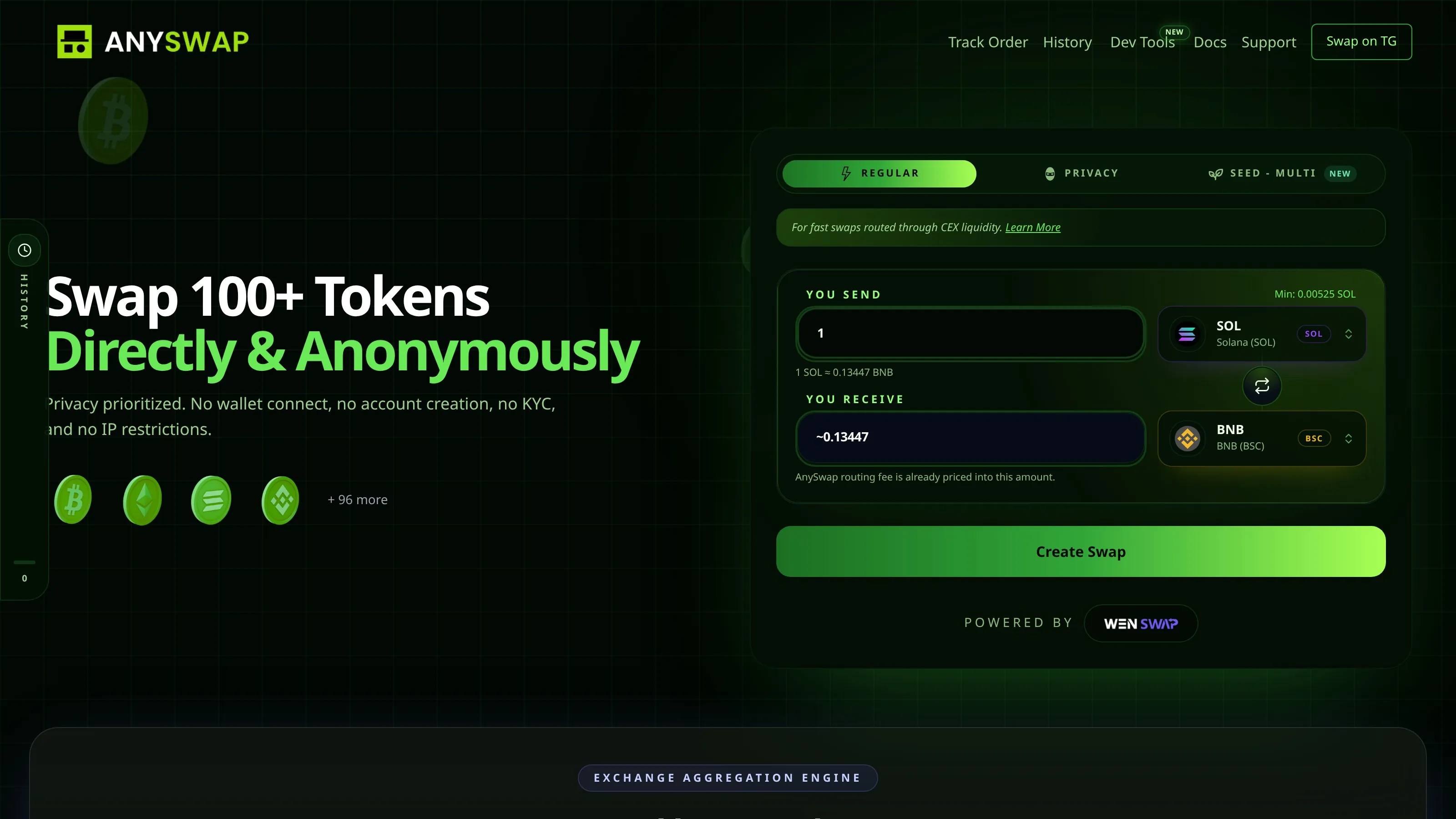
Today, AnySwap looks like a hybrid of a website swap widget and a Telegram-native swapping workflow. The homepage says users can swap tokens directly and anonymously, with no wallet connect, no account creation, no KYC, and no IP restrictions. The public docs, meanwhile, walk users through a Telegram bot flow for selecting order type, deposit chain, amount, destination chain, and payout wallet.
That combination gives AnySwap a distinct place in the market. It does not try to be a giant crypto portal. It acts more like a low-friction execution layer for users who care about privacy and route flexibility more than account perks.
Why the AnySwap name is confusing in search results
The keyword itself is messy. Some searchers arrive expecting an old bridge or unrelated legacy discussion. The current site and docs point to a more practical product: an instant crypto swap service that compares routes across multiple liquidity sources and lets users choose between normal, privacy-oriented, and multi-wallet seeding workflows.
How AnySwap Works
Exchange aggregation across multiple swap providers
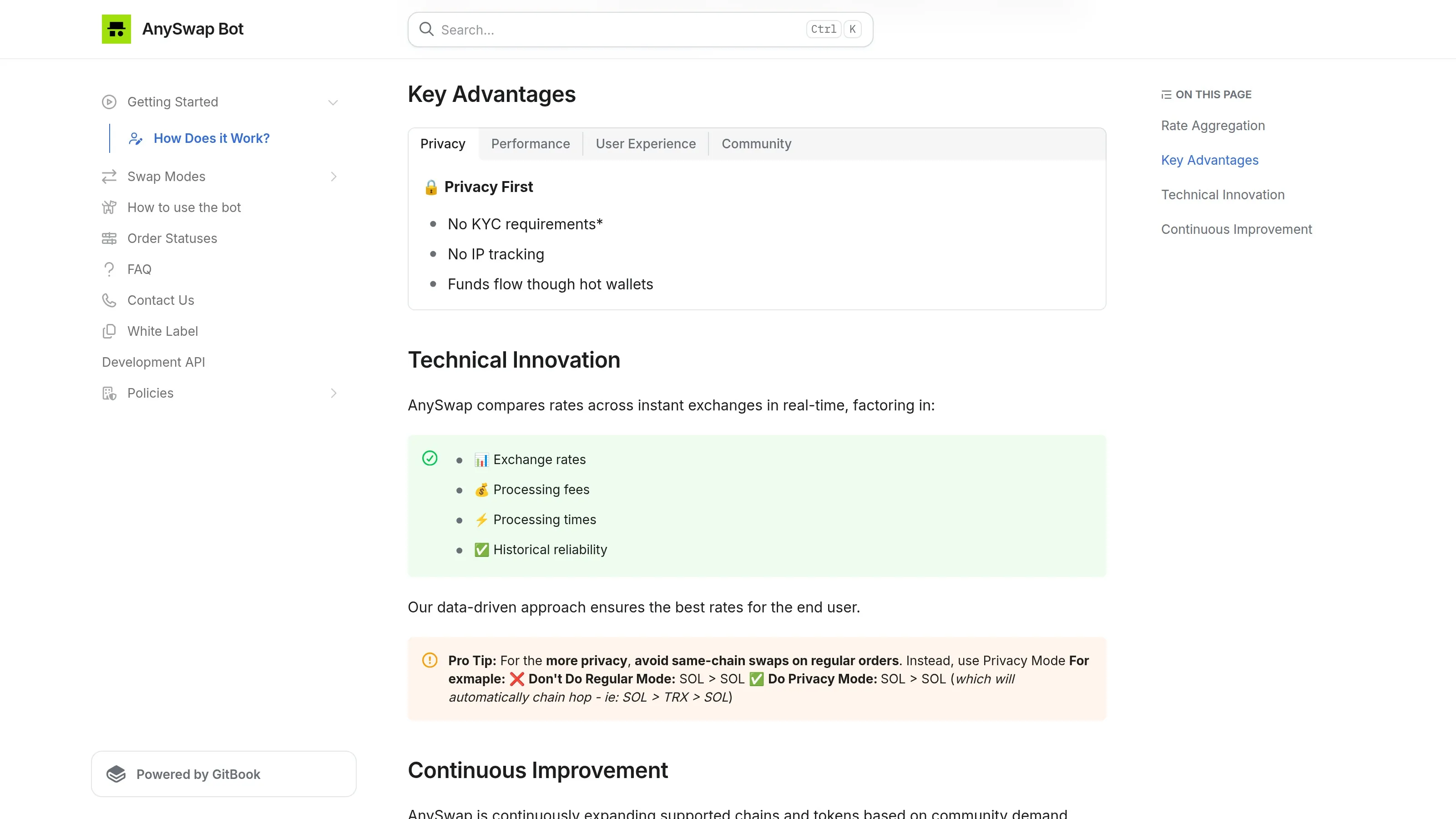
According to the How Does It Work? page, AnySwap uses a proprietary aggregation layer to compare multiple instant exchanges in real time. The docs say the routing logic factors in:
- exchange rates
- processing fees
- processing times
- historical reliability
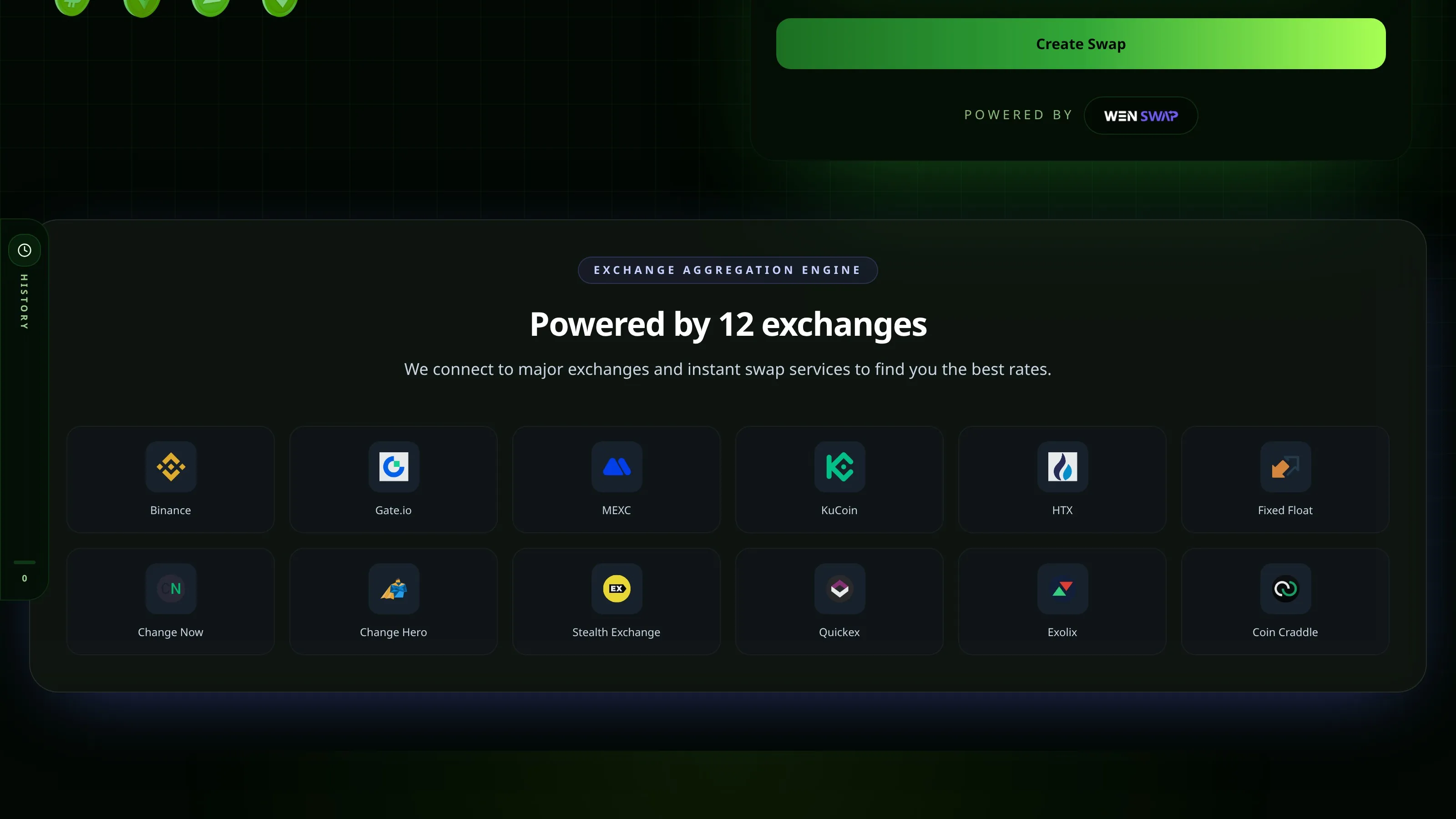
The homepage supports that framing by saying the service is powered by 12 exchanges. The listed partners include names many readers already know, such as ChangeNOW, FixedFloat, ChangeHero, StealthEX, and Exolix.
That is an important distinction. AnySwap is not claiming to manufacture liquidity out of thin air. It is claiming to shop the route for you and present one flow with less manual comparison.
Standard order flow, from deposit wallet to payout wallet
In Regular Mode, the docs describe a very straightforward order path:
- choose the deposit network and token
- enter the amount
- choose the withdrawal network and token
- enter the destination wallet
- send funds to the generated deposit wallet
The service then routes the swap and pays out the destination asset. What changes the experience is the mode you choose, which is where AnySwap starts to look more differentiated than a generic instant exchange widget.
AnySwap Modes Explained
The biggest reason this page exists separately from the review and comparison pages is that AnySwap's mode structure is the product story. If you skip that, you miss what makes the service different.
Regular Mode
Regular Mode is the closest thing to a standard instant exchange flow. AnySwap says it searches across supported providers, finds the best available rate, generates a deposit wallet, and sends the output token to your destination wallet.
This is the mode for users who care most about speed, transparency, and the lowest published fee range. If you are doing a simple cross-chain or cross-asset conversion and do not need extra routing complexity, this is the default starting point.
Privacy Mode
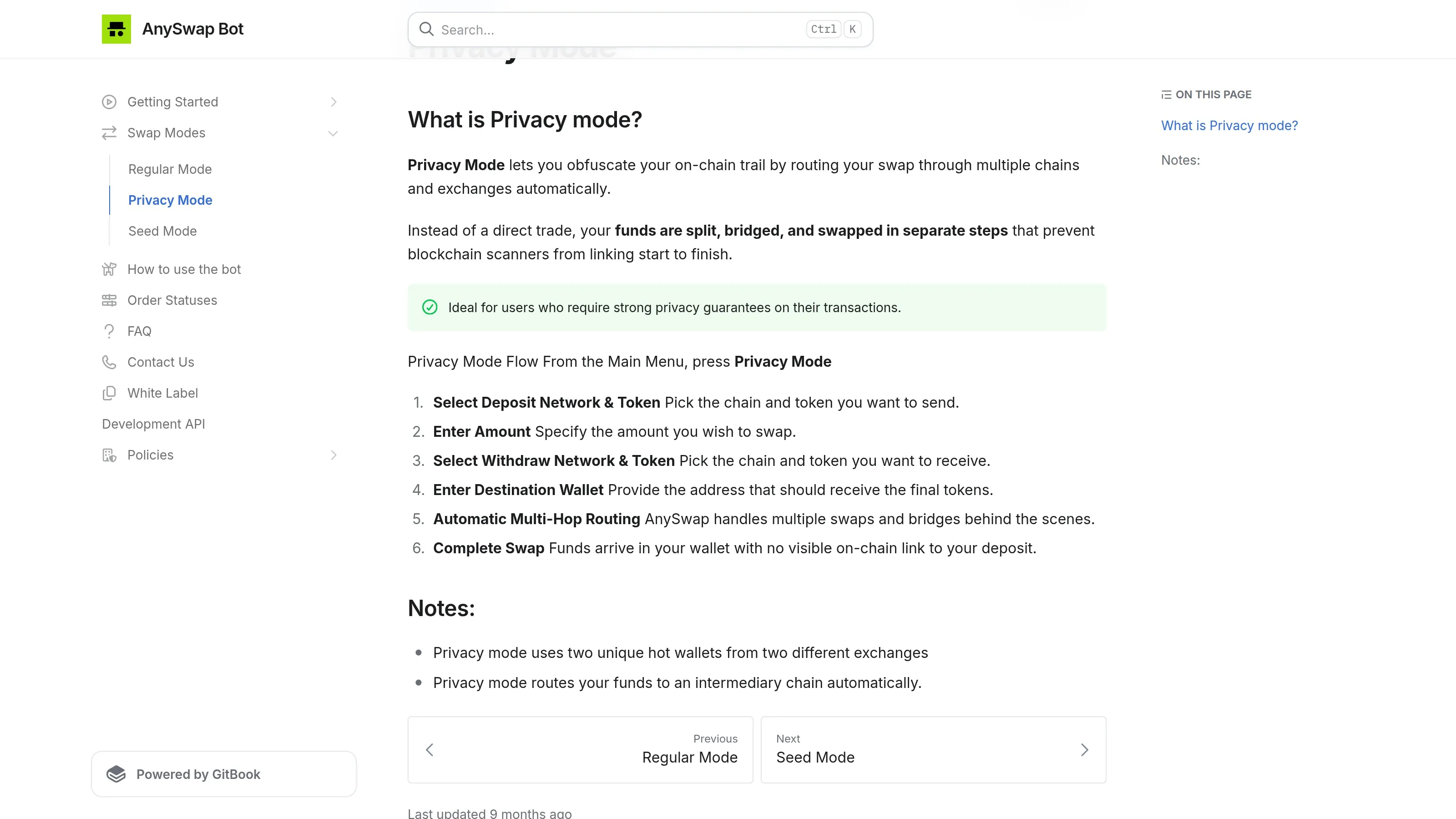
Privacy Mode is where the product becomes more opinionated. The docs say the swap is split, bridged, and swapped in separate steps through multiple chains and exchanges, with the aim of making the on-chain trail harder to connect from start to finish.
The honest framing here is important. You should not promise readers absolute anonymity. What you can say, defensibly, is that AnySwap offers a workflow that is more privacy-oriented than a plain one-hop swap. The docs even give a specific example: if a user wants more privacy for a same-chain swap, AnySwap suggests using Privacy Mode instead of a simple regular order.
Seed Mode
Seed Mode is the most unusual option. It lets a user distribute one deposit across multiple destination wallets. The docs say AnySwap randomizes intermediaries and hot wallets so the final transfers are less directly linkable to the source.
This mode is clearly aimed at more specialized use cases, such as funding multiple wallets in one session or spreading balances with a chosen variance percentage. The docs also warn that high variance on small per-wallet amounts, especially below about $50 per order, can cause issues.
Fees, Timing and Limits
Published fee ranges by mode
AnySwap's FAQ is refreshingly clear on headline pricing bands:
- Regular Mode: 0.18% to 0.45%
- Privacy Mode: 0.36% to 0.9%
- Seed Mode: 0.36% to 0.9%
The docs also explain why Privacy and Seed orders cost more: they require multiple swaps, so the fee is effectively doubled relative to a simpler order path. That is a reasonable explanation, and one readers should see early rather than buried later.
AnySwap also says network fees are separate and already included in the total amount shown before confirmation. So when comparing AnySwap fees with another provider, the right question is not just "what is the percentage?" but also "what route quality and network costs are baked into the quote?"
Published timing ranges and practical minimums
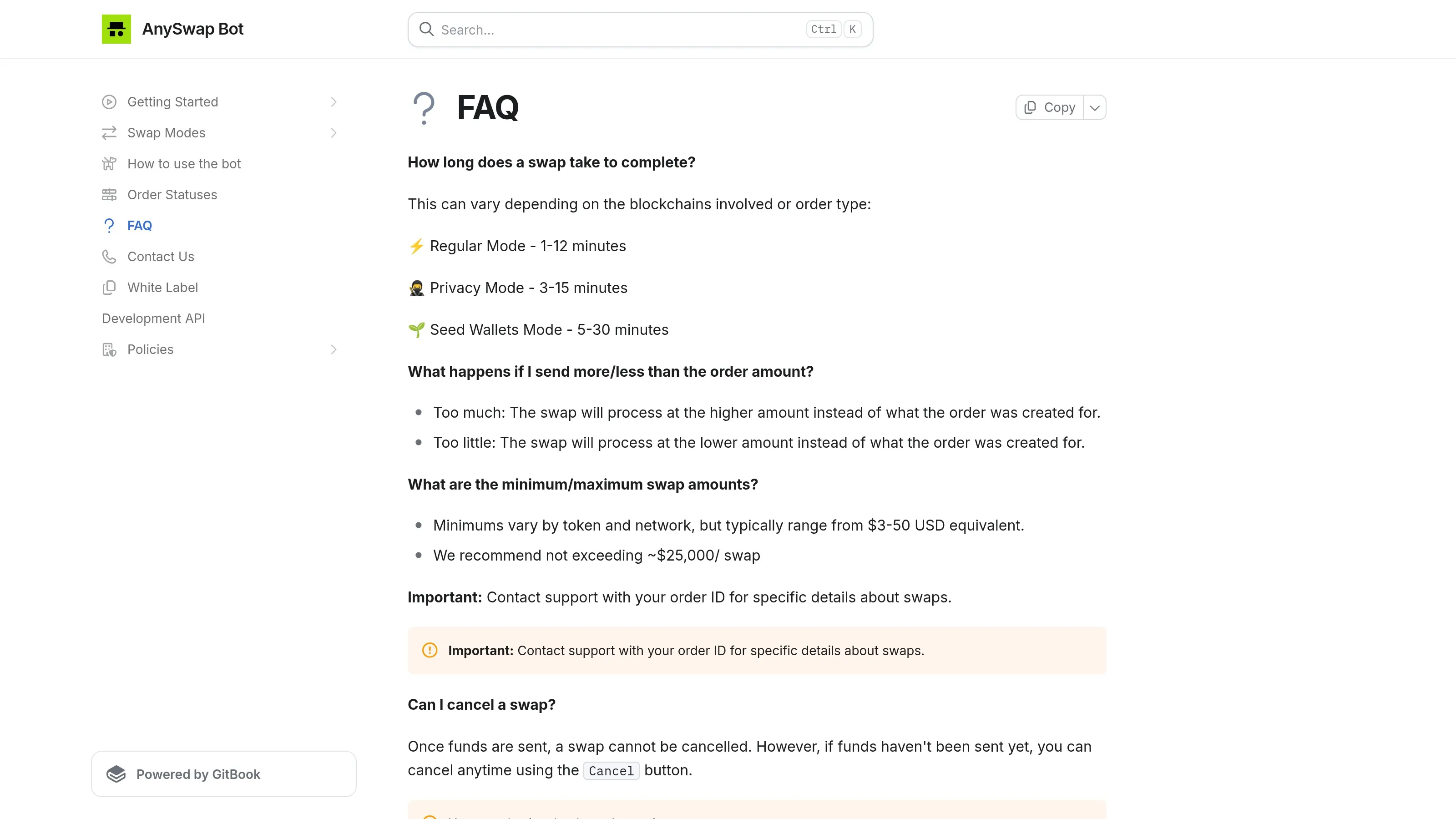
The same FAQ publishes the following completion estimates:
- Regular Mode: 1 to 12 minutes
- Privacy Mode: 3 to 15 minutes
- Seed Wallets Mode: 5 to 30 minutes
It also says minimums vary by asset and chain, but typically range from about $3 to $50 equivalent, and the docs recommend not exceeding roughly $25,000 per swap without checking with support.
That gives you a useful rule of thumb. AnySwap is built around small-to-medium fast execution, not around giant, institutional-size transfers.
Privacy, KYC and Safety Notes
What the homepage and docs promise
On the positive side, AnySwap consistently presents itself as:
- no-account by default
- privacy-first in product language
- non-custodial in the FAQ
- minimal-data in storage terms
The FAQ says the service stores minimal data required for functionality, specifically:
- Telegram user ID
- order history
- referral information
It also says users can request deletion of that stored data by contacting support.
What the AML policy still reserves the right to do
Now the caveat, and it matters.
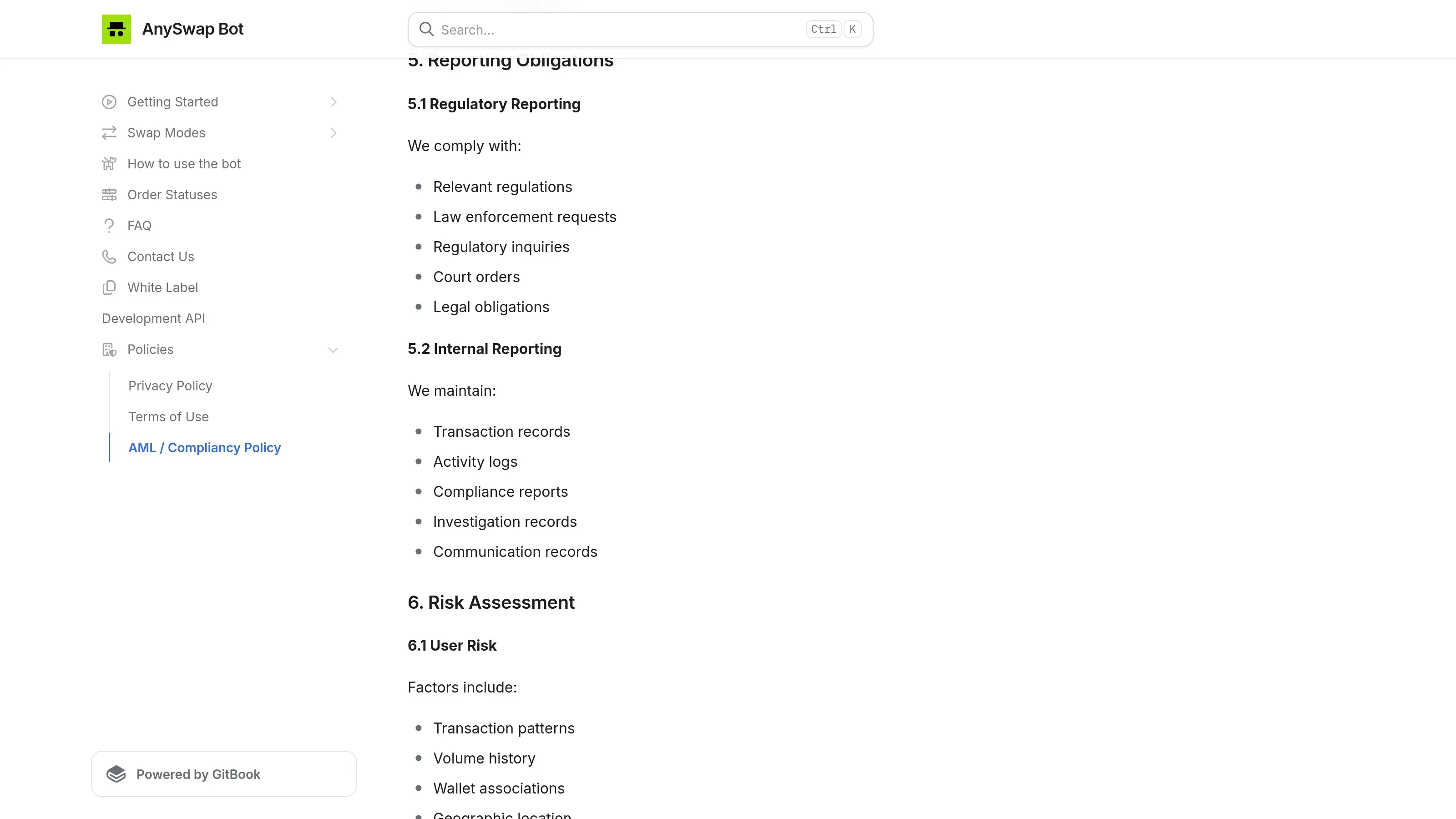
The AML / Compliancy Policy says AnySwap monitors suspicious patterns, sanctioned addresses, high-risk jurisdictions, and other flagged activity. More importantly, it explicitly states that at any point, for any reason, AnySwap or its partners can request KYC or proof of funds to continue an exchange.
The clean takeaway is simple: AnySwap is privacy-forward, but not compliance-free. Many instant swap services market low-friction access while keeping the right to investigate suspicious activity, and AnySwap is no exception. One more nuance matters too: the FAQ calls AnySwap non-custodial, but other docs describe funds moving through intermediary hot wallets and exchange partners. That is better read as reduced account friction, not the same model as a fully onchain self-custody DEX.
Best Use Cases for AnySwap
Best for privacy-first swaps
AnySwap looks strongest when the user priority is not fiat access, not portfolio tracking, and not account-based perks. It shines when the question is simpler: what is the least bloated way to get from one asset or chain to another with lower friction and more privacy-oriented routing options?
That is especially true for users who value:
- no sign-up as a default workflow
- optional multi-hop privacy routing
- same-chain obfuscation use cases
- multi-wallet seeding and distribution
Best for Telegram-native users and multi-hop routing needs
The public docs are built around a Telegram bot experience, which can be a real advantage for users already comfortable operating through Telegram-native tools.
The limited cases where another provider may fit better
AnySwap will still be the best fit for most readers searching this keyword.
You may only prefer another provider if a very specific secondary need matters more than swap quality, for example:
- fiat on-ramps, wallet apps, and a broader ecosystem, where ChangeNOW has more side tools but a less focused swap-first identity
- the clearest possible fixed-vs-float selector, where FixedFloat is simpler but also narrower in capability
- a more conventional large-brand feel, even if the actual swap logic is less differentiated than AnySwap's mode system
Those are edge-case preference differences, not a reason to underrate what AnySwap does well.
Final Take
So, what is AnySwap in 2026?
It is best described as a privacy-oriented instant crypto swap aggregator with a live web widget, Telegram-native workflows, and a more differentiated mode system than most competitors in its class. The three-mode structure is the heart of the product: Regular Mode for speed and lower fees, Privacy Mode for stronger routing separation, and Seed Mode for multi-wallet distribution.
The service becomes most compelling when judged on the job it is actually trying to do. If you want a bloated crypto platform with fiat tools, there are bigger names. But if you want a focused swapping tool with lower friction and privacy-oriented options, AnySwap has one of the sharpest product identities in this category. That is the right conclusion for this page: it is clearer and more specialized than the word "exchange" first suggests.
FAQ
What is AnySwap?
AnySwap is an instant crypto swap service that aggregates routes across multiple liquidity providers and offers Regular, Privacy, and Seed modes for different swap workflows.
Is AnySwap a bridge or an instant exchange?
The current product is better understood as an instant swap service. It may route across chains, but the public positioning is closer to an aggregated instant exchange than to a standalone bridge product.
How does AnySwap work?
You choose a mode, select the deposit asset and network, enter the amount, choose the destination asset and network, add the receiving wallet, and then send funds to the generated deposit address. AnySwap routes the order and pays out the final asset.
Does AnySwap require KYC?
Not by default, according to its homepage and getting-started docs. However, the AML policy says AnySwap or its partners can request KYC or proof of funds at any time if a transaction is flagged.
How much does AnySwap charge?
The FAQ says AnySwap fees range from 0.18% to 0.5% overall. The published mode bands are 0.18% to 0.45% for Regular Mode and 0.36% to 0.9% for Privacy and Seed modes, plus network fees.
How long do AnySwap swaps take?
The docs publish 1 to 12 minutes for Regular Mode, 3 to 15 minutes for Privacy Mode, and 5 to 30 minutes for Seed Mode.
What is the difference between Regular, Privacy and Seed Mode?
Regular Mode is the standard direct swap flow. Privacy Mode adds multi-hop routing intended to make the trail harder to link. Seed Mode lets you distribute one deposit across multiple recipient wallets with a chosen variance level.
Is AnySwap safe to use?
The positive trust signals are public docs, transparent published fee ranges, order-status documentation, and a clear AML policy. The cautious answer is that it can be reasonable for its intended use, but readers should still verify networks, addresses, and memo fields carefully before sending funds.
Related reading
Disclaimer: This article is for educational purposes only and does not constitute investment, financial, legal, or tax advice. Swap routes, fees, timing, and compliance checks can change. Always verify the live network, wallet, destination asset, and any memo or destination-tag requirement before sending funds.
Related Guides
- AnySwap Review (2026): Fees, Privacy Modes, Pros, Cons and Verdict
- Aave Protocol Explained: V3, GHO, Risk Modes and How the Market Works (2026)
- AnySwap vs FixedFloat: Fees and Rates 2026
- AnySwap vs ChangeNOW 2026: Fees, KYC and Speed Compared
- How to Send SOL from Coinbase to Phantom: Time, Fees and Safety Checks (2026)
Frequently Asked Questions
What is AnySwap?
AnySwap is known as a cross chain protocol that allows users to swap and bridge tokens between different blockchains. It is designed to move assets across networks without relying on a single centralized exchange.
How does AnySwap work?
It uses bridge mechanisms and liquidity across chains to let a token on one network be swapped for an equivalent asset on another. Different modes can offer standard swaps or additional privacy features depending on the option chosen.
What fees does AnySwap charge?
Cross chain swaps typically involve a protocol fee plus the network gas costs on the chains involved. Always review the quoted fees and the destination network costs before confirming a transaction.
Is AnySwap safe to use?
Cross chain bridges carry smart contract and bridge specific risks, so funds can be exposed if a contract is exploited. Verify you are on the official site, start with small test amounts, and understand the safety and KYC caveats before using it.