AnySwap vs ChangeNOW 2026: Fees, KYC and Speed Compared
— By Tony Rabbit in Tutorials

AnySwap vs ChangeNOW compared for 2026: fees, KYC and privacy, swap speed, supported chains, and which cross-chain swap is better for you.
If you are comparing AnySwap vs ChangeNOW, this page is for the side-by-side comparison intent, not the broad AnySwap overview. It focuses on swap-first use cases, fees, KYC friction, privacy posture, and which product is the better fit for the job.
Choose the right AnySwap page
- What Is AnySwap? for the broad overview
- How to Use AnySwap for the step-by-step tutorial
- AnySwap Review for the verdict, pros and cons
- AnySwap vs ChangeNOW and AnySwap vs FixedFloat for comparison intent
Quick verdict
For most crypto-to-crypto users, AnySwap is the better pick. Its Regular, Privacy, and Seed modes give users more routing flexibility, and the product feels built around low-friction execution rather than surrounding upsells.
ChangeNOW only pulls ahead if you specifically want fiat access, wallet products, or a broader account ecosystem. Those extras are real, but they are secondary for readers whose main goal is simply getting the swap done with less clutter.
The cleanest summary is this:
AnySwap vs ChangeNOW at a glance
What AnySwap is built for
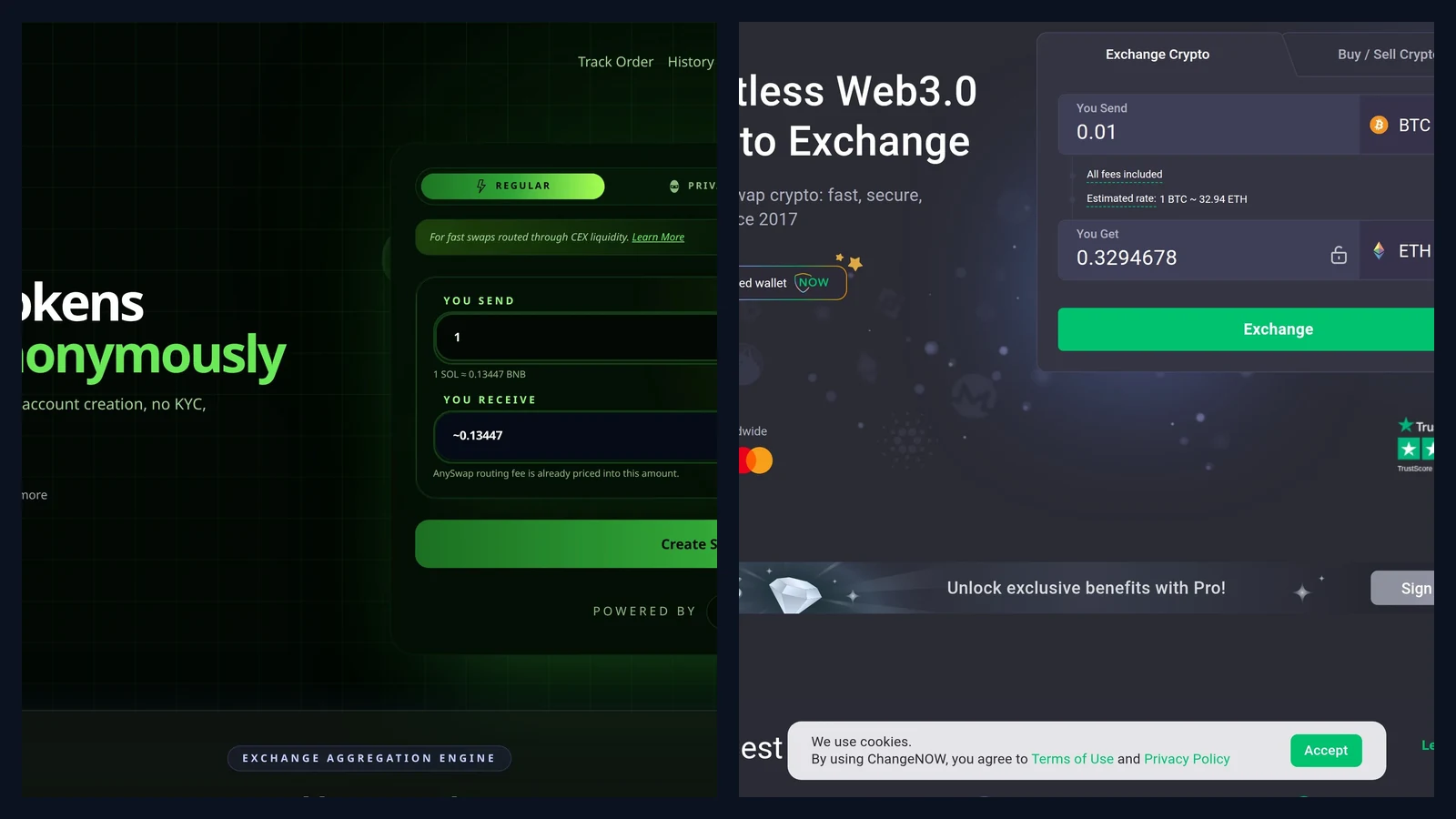
AnySwap is built around one main idea: make cross-chain swaps feel lighter, more private, and more configurable without turning the product into a crypto super-app. The homepage says users can swap 100+ tokens with no wallet connect, no account creation, no KYC, and no IP restrictions. Its docs focus on route aggregation and mode selection, not on lifestyle features.
That makes AnySwap feel more opinionated. You land on the site and immediately understand the promise: swap, route, receive, move on.
What ChangeNOW is built for
ChangeNOW is trying to do more. Its homepage promotes:
- more than 1M+ supported currency pairs
- 1263 currencies available for exchange
- fiat buying
- NOW Wallet
- a mobile app
- cashback and extra tools in ChangeNOW Pro
That wider ecosystem is real. It is also why the product can feel heavier for this keyword. If you want more than a swap, ChangeNOW gives you more. If you mainly want the swap itself, that extra surface area often becomes noise rather than an advantage.
Fees and rate mechanics
AnySwap published fee bands by mode
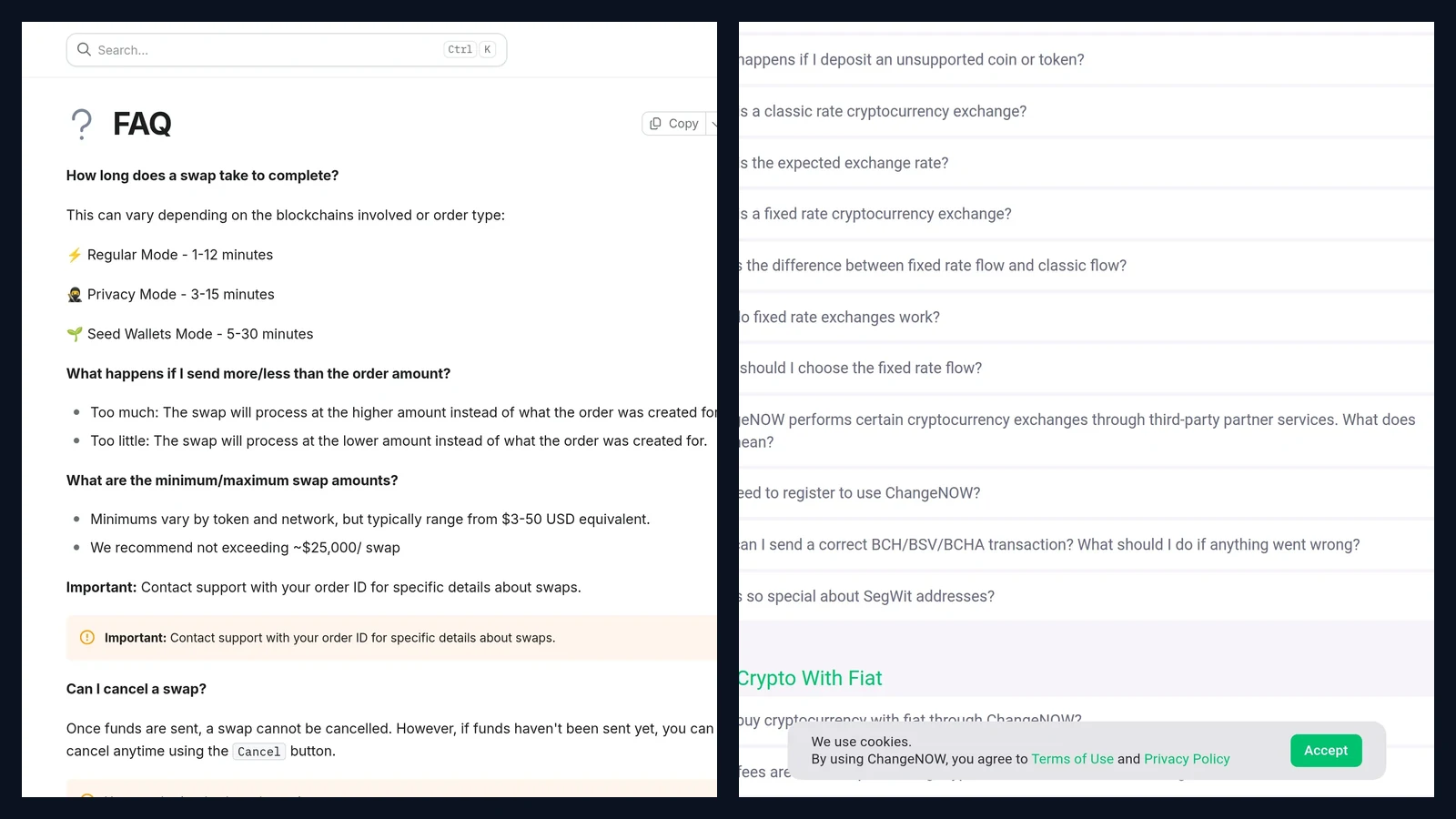
AnySwap makes fee comparison relatively easy because the FAQ publishes headline ranges:
- Regular Mode: 0.18% to 0.45%
- Privacy Mode: 0.36% to 0.9%
- Seed Mode: 0.36% to 0.9%
It also says the total platform fee range is 0.18% to 0.5% per swap, with network fees separate and included in the quoted amount before confirmation. For readers, that means AnySwap gives you a usable mental model before you even start.
ChangeNOW classic rate vs fixed rate workflow
ChangeNOW uses a different pricing language. Instead of a simple fee band, the FAQ explains that quotes incorporate several moving parts, including:
- deposit network fees
- transfer fees to liquidity providers
- provider trading fees
- withdrawal network fees
The product also separates exchange flow into:
- classic rate, which tracks the market and can move during execution
- fixed rate, which locks the displayed rate for a limited time but may be less favorable than the floating quote
That approach is reasonable, but it makes side-by-side comparison harder. ChangeNOW gives you a more dynamic quote engine. AnySwap gives you a clearer published fee frame.
What this means in practice
This is where many comparison pages get sloppy. Published fee percentages are not the same thing as final output value.
A lower percentage on paper can still lose if:
- the route is weaker
- network costs are higher
- the fixed quote includes more protection against slippage
- the execution path is longer
Still, if you want the cleaner headline answer, AnySwap is easier to understand. If you want classic-vs-fixed choice inside a broader exchange experience, ChangeNOW has the more familiar mainstream setup.
Privacy, KYC and data friction
AnySwap homepage promise vs AML policy caveat
AnySwap clearly leans harder into privacy language. The homepage says no wallet connect, no account creation, no KYC, and no IP restrictions. The docs also position Privacy Mode as a way to route funds through multiple chains and exchanges to make the on-chain path harder to link.
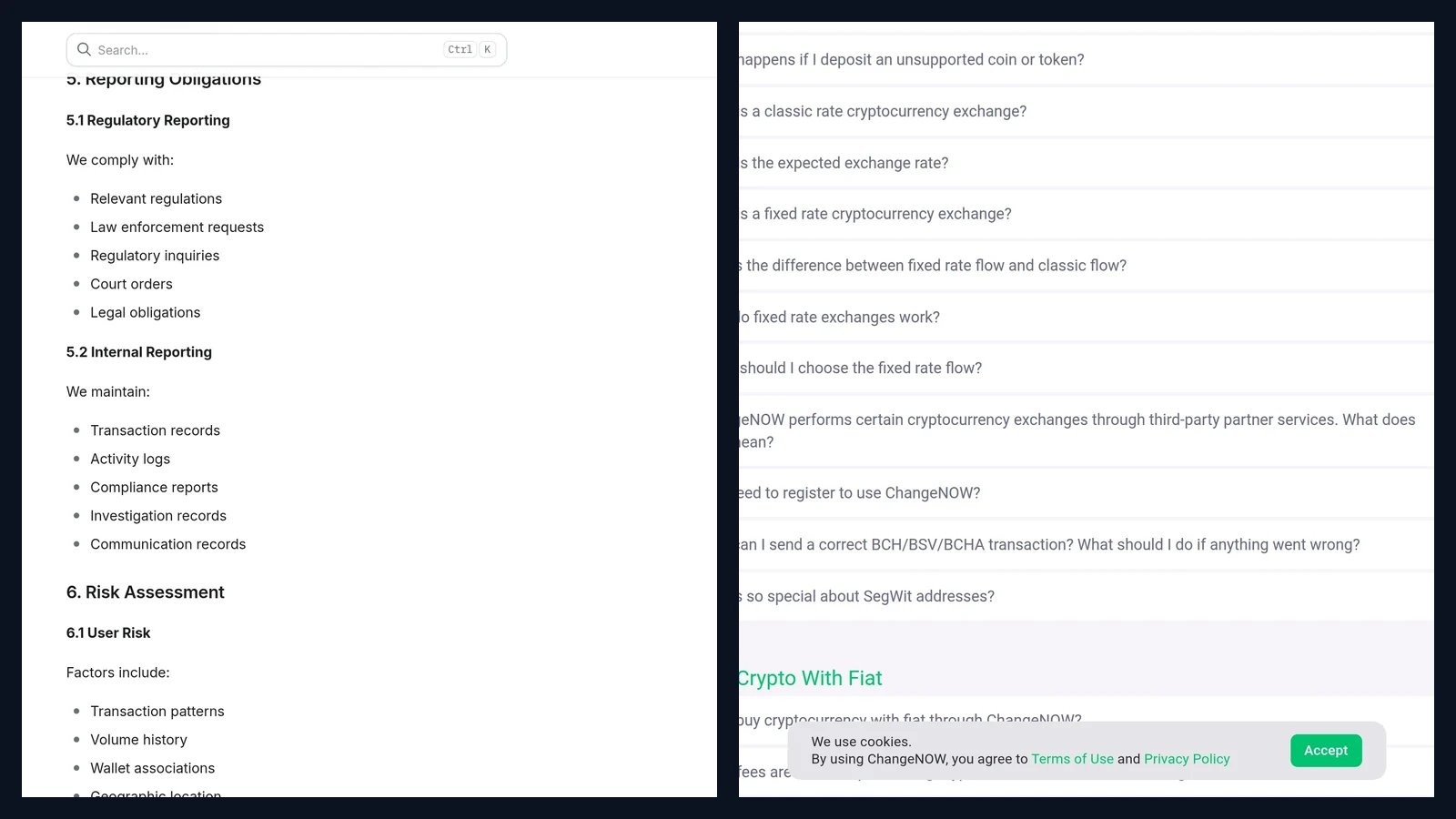
But the important caveat is in the AML policy: AnySwap says it can request KYC or proof of funds at any point, for any reason, and that this can happen through AnySwap or its partners.
So the honest scorecard is:
- marketing privacy posture: advantage AnySwap
- ability to guarantee no verification ever: advantage neither
ChangeNOW no-account flow vs automated AML checks
ChangeNOW also says users do not need to register to use the service. That puts it in the same broad low-friction bucket. But its FAQ is explicit that transactions run through an automated risk management system, and flagged cases can lead to an ID request and additional information about the source of funds.
This makes the real comparison less dramatic than many affiliate articles suggest. Both brands market convenience. Both reserve compliance rights. The difference is that AnySwap is more privacy-centered in product identity, while ChangeNOW is more compliance-normalized within a bigger mainstream platform.
Which is better for privacy?
For privacy-oriented users, the answer is still AnySwap. Not because it is magic, and not because it eliminates all compliance risk, but because:
- privacy is central to its messaging
- it offers Privacy Mode and Seed Mode rather than just a standard exchange flow
- it feels designed around lower-friction movement first, ecosystem upsells second
Speed, order flow and user experience
AnySwap low-friction flow and mode selection
AnySwap's published timing ranges are:
- 1 to 12 minutes for Regular Mode
- 3 to 15 minutes for Privacy Mode
- 5 to 30 minutes for Seed Mode
That is a sensible range for a product that admits more complex routing can take longer. The interface logic is also focused. You choose a mode, define the swap, send funds, and track status.
For a user who just wants to complete a swap with as little product clutter as possible, this is appealing.
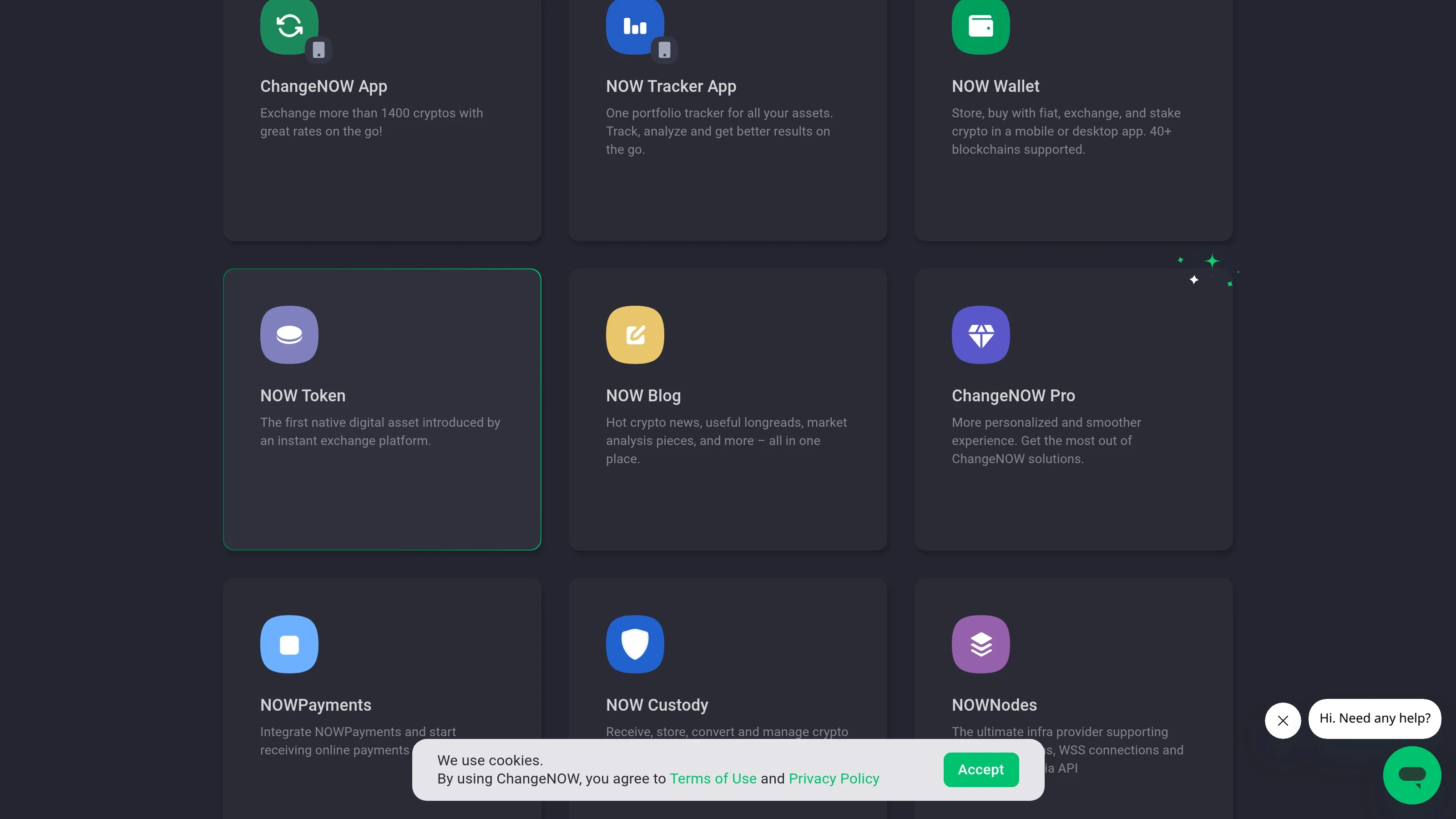
ChangeNOW broader web product stack, app, wallet and fiat tools
ChangeNOW's homepage says the average exchange time is about 2 minutes, which sounds excellent. Its FAQ is more conservative and says transactions usually take 5 to 30 minutes, with delays possible because of network congestion, large transactions, or temporary issues.
That difference is worth surfacing because it gives the reader a more realistic expectation.
UX-wise, ChangeNOW feels more polished as a big consumer crypto service. It has:
- a highly familiar website swap flow
- card-based buy crypto flows
- NOW Wallet
- mobile apps
- Pro features for account users
For readers who want a service they can keep using for multiple adjacent tasks, ChangeNOW is easier to grow into.
Which feels simpler on the first transaction?
This depends on what kind of beginner you are.
- If you want one focused swap with minimal distractions, AnySwap is simpler for most readers.
- If you specifically want a large-brand website with many extra options and a fiat path, ChangeNOW may feel more familiar.
That is why the verdict should be use-case based instead of absolute.
Which service is better for different use cases?
Best for privacy-first swaps
Winner: AnySwap
This is the clearest category. AnySwap's entire product story is stronger here. The mode system is more differentiated, and the privacy-oriented framing is much more deliberate.
Best for fiat extras and broader ecosystem access
Winner: ChangeNOW, but only for that specific requirement
If you want to buy crypto with fiat, use a wallet, install an app, or keep everything inside one larger ecosystem, ChangeNOW is ahead. If those things are not central to your decision, this advantage matters much less than it looks on paper.
Best for users who want the simplest first transaction
Winner: AnySwap for most readers
For most readers on this keyword, simple means fewer distractions and a clearer swap path, which points to AnySwap.
ChangeNOW can still feel comfortable if you explicitly want a mainstream-looking site with lots of guided options and a fiat path, but that is a narrower use case.
Final verdict
For this keyword, the stronger editorial answer is AnySwap.
ChangeNOW is broader. It has more products, more side tools, more fiat capability, and a bigger ecosystem footprint. None of that should be hidden. But most readers searching AnySwap vs ChangeNOW are not really comparing corporate breadth. They are asking which service creates less friction for the actual swap they want to make.
On that question, AnySwap wins more clearly.
It wins because its product story is sharper, its privacy-oriented positioning is more central, its mode structure offers more than just market-vs-fixed pricing, and the overall workflow feels more focused on execution rather than ecosystem expansion. As long as the article stays honest about the AML caveat, that verdict feels earned rather than forced.
FAQ
Is AnySwap cheaper than ChangeNOW?
Not always, pair by pair. But AnySwap publishes clearer fee bands, with 0.18% to 0.45% for Regular Mode and 0.36% to 0.9% for Privacy and Seed modes. ChangeNOW uses quote-based pricing that includes multiple fee components.
Does ChangeNOW require KYC?
Not by default, but its FAQ says the platform uses an automated risk management system and may request ID and source-of-funds information for flagged transactions.
Does AnySwap require KYC?
Not by default according to its homepage and docs, but its AML policy says AnySwap or its partners can request KYC or proof of funds at any time.
Which is faster, AnySwap or ChangeNOW?
ChangeNOW's homepage markets a faster average, but its FAQ still says transactions usually take 5 to 30 minutes. AnySwap publishes 1 to 12 minutes for Regular Mode and longer ranges for Privacy and Seed modes. For straightforward swaps, both can be quick, but quoted speed depends on route and network conditions.
Which is better for privacy?
AnySwap, because privacy is more central to its product design and it offers dedicated Privacy and Seed modes.
Which is better for beginners?
AnySwap is better for beginners who want a cleaner, more focused swap flow. ChangeNOW is better only if you specifically want fiat options or a broader consumer-style interface from the start.
Which is better if I also want fiat on-ramp tools?
ChangeNOW. It has fiat buying options and a larger product ecosystem around the core exchange flow.
Related reading
Disclaimer: This article is for educational purposes only and does not constitute investment, financial, legal, or tax advice. Exchange rates, swap routes, timing, and compliance checks can change. Always verify the live network, wallet, destination asset, and any memo or destination-tag requirement before sending funds.
Common Mistakes When Choosing a Swap Service
Many users pick a swap platform based on a single screenshot of a low rate, then feel surprised when the amount they actually receive is smaller. The advertised quote is rarely the final number. Network fees, the spread baked into the exchange rate, and minimum or maximum limits all shape the real result. Reading the quote breakdown before confirming, rather than after, saves both money and frustration.
Another frequent error is ignoring how a service handles support and reversals. Cross-chain swaps move quickly and are usually irreversible once broadcast, so there is little room to undo a wrong destination address or an unsupported network. Confirming the exact chain, the token contract, and the memo or tag field, when one is required, prevents the most painful losses.
Before sending funds, it helps to think through a short checklist:
- Verify the receiving address on your own wallet, not from a copied chat message.
- Match the network so you are not bridging to a chain your wallet cannot read.
- Check the token contract against a trusted source such as a block explorer or DEXTools before swapping into a new asset.
- Note the limits so a deposit is not stuck below the minimum.
Treating a swap as a deliberate, reviewed action rather than a reflex keeps the comparison between any two services grounded in the outcome that actually reaches your wallet.
Related Guides
- 5 Best ChangeNOW Alternatives in 2026, Ranked by Privacy, Fees and Speed
- TRON vs Solana: Speed, Fees and Use Cases Compared (2026)
- Top 5 Crypto Mixers in 2026: Privacy, Fees and Speed Compared
- What Is AnySwap? How It Works, Fees, Modes and Safety (2026)
- AnySwap vs FixedFloat: Fees and Rates 2026
Frequently Asked Questions
Is AnySwap better than ChangeNOW?
For most users comparing focused crypto-to-crypto swap execution, yes. ChangeNOW has more side tools and broader platform surface area, but AnySwap is usually the stronger answer for lower-friction, privacy-oriented swap usage.
Is AnySwap cheaper than ChangeNOW?
Not always on every pair. AnySwap publishes clearer fee bands, while ChangeNOW uses quote-based pricing that includes multiple fee components and can vary between classic and fixed-rate flows.
Does ChangeNOW require KYC?
Not by default, but its FAQ says ChangeNOW uses an automated risk management system and may request ID and source-of-funds information for flagged transactions.
Does AnySwap require KYC?
Not by default according to its homepage and docs, but its AML policy says AnySwap or its partners can request KYC or proof of funds at any time.
Which is faster, AnySwap or ChangeNOW?
ChangeNOW markets a faster average on the homepage, while its FAQ says transactions usually take 5 to 30 minutes. AnySwap publishes 1 to 12 minutes for Regular Mode and longer ranges for Privacy and Seed modes.
Which is better for privacy, AnySwap or ChangeNOW?
AnySwap is better for privacy-oriented users because privacy is more central to its product identity and it offers dedicated Privacy and Seed modes.
Which is better for beginners, AnySwap or ChangeNOW?
AnySwap is better for beginners who want a cleaner, more focused swap flow. ChangeNOW is only better if you specifically want fiat options or a broader consumer-style interface from the start.