Governance Quorum vs Whale Voting: How DAO Control Risk Affects Tokenholders
— By Whatsertrade in Tutorials

DAO governance is often presented as decentralized decision making. Tokenholders vote on proposals, protocol changes, treasury spending and risk parameters. But
DAO governance is often presented as decentralized decision making. Tokenholders vote on proposals, protocol changes, treasury spending and risk parameters.
But not all governance systems are equally decentralized.
Two important concepts are governance quorum and whale voting. Quorum determines whether enough participation exists for a vote to count. Whale voting shows whether large holders can dominate outcomes.
Understanding governance quorum vs whale voting can help tokenholders evaluate control risk inside a DAO.
What Is Governance Quorum?
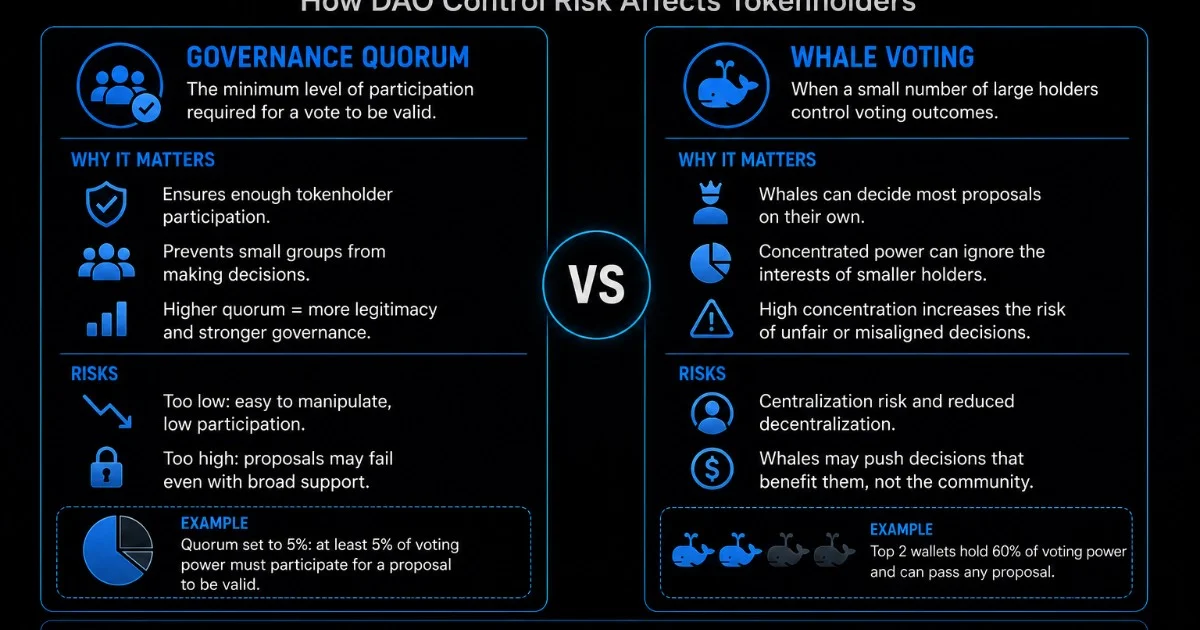
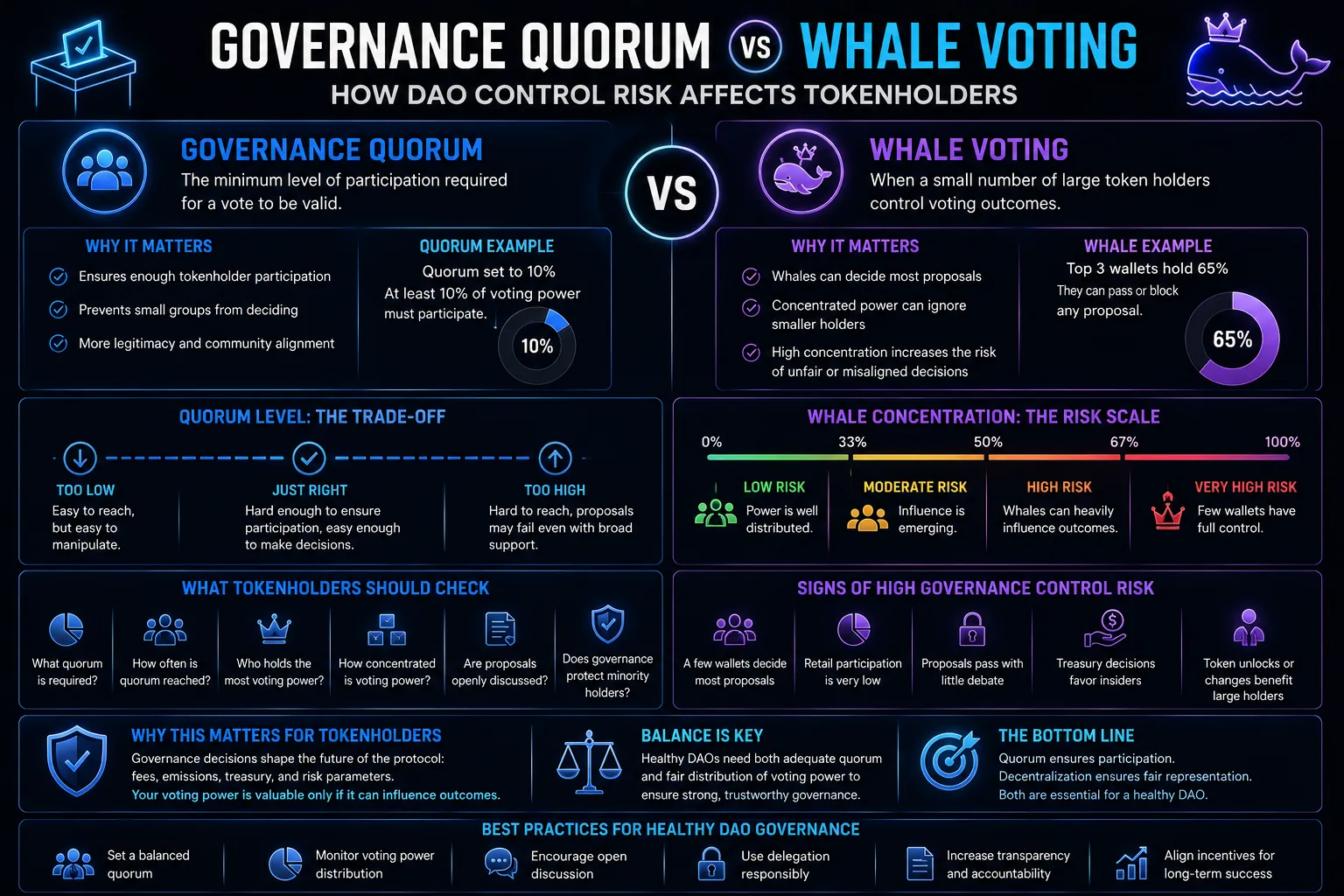
Governance quorum is the minimum level of participation required for a vote to be valid.
For example, a DAO may require that at least 5 percent of eligible voting power participates before a proposal can pass.
Quorum exists to prevent small groups from making major decisions when most tokenholders are inactive.
A healthy quorum can improve legitimacy because it shows that proposals have enough community participation.
What Is Whale Voting?
Whale voting happens when a small number of large tokenholders have enough voting power to strongly influence or control governance outcomes.
This can happen in token based governance systems where voting power is tied directly to token holdings.
Whales may include founders, investors, treasuries, exchanges, funds or early participants.
Whale voting does not always mean malicious control, but it can create concentration risk.
Governance Quorum vs Whale Voting: The Key Difference
The key difference is participation vs concentration.
Quorum measures whether enough voting power participates.
Whale voting measures who controls that voting power.
A DAO can meet quorum and still be dominated by whales. This means a vote can look legitimate while being controlled by a small group of large holders.
For tokenholders, both metrics matter.
Why Low Quorum Is Risky
Low quorum can allow important decisions to pass with limited participation.
If only a small fraction of tokenholders vote, governance may not reflect the broader community.
This can make DAOs vulnerable to coordinated groups, low participation attacks or decisions that benefit active insiders more than passive holders.
Low quorum can also signal weak community engagement.
Why High Quorum Can Also Be a Problem
High quorum can protect against low participation decisions, but it can also make governance difficult.
If quorum is too high, proposals may fail even when most active voters support them. This can create governance gridlock.
A DAO needs enough quorum to ensure legitimacy, but not so much that decision making becomes impossible.
Good governance requires balance.
Why Whale Voting Matters
Whale voting matters because it can shape protocol direction.
Large holders may vote on treasury spending, fee models, emissions, token unlocks, risk parameters or product decisions.
If whales control most outcomes, smaller tokenholders may have limited influence.
This can reduce trust in governance and make the DAO feel centralized.
When Whale Voting Can Be Positive
Whale voting is not always negative.
Large holders may have long term alignment with the protocol. They may provide stability, expertise and voting participation when smaller holders are inactive.
Some whales may also be responsible institutions or contributors.
The risk depends on incentives, transparency and whether voting power is too concentrated.
Signs of Governance Control Risk
Governance control risk may be high when:
A few wallets decide most proposals.
Quorum is reached only because whales vote.
Retail participation is low.
Treasury decisions benefit insiders.
Voting power is not transparent.
Delegation is concentrated.
Major changes pass with little debate.
These signs suggest that governance may be less decentralized than it appears.
Why This Matters for Tokenholders
Governance affects token value.
A DAO can change fees, emissions, treasury spending and protocol strategy. If governance is controlled by a small group, tokenholders may face decisions that do not benefit them equally.
Traders should not assume that governance rights are valuable unless tokenholders can actually influence outcomes.
Voting power distribution is part of token risk.
What Traders Should Analyze
Before buying a governance token, traders should ask:
What quorum is required?
How often is quorum reached?
Who votes most often?
How concentrated is voting power?
Are delegates independent?
Do whales control outcomes?
Are proposals debated publicly?
Can governance change token economics?
Does the token have meaningful voting power?
These questions help traders understand whether governance is real or mostly symbolic.
How DEXTools Can Help
DEXTools can help traders monitor market reactions to governance events. Major proposals can affect token price, liquidity and trading volume.
If governance decisions change emissions, fees or treasury strategy, traders should watch how the token market responds.
Governance risk and market risk often connect.
Final Thoughts
Governance quorum and whale voting are both essential to understanding DAO control.
Quorum shows whether enough voting power participates. Whale voting shows whether that power is concentrated.
A DAO can have active governance but still be controlled by a few large holders.
For tokenholders, governance value depends on real influence, transparency and balanced participation.
In crypto, decentralization is not only about having a vote. It is about whether that vote actually matters.
How to Bridge Crypto Between Chains: Complete Cross-Chain Tutorial 2026 How to Use 1inch for Swaps: Classic, Fusion and Limit Orders (2026) OKX Web3 Wallet Tutorial 2026: Multi-Chain Setup GuideRelated Guides
- What Is Snapshot: Complete DAO Governance Voting Guide (2026)
- How Do DAOs Work? Governance, Treasury and Voting Explained (2026)
- TRON Super Representatives: How Voting and Governance Work (2026)
- Freeze Authority on Solana: Blacklist Risk and Transfer Control (2026)
- Borrower Diversity vs Whale Borrowing: How Concentrated Loan Demand Creates DeFi Risk
Frequently Asked Questions
What is quorum in DAO governance?
Quorum is the minimum amount of voting participation required for a governance proposal to be valid. It is meant to ensure decisions reflect enough of the community rather than a tiny minority.
What is whale voting in a DAO?
Whale voting refers to a small number of large token holders having outsized influence over governance outcomes. Because many DAOs weight votes by token holdings, large holders can sway or even decide proposals.
How does whale voting create control risk for tokenholders?
When a few large holders can pass or block proposals, decisions about treasury, parameters, and upgrades may favor their interests over the broader community. This concentration can undermine the goal of decentralized decision making.
How do DAOs try to reduce concentration of voting power?
DAOs may use mechanisms like quorum requirements, delegation, timelocks, or alternative voting designs to limit single-holder dominance. No single method fully eliminates the risk, so understanding a DAO's rules is important.