What are Ordinals? Bitcoin NFTs Explained

Traditional NFTs rely on external web servers that can be deleted or altered. We break down how Bitcoin Ordinals use Taproot witness scripts to etch immutable digital artifacts directly on-chain.
The Paradigm Shift: Satoshis as Individual Artifacts
- Bitcoin was originally engineered to be purely fungible. Every Bitcoin is identical to any other, serving as an interchangeable, fractional accounting unit across a decentralized ledger. However, the activation of the Segregated Witness (SegWit) upgrade in 2017 and the Taproot upgrade in 2021 inadvertently expanded Bitcoin's data storage capacities. These upgrades laid the groundwork for a structural transformation of the network's baseline utility.
- Introduced by developer Casey Rodarmor, Ordinals Theory completely redefines the nature of Bitcoin's underlying architecture. By imposing a chronological numbering system on every individual satoshi (the smallest unit of a Bitcoin, where 1 BTC = 100,000,000 satoshis), Ordinals turn raw money into unique digital real estate. This guide explores the mathematical serialization of satoshis, the cryptographic design of on-chain Inscriptions, and the infrastructure frameworks driving Bitcoin's native asset marketplaces.
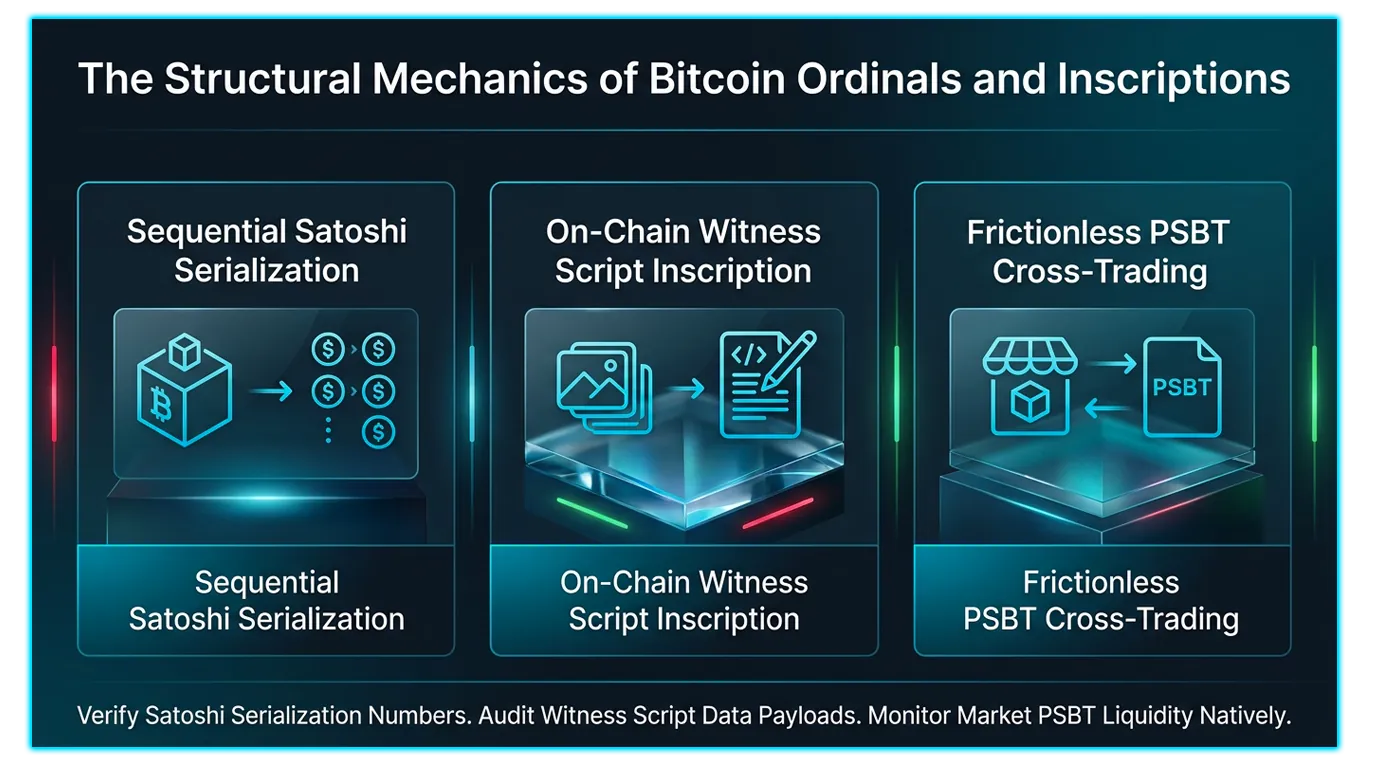
1. The Math: Sat Ordering (Ordinal Theory)
At its core, Ordinal Theory is a software-level protocol that does not require any structural modifications to the underlying Bitcoin code. It functions as a universal tracking system, numbering every satoshi sequentially in the exact chronological order that they are mined into existence.
Because the software tracks each satoshi across every transaction output (UTXO), individual sats can inherit unique scarcity tiers based on historic cryptographic milestones inside the Bitcoin network:
Common: Any satoshi that is not the first sat of its block (99% of all supply).
Uncommon: The very first satoshi minted of every newly confirmed block (occurring roughly every 10 minutes).
Rare: The first satoshi minted at the turn of every difficulty adjustment period (occurring roughly every two weeks).
Epic: The first satoshi minted immediately following a programmatic Halving event (occurring roughly every four years).
Legendary: The first satoshi minted at the intersection of a Halving and a difficulty adjustment cycle (occurring roughly every 24 years).
2. Digital Artifacts: Inscriptions vs. Traditional NFTs
- The terms "Ordinal" and "Inscription" are frequently conflated, but they represent entirely different technical steps. While an Ordinal is the tracked, numbered satoshi itself, an Inscription is the actual content payload bound permanently to that satoshi.
- Unlike traditional NFTs on Ethereum or Solana (which typically store only a basic URL pointer redirecting a web browser to a third-party centralized server or an IPFS node) Bitcoin Inscriptions are completely self-contained. Using the expanded data storage limits unlocked by Taproot, creators write arbitrary raw data (such as JPEGs, audio files, SVGs, or HTML code) directly into the witness script field of an active Bitcoin transaction.
- Because this data is etched natively into the immutable ledger blocks, it inherits Bitcoin's structural decentralization, security architecture, and persistence layers. Rodarmor explicitly characterizes these assets as Digital Artifacts rather than NFTs, highlighting that they are permanently complete, immutable, and incapable of being altered, deleted, or rugged by a smart contract developer.
3. The Infrastructure & The Rise of Marketplaces
Trading early Digital Artifacts was a complex, manual process that required users to run full Bitcoin nodes, pass raw command-line interface instructions, and manually sign transactions to avoid accidentally spending their rare inscribed satoshis as basic network transaction fees. The ecosystem matured rapidly through the development of Partially Signed Bitcoin Transactions (PSBTs), which enabled secure, non-custodial marketplace architectures.
The Role of Magic Eden BTC
- During the initial expansion of the Ordinals and Runes protocols, Magic Eden BTC emerged as a premier cross-chain venue. It built highly dependable, non-custodial PSBT trading pipelines that allowed collectors to list, inspect, and purchase high-value inscriptions with retail-ready web3 wallets.
- While Magic Eden subsequently consolidated its primary core brand footprint toward native Solana execution tracks to maximize localized transaction speed efficiencies, its historical infrastructure contributions established the technical standard for modern, high-volume Bitcoin native marketplaces like UniSat, OKX Wallet, and Gamma.
Digital Asset Architecture Comparison Matrix
| Feature | Traditional NFTs (ERC-721) | Bitcoin Ordinal Inscriptions |
| Data Storage | Off-Chain (IPFS / Central Servers) | 100% Native On-Chain (Witness Data) |
| Immutability | Alterable via Smart Contract Code | Permanently Enforced by Base Consensus |
| Dependencies | Requires External Token Registries | Independent Native Satoshi Ingestion |
| Trading Rails | Standard EVM Smart Contracts | Partially Signed Bitcoin Transactions (PSBT) |
4. Monitoring Ordinals and BRC-20 Assets via DEXTools Telemetry
- As Bitcoin's asset layer scales through accompanying BRC-20 utility tokens, Runes, and layer-2 scalability frameworks, maintaining precise clear-text visibility into live liquidity movements and capitalization metrics is an absolute technical necessity. Sourcing analytics through advanced decentralized charting architectures like DEXTools gives market participants an essential universal platform to monitor live token behaviors, evaluate pool depths, and inspect contract parameters across all public execution networks.
- By leveraging core features like the Pair Explorer, Live New Pairs dashboard, and the integrated Trade Story or Top Traders diagnostic tools, technical traders can seamlessly audit localized volume trends, track large whale wallet capital reallocations via the Big Swap Explorer, and check automated contract safety scores before initiating any on-chain interactions, ensuring your hardened hardware setup interacts safely with verified market venues.
You can access DEXTools here and start trading today!
Disclaimer: This article is for informational purposes only and does not constitute investment advice, financial advice, trading advice, or any other kind of advice. DEXTools does not recommend buying, selling, or holding any cryptocurrency or token. Users should conduct their own research and consult with a qualified financial advisor before making any investment decisions. Cryptocurrency investments are volatile and high-risk. DEXTools is not responsible for any losses incurred.
Ordinals and the UTXO Model: A Deeper Dive
The true genius of Ordinals lies in their seamless integration with Bitcoin's Unspent Transaction Output (UTXO) model. Unlike traditional account-based systems, Bitcoin transactions consume existing UTXOs and create new ones. An Ordinal inscription isn't a separate token or smart contract living elsewhere; it's data "etched" onto the witness script of a specific UTXO. This makes it intrinsically tied to Bitcoin's core mechanism for value transfer and ownership.
When an Ordinal is inscribed, the data is added to the witness data of a transaction output. This output then effectively "contains" the Ordinal. As this UTXO is spent in subsequent transactions, the Ordinal moves with it, following the first-in, first-out (FIFO) ordering rule established by the Ordinal theory. This ensures a clear, immutable, and on-chain lineage of ownership, a significant departure from the off-chain metadata reliance of many other NFT standards.
Practical Implications for On-Chain Immutability
- Direct Bitcoin Ownership: Ordinals are directly tied to Bitcoin UTXOs, meaning ownership is secured by the same cryptographic principles as Bitcoin itself.
- No External Dependencies: Unlike many NFTs that link to external servers for their media, Ordinals store data directly on the Bitcoin blockchain.
- Transaction Fee Costs: Inscribing Ordinals incurs Bitcoin transaction fees, reflecting the on-chain storage cost and network usage.
- Wallet Compatibility: Specialized wallets are often needed to properly display and manage Ordinals, as they need to interpret the Ordinal theory rules.
- Immutable Digital Artifacts: Once inscribed, the data for an Ordinal is permanently recorded on the Bitcoin blockchain, resistant to censorship or alteration.
Related Guides
- Bitcoin Ordinals and BRC-20 Inscriptions: Complete Guide 2026
- What Are Bitcoin Ordinals: Complete NFT Inscription Guide (2026)
- Bitcoin Runes vs BRC-20 vs Ordinals: Complete Comparison 2026
- TON NFTs and Telegram Gifts: Complete Guide (2026)
- NFT Lending Explained: How to Borrow Against Your NFTs
Frequently Asked Questions
What are Bitcoin Ordinals?
Ordinals are a way to inscribe data such as images or text directly onto individual satoshis, the smallest unit of bitcoin, creating unique digital artifacts on the Bitcoin network. They are often described as a form of Bitcoin native non fungible tokens.
How are Ordinals different from typical NFTs?
Many traditional NFTs reference files stored off chain, while Ordinals inscribe the content directly on the Bitcoin blockchain. This means the data lives on chain rather than on an external server.
What is an inscription in Ordinals?
An inscription is the content, such as an image or text, that is attached to a specific satoshi using Bitcoin transaction data. The inscription becomes part of the on chain record.
Do Ordinals change the Bitcoin network?
Ordinals build on existing Bitcoin features rather than changing the core protocol, using transaction data to store inscriptions. They have, however, added new types of activity and demand for block space.