Bitcoin Ordinals and BRC-20 Inscriptions: Complete Guide 2026
— By Tony Rabbit in Tutorials
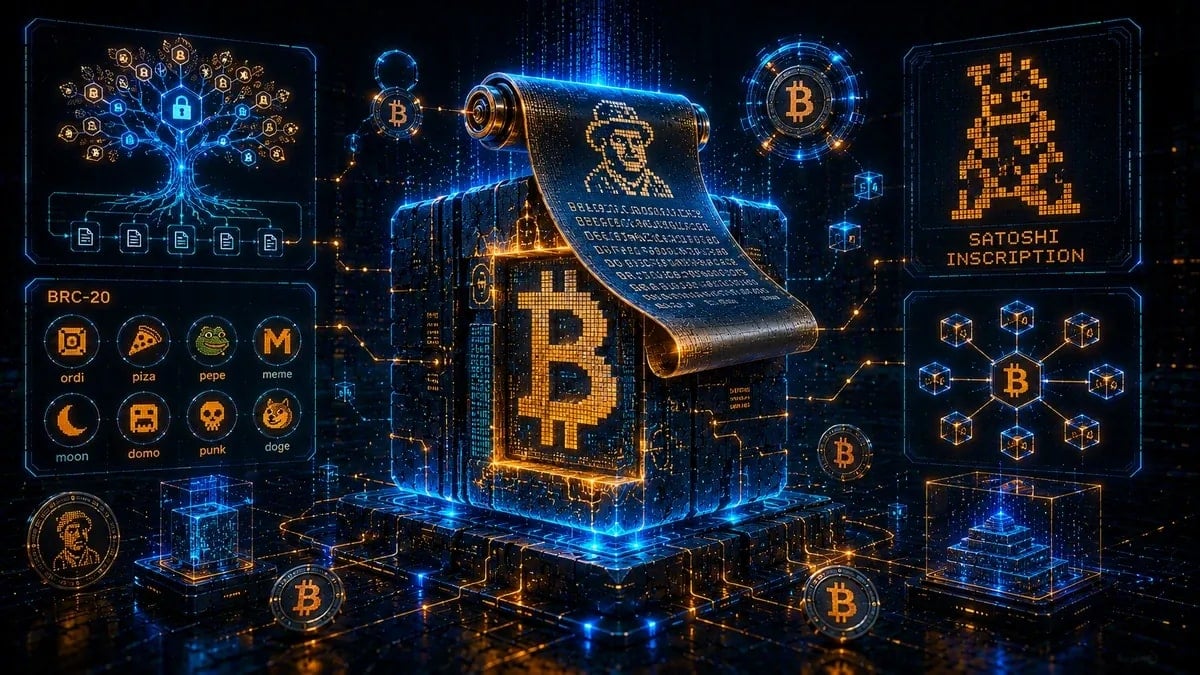
Bitcoin Ordinals and BRC-20 explained: inscriptions, Runes, Atomicals, top marketplaces, wallets, and how to buy your first inscription in 2026.
Bitcoin was originally designed as digital cash, a peer-to-peer payment system. For more than a decade, that was essentially all it did. Then in January 2023, a developer named Casey Rodarmor flipped the script and turned Bitcoin into a platform for native digital assets, NFT-style collectibles, and fungible tokens. The protocol he released is called Ordinals, and the experiment it triggered reshaped how people use the oldest blockchain in the world.
Ordinals introduced the idea of "inscribing" arbitrary data directly onto individual satoshis, the smallest unit of Bitcoin. Within weeks, JPEGs, PFP collections, audio files, and early video games were living permanently inside Bitcoin blocks. A few months later, a pseudonymous developer called Domo used the same primitive to create BRC-20, a fungible token standard that turned Bitcoin into an unexpected meme-coin casino and pushed network fees to all-time highs.
This guide is the long version of that story, updated for 2026. You will learn what Bitcoin Ordinals actually are, how inscriptions work at the protocol level, how BRC-20 tokens are deployed and minted, how Runes fits in, which marketplaces and wallets matter today, and how to buy your first inscription. By the end you will know the difference between an Ordinal, a BRC-20, a Rune, and an Atomical.
What Are Bitcoin Ordinals?
Bitcoin Ordinals are a protocol that assigns a unique serial number to every single satoshi ever mined and lets users attach arbitrary data to individual sats. That data, called an inscription, is stored permanently inside Bitcoin blocks. Ordinals effectively turn each sat into a one-of-a-kind digital artifact, making them Bitcoin's native answer to NFTs and tokenized assets, with the entire content living on-chain rather than on IPFS or external servers.
The protocol was launched on January 21, 2023 by Casey Rodarmor, a former Bitcoin Core contributor who had been working on the idea since 2022. There was no token sale, no foundation, no premine. Rodarmor wrote the ord client, published the theory, and inscribed the first inscription, a pixel art skull on sat number 1,252,201,400,000,000. Within six months, more than ten million inscriptions had been created.
What made Ordinals possible was not a hard fork or a controversial upgrade. The protocol piggybacks on two existing Bitcoin features: the SegWit upgrade of 2017, which moved signature data into a separate "witness" section, and the Taproot upgrade of November 2021, which made it much cheaper to embed large amounts of arbitrary data in that witness section. Without Taproot, inscribing a meaningful image on Bitcoin would have been economically absurd. With Taproot, it became practical.
The Theory: Ordinal Numbering of Satoshis
To understand Ordinals you need the underlying theory, which Rodarmor published as the Ordinal Theory Handbook. The premise is simple. There are 2.1 quadrillion satoshis in Bitcoin's total supply (21 million BTC times 100 million sats per BTC). Each is created in a specific block, in a specific order, by a specific coinbase transaction. If you number them sequentially, every sat has a unique ordinal number from 0 to roughly 2,099,999,997,690,000.
That ordinal number stays with the sat as it moves through transactions, as long as you track inputs and outputs using a first-in-first-out rule. Sat number 1 has been moving through Bitcoin wallets since January 2009. Both early and late sats are still identifiable today if you run an ord indexer.
This numbering is the foundation. Once every sat has a unique identifier, you can collect rare sats: the first sat of every block (uncommon), the first sat of every difficulty period (rare), the first sat after a halving (epic), or sat number 1 itself (mythic). You can attach data to a specific sat to create an inscription. And you can build entire token systems on top of that data, which is exactly what BRC-20 did.
Inscriptions vs Traditional NFTs
If you have used Ethereum NFTs, the inscription model will look strange at first. A typical Ethereum NFT is a smart contract entry that points to a URL, usually an IPFS hash, where the actual image lives. The on-chain part is just a token ID and metadata. The image itself is hosted somewhere off the blockchain. If the IPFS pinning service goes down or the metadata server disappears, the NFT might point to nothing.
An Ordinal inscription is different. The full content, whether that is a JPEG, an SVG, an MP3, an HTML file, or even a small video, is embedded directly inside a Bitcoin transaction's witness data. There is no external URL, no IPFS dependency, no off-chain storage. As long as Bitcoin nodes keep storing the blockchain, the inscription content keeps existing. This makes inscriptions arguably more permanent than any other on-chain asset format in existence.
There are trade-offs. Bitcoin blocks are limited to roughly 4 megabytes of witness data, so inscriptions cannot be huge. Storing data on Bitcoin is also expensive, especially during fee spikes. But for collectors who care about immutability and self-sovereignty, full on-chain storage is the killer feature that Ethereum-style NFTs never delivered.
Witness Data and the Taproot Upgrade
The technical reason inscriptions exist comes down to two Bitcoin upgrades. SegWit (Segregated Witness), activated August 2017, restructured Bitcoin transactions so signature data lived in a separate witness section. Witness data is discounted for block-space accounting, which means storing data in the witness costs four times less than the equivalent data in a regular transaction output.
Taproot, activated on November 14, 2021, went further. It introduced Schnorr signatures and allowed much larger, more flexible scripts in the witness. Taproot was pitched as a privacy and efficiency upgrade, but Rodarmor realized it had also created a generous, cheap data storage layer hiding inside Bitcoin.
An inscription is created using a two-transaction pattern. The commit transaction creates a Taproot output locking coins to a script containing the inscription content. The reveal transaction spends that output and exposes the script, sending the content into the witness section. The reveal is what indexers like ord parse to identify a new inscription.
What Are BRC-20 Tokens?
BRC-20 is a fungible token standard built on top of Bitcoin Ordinals. Instead of inscribing an image, you inscribe a small JSON document that follows a specific schema describing a token deploy, mint, or transfer event. Off-chain indexers read every inscription on Bitcoin, identify the ones with valid BRC-20 JSON, and track balances accordingly. BRC-20 turned Bitcoin into a Solana-style meme-coin platform almost overnight.
The standard was published on March 8, 2023 by a pseudonymous developer called Domo, who described it as an experiment to see whether the Ordinals primitive could support fungible tokens. Domo was clear that BRC-20 was not meant to be a production token standard, just a proof of concept. The market did not care. Within weeks, BRC-20 tokens were minting nonstop, fees were spiking, and exchanges were listing tokens that had been deployed for the cost of a few dollars in fees.
How BRC-20 Mechanics Actually Work
BRC-20 uses three operation types, each represented as a small JSON inscription. The first is deploy, which creates a new token with a four-character ticker, a maximum supply, and a per-mint limit. The second is mint, which any user can call up to the limit until the total supply runs out. The third is transfer, which lets a holder move tokens by inscribing a transfer intent and then sending that inscription to another address.
Here is what really matters: BRC-20 has no smart contracts. Bitcoin does not execute any logic when you inscribe a deploy or a mint. The rules of BRC-20 live entirely inside indexers, which are off-chain programs that scan inscriptions, validate them against the BRC-20 spec, and produce a balance ledger. If two indexers disagree about the rules, they can produce different balance states. In practice, the major indexers (Unisat, OKX, Magic Eden) follow the same rules, but the dependency on off-chain consensus is real and important.
This is the central trade-off of BRC-20. The data is on Bitcoin, which gives it the same permanence as inscriptions in general. The interpretation of that data is off-chain, which means it depends on indexers being honest and consistent. This is fundamentally different from USDT on Ethereum or any ERC-20, where the smart contract itself enforces the rules and every node agrees.
Top BRC-20 Tokens and the Original Cohort
The first BRC-20 Domo deployed was ORDI, with a max supply of 21 million to mirror Bitcoin itself. ORDI was a free, gas-only mint, and within hours thousands of users were spending sats to claim their share. ORDI became the canonical BRC-20, listed on Binance, OKX, Bybit and most major exchanges, with a market cap that peaked above $1 billion during the 2024 cycle.
SATS came next, deployed with a max supply of 2.1 quadrillion to match the total number of satoshis in existence. SATS positioned itself as a "fair-launch" meme coin for the Bitcoin community. RATS, MUBI, PUPS, OXBT and a handful of others rounded out the original cohort that survived the post-launch frenzy and made it onto major exchanges.
In 2026, BRC-20 is past its hype peak but still a meaningful corner of crypto. The top tokens (ORDI, SATS, PUPS, MUBI, RATS) trade with daily volumes in the millions, mostly on OKX, Binance and Bitget. New BRC-20 deployments still happen, but the spotlight has shifted to Runes. The lesson: fair-launch token primitives on Bitcoin find users, even when the standard itself is technically rough.
Runes: Casey Rodarmor's Sequel
While BRC-20 was taking over fee markets, Rodarmor was working on a cleaner fungible token protocol. He proposed Runes in September 2023 as an alternative designed for Bitcoin's UTXO model. Runes launched on April 20, 2024, at the exact block of the fourth Bitcoin halving. The timing was intentional, a cultural moment that tied a new protocol to one of Bitcoin's biggest events.
Runes differ fundamentally from BRC-20 in how they store data. Instead of using inscriptions, Runes encode token operations inside OP_RETURN outputs, the standard Bitcoin mechanism for embedding small amounts of data. Each rune transfer creates UTXOs that represent rune balances natively, so you hold and move runes using the same mental model as ordinary Bitcoin.
For users, the practical difference is huge. BRC-20 transfers require two steps (inscribe a transfer, then send it). Rune transfers happen in a single transaction. Runes also produce less inscription junk in the witness, which means lower fees per operation. And because the protocol uses Bitcoin's UTXO model natively, multiple wallets can implement Runes without a centralized indexer defining balances.
Runes vs BRC-20: The Mechanics Compared
Both Runes and BRC-20 are fungible token standards on Bitcoin, but the engineering choices are very different. Here is a side-by-side comparison covering the main dimensions.
The most important takeaway: Runes solves the structural weaknesses of BRC-20 (off-chain indexers, awkward two-step transfers, inscription bloat) by sticking to OP_RETURN and UTXOs. For users it feels like sending Bitcoin. For Bitcoin itself it produces less block bloat per token operation, which matters in a constrained fee market.
Top Runes in 2026
Runes launched with a famous etching frenzy on April 20, 2024. Several memorable runes were etched in the halving block itself, including UNCOMMON GOODS, Z Z Z Z Z FEHU Z Z Z Z Z, and DECENTRALIZED. The first day saw more than $135 million in transaction fees paid by users racing to etch and mint, turning April 20 into one of the most profitable single days for Bitcoin miners ever.
The standout rune in the months after launch was DOG GO TO THE MOON, ticker DOG, an airdrop to RSIC Metaprotocol holders. DOG hit a market cap above $1 billion before settling back. RSIC became a key piece of Runes lore, having been a free mint Ordinals collection that rewarded holders with mining points convertible to DOG. Other relevant runes in 2026 include PUPS WORLD PEACE, MEME ECONOMICS, RUNESTONE, and a long tail of smaller runes on OKX and Magic Eden.
Daily Runes trading on Magic Eden and OKX combined sits in the tens of millions during normal weeks and spikes during major Bitcoin moves. The launch frenzy of 2024 has cooled into a mature market dominated by a handful of recognized tickers.
Bitcoin Ordinals Marketplaces
Buying and selling inscriptions, BRC-20s, and Runes happens on a small set of marketplaces. The big ones in 2026 are Magic Eden, OKX, Unisat, Gamma, and Ordinals Wallet.
Magic Eden started on Solana and expanded into Bitcoin in 2023. It is now the largest cross-chain marketplace by volume and supports inscriptions, BRC-20s, and Runes. It has the deepest order books for blue-chip collections like NodeMonkes, Quantum Cats, Bitcoin Puppets, and Runestone. Fees are 1.5% for buyers plus creator royalties.
OKX is a marketplace, centralized exchange, wallet, and Web3 hub combined. The OKX Web3 wallet is one of the most popular ways to interact with Ordinals and Runes, and the marketplace supports inscriptions, BRC-20s, Runes, and Atomicals. OKX's CEX listings of major BRC-20s and Runes drove deep secondary liquidity.
Unisat was the first dedicated Ordinals marketplace and remains the technical leader for power users. Unisat runs one of the most-trusted BRC-20 indexers, offers the deepest BRC-20 markets, and has tools for inscribing, minting, and managing wallets that others do not match.
Gamma is the friendly inscriber, the easiest place to create an inscription with a drag-and-drop interface that handles the commit/reveal dance behind the scenes. Gamma also hosts curated artist drops.
Ordinals Wallet is both a wallet and a marketplace, smaller in volume but appreciated by collectors who want a self-contained tool with built-in trading and minting flows.
Bitcoin Ordinals Wallets
You cannot use a regular Bitcoin wallet to hold Ordinals and Runes safely. Standard Bitcoin wallets do not distinguish between sats with inscriptions and ordinary sats, which means they might spend an expensive inscription as fee or merge it with other coins in a way that destroys the data. You need a wallet that understands ordinal numbering and treats inscribed sats as separate UTXOs.
Xverse is the most user-friendly Ordinals wallet for beginners. It runs as a browser extension and mobile app, supports Ordinals, BRC-20s, Runes, and Stacks, has a clean marketplace integration, and is the default recommendation for people new to the space. Xverse handles sat selection automatically so you do not accidentally burn an inscription.
Leather, formerly known as Hiro Wallet, comes from the Stacks ecosystem and is a strong choice if you also use sBTC or other Stacks assets. Leather supports Ordinals and Runes natively and integrates well with Stacks DeFi apps.
Unisat Wallet is the power-user choice. It exposes more low-level functionality, supports the widest range of standards (Ordinals, BRC-20, Runes, Atomicals), and is closely tied to the Unisat marketplace and indexer. If you plan to inscribe, mint, or batch-trade frequently, Unisat is hard to beat.
Phantom Wallet, the famous Solana wallet, added Bitcoin and Ordinals support in 2023 and continues to expand its multi-chain capabilities. For users who already hold multi-chain portfolios, Phantom makes Bitcoin Ordinals feel like just another asset class inside the same interface they already use.
Magic Eden Wallet is Magic Eden's own multi-chain wallet, built specifically for the marketplace experience. It supports Bitcoin, Ethereum, Solana, and Polygon, with deep integration into the Magic Eden marketplace itself.
Whichever wallet you choose, follow basic crypto wallet security tips: write down your seed phrase on paper, never type it into a website, and consider using a hardware wallet for any inscription worth more than a few hundred dollars.
Impact of Inscriptions on Bitcoin Fees
One of the most consequential effects of Ordinals has been on Bitcoin's fee market. Before inscriptions, Bitcoin fees were driven almost entirely by financial activity (payments, exchange withdrawals, large transfers). After inscriptions, a new source of demand for block space appeared: people minting JPEGs, BRC-20s, and runes. This demand does not care about urgency for payments but cares deeply about getting included before someone else mints out a supply cap.
The result has been periodic fee spikes that look very different from pre-Ordinals Bitcoin. The May 2023 BRC-20 frenzy pushed median fees above $30, the highest since the 2021 bull market. The April 2024 Runes launch produced a single block with more than $2.4 million in fees, the highest fee block in Bitcoin history. These spikes are great for miners (especially miners running their operations close to break-even) but painful for users sending payments.
From a network security perspective, this is actually important. Bitcoin's block subsidy halves roughly every four years, dropping from 6.25 BTC per block in 2020 to 3.125 BTC in 2024 to 1.5625 BTC after the 2028 halving. Eventually the subsidy will be tiny and miners will need to be paid almost entirely from fees. Inscriptions and runes provide a meaningful new source of fee demand that could matter a lot in 2030 and beyond, although whether they will be enough to secure the network is still a debate among Bitcoin researchers.
Bitcoin Layer 2 and Bitcoin DeFi Connections
Ordinals reignited interest in building a real DeFi ecosystem on Bitcoin. If sats can be unique assets and fungible tokens can live on Bitcoin, the next logical question is whether you can lend, borrow, and trade those assets without giving up Bitcoin custody. Several Bitcoin Layer 2 and sidechain projects have emerged to answer that.
Stacks is the most established Bitcoin smart contract platform. Its sBTC asset, fully launched in 2024, is a decentralized BTC-pegged token that lives on Stacks but is backed by real Bitcoin. With sBTC, users can run DeFi apps that use Bitcoin as collateral without trusting a centralized custodian. Stacks works closely with the Ordinals ecosystem and is one of the main ways to actually do DeFi with inscribed assets.
Babylon is a different approach. Babylon lets Bitcoin holders stake their BTC to secure proof-of-stake chains and earn yield, without bridging or wrapping. By 2026, Babylon is securing dozens of staking-style protocols and has become a major source of Bitcoin yield for institutional holders.
Merlin Chain is an EVM-compatible Bitcoin Layer 2 that specifically targets Ordinals, BRC-20s, and Runes interoperability. Merlin bridges inscriptions to its rollup, enabling trading and DeFi composability with much lower fees than mainnet Bitcoin. Other L2s in the same category include BOB, Bitlayer, and BEVM.
The broader story is that inscriptions revealed a demand for Bitcoin-native financial primitives that existing infrastructure could not satisfy. Layer 2s are filling that gap and pulling Bitcoin closer to a multi-asset, multi-application platform without breaking the security model of the base chain.
Step-by-Step: Get Started With Bitcoin Ordinals
If you want to actually buy your first inscription or mint a BRC-20, here is the path most users follow in 2026. Total setup time is around 15 minutes once you have BTC on hand.
Step 1: Install Xverse Wallet
Go to xverse.app and install the browser extension or mobile app. During setup, write your 12-word seed phrase down on paper, store it somewhere safe, and never share it with anyone. Xverse generates separate addresses for ordinary BTC (Native SegWit) and inscriptions (Taproot). The Taproot address is the one that will hold your Ordinals.
Step 2: Fund Your Wallet
Send a small amount of BTC, say 0.001 to 0.005 BTC, to your Xverse Bitcoin address. You can buy BTC on any major exchange and withdraw to your Xverse address. Wait for at least one confirmation before doing anything else. If you are concerned about address poisoning scams, double-check the destination address before sending.
Step 3: Connect to a Marketplace
Go to magiceden.io/ordinals or okx.com/web3/marketplace. Click Connect Wallet and select Xverse. Approve the connection in your wallet. You should now see your Bitcoin balance and any inscriptions you own (none, yet).
Step 4: Buy Your First Inscription
Browse collections like NodeMonkes, Bitcoin Puppets, Quantum Cats, Runestone, or any open marketplace listing. For a first purchase, look for floor-priced inscriptions in a recognized collection, ideally under 0.01 BTC. Click Buy, review the transaction details (price, network fee, marketplace fee), and approve in Xverse. The transaction will hit the mempool and confirm within 10-30 minutes depending on fee conditions.
Step 5: Mint a BRC-20 or Rune
If you want to mint a fresh BRC-20 or Rune, go to unisat.io or okx.com/web3. Find an active mint, click Mint, pay the inscribe fee (usually $1 to $5 in BTC), and wait for confirmation. Remember that BRC-20 minting is a race: when a token's supply runs out, the mint closes. Successful mints land in your wallet as transferable BRC-20 balances or Rune UTXOs.
Use Cases Beyond Speculation
Most attention on Ordinals focuses on speculative trading, but there are real use cases emerging that are worth understanding.
Fully on-chain art that does not depend on IPFS or hosted servers. Artists love the permanence guarantee.
Doom, chess, and other small games inscribed directly into Bitcoin blocks. Playable from any ord-aware explorer.
Notarizing documents, certificates, or timestamps directly on Bitcoin with full content rather than just a hash.
Permissionless BRC-20 and Rune deployments with no team allocation, no presale, just an open mint for anyone.
The digital art use case is especially interesting because it represents a real alternative to the broken metadata models of most NFT collections. When you buy an Ordinals NodeMonkes inscription, you own the image bytes inscribed on a specific sat, not a pointer that might break. For collectors who care about durability over decades, that is meaningful.
Risks and Trade-offs
Ordinals, BRC-20, and Runes are exciting but they come with real risks that anyone using them should understand clearly.
Off-chain indexer dependence (BRC-20). BRC-20 balances live entirely inside off-chain indexers. If indexers disagree about edge cases, you can end up with a token that one exchange recognizes and another does not. Major BRC-20s have settled into stable indexer consensus, but smaller tokens have had incidents where balances diverged. Runes mitigate this by being UTXO-native but BRC-20 holders should be aware.
Fee volatility. Inscription costs vary by orders of magnitude. Minting a BRC-20 can cost $2 on a quiet day and $200 during a mint frenzy. If you set fees too low, your transaction sits in the mempool while the mint closes around you. Always check current mempool conditions on mempool.space before sending and use a wallet that lets you set custom fees.
Wallet mistakes burn money. Sending an inscription to a non-Taproot address, accidentally spending it as fee, or using a wallet that does not track ordinal numbering can destroy valuable inscriptions permanently. Use a wallet built for Ordinals, double-check addresses, and never improvise.
Regulatory uncertainty. Fungible tokens on Bitcoin sit in an awkward place regulator-wise. They could be classified as securities in some jurisdictions, especially if they were sold with marketing or expectations of profit. The same caution that applies to any DeFi token applies here.
Liquidity is thin outside the top names. The top 10 BRC-20s and top 10 Runes have decent liquidity. Beyond that, you can find tokens with $50,000 market caps and order books that vanish if you try to sell. Stick to recognized names unless you are explicitly speculating on small caps.
Fake volume and wash trading. Some Bitcoin marketplaces have been observed inflating volume with self-trading. Cross-check with multiple sources before relying on volume rankings, and read our guide on detecting fake volume on crypto charts to learn the patterns.
Pros and Cons
- Full on-chain storage with Bitcoin's permanence guarantee
- Native Bitcoin assets with no bridge or wrapper risk
- Fair-launch primitives with no premine or VC allocation
- Creates new fee demand that supports miner revenue
- Mature wallet and marketplace infrastructure by 2026
- Runes brings clean UTXO-native fungible tokens
- BRC-20 depends on off-chain indexer consensus
- Inscription frenzies push payment fees to painful levels
- Easy to accidentally burn inscriptions with wrong tools
- Thin liquidity outside the top tokens
- Regulatory status of BRC-20 and Runes is unclear
- Some Bitcoin purists view Ordinals as spam
The Bitcoin Civil War: Are Ordinals Spam?
It would be incomplete to write about Ordinals without acknowledging the cultural battle inside Bitcoin. Many long-time Bitcoiners view Ordinals as a misuse of the protocol, an exploit that turns block space meant for monetary transactions into a billboard for JPEGs. Luke Dashjr, a prominent Bitcoin Core developer, has publicly called Ordinals a vulnerability that should be filtered out. There have been proposals to specifically discourage or block inscription transactions.
On the other side, supporters argue that Bitcoin is permissionless, that fee markets are the correct mechanism for prioritizing block space, and that anyone willing to pay the fees has the right to use that space. By 2026, this debate has stabilized into a fragile equilibrium: most Bitcoin nodes accept inscriptions, miners happily process them, and the user base has grown large enough that any attempt to filter them out would split the community.
Practically, if you are using Ordinals in 2026, you can assume the infrastructure works and is here to stay. If you are a Bitcoin maximalist who hates Ordinals, you can still run a node that filters them at the mempool level, although they will eventually appear in your chain once mined. The civil war is real but mostly cultural at this point.
The Future: L2s, Cheaper Inscriptions, and Beyond
The most likely future for Ordinals and Runes runs through Bitcoin Layer 2s. Inscribing on mainnet is expensive. Inscribing on a Bitcoin L2 that batches state back to Bitcoin can be 10x to 100x cheaper while inheriting Bitcoin's security. Several rollups are working on this: BOB, Bitlayer, Merlin, Citrea, and others.
Another direction is composability. Today, an Ordinals inscription is passive. It sits on a sat, can be transferred, but cannot interact with other inscriptions without an off-chain coordinator. Future protocols may add lightweight scripting that lets inscriptions participate in DeFi, automated markets, or governance through L2 contracts that maintain a verifiable link to the underlying inscriptions.
Runes will probably continue to gain ground over BRC-20 because of its cleaner mechanics, but BRC-20 has enough entrenched liquidity and exchange listings that it is unlikely to disappear. The two standards will coexist, similar to how ERC-20 and other token standards coexist on Ethereum. Atomicals, the third major competing standard, has carved out a niche but has not reached the scale of either BRC-20 or Runes.
Finally, the broader cultural shift matters. Bitcoin in 2020 was almost exclusively a savings vehicle. Bitcoin in 2026 is a savings vehicle, an asset platform, a meme-coin casino, an art layer, and a settlement layer for L2 ecosystems. Whether you view that evolution as a feature or a corruption, it is the reality of how the network is used now.
Frequently Asked Questions
Q What is a Bitcoin Ordinal in simple terms?
A Bitcoin Ordinal is a unique digital artifact created by inscribing data onto a specific satoshi, the smallest unit of Bitcoin. Each satoshi has a unique ordinal number, and inscribing content (an image, text, audio, or code) makes that sat identifiable and tradeable as a one-of-a-kind asset, similar to an NFT but stored fully on the Bitcoin blockchain.
Q Who created Bitcoin Ordinals?
Bitcoin Ordinals were created by Casey Rodarmor, a developer who previously contributed to Bitcoin Core. He launched the protocol on January 21, 2023 by inscribing the first inscription and releasing the ord client software. There was no token sale, foundation, or premine, just open-source software released publicly.
Q What is a BRC-20 token?
BRC-20 is a fungible token standard built on top of Bitcoin Ordinals. Each token operation (deploy, mint, transfer) is a small JSON inscription on Bitcoin. Off-chain indexers parse those inscriptions and maintain the token's balance ledger. The standard was created in March 2023 by a developer called Domo. ORDI was the first BRC-20 token.
Q How is BRC-20 different from ERC-20?
ERC-20 tokens are enforced by Ethereum smart contracts. Every node verifies token rules automatically. BRC-20 tokens have no smart contract enforcement on Bitcoin. The rules live entirely in off-chain indexers that read inscriptions and compute balances. This makes BRC-20 lighter and more flexible but also more dependent on indexer consensus, which is a different trust model than ERC-20.
Q What are Runes and how do they differ from BRC-20?
Runes are a fungible token protocol on Bitcoin launched by Casey Rodarmor in April 2024 at the fourth halving block. Unlike BRC-20, which uses inscriptions, Runes encode token operations in OP_RETURN outputs and represent balances natively in UTXOs. This makes Runes faster, cheaper, and less dependent on off-chain indexers than BRC-20.
Q Where can I buy Bitcoin Ordinals?
The largest Ordinals marketplaces in 2026 are Magic Eden, OKX, Unisat, Gamma, and Ordinals Wallet. Magic Eden has the deepest order books for blue-chip collections. OKX combines a marketplace with a centralized exchange and Web3 wallet. Unisat is the power-user choice with the strongest BRC-20 tooling.
Q What wallets support Bitcoin Ordinals?
Xverse, Leather (formerly Hiro), Unisat Wallet, Phantom, and Magic Eden Wallet are the most-used Ordinals-aware wallets. Xverse is the easiest for beginners. Unisat is best for power users and BRC-20 minting. Phantom is convenient for multi-chain users. Never store inscriptions in a regular Bitcoin wallet that does not understand ordinal numbering.
Q Do Ordinals raise Bitcoin transaction fees?
Yes, during periods of high inscription or rune minting activity. Block space is a finite resource and inscriptions compete with payments for inclusion. The April 2024 Runes launch produced the highest-fee block in Bitcoin history, with miners earning more than $2.4 million in a single block. Fee spikes happen during mint frenzies and have made median transaction fees significantly more volatile.
Q Are Bitcoin Ordinals NFTs?
Functionally yes, Ordinals serve the same purpose as NFTs: representing unique digital assets that can be owned and traded. Technically they are different. Ethereum NFTs are smart contract entries with off-chain metadata. Ordinals are full on-chain inscriptions attached to specific satoshis, with no smart contract and no external storage dependency.
Q Can I lose money buying Ordinals or BRC-20?
Yes. Prices for Ordinals collections and BRC-20 tokens are highly volatile and many collections have lost more than 90% from their peaks. Liquidity outside the top names is thin, fees can be unpredictable, and wallet mistakes can permanently destroy inscriptions. Only spend amounts you can afford to lose and stick to recognized marketplaces and wallets.
Q What is the difference between Ordinals, BRC-20, Runes, and Atomicals?
Ordinals is the base protocol for inscribing arbitrary data on satoshis, mainly used for NFT-like collectibles. BRC-20 builds fungible tokens on top of Ordinals using JSON inscriptions and off-chain indexers. Runes is a separate fungible token protocol using OP_RETURN and native UTXOs. Atomicals (ARC-20) is another competing standard supporting both fungible and non-fungible assets through colored sats. All four coexist on Bitcoin in 2026.
Q Do I need to run a Bitcoin node to use Ordinals?
No. You can buy, sell, mint, and hold Ordinals, BRC-20s, and Runes using consumer wallets like Xverse or Unisat without running a node. Running your own Bitcoin Core node plus an ord indexer gives you maximum sovereignty but is not required for normal use. Most users rely on the indexers operated by marketplaces and wallet providers.
Conclusion
Bitcoin Ordinals turned the oldest blockchain into something its creator never explicitly designed it to be: a platform for digital artifacts, fungible tokens, and on-chain art. Three years after Casey Rodarmor inscribed the first sat, the ecosystem has matured into a real corner of crypto with a stable set of marketplaces and wallets and a credible roadmap toward Bitcoin DeFi via Layer 2s.
BRC-20 proved fungible tokens were possible on Bitcoin and revealed enough demand to justify a better protocol. Runes is that protocol, and by 2026 it has captured the bulk of new token activity. Atomicals carved out a smaller niche. Together, the four standards represent a richer Bitcoin than the simple payment network most people imagined in 2015.
If you want to get hands-on, start small: install Xverse, fund it with a tiny amount of BTC, buy a floor-priced inscription on Magic Eden, and try minting a Rune on OKX. Pay attention to fees, never share your seed phrase, and treat every position as speculative until you have built real understanding.