Web3 Startup Data Room for Investors: What to Include (2026)
— By Whatsertrade in Tutorials

Learn how to build a Web3 startup data room for investors, including pitch materials, token docs, treasury, audits, legal files, traction metrics, and access control.
This guide is specifically about preparing a Web3 startup data room for investors. It is a fundraising and due-diligence page, not a general tokenomics or security explainer.
Key Takeaways
- The Need for More Than Just a Pitch Deck in Web3
- Understanding the Importance of a Data Room
- Defining a Web3 Startup Data Room
- Core Benefits of a Data Room
- Timing Your Data Room Preparation
- Key Components of a Web3 Data Room
The Need for More Than Just a Pitch Deck in Web3
Fundraising in Web3 is competitive. Investors do not only look at your pitch deck. They want to understand your product, team, market, traction, token model, legal structure, security posture, and long-term strategy.
Understanding the Importance of a Data Room
A well-prepared data room helps you organize all of that information in one place. It makes the due diligence process easier and shows investors that your startup is serious, transparent, and ready for professional conversations.
Defining a Web3 Startup Data Room
A Web3 startup data room is a secure online folder that contains the key documents investors need before making a decision. For a traditional startup, this may include pitch materials, financials, company documents, and legal information. For a Web3 startup, the data room often needs to go further. Investors may also want to review token documentation, smart contract audits, treasury details, governance plans, and on-chain metrics.
Core Benefits of a Data Room
Speed
The first reason to create a data room is speed. During fundraising, investors often ask for documents after an initial call. If you have to prepare everything from scratch, you can lose momentum. A ready data room allows you to respond quickly and keep the conversation moving.
Trust
The second reason is trust. A messy or incomplete data room can create doubts. If investors cannot find basic information, they may wonder if the team is equally disorganized in other areas. A clean data room does not guarantee investment, but it creates a stronger first impression.
Timing Your Data Room Preparation
The best time to prepare your data room is before you start active fundraising. Many founders wait until investors ask for materials, but this usually creates stress. It is better to build a simple version early and improve it over time.
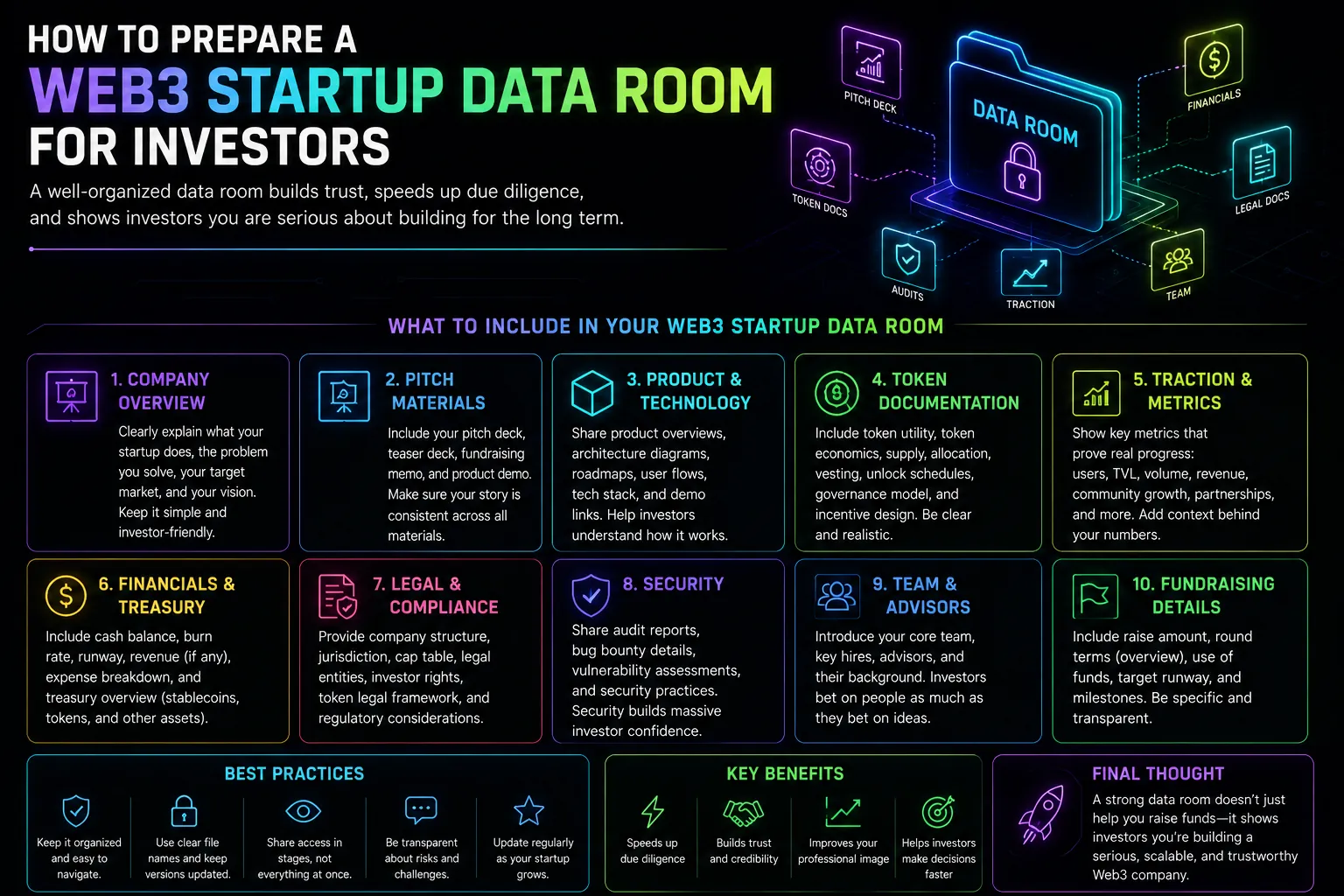
Key Components of a Web3 Data Room
Company Overview
A strong Web3 startup data room should begin with a clear company overview. This section should explain what the startup does, what problem it solves, who the target users are, and why the market opportunity matters. The explanation should be simple enough for an investor to understand quickly, even if the product is technically complex.
Pitch Materials
The pitch materials should also be easy to find. This usually includes the main pitch deck, a shorter teaser deck, a product demo, and a fundraising memo. These documents should tell the same story. If your pitch deck says one thing and your data room says another, investors may notice the inconsistency.
Product and Technology Documentation
Product and technology documentation is especially important in Web3. Investors need to understand what you are building and how it works. This does not mean every investor will read deep technical documents, but the information should be available. A good product section can include a product overview, architecture explanation, roadmap, user flows, demo links, and technical dependencies.
Token Model
If your startup has a token or plans to launch one, token documentation deserves special attention. Many investors will want to know why the token exists, how it is used, how supply is allocated, and how incentives work. A weak token model can damage investor confidence, even if the product is strong. Token documentation should be clear and realistic. It should explain token utility, allocation, vesting, unlock schedules, governance role, and incentive design. Avoid overly aggressive assumptions, as investors are usually skeptical of token models that depend only on hype or unrealistic growth.
Traction and Metrics
Traction is another critical part of the data room. Web3 traction can include users, wallet connections, transaction volume, total value locked, revenue, protocol fees, community growth, partnerships, developer activity, or testnet usage. The exact metrics depend on the type of startup. It is important to explain how metrics are calculated. For example, wallet count alone may not prove real adoption if most wallets are inactive. Transaction volume may not be meaningful if it is driven by incentives or bots. Investors appreciate honest context because it helps them understand the quality of the traction.
Financial, Legal, and Security Considerations
Financial and Treasury Information
Even early-stage startups should provide a basic view of cash balance, burn rate, runway, revenue, expenses, and hiring plans. For crypto startups, treasury information may be relevant, especially if the project holds stablecoins, native tokens, or other digital assets.
Legal and Compliance Documents
Legal and compliance documents are often more important in Web3 than founders expect. Investors may want to understand the company structure, jurisdiction, ownership, investor rights, token issuance plans, and regulatory risks. If legal questions are unclear, the investment process can slow down quickly.
Security Documentation
Security documentation can be a major trust signal. If your product uses smart contracts or manages user funds, investors will want to know whether audits have been completed, whether vulnerabilities have been fixed, and whether a bug bounty program exists. Security does not need to be perfect, but the team should show that it takes risk seriously.
Community, Team, and Fundraising
Team and Advisors
The team section should help investors understand who is building the company. This can include founder bios, key team members, advisors, hiring plans, and relevant previous experience. In Web3, investors often care about technical ability, community credibility, and execution history.
Community and Governance Information
Community and governance information can also be useful. If your startup has a strong community, show how it is growing and how engaged it is. If governance is part of the project, explain how decisions are made now and how governance may evolve in the future.
Fundraising Documents
A Web3 data room should also include fundraising documents. This may include the current round terms, amount being raised, use of funds, target runway, and investor materials. The use of funds should be specific. Investors want to know whether capital will be used for product development, hiring, security, marketing, liquidity, compliance, or ecosystem growth.
Access Control and Organization
Access control is important. Not every investor needs access to every document at the beginning. Sensitive legal, financial, or token information may be shared later in the process. Many founders create a lighter version for early conversations and a deeper version for serious due diligence. Organization matters. File names should be clear. Folders should be easy to navigate. Old versions should be removed or archived. Investors should not have to search through messy folders to find basic documents.
Avoid Overloading
One common mistake is overloading the data room with unnecessary information. More documents do not always create more confidence. The goal is to provide useful, relevant, and well-organized materials. Another mistake is hiding weak areas. Investors know early-stage startups are imperfect. It is better to explain risks clearly than to pretend they do not exist.
Proactively Address Investor Questions
A good data room should answer the main investor questions before they are asked. What does the company do? Why now? Why this team? What traction exists? How does the business make money? Why does the token matter? What are the risks? How will the money be used? What needs to happen next?
Preparing a Web3 startup data room takes time, but it can improve the fundraising process significantly. It helps founders stay organized, gives investors confidence, and reduces friction during due diligence.
In Web3, where projects often involve tokens, smart contracts, communities, and regulatory complexity, clarity is a competitive advantage. A strong data room shows that your startup is not only building a product, but also building a serious company.
How to Bridge Crypto Between Chains: Complete Cross-Chain Tutorial 2026 How to Use 1inch: Complete DEX Aggregator Swap Tutorial (2026) How to Use OKX Web3 Wallet: Multi-Chain DeFi Hub Guide (2026)Frequently Asked Questions
What is a web3 startup data room?
A web3 startup data room is a secure online repository for essential documents and information that a web3 startup shares with potential investors during due diligence.
What types of documents are typically included?
It typically includes legal documents, financial projections, tokenomics, team bios, whitepapers, technical roadmaps, and information on smart contracts and blockchain integrations.
How does a web3 data room differ from a traditional startup data room?
Key differences include the emphasis on tokenomics, smart contract audits, decentralized governance models, and community engagement metrics, which are unique to web3 projects.
What is the purpose of a data room for investors?
For investors, the data room provides a comprehensive overview of the startup's operations, technology, market potential, and risks, enabling informed investment decisions.
What security considerations are important for a web3 data room?
Security considerations include robust access controls, encryption, audit trails, and potentially blockchain-based verification for document integrity, given the sensitive nature of the information.
Related Guides
- Gate.io Beginner Guide: Startup and Web3 Explained
- What Is Moralis: Web3 APIs, Indexed Data and Backend Acceleration (2026)
- What Is Filecoin: Decentralized Storage Markets, Incentives and Web3 Data (2026)
- Can You Stake XRP? What Investors Actually Mean by that
- What Is Vana Protocol Data Sovereignty Dao Token Guide 2026