Multisig Wallet Security Models: Thresholds, Roles and Failure Modes (2026)
— By Whatsertrade in Tutorials

A narrower multisig guide focused on threshold design, signer roles, operational failure modes and governance security in 2026.
Where this page fits: This page is the security-model angle. It focuses on thresholds, signer roles and failure modes. For the broader beginner explainer, read our main multisig guide.
A multisig wallet is one of the most important security tools in crypto, especially for teams, DAOs, funds, and anyone managing large amounts of digital assets. While a standard crypto wallet is controlled by one private key, a multisig wallet requires multiple approvals before a transaction can be executed. This simple difference changes how control, security, and trust work in crypto.
For beginners, the idea can seem technical. In practice, it is easy to understand. A multisig wallet is a shared control wallet. Instead of one person holding all the power, multiple people must sign off before funds move. That makes it far more difficult for a single mistake, hack, or bad actor to cause damage.
What a multisig wallet means
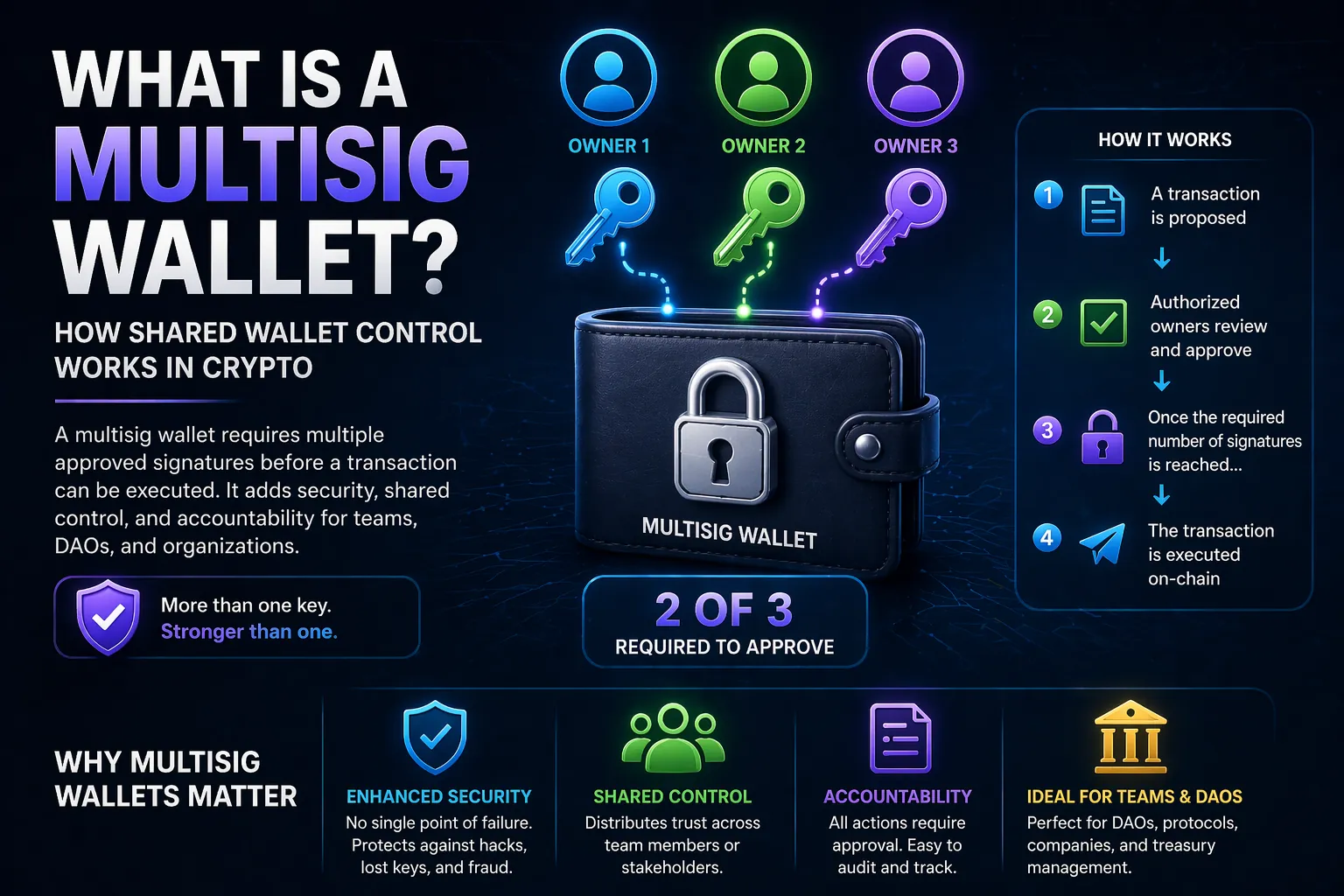
The term multisig stands for multi signature. It refers to a wallet setup where more than one cryptographic signature is required to authorize a transaction. The most common structure is called M of N.
For example, in a 2 of 3 multisig wallet, there are three authorized signers, but only two are needed to approve a transaction. In a 3 of 5 setup, five people are allowed to sign, but at least three must approve before the transaction goes through.
This creates shared control. No single signer can move funds alone unless the wallet is deliberately configured that way.
How a multisig wallet works
When a multisig wallet is created, the authorized signers are defined at the start. These signers can be individuals, devices, or wallets controlled by different members of a team. The wallet then follows the signature threshold chosen during setup.
If someone wants to send funds, they create a transaction proposal. That proposal is visible to the other signers. Once the required number of signers approve the transaction, it can be executed on chain.
This process adds a layer of coordination. It slows things down slightly, but it also creates protection against rushed decisions, compromised keys, and unauthorized transfers.
In short, a multisig wallet trades convenience for stronger control.
Why multisig wallets matter in crypto
Multisig wallets matter because crypto is built around private key ownership. If one private key controls everything, then one mistake can destroy everything. A lost key, a hacked device, or a phishing attack can wipe out a treasury in seconds.
A multisig wallet reduces that single point of failure. Even if one signer is compromised, the attacker still cannot move funds without the additional required approvals.
This is especially important for DAOs, startups, protocols, investment groups, and communities. When a treasury belongs to multiple stakeholders, it makes little sense for one person to control it alone. Shared assets need shared authority.
Multisig also creates accountability. Because multiple people must approve transactions, treasury activity becomes easier to oversee and harder to abuse.
Common use cases for multisig wallets
Multisig wallets are widely used in crypto treasury management. Protocol teams often use them to hold stablecoins, native tokens, payroll funds, and ecosystem reserves. DAOs use multisig wallets to manage grants, contributor payments, and operational budgets.
They are also useful for families, business partners, and high net worth individuals who want a more secure storage model. Someone managing a large long term crypto portfolio may prefer a multisig wallet to reduce the risk of a single device failure or compromise.
In many cases, multisig acts like a crypto version of dual authorization in traditional finance. Large decisions require more than one person to approve them.
The main benefits of a multisig wallet
The biggest advantage of a multisig wallet is security. By distributing control across multiple signers, the wallet becomes more resistant to theft and human error.
Another major benefit is governance. A multisig wallet is not just a storage tool. It is also a decision making structure. It allows a team to formalize how funds are controlled and who is responsible for approvals.
Multisig wallets also improve business continuity. If one signer loses access to a device or becomes unavailable, the wallet can still function if the threshold allows enough remaining signers to approve transactions.
Finally, multisig can increase trust inside a project. Communities and investors generally feel more comfortable when treasury funds are not controlled by one anonymous wallet.
The limitations of multisig wallets
A multisig wallet is safer, but not perfect. The main tradeoff is complexity. More signers means more coordination, and that can slow down urgent decisions. If the threshold is too high, the wallet may become difficult to use in practice.
There is also social risk. If signers disagree, transactions can stall. If several signers lose access at the same time, funds may become difficult or impossible to move depending on the setup.
Another limitation is that multisig does not eliminate every attack vector. If enough signers are compromised, the wallet can still be drained. Poor operational security, weak signer selection, and careless device management can still create serious risk.
This is why multisig works best when paired with strong procedures and clear internal rules.
Multisig wallet vs single key wallet
A single key wallet is simple and fast. One key controls the funds, and one person can act immediately. That works well for everyday wallets, trading accounts, and small balances.
A multisig wallet is better suited for higher stakes situations. It is designed for shared ownership, large amounts, and treasury level security. It introduces friction, but in crypto that friction is often a feature, not a flaw.
The choice depends on context. Not every wallet needs multisig, but many projects and serious holders benefit from it.
Who should use a multisig wallet
Anyone managing shared funds should seriously consider a multisig wallet. That includes DAOs, startup teams, protocol foundations, investment groups, and on chain communities.
It is also worth considering for individuals with large holdings who want stronger protection against key loss or theft. In those cases, multisig can be set up across multiple devices or trusted parties to reduce concentrated risk.
The core idea is simple: the more important the funds, the more dangerous it is to rely on a single key.
Final thoughts on multisig wallets
A multisig wallet is one of the clearest examples of how crypto security can be improved through better design. By requiring multiple approvals, it reduces single point of failure risk, strengthens governance, and makes shared asset control more responsible.
It is not the right tool for every wallet, but for treasuries, teams, and large balances, it is one of the smartest security choices available. In a market where one bad click can be catastrophic, shared control is often the difference between resilience and disaster.
How to Bridge Crypto Between Chains: Complete Cross-Chain Tutorial 2026 How to Use 1inch: Complete DEX Aggregator Swap Tutorial (2026) How to Use OKX Web3 Wallet: Multi-Chain DeFi Hub Guide (2026)Frequently Asked Questions
What is a multisig wallet security model?
A multisig wallet security model defines the number of signatures required to authorize a transaction (threshold) and the roles assigned to each signer.
How do thresholds work in multisig models?
Thresholds specify the minimum number of approvals needed from a set of signers. For example, a 2-of-3 model requires two out of three designated signers to approve a transaction.
What are the different roles in a multisig setup?
Roles can include owners, administrators, and recovery agents, each with specific permissions. These roles help distribute control and mitigate single points of failure.
How do multisig models address failure modes?
Multisig models mitigate failure modes like lost keys or compromised individual accounts by requiring multiple independent approvals. This redundancy enhances security and recovery options.
What are the benefits of using a multisig wallet security model?
Multisig models offer enhanced security, improved governance, and robust recovery mechanisms compared to single-signature wallets. They are particularly useful for managing shared or high-value crypto assets.