What Is a Merkle Tree in Crypto? Explained
— By Whatsertrade in Tutorials

Merkle tree in crypto explained: how it powers proofs and proof of reserves, and why it lets blockchains verify large data sets quickly and efficiently.
This page answers what a Merkle tree is in crypto. It is about data verification structure, not token-distribution strategy by itself.
Key Takeaways
- Mechanics of a Merkle Tree
- Benefits of Using Merkle Trees
- The Role of Merkle Trees in Airdrops
- Proof of Reserves and Merkle Trees
- Significance for Crypto Users
- How a Merkle Proof Verifies a Single Item
A Merkle tree is a data structure used in crypto to verify large sets of information efficiently. It allows someone to prove that a specific piece of data belongs to a bigger group without revealing the entire data set. This structure is crucial to various blockchain applications.
In blockchain systems where both efficiency and privacy are paramount, the Merkle tree in crypto finds extensive use in airdrops, proof systems, and reserve verification due to its unique capabilities.
Mechanics of a Merkle Tree
Building the Tree
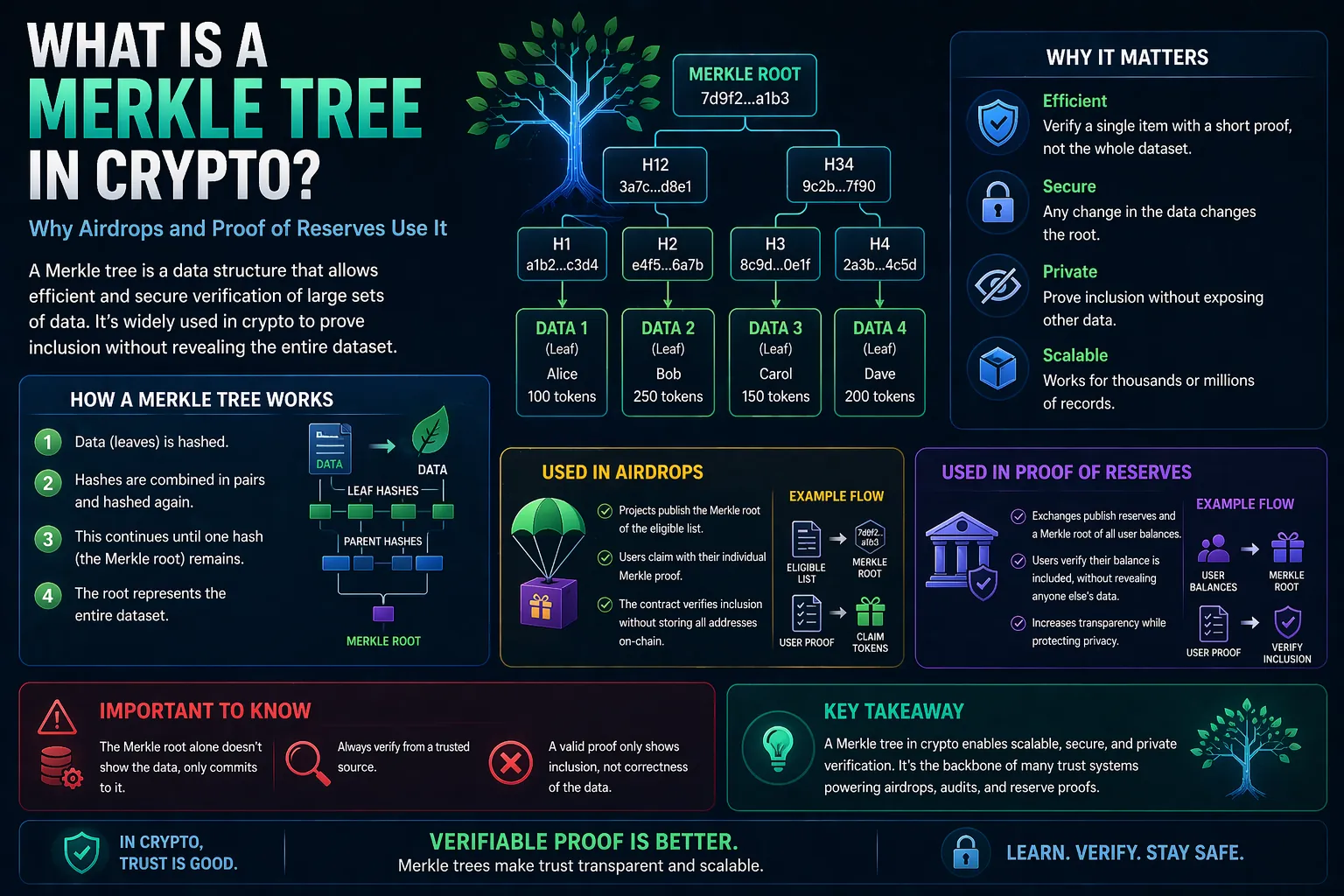
A Merkle tree begins with individual data entries known as leaves. Each leaf is hashed into a short cryptographic output. Hashes are then paired and hashed again, repeating the process until a single, final hash is produced.
This final output, known as the Merkle root, encapsulates the integrity of the entire dataset.
Integral Role of the Merkle Root
The Merkle root is akin to a fingerprint for the entire set of data. A change in any piece of data results in an altered root, thus ensuring data integrity.
Benefits of Using Merkle Trees
Space and Computational Efficiency
The efficiency of a Merkle tree allows verification of data inclusion without necessitating the full database. A simple proof path suffices to connect one leaf to the root, conserving space and reducing computation.
Practical Application
This method economizes space and makes verification practical on-chain, ensuring effectiveness without compromising data privacy.
In essence, a Merkle tree enables systems to confirm individual wallet balances' presence without the need for complete, on-chain dataset publication.
The Role of Merkle Trees in Airdrops
Airdrops, which might involve millions of wallets, benefit immensely from Merkle trees. Instead of publicly listing every wallet on-chain, a project can publish a Merkle root while users verify claims with their specific proofs. This method streamlines distribution.
It simplifies the distribution process for projects and users alike, making it cost-effective and easier to manage.
With this system, users can verify their eligibility without requiring access to the entire recipient list stored on the blockchain.
Proof of Reserves and Merkle Trees
In proof of reserves, Merkle trees confirm that a user's balance is included in a liabilities snapshot without exposing other users' data. This ensures a balance between privacy and transparency that is critical to crypto infrastructure.
This careful balance between transparency and privacy is precisely why Merkle trees are invaluable in crypto applications.
Significance for Crypto Users
Crypto users often engage with Merkle trees through airdrops, data verification, or eligibility systems, possibly without even realizing it. These trees are core to many operational aspects of the blockchain.
The mathematics might be complex, but the value of Merkle trees lies in their ability to help crypto systems scale efficiently.
Exploring Merkle Trees
Merkle trees are a pivotal part of blockchain infrastructure, simplifying large data verification and preserving privacy while reducing inclusion proving costs, strengthening today's crypto products.
Understanding this technical concept is valuable for users since it empowers the systems underpinning modern secure and efficient crypto solutions.
How to Bridge Crypto Between Chains: Complete Cross-Chain Tutorial 2026 How to Use 1inch: Complete DEX Aggregator Swap Tutorial (2026) How to Use OKX Web3 Wallet: Multi-Chain DeFi Hub Guide (2026)How a Merkle Proof Verifies a Single Item
The real power of a Merkle tree shows up when you want to confirm that one piece of data belongs to a large set without downloading the entire set. Instead of checking every record, you check a short trail of hashes that connects your item to the single root value at the top of the tree. This trail is called a Merkle proof, and it is what makes verification fast and lightweight even when the underlying data is enormous.
The idea works because each parent in the tree is the hash of its two children, all the way up to one root. To prove that a specific record is included, you only need that record plus the sibling hashes along the path to the top. Recomputing the hashes step by step should reproduce the known root. If the result matches, the record is genuinely part of the set. If even one bit had been altered, the recomputed root would differ.
This mechanism underpins several practical uses:
- Light clients that confirm a transaction is in a block without storing the whole chain.
- Proof of reserves, where a platform can show a user balance is included in an attested total.
- Data integrity checks across large files or distributed systems.
The elegant outcome is that trust collapses into a single comparison. You do not need to see everything, only enough to recompute the root and confirm it matches.
Frequently Asked Questions
What is a Merkle tree?
A Merkle tree is a data structure used in computer science and cryptography. It efficiently verifies the integrity and authenticity of data.
How does a Merkle tree work?
It works by repeatedly hashing pairs of nodes until a single root hash remains. This root hash, known as the Merkle root, represents all the underlying data.
Why are Merkle trees important in crypto?
Merkle trees are crucial in cryptocurrencies like Bitcoin for their role in verifying transactions. They allow for the efficient and secure verification of large sets of data.
What is a Merkle root?
The Merkle root is the topmost hash in a Merkle tree. It acts as a summary of all the data contained within the tree.
What is the benefit of using a Merkle tree?
Merkle trees enable light clients to verify transactions without downloading the entire blockchain. They provide a cryptographic proof that a specific transaction is included in a block.