AI x Crypto Explained: Sectors, Tokens and Use Cases.

Merging decentralized networks with machine learning layers creates an open-source alternative stack to Big Tech. We break down GPU compute routing, tokenized data acquisition, and autonomous agent economies.
The Core Thesis: Why Silicon Needs Cryptographic Rails
- The meteoric rise of generative artificial intelligence has brought the digital economy to a pivotal bottleneck. As AI models scale exponentially, they face profound resource constraints: centralized high-performance graphics processing units (GPUs) remain perpetually backordered, premium training data is increasingly locked behind proprietary corporate walls, and opaque black-box inference models require users to blindly trust that their data isn't being manipulated or exposed.
- At the same time, artificial intelligence is running into a financial wall. An autonomous AI software entity cannot open a traditional legacy bank account, sign a corporate credit card agreement, or legally hold property under standard fiat legal frameworks.
- The convergence of AI and Crypto solves these fundamental structural limitations. Blockchains provide a permissionless, trustless, and completely programmable economic substrate. It is an infrastructure where machines can transact natively with one another via stablecoins, rent hardware instantly via global marketplaces, and cryptographically prove the integrity of their outputs. By merging decentralized networks with machine learning layers, the Web3 ecosystem introduces an alternative, open-source technology stack to challenge the centralized monopolies of Big Tech.
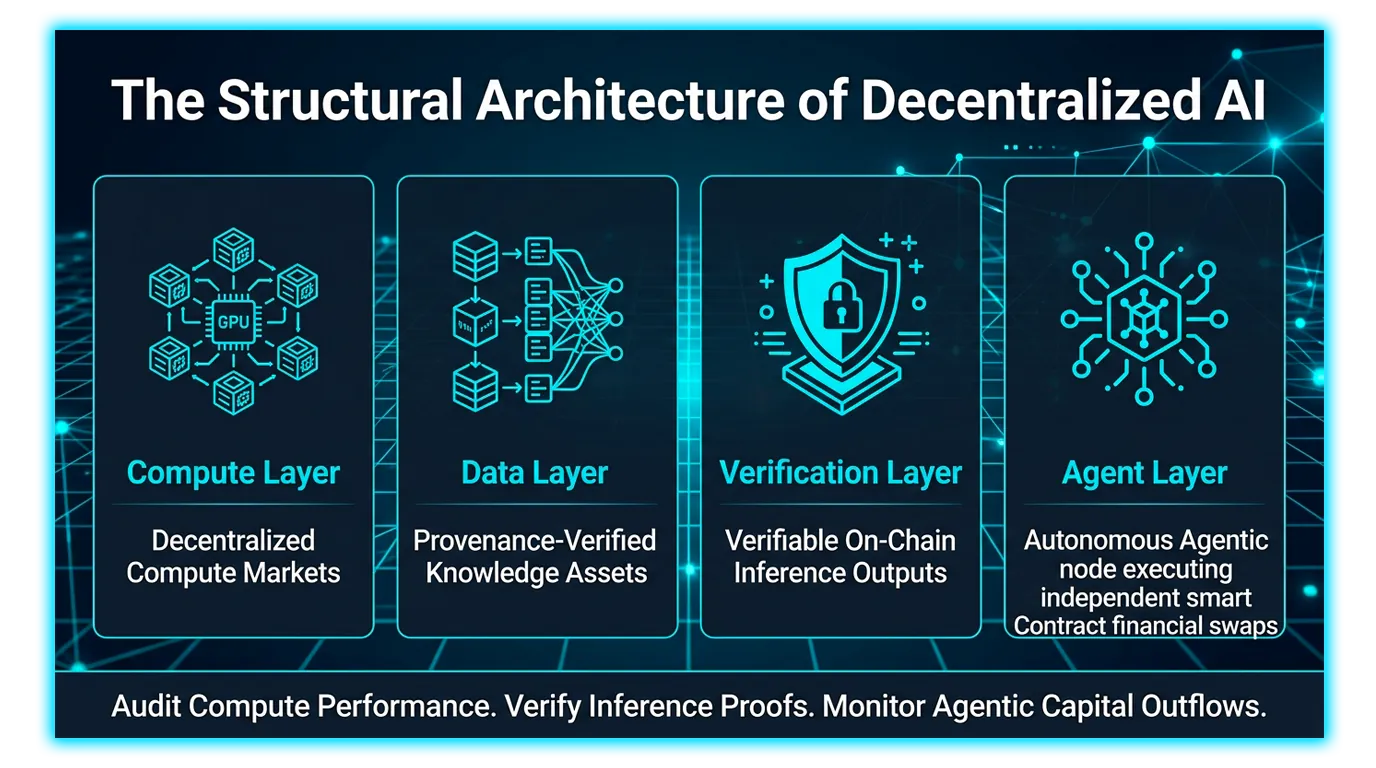
1. Distributed Compute Networks (The Infrastructure Layer)
The global AI hardware landscape faces an unprecedented supply crisis. Startups and independent research groups are routinely priced out of cloud services like AWS or Azure due to extensive lead times and high contract markups for enterprise silicon.
Decentralized Physical Infrastructure Networks (DePIN) resolve this supply bottleneck by aggregating underutilized compute resources from around the globe. These platforms source idle processing capacity from independent data centers, enterprise server arrays, and custom consumer gaming rings, pooling them into a unified, on-demand compute marketplace.
The Value Proposition: Renters gain instant, permissionless access to high-performance clustering environments at huge cost savings compared to centralized alternatives, while hardware providers earn sustainable, utilization-driven token incentives.
Top Ecosystem Tokens: Render Network ($RENDER) acts as a pioneer in distributed GPU rendering and machine learning workloads; Akash Network ($AKT) functions as an open-source cloud deployment engine; and io.net ($IO) specializes in clustering thousands of geographically distributed GPUs into massive, low-latency node networks for enterprise model training.
2. Decentralized Data & Knowledge Layers (The Intelligence Engine)
An AI model is only as effective as the data used to train and optimize its parameters. In a landscape dominated by data scraping lawsuits and synthetic model deterioration, sourcing uncorrupted, provenance-verified information has become a critical priority.
Web3 data layers turn knowledge acquisition into an open, tokenized marketplace. These networks incentivize users to securely contribute local datasets, verify data origins to prevent AI hallucinations, and distribute structured data pipelines straight to open-source models.
The Value Proposition: It eliminates platform-level censorship, coordinates data ownership through tokenized shared equity models, and establishes trustless indexing pipelines to feed real-time on-chain actions.
Top Ecosystem Tokens: Bittensor ($TAO) runs a modular subnet framework designed to reward contributors for crowdsourcing specialized machine learning tasks via its unique consensus; The Graph ($GRT) provides decentralized data indexing services tailored for agentic Web3 analysis; and Grass leverages a distributed web-scraping architecture to transform raw internet bandwidth into clean, structured training data for Large Language Models (LLMs).
3. Autonomous Economic Agents (The On-Chain Executioners)
Traditional automation systems rely on rigid, step-by-step API integration loops. Conversely, Autonomous AI Agents operate as independent software entities capable of analyzing complex, open-ended market scenarios, formulating independent decisions, and executing on-chain transactions without constant human supervision.
The Value Proposition: Machine-to-machine micro-payments unlock completely autonomous automated workflows, turning agents from simple chat assistants into fully operational economic actors.
Top Ecosystem Tokens: The Artificial Superintelligence Alliance ($ASI) (formed by the structural merger of Fetch.ai, SingularityNET, and Ocean Protocol) serves as a primary foundation for agentic coordination; Virtuals Protocol ($VIRTUAL) enables users to co-own tokenized AI agents specializing in interactive media; and networks like Kite ($KITE) deliver dedicated Layer 1 transaction rails purpose-built to handle agentic wallets and payment settlement flows.
4. Inference Verification & Security Layers (The Verifiable AI x Crypto Stack)
When a smart contract or a corporate platform automates high-value decisions based on an AI model's output, it creates a massive trust gap. Because traditional model execution happens off-chain in opaque data centers, a user cannot independently verify whether the model ran accurately, if the weights were subtly tampered with, or if a cheaper, low-tier algorithm was used to spoof the result.
The Verifiable AI Stack introduces cryptographic proof layers to solve this accountability problem. By leveraging hardware-isolated Trusted Execution Environments (TEEs) and Zero-Knowledge Machine Learning (ZKML) proofs, protocols generate a deterministic audit trail for every single inference calculation.
The Use Case: A DeFi protocol deploys an AI agent to adjust lending credit parameters. The verification layer generates a cryptographic signature proving the AI model ran exactly as hardcoded, providing full transparency to the underlying liquidity providers.
Top Ecosystem Protocols: NEAR Protocol ($NEAR) is a major pioneer in user-owned, verifiable AI, deploying high-speed private inference infrastructure powered natively by hardware isolation; Chainlink ($LINK) supplies secure decentralized oracle frameworks to securely route verified off-chain AI outputs to on-chain smart contracts; and middleware leaders like Ritual and Modulus Labs focus on generating trustless execution proofs for complex model parameters.
The Top Tokens Landscape: Architectural Matrix
| Market Sector | Core Technical Focus | Primary Use Case | Dominant Assets |
| Compute / DePIN | Distributed GPU Sourcing | Slashing AWS compute costs | $RENDER, $AKT, $IO |
| Data & Training | Crowdsourced Knowledge | Verifiable training data | $TAO, $GRT, Grass |
| Autonomous Agents | Machine Economic Rails | Machine-to-machine commerce | $ASI, $VIRTUAL, $KITE |
| Inference Proofs | Verifiable Model Outputs | Hardware-backed execution | $NEAR, $LINK, Ritual |
Universal On-Chain Forensics and Trading Telemetry via DEXTools
- Accessing comprehensive decentralized analytics through platforms like DEXTools offers Web3 traders an invaluable cockpit for tracking real-time token performance, analyzing liquidity pool configurations, and auditing code parameters across multiple networks.
- By utilizing integrated modules like the Pair Explorer, the Live New Pairs radar, and the Top Traders or Trade Story diagnostic ledgers, technical analysts can monitor localized volume movements, track institutional distribution patterns via the Big Swap Explorer, and evaluate algorithmic contract trust ratings prior to executing trades, keeping your secure hardware setup safely insulated from malicious venues.
You can access DEXTools here and start trading today!
Disclaimer: This article is for informational purposes only and does not constitute investment advice, financial advice, trading advice, or any other kind of advice. DEXTools does not recommend buying, selling, or holding any cryptocurrency or token. Users should conduct their own research and consult with a qualified financial advisor before making any investment decisions. Cryptocurrency investments are volatile and high-risk. DEXTools is not responsible for any losses incurred.
How to Bridge Crypto Between Chains: Complete Cross-Chain Tutorial 2026 How to Use 1inch for Swaps: Classic, Fusion and Limit Orders (2026) OKX Web3 Wallet Tutorial 2026: Multi-Chain Setup GuideRelated Guides
- What is Polygon zkEVM? Architecture and Use Cases (2026)
- What Does XRP Do? Real Use Cases & Utility Explained (2026)
- TRON vs Solana: Speed, Fees and Use Cases Compared (2026)
- 10 Best Stablecoins 2026: Safety, Yields & Use Cases
Frequently Asked Questions
What is AI x crypto?
AI x crypto refers to projects that combine artificial intelligence with blockchain and decentralized networks. The goal is often to build open alternatives for compute, data, and autonomous agents that do not rely solely on large centralized companies.
What are the main sectors in AI crypto?
Common sectors include decentralized compute and GPU sharing, data marketplaces, on-chain machine learning networks, and autonomous agent platforms. Each tackles a different part of building or running AI in a decentralized way.
How does blockchain help decentralized AI?
Blockchains can coordinate payments, ownership, and incentives among many independent participants without a central intermediary. This can support open marketplaces for compute power, data, and model contributions.
What is a crypto AI agent?
A crypto AI agent is software that can act autonomously on-chain, such as managing transactions or interacting with smart contracts based on its programming. These agents combine AI decision-making with blockchain execution.