Permit2 Phishing Risks: Why Signature Scams Are So Dangerous
— By Whatsertrade in Tutorials
Learn what Permit2 phishing is, why signature-based wallet scams can be more dangerous than approvals, and how DeFi traders can spot red flags in 2026.
This guide explains Permit2 phishing and signature-based wallet risk. It is a scam-defense page, not a general approvals explainer.
Key Takeaways
- Understanding Permit2
- Why Permit2 Phishing Works
- Targeting High-Value DeFi Traders
- Distinction Between Permit2 and Traditional Approvals
- Identifying Permit2 Phishing Red Flags
- Protecting Yourself Against Permit2 Phishing
Crypto users are trained to fear malicious token approvals. The fear is justified since an unlimited approval to a bad contract can drain assets rapidly. However, wallet attacks have evolved, and often the most dangerous action is not the traditional 'approve' click. Rather, it's signing a message that appears harmless. Welcome to the era of Permit2 phishing.
For active DeFi traders, understanding Permit2 phishing is vital as modern wallet drainers often leverage signatures, permissions, and confusing wallet prompts, rather than obvious transactions.
Understanding Permit2
Legitimate Use and Potential Abuse
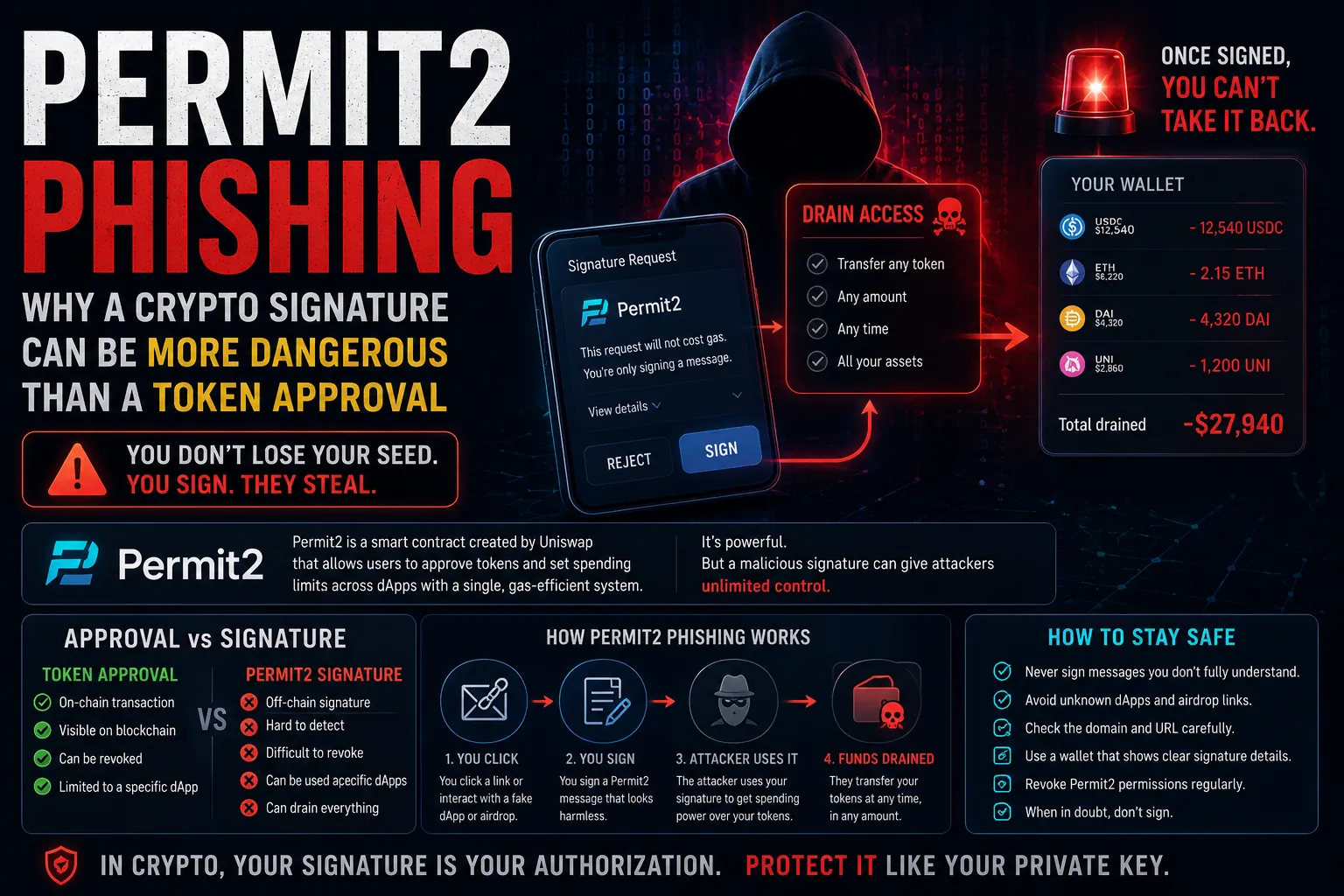
Permit2 is a permission system enabling users to grant token spending rights through signatures. It aims to enhance user experience in DeFi by making approvals more flexible and reusable.
In its legitimate application, Permit2 reduces friction, allowing users to authorize token movement more seamlessly, and enabling protocols to create smoother trading flows-useful for swaps, aggregators, and advanced DeFi interfaces. The core issue isn't Permit2; rather, it's the malicious exploitation of it. Attackers prey on users, tricking them into signing permissions they don't fully understand.
Why Permit2 Phishing Works
Exploiting User Unawareness
Permit2 phishing is effective largely because users often don't know how to interpret signature requests. A standard transaction typically displays gas, recipient, and contract interaction; a signature may seem less critical because it doesn't instantly move funds or incur gas fees.
This misperception creates a false sense of security. Users may believe signing a message is risk-free. In fact, a signature can authorize future token transfers.
Scammers exploit this gap by designing fake claim pages, trading tools, verification portals, or NFT mint sites requesting an unsuspecting Permit2 signature. The user signs, and the attacker uses the signature to move approved tokens under permissible conditions. Victims often only realize the consequences after their tokens have vanished.
Targeting High-Value DeFi Traders
How Traders Get Caught
DeFi traders are prime targets because they often hold multiple assets in 'hot' wallets. They frequently interact with new tokens, low liquidity pools, launchpads, bridges, and experimental protocols.
A trader might sign dozens of approvals or messages weekly, leading to fatigue. When faced with constant wallet popups, the odds of approving something by mistake increase. Speed compounds this problem, especially during token launches or fast-moving markets. Scammers generate urgency because it decreases caution. In this hectic environment, Permit2 phishing doesn't always resemble a classic approval transaction.
Common Phishing Scenarios
One typical scenario involves a fake airdrop claim, where a page informs users of an alleged reward, asking them to connect a wallet. The claim button triggers a signature request not for claiming tokens but for authorizing token movement.
Another scenario could be a fake token migration, where users are deceived into believing they must switch to a new contract. The interface requests a signature that inadvertently grants spending permission.
A third involves a fake trading bot or sniping tool, asking users to sign a permission to activate automated trading, while the true goal is asset access.
A fourth scenario is a fraudulent decentralized exchange clone, where the site seems legitimate, but the wallet prompt conceals harmful permission details.
Distinction Between Permit2 and Traditional Approvals
Off-Chain Risks
Traditional token approvals involve on-chain transactions, where users typically see gas fees, token amounts, and contract addresses. Security tools can detect and display many of these approvals.
Conversely, Permit2 approvals might involve off-chain signatures submitted by another party later. This renders them less visible to users at the signing moment.
Though not invisible forever, users should regard signatures with equal seriousness as transactions. A signature can equate to a financial authorization, a mindset every trader must adopt.
Identifying Permit2 Phishing Red Flags
Recognizing Warning Signs
Be cautious of any signature request during simple claims, verifications, or logins. If a site claims no transaction is needed but asks for complex permissions, it's suspicious.
Look out for unlimited amounts, another red flag. High risk exists if a signature grants broad token balance access.
Unknown spenders are dangerous-avoid signing if the permission targets an unfamiliar contract or address.
Beware of urgent countdowns, sudden rewards, unofficial links, and social media responses, as Permit2 phishing often employs the same emotional triggers as earlier wallet drainers.
Protecting Yourself Against Permit2 Phishing
Strategies for Safeguarding Assets
Utilize separate wallets for varied purposes, keeping long-term holdings distinct from active trading wallets. Consider funds in a hot wallet as tactical savings prepared for risk.
Thoroughly read wallet prompts; don't assume a signature's safety due to lack of gas fees. Scrutinize spender, token, amount, and permission type.
Opt for trusted interfaces access decentralized exchanges and protocols via verified domains, steering clear of links in comments, DMs, or search ads.
Regularly revoke permissions; even prudent traders accrue approvals over time-cleaning them mitigates future risks.
Avoid signing amid emotional states; if urgency is pushed, pause. True opportunities aren't contingent on hasty signatures.
Improving Wallet Design for Enhanced Security
Design Innovations as a Defense Mechanism
Permit2 phishing isn't solely a user education issue; wallets must simplify signature comprehension. Users should receive clear warnings when a signature can authorize token movement, with risky spenders and unbounded permissions highlighted prominently.
As DeFi evolves, wallet prompts should become more user-centric; traders shouldn't need to decode raw signing data to assess fund safety. While enhanced wallet design won't eliminate every scam, it can diminish success rates.
Ultimately, Permit2 has the potential to enhance the DeFi user experience, but attackers inevitably target convenience. Any tool that smoothens legitimate trading has the potential for misuse by phishing sites. Traders must recognize that signatures aren't innocuous; a non-gas message can signify significant financial authority. Permit2 phishing stands as a pivotal wallet security concern to grasp in 2026, as it targets ingrained trader habits. The most cautious users will employ separate wallets, think deliberately, and meticulously assess each permission before signing.
How to Bridge Crypto Between Chains: Complete Cross-Chain Tutorial 2026 How to Use 1inch: Complete DEX Aggregator Swap Tutorial (2026) How to Use OKX Web3 Wallet: Multi-Chain DeFi Hub Guide (2026)Frequently Asked Questions
What is Permit2 phishing?
Permit2 phishing involves tricking users into signing malicious Permit2 signatures. These signatures can grant attackers control over tokens without requiring a direct transaction approval.
How does Permit2 differ from traditional token approvals?
Traditional approvals grant a third party spending limits on your tokens. Permit2 allows for 'signature-based' approvals, where a signed message can authorize token transfers without an on-chain transaction.
What makes Permit2 phishing dangerous?
The danger lies in the signature itself. A malicious signature, once signed, can be used by an attacker to move tokens at a later time, even if the initial interaction seemed harmless.
How can I protect myself from Permit2 phishing?
Always be cautious about signing messages, especially if they are not part of a clear and trusted transaction. Verify the details of any signature request before approving it.
What should I do if I suspect I've been a victim of Permit2 phishing?
If you suspect a compromise, immediately revoke any suspicious approvals or signatures. Consider moving your assets to a new, secure wallet.