Ice Phishing Explained: Hidden Approval Drains

Guarding your private key cannot protect your capital if you voluntarily sign away your asset permissions. We break down the structural mechanics of ice phishing, malicious ERC-20 allowances, and gasless signature exploits.
The Deceptive Ledger: Shifting from Credential Theft to Permission Hijacking
- In the early days of Web3 security, protecting digital assets was a relatively straightforward battle centered on protecting credentials. If an investor memorized their 12-word seed phrase, stored their private keys entirely offline, and avoided malicious software downloads, their on-chain capital was generally considered secure.
- Traditional phishing attacks relied heavily on brute-force deception: tricking users into typing their master recovery phrases directly into fake web forms.
- Today, the threat landscape has undergone a dramatic structural evolution. Advanced Web3 cybercriminals no longer waste energy trying to steal your private keys or seed phrases. Instead, they deploy a highly sophisticated technique known as Ice Phishing.
- Rather than breaking into your wallet, ice phishing tricks you into politely opening the door and handing over full operational control of your assets. By manipulating smart contract user interfaces, exploiting off-chain signatures, and leveraging blind signing vulnerabilities, these hidden approval drains siphon millions from self-custody accounts while leaving the private keys entirely untouched.
What is Ice Phishing?
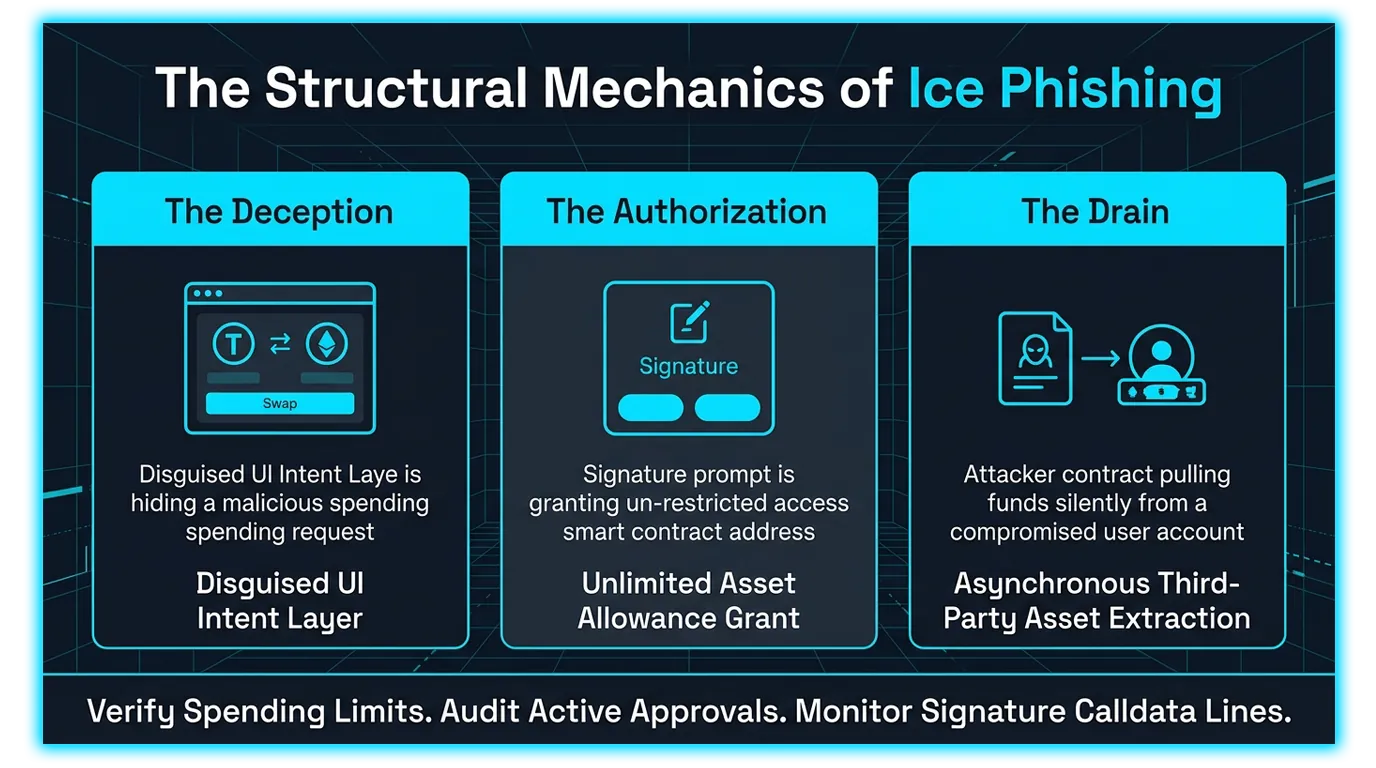
- Ice phishing is a cryptographic exploit wherein an attacker manipulates a user into signing a malicious smart contract transaction or token allowance. This authorization alters the token’s approval state on-chain, granting the attacker full, legal permission to spend the victim's assets.
- Unlike a typical transaction that instantly moves funds from point A to point B, ice phishing is an asynchronous threat. The moment a user signs a malicious approval, nothing appears to happen. No tokens leave the wallet immediately. Instead, the attacker waits for the signature to settle, then invokes the token contract's internal transfer functions at a later time to cleanly drain the account.
1. The Mechanics of the On-Chain Trap: approve and setApprovalForAll
- To interact with decentralized applications, automated market makers, and NFT marketplaces, Web3 users must interact with token allowance frameworks. Because smart contracts cannot automatically read or move the tokens inside your wallet without permission, you must first grant the contract a specific spending allowance.
Ice phishing campaigns exploit this design choice by deploying fraudulent decentralized applications (dApps) that alter the parameters of routine token interactions:
ERC-20 Token Allocations (
approve): When you believe you are configuring a routine token swap, the malicious dApp modifies the underlying transaction calldata payload. Instead of calling a swap function, it calls the token's native allocation function, granting the attacker's contract address a multi-trillion token spending ceiling.NFT Ecosystem Sweeps (
setApprovalForAll): For non-fungible tokens, the threat is even more absolute. Signing a transaction containing a malicioussetApprovalForAllflag grants the attacker full administrative power over your entire token collection within that specific contract. The hacker can subsequently pull every single high-value digital collectible out of your account in a single block execution.
2. The Invisible Signature: EIP-2612 Permit Phishing
- As wallet providers implemented better warning banners to flag suspicious on-chain approvals, drainer services shifted toward off-chain signature framework manipulation, specifically targeting EIP-2612 Permit modules.
- The EIP-2612 standard was introduced to create a more efficient user experience by allowing gasless token approvals. Instead of submitting a live, costly blockchain transaction to adjust an allowance, the user signs a structured, off-chain message inside their wallet client. This raw cryptographic signature string is then passed to a third party who pays the network gas fee to execute the transaction on-chain.
- In an ice phishing scenario, this feature turns into a silent vulnerability. Attackers build beautiful, clone web applications that prompt users to sign a simple, gasless text message to "verify wallet ownership" or "claim a community reward." Behind the front-end user interface, the payload is actually an EIP-2612 Permit validation string. The moment the user clicks sign, the drainer captures the raw signature payload, broadcasts it to the public blockchain ledger to secure the allowance, and strips the account of its tokens.
3. The Blind Signing Blindspot: Exploiting Hardware Wallets
- The ultimate line of defense for a Web3 participant is a hardware wallet. However, even the most secure physical security chip cannot save an investor from an ice phishing exploit if they fall victim to Blind Signing.
- Blind signing occurs when a hardware device is forced to authorize a smart contract transaction or complex message payload that it cannot natively parse or display on its small physical screen. Instead of showing clear text instructions like "Grant Transfer Rights to Contract X," the hardware wallet displays a generic warning message alongside a long, unreadable string of raw hexadecimal hexadecimal data.
- When users encounter these unreadable data fields during high-pressure market events, they frequently click through the warning prompts on their physical hardware buttons out of habit. By blind signing the unverified data string, the user cryptographically validates the malicious ice phishing payload, creating an un-appealable, irreversible on-chain approval that allows the drainer script to bypass the physical device's security model entirely.
Technical Design Matrix: Approval Drain Vector Signatures
| Vector Target | Action Trigger | On-Chain Cost | Operational Risk |
| ERC-20 Assets | approve payload | Requires Gas Tx | Grants unlimited spending limits |
| NFT Collections | setApprovalForAll | Requires Gas Tx | Sweeps entire contract balances |
| Gasless Off-Chain | EIP-2612 Permit | Completely Free | Signature stolen via raw text message |
| Hardware Layers | Blind Signing | Variable | Validates unreadable malicious code |
4. How to Recognize and Protect Your On-Chain Capital
Defending your portfolio against sophisticated ice phishing attacks and other "phishings", requires an uncompromising commitment to strict operational security protocols.
Audit Transaction Simulation Data: Modern, secure Web3 wallets incorporate advanced transaction simulation modules. Before authorizing any transaction prompt, review the simulation output screen carefully. If a website claiming to perform a basic function generates a simulation warning stating that your wallet is modifying an allowance, or if it requests an action containing terms like
approveorPermit, reject the connection immediately.Never Blind Sign Unknown Payloads: Treat blind signing prompts on your hardware wallets as high-risk security events. If your physical device screen cannot display clear, readable text outlines explaining exactly where your tokens are moving and why, do not press the confirmation buttons. Update your device firmware or utilize alternate, verified dApp interface routes to ensure clear data visibility.
Enforce Routine Permission Audits: Token allowances are persistent; once granted, they remain active on the blockchain forever until explicitly modified. Utilize independent allowance auditing applications like Revoke.cash or native wallet security portals to periodically clear out historical approvals, ensuring that compromised legacy platforms cannot act as a backdoor to your current balances.
Tracking Capital Inflows via DEXTools Forensic Telemetry
- By leveraging advanced decentralized charting tools like DEXTools, market participants gain a vital, all-in-one platform to track real-time token behavior, analyze liquidity pool depth, and review smart contract parameters across all public chains.
- Utilizing core features like the Pair Explorer, Live New Pairs dashboard, and Trade Story enables technical traders to audit localized volume patterns and verify automated contract safety scores prior to execution. This extra layer of scrutiny ensures that your secure hardware setup interacts exclusively with verified market venues.
Disclaimer: This article is for informational purposes only and does not constitute investment advice, financial advice, trading advice, or any other kind of advice. DEXTools does not recommend buying, selling, or holding any cryptocurrency or token. Users should conduct their own research and consult with a qualified financial advisor before making any investment decisions. Cryptocurrency investments are volatile and high-risk. DEXTools is not responsible for any losses incurred.
Related Guides
- What Is Signature Phishing in Crypto? Safety Guide
- What Is Revoke.cash: Token Approvals, Permit Risks and Wallet Hygiene (2026)
- What Is an XRP ETF? Approval and Trading Guide 2026
- What Is a Token Approval Transaction? Risks Explained (2026)
- What Are Bridge Fees in Crypto? Cost Breakdown, Quotes and Hidden Charges (2026)
Frequently Asked Questions
What is ice phishing in crypto?
Ice phishing is an attack where you are tricked into signing a transaction that grants a malicious party permission to move your tokens. Your private key stays safe, but the approval lets the attacker drain approved assets.
How do token approvals enable ice phishing?
Many tokens use approval mechanisms that let a contract spend tokens on your behalf, and a malicious approval can be unlimited. Attackers disguise these approval requests so users authorize spending without realizing it.
How can you protect yourself from ice phishing?
Carefully review what each transaction is requesting before signing, and be cautious with unfamiliar sites or contracts. Periodically reviewing and revoking unnecessary token approvals reduces your exposure.
Does ice phishing require stealing your private key?
No, ice phishing does not need your private key because you grant the dangerous permission yourself by signing. That is what makes it different from attacks that try to steal your keys directly.