How to Provide Liquidity on Uniswap: Fee Tiers, Price Ranges and IL Basics (2026)

A Uniswap LP guide focused on fee tiers, active ranges, impermanent loss, rebalancing, and the main mistakes liquidity providers make in v3 and v4-style markets.
Intent check: This page is the LP-specific Uniswap guide. If you want the beginner token-swap walkthrough, read How to Swap Tokens on Uniswap. If you want the broader interface guide with slippage and route checks, read How to Use Uniswap. If you want the protocol explainer, read What Is Uniswap?.
A Technical Guide for Uniswap Liquidity Providers
- Decentralized financial ecosystems rely on crowdsourced capital repositories rather than traditional institutional matching engines to clear transactions. When a user executes a token swap on a decentralized exchange (DEX) like Uniswap, they are not interacting with an order book managed by a broker; they are executing a peer-to-pool transaction directly against a smart contract liquidity pool.
- Providing liquidity (known as LPing) means depositing an equivalent value of two separate digital assets into an automated market maker (AMM) pool. This capital underwrites the trading activity of the public. In return for locking up assets and absorbing market volatility, liquidity providers earn a pro-rata share of the transaction fees generated by the pool.
- This guide outlines the operational pipeline for deploying capital as a Uniswap liquidity provider, covering pair selection, price customization, fee categorization, and the underlying structural risks.
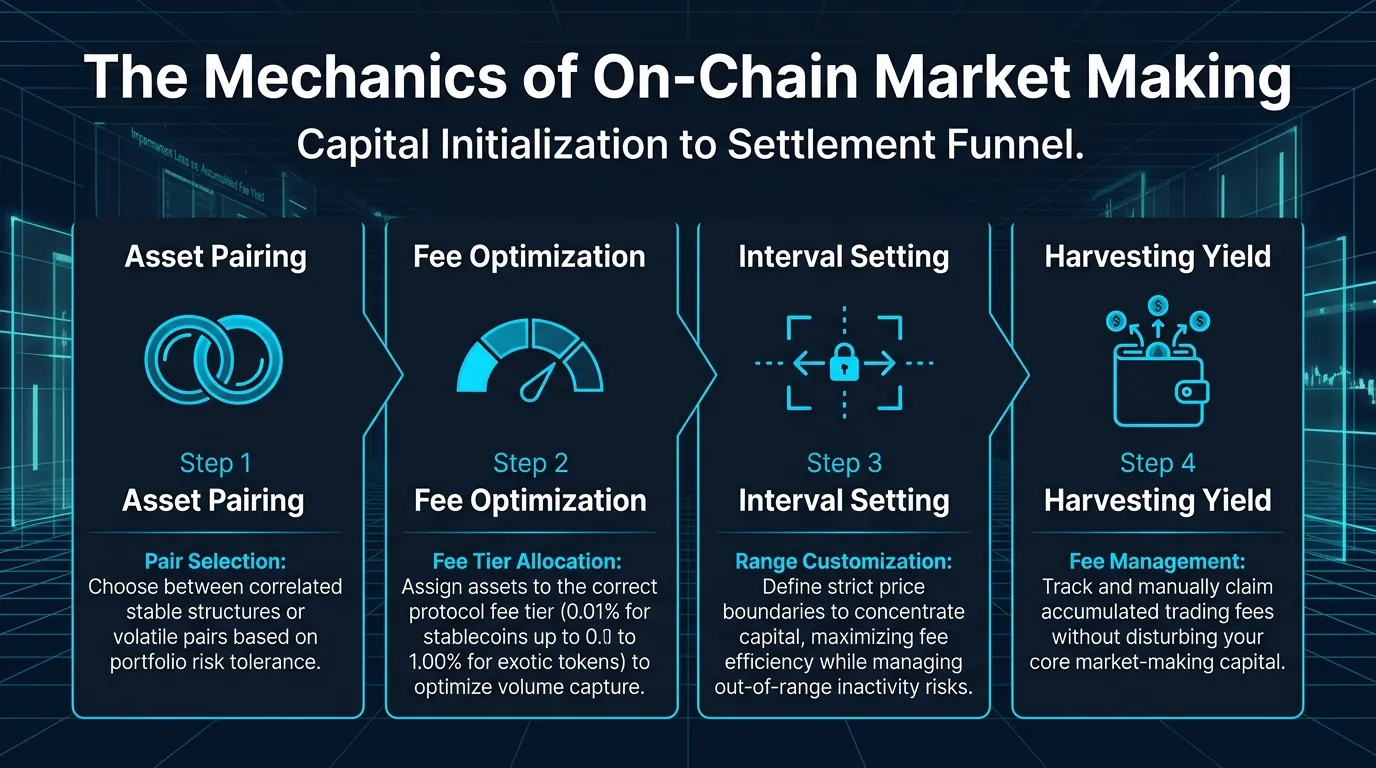
1. Core Preparation: Pair Selection and Fee Tiers
An efficient liquidity strategy requires aligning asset selection with the appropriate protocol fee tier. Pools are categorized into distinct risk tiers based on the volatility profiles of the underlying assets.
Asset Pair Configurations
Correlated Pairs (Low Volatility): Tokens engineered to maintain parity with each other or a shared reference point, such as stablecoin pairs like USDC/USDT or liquid staking pairs like ETH/stETH. These pools support high trading volumes with minimal price divergence.
Uncorrelated Pairs (High Volatility): Assets undergoing independent price discovery, such as a utility token paired with a base reserve asset like UNI/ETH. These pools experience wider price swings, introducing higher risk for the depositor.
Selecting the Fee Tier
Uniswap enforces specific fee tiers to properly incentivize liquidity deployment relative to token risk profiles:
0.01% Fee Tier: Optimized exclusively for highly correlated assets like stablecoins. Because price divergence is minimal, LPs accept a lower take-rate in exchange for capturing massive institutional volume.
0.05% Fee Tier: Typically utilized for highly liquid, premier asset pairs undergoing moderate structural volatility, such as ETH/USDC.
0.30% Fee Tier: The standard deployment venue for traditional volatile crypto assets. This tier balances competitive execution costs for traders with sustainable fee margins for passive LPs.
1.00% Fee Tier: Reserved for exotic, early-stage, or highly illiquid token deployments where LPs require a premium fee structure to offset extreme price manipulation risks.
2. Range Configuration: Concentrated Liquidity Mechanics
Uniswap utilizes a concentrated liquidity architecture. Instead of distributing your deposited capital uniformly across an infinite price scale from zero to infinity, the protocol requires you to choose a specific price boundary within which your capital will facilitate swaps.
The Concentrated Interval Strategy
- By bounding your capital within a narrow price window (e.g., setting an ETH/USDC position strictly between 2,800 and 3,200), your assets are compressed into a highly efficient market-making position. This configuration dramatically multiplies your fee-earning potential compared to legacy uniform pools, allowing small capital deposits to capture substantial transaction revenues.
- Under a Full Range Strategy, your capital is spread thin across an infinite spread, resulting in very low capital efficiency. Under a Concentrated Strategy, your capital is localized around the active market price, maximizing utility but requiring closer monitoring.
The Out-of-Range Trap
Concentrating your liquidity introduces a specific operational constraint. If the open-market price of the pair shifts completely outside your designated boundaries, your position becomes 100% inactive.
Your capital stops earning transaction fees.
The smart contract automatically converts your entire pool allocation into the underperforming asset of the pair. For example, if the price of ETH rises above your upper boundary, your position is converted entirely into USDC and sits idle until you manually rebalance the range or the market returns to your interval.
3. The Risk Dimension: Understanding Impermanent Loss
The primary financial risk incurred by liquidity providers is Impermanent Loss (IL). This loss is a direct consequence of the automated rebalancing mechanism inherent to AMMs.
The Mechanics of Rebalancing
When you deposit tokens into a pool, the AMM relies on arbitrageurs to keep the pool's internal asset price aligned with the global market. If one token’s price rises on external exchanges, arbitrageurs buy the cheaper token from your pool, leaving you with more of the depreciating token and less of the appreciating asset.
The Calculation Baseline
Impermanent loss represents the difference in portfolio value between holding your assets passively in a cold storage wallet versus depositing them into an active liquidity pool.
If the relative price ratio of the two assets diverges significantly from your initial entry point, your pool value will lag behind a simple buy-and-hold strategy.
The loss is designated as "impermanent" because if the market prices return to the exact relative ratio of your initial deployment, the loss disappears.
However, if you choose to withdraw your assets while the price ratio is skewed, the impermanent loss is permanently locked in, requiring your accumulated fee earnings to exceed the divergence penalty to achieve net profitability.
4. Settlement: Monitoring and Claiming Accumulated Fees
Unlike legacy liquidity pool standards where generated trading fees are automatically reinvested back into the main principal pool, Uniswap separates fee distribution from core capital allocations.
As swaps occur, your accrued fees accumulate in real-time as a distinct balance asset layer.
These fees do not compound automatically into your active concentrated liquidity range.
You can review your uncollected fee balances directly through your Web3 wallet or analytical dashboard interfaces.
Manual Retrieval: Liquidity providers can execute a claim transaction to withdraw accumulated fees at any time without closing out the underlying liquidity position or disturbing active price boundaries.
Technical Trade-offs and Market Realities
Liquidity Provisioning Deployment Matrix
| Deployment Strategy | Capital Efficiency Rating | Impermanent Loss Exposure | Operational Overhead | Optimal Market Condition |
| Full Range Interval | Minimal | Low | Zero Maintenance | High macroeconomic volatility across broad price scales. |
| Broad Concentrated Range | Moderate | Medium | Low to Moderate Rebalancing | Sustained market trends within predictable macro channels. |
| Narrow Concentrated Range | Maximum | High | High Active Management | Horizontal consolidation patterns and sideways price action. |
5. Real-Time On-Chain Due Diligence via DEXTools
Deploying capital into an automated market maker pool without assessing market telemetry can result in severe capital underutilization or immediate impermanent loss. Before signing a liquidity transaction, independent auditing of pool data is mandatory.
Market participants use the analytical suite on www.dextools.io to conduct on-chain research:
Auditing Pool Depth via Pair Explorer: Before initializing a position, review the target asset pairs on the charting dashboard to analyze historical volume profiles and verify the absolute distribution of existing competitor ranges.
Tracking Whale Movement via Big Swap Explorer: Monitor the real-time transaction stream of high-volume pairs to determine if institutional actors are executing large-scale directional swaps that could push your active concentrated ranges out-of-bounds.
Verifying Real-Time Velocity: Evaluate the trade history to confirm that a pool maintains continuous organic volume, ensuring that your collected transaction fees will be sufficient to offset potential impermanent loss factors.
Disclaimer: This article is for informational purposes only and does not constitute investment advice, financial advice, trading advice, or any other kind of advice. DEXTools does not recommend buying, selling, or holding any cryptocurrency or token. Users should conduct their own research and consult with a qualified financial advisor before making any investment decisions. Cryptocurrency investments are volatile and high-risk. DEXTools is not responsible for any losses incurred.
Related Guides
- How to Use Uniswap: Wallet Connect, Swap, Slippage and LP Basics (2026)
- What Is Uniswap? AMM, Liquidity Pools, Fees and UNI Token Explained (2026)
- Crypto Tax Guide USA: IRS Rules, Forms and Filing Basics (2026)
- What Is a Fee-on-Transfer Token? Crypto Explained
- OKX Exchange Tutorial 2026: Trading + Fee Discount Guide
Frequently Asked Questions
How do you provide liquidity on Uniswap?
You deposit a pair of tokens into a pool through the Uniswap interface, which makes your funds available for others to trade against. In return you earn a share of the swap fees generated by that pool.
What are Uniswap fee tiers?
Fee tiers are different preset swap-fee levels that pools can use, letting providers choose a tier suited to how volatile or stable the pair is. Stable pairs often use lower tiers while more volatile pairs may use higher ones.
What is a concentrated liquidity price range?
Concentrated liquidity lets a provider supply funds within a chosen price range instead of across all prices, which can increase fee efficiency. The trade-off is that your position only earns fees while the price stays inside your selected range.
What is impermanent loss?
Impermanent loss is the difference in value between holding tokens in a liquidity pool versus simply holding them in your wallet when prices move apart. It becomes a realized loss only if you withdraw while that price divergence persists, and fees earned can offset it.