Best DeFi Yield Strategies for 2026 (Beyond Stablecoins)

Seeking sustainable yield requires moving past basic token incentives. We break down the technical realities of restaking, rate tokenization, and tokenized RWAs.
The Yield Paradigm: Migrating from Native Token Dilution to Hard-Anchored Capital
- The contemporary decentralized finance (DeFi) landscape has undergone a major structural restructuring. In early market iterations, yield farming relied on an unsustainable model: protocols printed inflationary utility governance tokens to artificially subsidize high annualized returns. When public attention shifted, those token models collapsed, forcing the ecosystem to seek sustainable value.
- The market operates on "real DeFi yield": returns derived from organic protocol transaction fees, proof-of-stake consensus rewards, and real-world cash flows. With base-layer cryptocurrency lending rates experiencing structural compression, market participants must look beyond simple stablecoin deposits to maintain capital growth.
- Navigating this environment requires utilizing multi-layered liquid staking tokens (LSTs), advanced restaking frameworks, yield tokenization platforms, and structured off-chain asset integrations. This comprehensive guide details the premier alternative yield architectures, their execution mechanics, and the risk dimensions that define them.
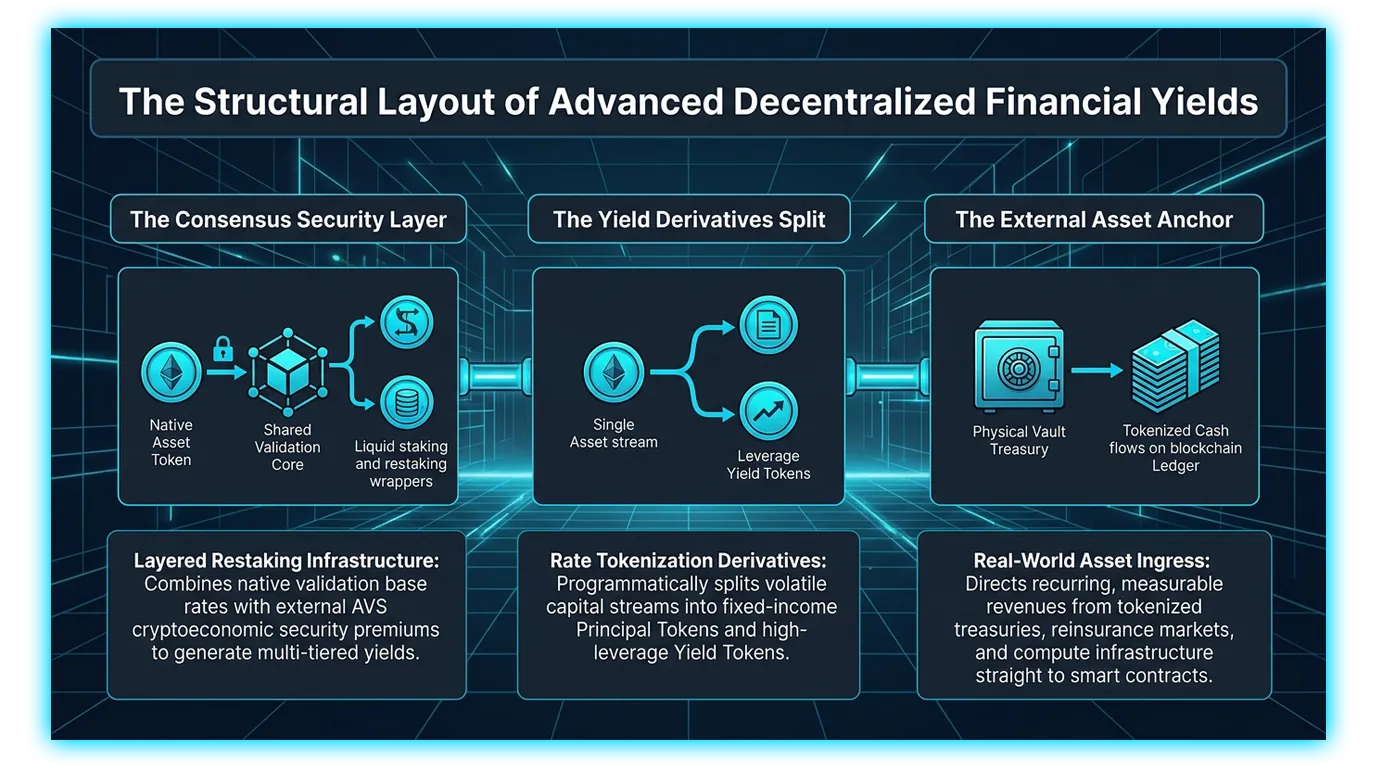
1. Layered Cryptoeconomic Security: LSTs and Liquid Restaking (LRTs)
- The transition of premier networks to Proof-of-Stake has established native network validation as the foundational risk-free rate of the crypto economy. However, locking assets directly into validator nodes introduces liquidity constraints. The liquid staking and restaking sectors resolve this capital lockup.
The Liquid Staking Baseline (LSTs)
- Liquid staking platforms permit users to pool their native capital (such as ETH or SOL) to support network consensus nodes, instantly receiving a composable liquid staking token like stETH in return. This wrapper continuously accrues consensus block rewards and Maximum Extractable Value (MEV) payouts directly into its token balance or underlying redemption value, serving as a highly liquid capital asset across decentralized finance.
The Restaking Multiplication Layer (LRTs)
- Restaking extends the economic security generated by staked assets to protect external infrastructure applications, known as Actively Validated Services (AVSs), such as oracle networks, bridges, and data availability layers.
- By depositing LSTs into restaking protocols like EigenLayer, Symbiotic, or Karak, users allow their capital to back multiple security networks simultaneously.
- To preserve liquidity, Liquid Restaking Protocols (LRPs) like Ether.fi or Renzo abstract this infrastructure by issuing Liquid Restaking Tokens (LRTs) like eETH or ezETH. This model creates a multi-layered yield stack.
2. Yield Tokenization: Fixed Income Fixed Derivatives
- As the cash flows generated by restaking and synthetic assets become increasingly complex and variable, the market requires specialized financial primitives to hedge rate volatility. Pendle Finance controls this yield-tokenization niche, functioning essentially as an on-chain bond and rates derivative market.
PT and YT Mechanics
Pendle takes a yield-bearing asset (like stETH or an LRT) and programmatically splits it into two separate, independent token classes prior to a specified maturity date:
Principal Tokens (PT): PT represents the baseline underlying core asset minus its future yield. It behaves identically to a zero-coupon bond in traditional finance. Because it trades at a discount to the spot asset price, holding a PT token to maturity guarantees a completely fixed, predictable, and automated annualized yield, shielding the investor from on-chain rate compression.
Yield Tokens (YT): YT bundles 100% of the future variable yield and points generated by the underlying asset. Buying YT is a leveraged bet on rising yields; if active staking distributions or protocol reward points outperform the cost paid for the token, the YT holder captures significant outsized gains.
3. Real-World Assets (RWAs): Harvesting External Value Anchors
DeFi has established direct infrastructure bridges to traditional finance, integrating real-world assets (RWAs) directly into smart contract pools to insulate portfolios from pure crypto-native volatility.
The RWA Heavy Pivot
The tokenized RWA sector has expanded from simple treasury tracking into an absolute yield powerhouse. This transformation is highly evident across yield-trading protocols: approximately 97% of the total value locked within top-tier asset tokenization pools derives from products backed by real-world cash flows rather than circular on-chain lending loops.
Diversified Off-Chain Ingress
Investors deploy capital into diverse tokenized RWA structures to access institutional fixed-income horizons:
Sovereign Debt Tokenization: Platforms like Sky Protocol (via stUSDS) and specialized yield issuers offer programmatic access to short-term U.S. Treasury yields, providing stable baselines that consistently outperform native variable lending protocol rates during market consolidation phases.
Alternative Real-World Vectors: Advanced pools now offer structured exposure to institutional reinsurance underwriting markets (such as reUSD) and decentralized AI compute infrastructure lease agreements (such as USDat). These primitives import uncorrelated, measurable, and highly recurring real-world revenues straight to the blockchain ledger.
4. Leveraged Looping Strategies: Multiplying Capital Efficiency
For advanced market participants willing to assume higher execution and liquidation tracking overhead, the high composability of contemporary lending layers allows for the deployment of leveraged looping strategies.
The Composability Spread Strategy
This strategy capitalizes on positive interest rate differentials between fixed-income tokens and variable borrowing costs across optimized modular lending systems like Aave or Morpho Blue. A prominent execution loop operates as follows:
An investor purchases a fixed-income asset, such as a Principal Token (PT) or a synthetic dollar derivative, locking in a premium fixed yield.
The user deposits this yield-bearing token into an optimized lending market vault that accepts the token as high-quality collateral.
The borrower draws a low-rate credit line denominated in the underlying base asset (such as USDC or ETH).
The borrowed base asset is instantly routed back to the open market, swapped for more yield-bearing tokens, and deposited right back into the collateral vault.
By repeating this loop through automated credit structures, traders can scale up their notional exposure to 3x or 4x their initial principal capital. This leverages their net return, multiplying the positive spread between the collateral yield and the borrow interest rate while remaining fully protected from cross-asset price volatility.
The DeFi Yield Risk Matrix
| Strategy Category | Core Underlying Mechanism | Target APY Range | Primary Structural Risk Vectors |
| Liquid Restaking (LRT) | Multi-network cryptoeconomic validation via AVS modules. | 8% - 15% | Multi-layer slashing penalties; smart contract logic vulnerabilities. |
| Fixed Income (Pendle PT) | Discounted zero-coupon bond purchases to maturity. | 4% - 9% Fixed | Smart contract exploits; liquidation queue locks at maturity. |
| Yield Speculation (Pendle YT) | Leveraged future yield and points market extraction. | Highly Variable | Absolute yield compression; zero value decay at maturity. |
| Tokenized RWAs | On-chain tokenization of treasuries and alternative assets. | 4.5% - 12% | Off-chain counterparty default; regulatory or legal asset freezes. |
| Leveraged Looping | Recursive collateral borrowing loops via lending vaults. | 15% - 35%+ | Oracle pricing lags; sudden borrow rate spikes triggering liquidations. |
Universal On-Chain Forensics and Trading Telemetry via DEXTools
- Navigating multi-layered decentralized DeFi yield strategies requires independent, highly reliable data analytics to monitor pool balances, audit capital velocity, and track institutional wallet entries across the market.
- Advanced data analytical platforms like DEXTools provide an indispensable, universal toolkit for contemporary financial participants, operating seamlessly as an agnostic tracking layer independent of individual blockchain networks or specific protocol architectures.
You can access DEXTools here and start trading today.
How to Bridge Crypto Between Chains: Complete Cross-Chain Tutorial 2026 How to Use 1inch for Swaps: Classic, Fusion and Limit Orders (2026) How to Use OKX Web3 Wallet: Multi-Chain DeFi Hub Guide (2026)Disclaimer: This article is for informational purposes only and does not constitute investment advice, financial advice, trading advice, or any other kind of advice. DEXTools does not recommend buying, selling, or holding any cryptocurrency or token. Users should conduct their own research and consult with a qualified financial advisor before making any investment decisions. Cryptocurrency investments are volatile and high-risk. DEXTools is not responsible for any losses incurred.
Related Guides
- Yield Farming Strategies, APY Quality and Risk Management (2026)
- How to Earn Yield on Stablecoins Safely.
- Pendle PT vs YT Strategies: Fixed Yield, Rate Views and Risk Setup (2026)
- How to Use DefiLlama: Track TVL, Stablecoins and Protocol Revenue (2026)
- What Is Yield Farming: Complete DeFi Earning Guide (2026)
Frequently Asked Questions
What is restaking in DeFi?
Restaking is the practice of reusing already-staked assets to help secure additional protocols or services in exchange for extra rewards. It can increase yield but also stacks additional slashing and smart contract risks on top of base staking.
What are tokenized real-world assets?
Tokenized real-world assets, or RWAs, are traditional assets such as bonds or treasuries represented as tokens on a blockchain. They aim to bring off-chain yield on-chain, though they introduce issuer and legal considerations.
How can I find sustainable DeFi yield?
Sustainable yield usually comes from real economic activity like trading fees, lending interest, or staking rewards rather than short-lived token incentives. Checking where the yield actually originates helps separate durable returns from temporary farming bonuses.
What risks come with chasing high DeFi yields?
Very high advertised yields often carry elevated risks such as smart contract bugs, token inflation, or temporary incentives that fade quickly. It is generally wise to understand the source of any yield before committing capital.