Event-Driven Liquidity: How Airdrops, Listings and TGEs Create Temporary Markets
— By Whatsertrade in Tutorials

Crypto markets often move before and after major events. A token generation event, a CEX listing, an airdrop, a staking launch, a major partnership, or a protoc
Crypto markets often move before and after major events.
A token generation event, a CEX listing, an airdrop, a staking launch, a major partnership, or a protocol upgrade can attract sudden liquidity and trading volume.
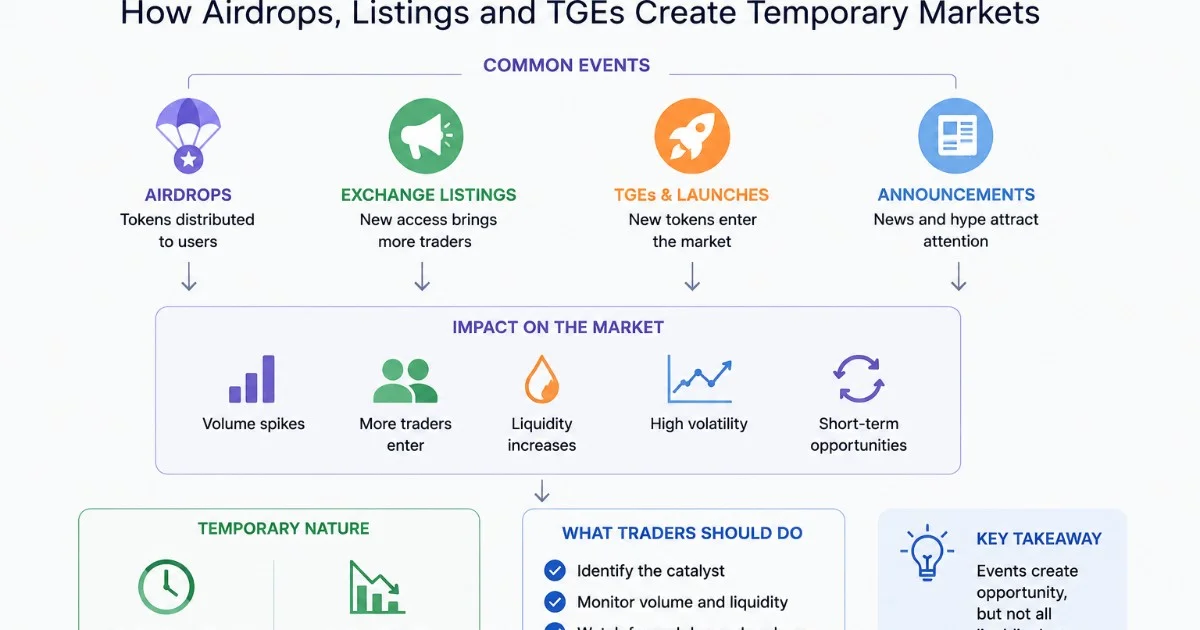
At first, this activity can look like strong demand.
But not all event-driven liquidity is sustainable.
Sometimes, the market is active only because traders are reacting to a short-term catalyst. Once the event passes, volume fades, liquidity leaves, and the chart changes completely.
This is called event-driven liquidity.
What Is Event-Driven Liquidity?
Event-driven liquidity happens when trading activity increases because of a specific catalyst.
Common crypto events include:
- Token generation events
- Airdrop claims
- Centralized exchange listings
- DEX launches
- Staking or farming programs
- Token unlocks
- Major product releases
- Governance votes
- Ecosystem announcements
- Influencer or community campaigns
These events can attract buyers, sellers, liquidity providers, arbitrage traders, bots, and speculators.
The result is a temporary market that may not behave like normal trading conditions.
Why Event-Driven Markets Are Different
During an event, many traders are not buying because they believe in the long-term value of the token. They may be buying because they expect volatility, short-term momentum, or a fast trade.
At the same time, many sellers may appear.
For example, after an airdrop, recipients may sell tokens they received for free. After a CEX listing, early buyers may take profits. After a token unlock, supply can increase. After a staking launch, liquidity may move into reward programs instead of open market trading.
This creates a market where volume can be high, but conviction may be low.
The Airdrop Liquidity Effect
Airdrops can create intense short-term trading activity.
When users receive tokens, some hold, some sell immediately, and others buy after the launch. This can create fast price discovery, high volume, and sharp volatility.
However, airdrop markets can be difficult to read.
High volume after an airdrop does not always mean new demand. It may simply reflect distribution from recipients to buyers.
Traders should ask:
- Are buyers absorbing airdrop sellers?
- Is liquidity growing after the claim period?
- Does the token recover after initial selling?
- Are large wallets selling quickly?
- Is volume still strong after the first wave?
If demand remains after the event, the market may be healthier. If activity disappears, the liquidity was probably temporary.
The CEX Listing Effect
A centralized exchange listing can bring attention, volume, and new participants.
But it can also change the structure of the market.
Before a listing, DEX liquidity may be the main source of price discovery. After the listing, trading may shift to the CEX. This can make the DEX chart less representative of the full market.
CEX listings can also create profit-taking. Traders who bought before the listing may sell into new demand.
For this reason, a listing is not always bullish after it happens. Sometimes, the strongest move happens before the official event.
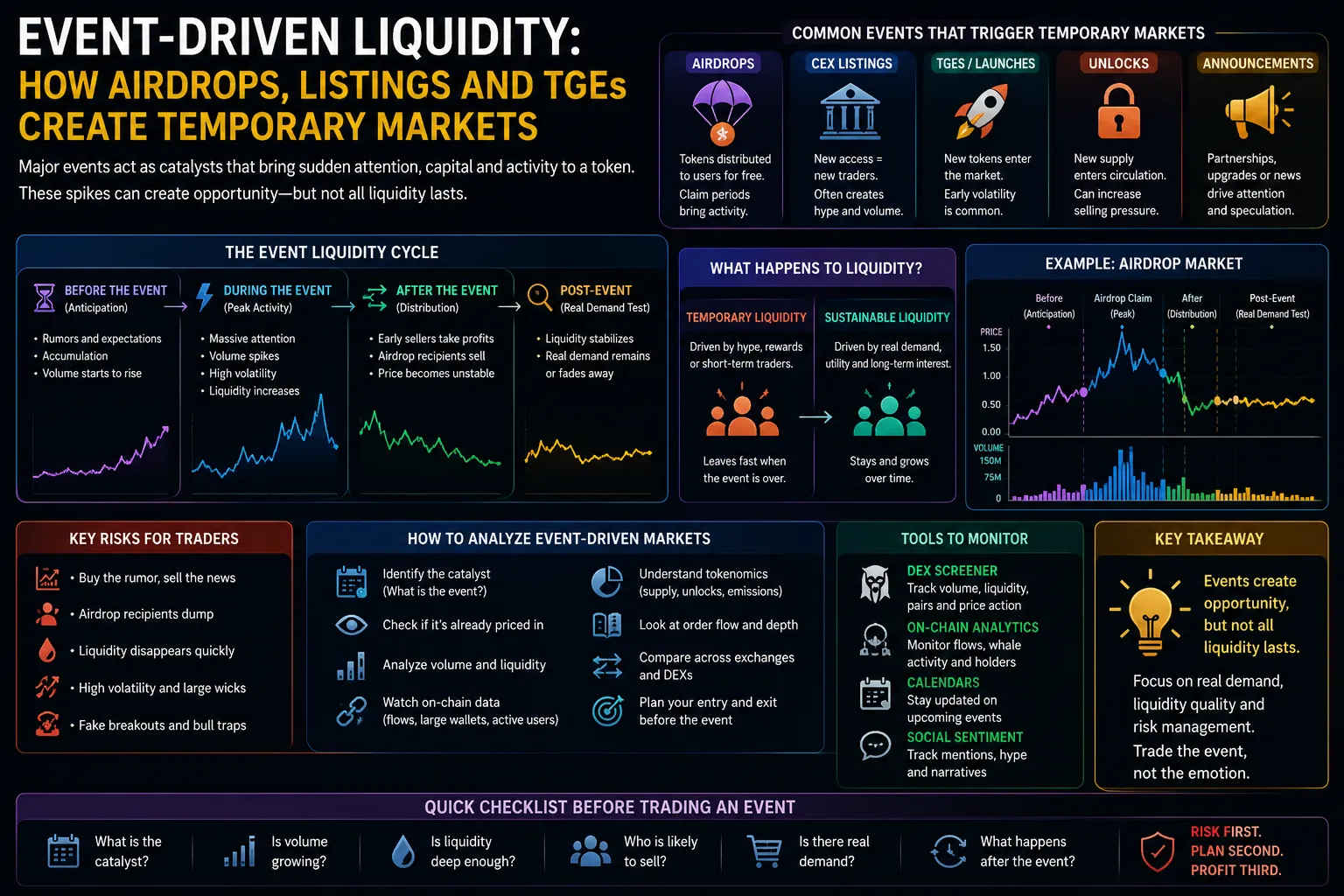
The TGE Effect
A token generation event is one of the most important liquidity moments in a token's life.
At TGE, the market must absorb initial circulating supply, early buyers, airdrop recipients, market makers, and new speculators.
This can create extreme volatility.
A healthy TGE usually shows:
- Strong liquidity from the beginning
- Balanced buying and selling
- Demand after the first volatility wave
- Clear trading venues
- Transparent circulating supply
- Continued interest after launch day
An unhealthy TGE often shows high initial hype followed by rapid volume collapse.
Temporary Liquidity vs Sustainable Liquidity
The key difference is what happens after the event.
Temporary liquidity appears quickly and disappears quickly. It is driven by excitement, speculation, or forced activity.
Sustainable liquidity remains after the event. It comes from real traders, long-term holders, active markets, and continued demand.
Traders can look for signs such as:
- Volume remains stable after the catalyst
- Liquidity does not disappear after the event
- Buyers continue entering after pullbacks
- The token forms a clear market structure
- Large sellers are absorbed without destroying the chart
- Social attention converts into real trading activity
The event may start the market, but demand must sustain it.
How Traders Can Analyze Event-Driven Liquidity
Before trading around a major event, traders should use a structured checklist.
- What is the catalyst?
- Is the event already priced in?
- Who is likely to sell after the event?
- Is liquidity deep enough for exits?
- Does volume continue after the initial spike?
- Are large wallets accumulating or distributing?
- Is the DEX still the main market after the event?
- Are price moves supported by real buyers?
This helps traders avoid confusing temporary excitement with durable demand.
Final Thoughts
Events create opportunity, but they also create distorted markets.
Airdrops, listings, TGEs, unlocks, and announcements can bring fast liquidity into a token. But that liquidity may not last.
The most important question is not whether an event creates volume. The real question is whether the market remains healthy after the event passes.
Before trading an event-driven token, always ask: is this real demand, or just temporary liquidity?
That question can help traders avoid late entries, weak exits, and misleading market signals.
What Is Chain Abstraction: The End of Bridging in Crypto (2026) How to Read On-Chain Data: Metrics, Wallet Flows and Dashboards (2026) Dark AMMs and Hidden Liquidity: Why Some DEX Activity Is Harder to ReadFrequently Asked Questions
What is an event-driven market in crypto?
An event-driven market in crypto refers to the temporary increase in trading activity and liquidity around specific occurrences like airdrops, new listings, or token generation events (TGEs). These events often generate significant interest and price volatility.
How do airdrops create temporary markets?
Airdrops distribute free tokens to existing holders, often leading to immediate selling pressure from recipients looking to realize gains or acquire other assets. This influx of new tokens and subsequent trading activity creates a temporary market around theized asset.
What role do new listings play in event-driven liquidity?
New listings on major exchanges expose a cryptocurrency to a wider audience and increased trading volume. This surge in accessibility and investor interest often results in a temporary boost in liquidity and price discovery for the newly listed asset.
How do Token Generation Events (TGEs) impact market liquidity?
TGEs, or initial token distributions, mark the point where a new cryptocurrency becomes publicly available for trading. The initial allocation and subsequent buying or selling by early investors and the public create a period of heightened liquidity and price fluctuation.
Are event-driven markets sustainable?
Event-driven markets are typically temporary, characterized by a burst of activity around a specific occurrence. While they can offer opportunities for traders, the increased liquidity and price movements often subside once the immediate impact of the event diminishes.
Related Guides
- How to Launch a Meme Coin on Raydium: Migration Route, Liquidity and Verification (2026)
- Liquidity Depth in Crypto Explained: Deep Markets
- What Is a Token Generation Event (TGE) in Crypto? Complete Beginner Guide (2026)
- Understanding Block Reorgs: Temporary Blockchain Changes
- Burner Wallet for Crypto: Complete Airdrop & Risky dApp Guide (2026)