ERC-721 vs ERC-1155 Comparison for Traders
— By AliceOnChain in Tutorials

A comprehensive technical evaluation of Ethereum's dominant token structures, exploring how contract architecture, gas fee dynamics, and liquidity models dictate modern digital asset trading strategies.
ERC-721 vs ERC-1155: NFT Standards Compared for On-Chain Market Analysis
The architecture of decentralized applications relies heavily on standardized token frameworks. In the non-fungible token landscape, understanding the mechanics of specific token standards is essential for precise market execution and risk mitigation. When analyzing or interacting with digital collectibles, gaming protocols, or financialized on-chain positions, selecting or evaluating the underlying contract design can mean the difference between capital efficiency and severe structural friction. This deep ERC-721 vs ERC-1155 comparison explores the technological and economic trade-offs that define Ethereum's two most prominent non-fungible frameworks.
For years, the market treated non-fungible assets as monolithic structures, but experienced traders look directly at the smart contract implementation to see how these structural variables impact their portfolio. The structural design of a contract governs how assets are minted, transferred, tracked, and priced across automated market makers and decentralized marketplaces. By evaluating these differences, market participants can better interpret volume spikes, manage position volatility, and execute cleaner risk management frameworks.
Technical Foundations of the Dominant Token Frameworks
To evaluate the ecosystem effectively, we must look at how each standard maintains state across public distributed ledgers. The primary technical divergence between these protocols lies in how ownership mapping and resource balances are designated within the smart contract bytecode.
The Original Non-Fungible Blueprint: ERC-721
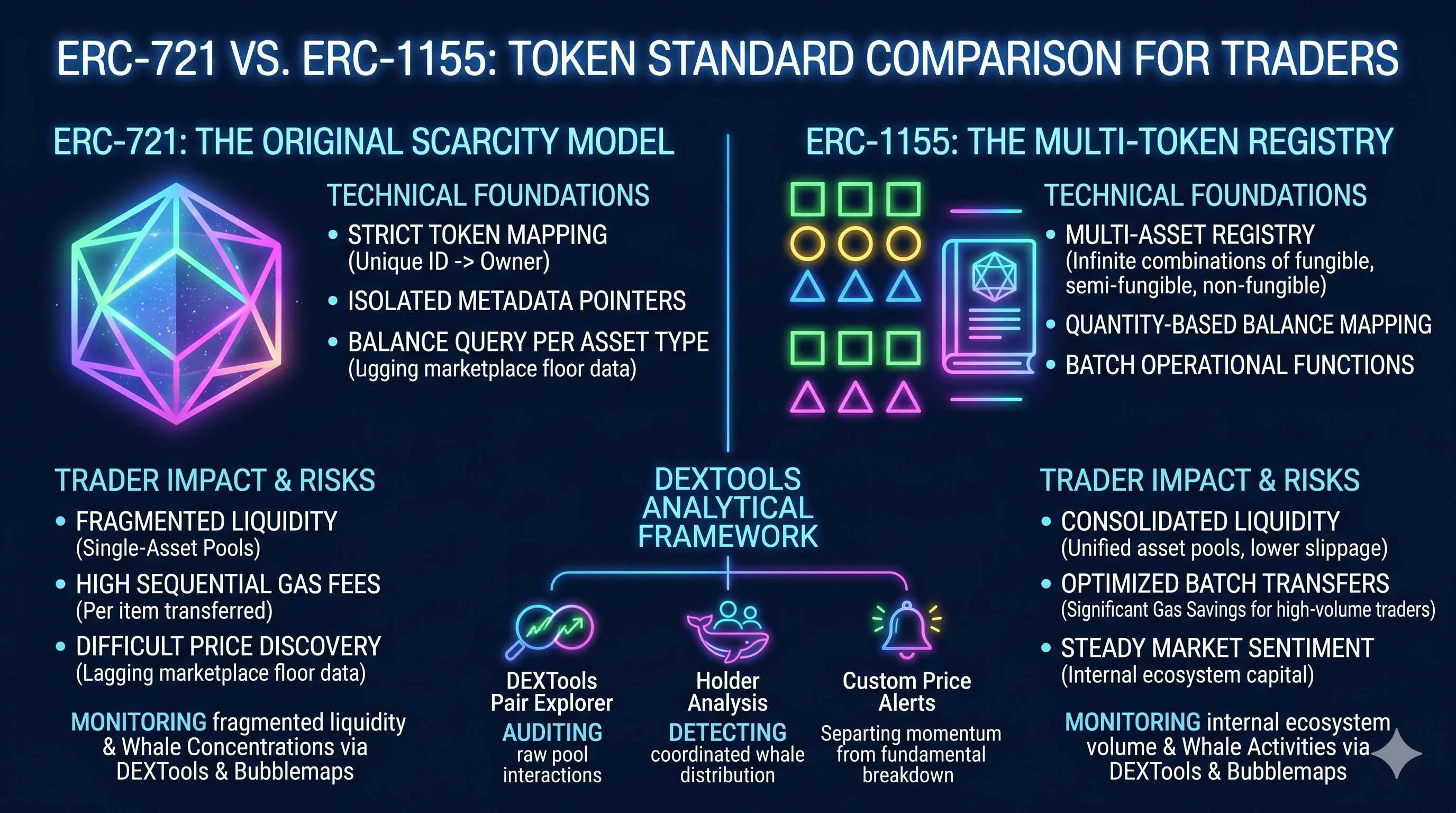
Introduced in 2018, erc-721 established the concept of absolute digital scarcity on EVM-compatible networks. At its core, an erc-721 contract maintains a direct, strict mapping between an individual, unique token identifier and its current owner's wallet address. Each asset exists as an isolated entity with unique metadata pointers, making it a foundational benchmark when initiating a structural analysis.
In this architecture, the contract's standard check functions query how many distinct unique assets a specific wallet address possesses within that isolated collection, rather than identifying a quantity of a single asset type. This model is exceptionally well-suited for completely distinct, one-of-a-kind items like digital art installations, specific real estate configurations, or highly individualized financial debt positions.
The Multi-Token Multi-Asset Approach: ERC-1155
Developed to address the structural constraints of its predecessor, erc-1155 introduces a multi-token standard architecture. Instead of restricting a single smart contract instance to representing a single collection of fully distinct items, an erc-1155 deployment acts as an expansive registry capable of simultaneously governing infinite combinations of fungible tokens, non-fungible tokens, and semi-fungible structures.
Architecturally, the erc-1155 contract replaces the simple token-to-owner mapping with a nested lookup structure. It maps a specific token ID to an account address, which then maps to a specific numerical balance. This allows a single deployed contract interface to issue both unique, one-of-a-kind digital assets alongside massive supplies of identical, fractionalized commodities, altering how analysts approach an asset breakdown.
Transaction Fees and Gas Optimization Under Load
For high-frequency traders and on-chain protocol users, transaction cost efficiency is a major factor when assessing an ERC-721 vs ERC-1155 comparison. Every computational state modification on Ethereum demands execution fees, meaning contract design directly impacts net portfolio yield during periods of elevated network congestion.
The Financial Overhead of Sequential Operations
When an operator interacts with an erc-721 contract to move multiple items simultaneously, the platform must execute independent, sequential transactions or loop iterations. To move five separate digital collectibles, the contract must invoke the basic transfer function five separate times, updating the storage state for five unique index items independently.
This structure generates massive transaction fee overhead. Each individual state write forces the network to calculate independent cryptographic validation steps, which significantly raises costs during volatile market movements or high-demand mint cycles.
Efficiency Improvements with Combined Batch Transfers
Conversely, erc-1155 introduces native batch transfers smart contract functions. This optimization allows users to package multiple token IDs and their corresponding transfer quantities into a single, unified array execution argument, adding another layer of efficiency to the modern ecosystem.
Instead of triggering multiple state-writing transactions across the network ledger, an operator can execute a single unified batch transaction. The network processes the entire package simultaneously, updating multiple token balances in a single block execution step. For gaming ecosystems, fractionalized liquidity distributions, and complex portfolio adjustments, this consolidation drastically reduces consumption expenses and shortens confirmation timeframes.
Asset Liquidity and Modern Market Dynamics
The architectural choice between these standards heavily influences how an asset trades on secondary markets and how market participants track on-chain asset liquidity.
Liquidity Fragmentation in Single-Asset Pools
Because erc-721 treats every single token identifier as an entirely distinct economic variable, creating automated market maker liquidity pools can be challenging. To establish an automated trading pair, tokens are often wrapped into specialized vault pools or aggregated via decentralized liquidity routers. This structure can lead to fragmented liquidity across multiple execution venues, making it more difficult to pinpoint precise historical support and resistance zones.
Traders looking to navigate these conditions must use advanced analytical frameworks to run a precise comparison in real time. Monitoring real-time order flows through tools like the DEXTools Pair Explorer becomes crucial for detecting subtle shifts in trading volume and capital depth before they reflect in broader marketplace floor pricing.
Combined Asset Pools and Semi-Fungible Dynamics
The erc-1155 framework mitigates asset isolation by allowing fungible and non-fungible components to exist within the same technical perimeter. For instance, an asset can exist as a highly liquid, fungible ticket or token during a primary phase, and transition seamlessly into a rare, non-fungible collectible later.
Because these assets share a contract interface, developers can establish unified liquidity pairs where users swap directly between different tiers of a project's ecosystem without exiting to external wrapping protocols. This unified liquidity structure helps maintain steadier market sentiment, as capital remains consolidated inside a single contract infrastructure rather than scattering across disjointed market platforms, proving to be a critical point of interest in any architecture evaluation.
On-Chain Risk Management and Advanced Analytical Tools
Navigating the shifting dynamics highlighted in our comparison requires rigorous data verification. Regardless of which standard an asset collection deploys, market participants must look past marketing narratives and verify actual smart contract activity.
Identifying Whale Concentrations and Asset Distribution
Understanding a token's actual ownership distribution is an effective way to manage digital asset risk. When evaluating erc-1155 multi-token ecosystems, large concentrations of supply inside a few specific wallets can create severe market vulnerability if those operators begin distributing positions into available liquidity.
Traders can address this by leveraging advanced wallet metrics. Utilizing holder analysis features alongside integrated visualization structures, such as the Bubblemaps view on DEXTools, helps reveal hidden relationships between seemingly independent wallet addresses. Detecting these clusters allows market participants to spot whale activity early and anticipate sudden pressure on established support zones.
Volatility Management and Price Discovery
During volatile trading cycles, standard marketplace dashboards often suffer from lag or misreported metadata. Establishing objective, real-time market tracking is critical for preserving capital and ensuring your portfolio strategy is based on live metrics.
Using analytical charting suites to track raw pool interactions provides traders with an unvarnished view of order execution. Setting custom price alerts based on raw on-chain data rather than delayed front-end floor aggregators allows traders to execute entries and exits with maximum precision. This analytical discipline helps separate temporary momentum swings from fundamental structural breakdown within the token contract itself.
Use Case Optimization: Selecting the Correct Standard
When reviewing an ERC-721 vs ERC-1155 comparison, it becomes clear that neither framework is universally superior. Instead, each standard serves a distinct, specialized role within the digital asset market:
Deploy ERC-721 When: The project requires completely unique, high-value assets where each item must hold independent provenance data. Examples include premium digital art collections, individual tokenized real-world assets, and custom financial derivatives where fractional identity sharing would overcomplicate ownership tracking.
Deploy ERC-1155 When: The system requires an expansive, interconnected asset economy with frequent multi-token transactions. Examples include Web3 MMORPG gaming environments with thousands of fungible resource tokens and unique non-fungible gear pieces, fractionalized real estate networks, and decentralized loyalty reward platforms.
Conclusion
The ongoing evolution of Ethereum token frameworks shows that smart contract architecture shapes market behavior. As the broader digital asset landscape trends toward deep financialization, understanding the underlying technical standards becomes a core trading requirement rather than just a developer preference.
By mastering the details found in this technical comparison, market participants can better understand liquidity patterns, anticipate transaction fee spikes, and identify systemic platform risks before they impact capital. Utilizing advanced analytics engines like DEXTools to audit holder distribution, monitor active pool volume, and configure real-time market tracking ensures that traders remain independent, analytical, and highly agile across all market conditions.
- Fee Revenue per Active Wallet vs Total Fees: Which Shows Real dApp Monetization?
- Fee Payer Growth vs Transaction Count: Which Better Shows Real Network Adoption?
- Settlement Volume vs Transfer Count: Which Better Shows Real On Chain Value Movement?
- Active Contracts vs Contract Deployments: Which Better Shows Real Developer Adoption?
Disclaimer: This article is for informational purposes only and does not constitute investment advice, financial advice, trading advice, or any other kind of advice. DEXTools does not recommend buying, selling, or holding any cryptocurrency or token. Users should conduct their own research and consult with a qualified financial advisor before making any investment decisions. Cryptocurrency investments are volatile and high-risk. DEXTools is not responsible for any losses incurred.
Related Guides
- OpenSea vs Blur: NFT Marketplaces Compared (2026)
- TRC-20 vs ERC-20: Complete USDT Comparison Guide (2026)
- Top NFT Marketplaces Compared: OpenSea and others.
- zkEVM Types Compared: Polygon vs zkSync vs Scroll 2026
- TRON vs Solana: Speed, Fees and Use Cases Compared (2026)
- Comparison of ERC
Frequently Asked Questions
What is the difference between ERC-721 and ERC-1155?
ERC-721 defines unique, non-fungible tokens where each token ID is one of a kind, while ERC-1155 is a multi-token standard that can manage both fungible and non-fungible tokens in one contract. ERC-1155 is often used when many item types need to be handled efficiently.
Which standard is more gas efficient for many tokens?
ERC-1155 supports batch transfers and managing multiple token types in a single contract, which can reduce gas costs when handling many items at once. ERC-721 handles tokens individually, which can be less efficient for large collections of varied items.
Can ERC-1155 represent unique NFTs like ERC-721?
Yes, ERC-1155 can represent non-fungible tokens by giving a token type a supply of one. It is flexible because the same contract can hold both one-of-one items and items with many identical copies.
Why would a project choose ERC-721 over ERC-1155?
ERC-721 is widely supported and is the established standard for purely unique collectibles, so it can offer broad compatibility and simplicity. Projects that only need distinct one-of-one tokens may prefer it for that reason.