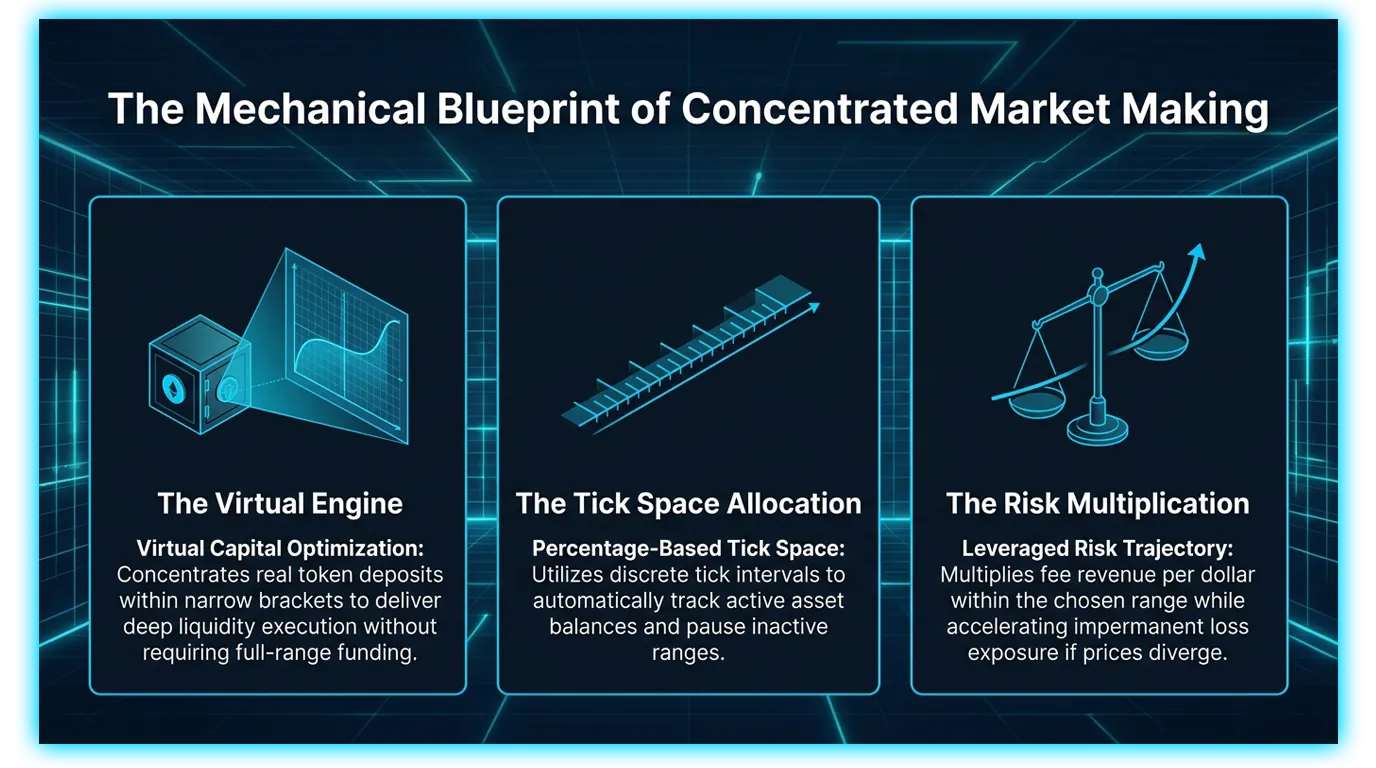
Concentrated liquidity multiplies capital efficiency but amplifies risk. We analyze the mathematical mechanics, tick intervals, and leveraged impermanent loss profiles.
The Liquidity Evolution: Shifting the Market-Making Paradigm
Early decentralized applications relied on traditional constant product curves to manage trading reserves. Under a legacy Automated Market Maker (AMM) design, liquidity providers (LPs) had their capital distributed uniformly across an infinite price scale from zero to infinity. While this uniform approach ensured that a liquidity pool could facilitate swaps regardless of how volatile the market became, it introduced massive structural inefficiency. The vast majority of a pool's idle assets sat unused at extreme price points, forcing traders to endure high execution slippage on standard, mid-sized orders.
Concentrated liquidity dismantles this legacy framework. By allowing market makers to confine their capital within specific price boundaries, contemporary exchanges maximize asset utilization. However, compressing liquidity into narrow ranges changes the financial risk profile for the provider. This guide analyzes the structural mechanics of concentrated liquidity, the infrastructure of custom range ticks, the threat of algorithmic fee dilution, and the accelerated impermanent loss profiles that define modern market making.
1. The Structural Foundation: Virtual Reserves and Token Deltas
Concentrated liquidity functions by establishing an invisible, virtual pricing curve that acts with the capital efficiency of a much larger, infinite-range pool. The system handles transactions by separating real deposited tokens from the broader virtual liquidity architecture.
The Real vs. Virtual Balance Invariant
When an LP specifies a tight price interval bounded by a lower and upper price limit, they do not need to provide the massive asset reserves required to cover the entire infinite curve. Instead, they only deposit the precise amount of real assets needed to facilitate trading within that specific window.
The relationship between virtual liquidity and real tokens means that the pool acts as if it has vastly deeper reserves. The smart contracts track the active trading range dynamically, meaning that small amounts of real tokens provide the same depth as massive traditional pools within that specific price corridor.
Tracking Token Changes
As trades occur within a specified interval, the internal marginal price moves smoothly across the active curve. The protocol calculates the exact changes in token amounts added or removed from an individual position during a swap based on the movement of the price relative to the boundaries.
Within a concentrated range, asset balances are consumed and rebalanced at an accelerated rate compared to legacy pools, yielding a massive capital multiplier effect without requiring endless token backing.
2. Managing Custom Ranges and Tick Space
To track thousands of overlapping individual liquidity brackets without crushing the blockchain ledger with massive computation costs, protocols divide the continuous price scale into discrete mathematical units called Ticks.
The Tick Vector Space
Ticks represent discrete price boundaries established at regular intervals. This mathematical layout ensures that each adjacent tick is positioned exactly a fraction of a percent away from the previous one, creating a geometric progression of steps.
When an LP opens a position, they lock their capital to specific tick boundaries. As the active market price crosses these tick intervals during a swap, the protocol updates the aggregate active liquidity instantly, ensuring seamless fee tracking.
The Inactive State
If market momentum pushes the asset price completely past an LP's upper or lower tick boundary, the position transitions into an inactive state.
Asset Transformation: The smart contract automatically converts the entire position's capital into the depreciating asset of the pair. For instance, if the price rises above the upper boundary, the position is converted entirely into the quote asset, such as a stablecoin.
Fee Halting: While inactive, the position stops generating transaction fees. Capital remains idle until the open-market price re-enters the specified tick interval or the LP manually closes the position to redeploy a new range.
3. The Threat of Just-In-Time (JIT) Liquidity Attacks
The highly localized efficiency of concentrated liquidity environments has enabled a sophisticated, predatory Maximum Extractable Value (MEV) strategy known as a Just-In-Time (JIT) liquidity attack.
JIT attacks target passive liquidity providers during high-volume transactions:
An MEV bot monitors the public mempool and identifies a large pending swap that will generate significant transaction fees.
Within the exact same blockchain block, the bot front-runs the trade by minting an ultra-narrow, highly concentrated liquidity position directly inside the specific tick where the trade will execute.
The large swap executes. Because the bot's hyper-concentrated position commands the vast majority of depth inside that specific tick, the bot captures almost all of the transaction fee revenue.
Immediately following the swap, the bot executes a back-run transaction to burn its position and reclaim its assets.
This sandwich-style liquidity provision allows JIT bots to harvest fee premiums while completely bypassing overnight inventory risk, diluting the structural returns of passive, long-term LPs.
4. The Impermanent Loss Profile: Concentrated Liquidity vs. v2
Impermanent loss represents the opportunity cost incurred when deploying assets into a rebalancing pool instead of holding them passively in a cold wallet. In a concentrated liquidity ecosystem, the structural trajectory of impermanent loss behaves like an automated market-making position running on high financial leverage.
Accelerated Divergence Risk
Because capital is compressed into a narrow interval, the rate of asset rebalancing is heavily amplified. Within the active range boundaries, a price shift causes impermanent loss to accumulate at a significantly faster rate than in a standard uniform pool. Depending on how tightly the brackets are configured, an LP can experience several times higher impermanent loss for the exact same percentage price move compared to an infinite-range position.
The Out-of-Range Freeze
The moment the market price breaches a tick boundary, the accumulation of impermanent loss reaches its localized maximum and freezes. The position is left holding only the unpegged, underperforming token. While the loss percentage stabilizes and stops compounding further, the position stops earning trading fees to offset the deficit, turning a temporary drop into a permanent loss of purchasing power if the market trends indefinitely away from the range.
5. Universal On-Chain Forensics and Trading Telemetry via DEXTools
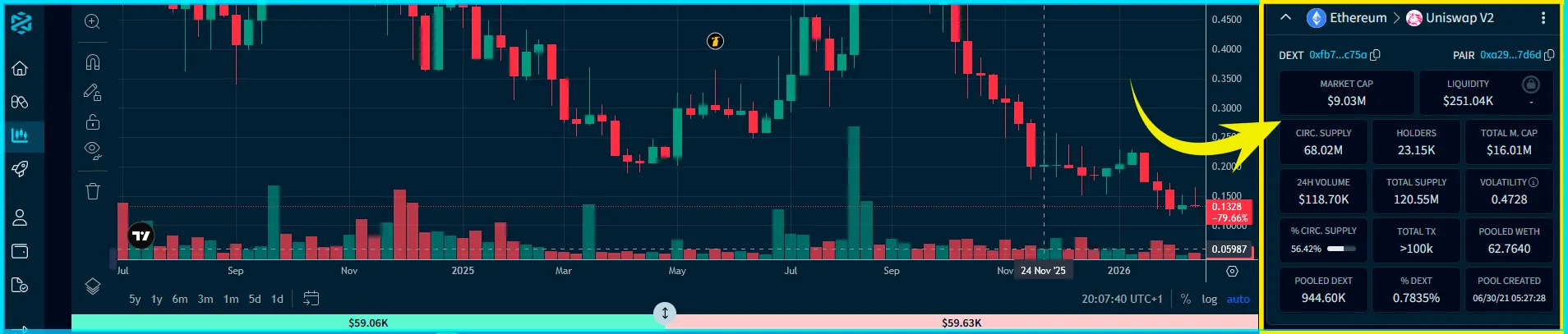
Navigating highly technical decentralized market structures requires robust, real-time data analytics to evaluate pool depth, verify contract configurations, and audit capital shifts across active token pairs. Advanced data environments like DEXTools provide an indispensable, universal toolkit for contemporary market participants, operating seamlessly as an agnostic tracking layer across all public execution networks.
By leveraging core diagnostic features such as the Pair Explorer, Live New Pairs directory, and the Big Swap Explorer, technical analysts can instantly evaluate localized liquidity distributions, audit contract safety scores, and map high-volume block transactions executed by algorithmic MEV bots or automated yield aggregators, providing the objective transparency needed to manage capital risk safely.
You can access DEXTools here and start trading today!
Disclaimer: This article is for informational purposes only and does not constitute investment advice, financial advice, trading advice, or any other kind of advice. DEXTools does not recommend buying, selling, or holding any cryptocurrency or token. Users should conduct their own research and consult with a qualified financial advisor before making any investment decisions. Cryptocurrency investments are volatile and high-risk. DEXTools is not responsible for any losses incurred.
Concentrated liquidity lets liquidity providers allocate their funds within a chosen price range instead of across the entire price curve. This can make capital more efficient because liquidity is focused where most trading occurs.
What are the main advantages of concentrated liquidity?
Its main advantage is improved capital efficiency, since the same amount of capital can provide deeper liquidity within a chosen range and potentially earn more fees. This benefits providers when prices stay inside their selected range.
What are the risks of providing concentrated liquidity?
If the price moves outside your chosen range, your position can stop earning fees and may become fully weighted toward one asset. Concentrated positions can also experience impermanent loss more sharply than full-range positions.
What is a tick in concentrated liquidity?
A tick is a discrete price point used to define the boundaries of a liquidity range. Providers set ranges between ticks to control where their liquidity is active.