When DEX Liquidity Stops Representing the Main Market After a CEX Listing
— By Whatsertrade in Tutorials

Many tokens begin their life on decentralized exchanges. In the early stages, DEX data often gives traders the clearest view of the market. Liquidity, volume, s
Many tokens begin their life on decentralized exchanges.
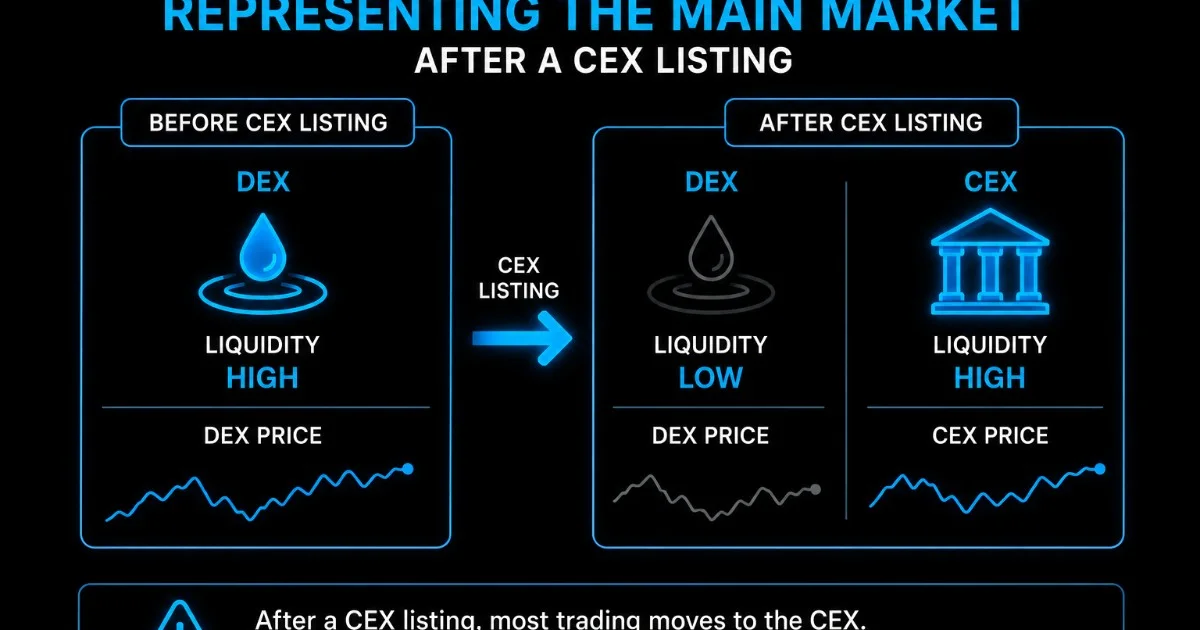
In the early stages, DEX data often gives traders the clearest view of the market. Liquidity, volume, swaps, holders, and price action all happen on chain.
But when a token lists on a centralized exchange, the market can change.
A CEX listing can shift trading activity away from DEX pools. It can split liquidity across venues. It can also change where price discovery happens.
For traders, this creates an important question: does the DEX pool still represent the main market, or has the center of trading moved elsewhere?
What Happens to Liquidity After a CEX Listing?
After a token lists on a centralized exchange, trading activity may become divided between DEXs and CEXs.
Before the listing, most liquidity may sit in one or more DEX pools. After the listing, new traders may choose the centralized exchange because it offers order books, easier onboarding, lower friction, or more familiar execution.
This does not make DEX data irrelevant. It simply means that on chain data may no longer show the full picture.
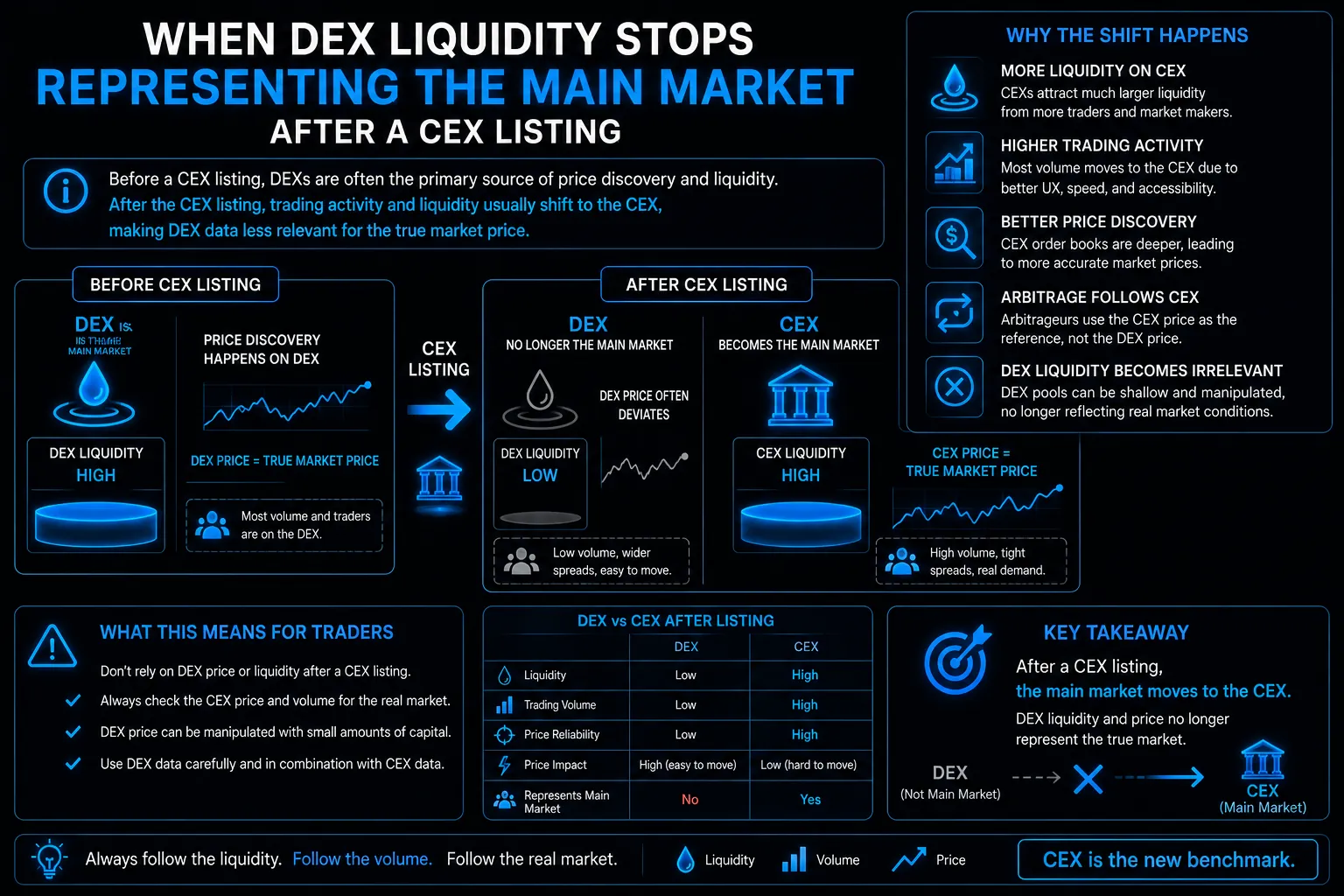
Why DEX Data Can Become Incomplete
DEX data is transparent and valuable. Traders can see swaps, liquidity changes, pool activity, and wallet behavior.
However, centralized exchange activity is not displayed in the same way. Once a token gains meaningful CEX volume, the visible DEX market may become only one part of the total market.
This can create several interpretation risks.
A DEX chart may look quiet while the token is actively trading on a CEX. A DEX pool may show sharp volatility because it is thinner than the broader market. A large on chain swap may move the DEX chart, even if the wider market remains stable.
In other words, DEX liquidity may stop representing the main market.
Signs That the Main Market Has Shifted Away From DEX Liquidity
Traders should watch for signs that a token's main liquidity has moved or become split after a CEX listing.
Common signs include:
- DEX volume drops after the listing
- The DEX pool becomes more volatile than expected
- DEX liquidity stays flat while overall attention grows
- Price gaps appear between DEX and CEX markets
- Large DEX swaps create outsized price impact
- Most trader discussion moves toward exchange order books
- The main source of volume appears to come from centralized venues
None of these signs are automatically bullish or bearish. They simply mean traders need more context.
Why This Matters for DEX Traders
A trader using a DEX needs to understand whether the DEX pool is still deep enough for their trade size.
If most liquidity has moved to centralized exchanges, the DEX pool may become thinner. This can increase slippage, widen spreads, and make exits harder.
A token can be popular overall while still being difficult to trade efficiently on chain.
This is one of the biggest risks after a CEX listing. Traders may assume that higher visibility means better liquidity everywhere, but liquidity can be unevenly distributed.
Price Discovery Can Also Move
Price discovery is the process through which the market determines the fair price of an asset.
Before a CEX listing, price discovery may happen mainly on DEXs. After a listing, the deepest venue may start leading the market.
If the CEX has more volume and tighter spreads, it may influence price faster than the DEX pool. In that case, DEX traders need to watch for lag, gaps, and delayed reactions.
The DEX chart still matters, but it may follow the broader market rather than lead it.
How to Analyze DEX Liquidity After a CEX Listing
Traders can use a simple checklist after a token lists on a centralized exchange:
- Did DEX volume increase or decrease after the listing?
- Is the main DEX pool still liquid enough for your trade size?
- Are price gaps appearing between venues?
- Are large DEX trades causing high price impact?
- Is liquidity being removed from on chain pools?
- Is the token still mainly traded by on chain users?
- Does the DEX chart still reflect the broader market?
This type of analysis can help traders avoid relying on incomplete signals.
CEX Listing Does Not Always Mean Better Trading Conditions
Many traders assume that a CEX listing automatically improves a token's market quality.
Sometimes it does. A listing can increase visibility, attract new participants, and deepen overall liquidity.
But it can also create fragmentation.
Liquidity may become divided. DEX pools may become less active. Price action may become harder to interpret. Traders may also see stronger reactions to news, unlocks, market maker activity, or exchange specific flows.
The listing is not the end of analysis. It is the beginning of a new market structure.
Final Thoughts
A token's market can evolve quickly after a centralized exchange listing.
The DEX pool may remain important, but it may no longer represent the entire market. Traders who ignore this shift can misread volume, liquidity, price action, and execution risk.
Before trading a token after a CEX listing, ask one key question: is the DEX still the main market, or only one part of it?
That answer can help traders avoid misleading signals and make better decisions.
How to Bridge Crypto Between Chains: Complete Cross-Chain Tutorial 2026 How to Use 1inch: Complete DEX Aggregator Swap Tutorial (2026) How to Use OKX Web3 Wallet: Multi-Chain DeFi Hub Guide (2026)Frequently Asked Questions
Q: What happens when DEX liquidity no longer reflects the main market after a CEX listing?
A: Trading volume may shift significantly to the CEX, potentially reducing the influence of DEX price discovery and increasing price discrepancies between platforms.
Q: How does this impact arbitrage opportunities?
A: Arbitrage opportunities may increase as price differences between DEXs and CEXs become more pronounced, attracting traders to profit from these discrepancies.
Q: What are the implications for token holders?
A: Token holders might experience greater price volatility on DEXs if liquidity there becomes thin, potentially affecting trade execution and slippage.
Q: Does this affect the overall market efficiency?
A: Market efficiency could decrease if a substantial portion of trading moves off-chain, making it harder to gauge true market sentiment and fair value on decentralized platforms.
Q: What role do CEXs play in this scenario?
A: CEXs become the primary venue for price discovery and liquidity, potentially attracting more institutional capital and larger trades due to their centralized infrastructure and regulatory compliance.
Related Guides
- Main Pool Drift: How to Know When a Token's Real Market Has Moved
- Where to Trade New Meme Coins Early: DEX vs CEX Entry Map (2026)
- DEX vs CEX: Complete Guide to Decentralized vs Centralized Exchanges (2026)
- Best Meme Coin Trading Platform in 2026: DEX vs CEX for Execution
- Stablecoin Market Cap vs On-Chain Liquidity Guide
- The Zero to Liquidity Window