Coin vs Token in Crypto: What Is the Difference?
— By Tony Rabbit in Tutorials

Coin vs token in crypto explained: simple definitions, real examples, common token types and why the distinction actually matters for investors.
Top results for coin vs token crypto focus on the basic difference, use cases, and easy examples. This guide is tuned to that comparison intent, not to ranking which assets are better investments.
If you have spent more than ten minutes in the crypto space, you have probably heard the words "coin" and "token" used as if they meant exactly the same thing. They do not. The distinction is one of the first technical concepts every trader, builder, and long-term investor needs to internalize, because confusing the two leads directly to wrong assumptions about custody, gas fees, risk, and even which wallet to use.
The short version is simple. A coin is the native currency of its own blockchain. Bitcoin is the coin of the Bitcoin network. Ether is the coin of Ethereum. Solana's SOL is the coin of the Solana network. A token, on the other hand, is an asset that lives on top of someone else's blockchain. USDT, UNI, SHIB, and most of the assets you trade on a daily basis are tokens, not coins. They borrow the security and infrastructure of a host chain instead of running their own.
This guide walks you through the full picture: what makes something a coin versus a token, the major token standards you will encounter (ERC-20, ERC-721, BEP-20, SPL, TRC-20), the different types of tokens that exist, real-world examples placed side by side, and practical ways to tell them apart in a block explorer. By the end, you will never confuse BNB on its own chain with BNB as a token, or ETH with WETH, ever again.
The Quick Answer (TL;DR)
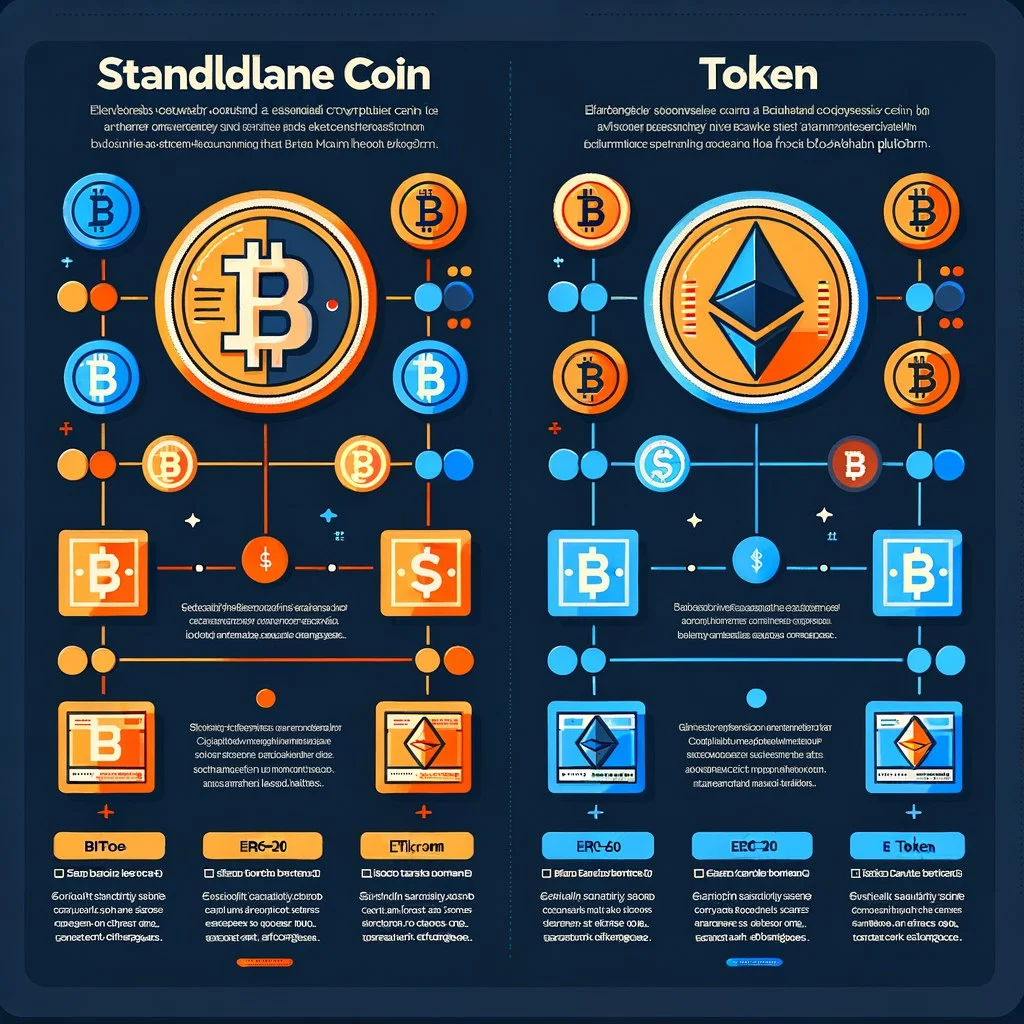
If you only have thirty seconds, this comparison block is the answer to "what is the difference between a coin and a token in crypto?" Everything else in this guide is detail and examples.
| Own blockchain? | Coin: Yes | Token: No, uses a host chain |
| Validated by? | Miners or validators | The host chain's validators |
| Pays gas fees? | Yes (used to pay fees) | No, pays fees IN the host coin |
| Created by? | Protocol-level code | A smart contract |
| Examples | BTC, ETH, SOL, ADA, AVAX | USDT, UNI, LINK, SHIB, PEPE |
Notice the gas fee row, because it is the most practical consequence of the difference. If you hold only USDT on Ethereum and you want to send it, you cannot. You need ETH in the same wallet to pay the gas fees. That single fact trips up more newcomers than almost anything else.
What Is a Coin?
A coin is the native cryptocurrency of a blockchain. It is hardcoded into the protocol itself. When the blockchain is launched, the coin exists by definition. You cannot have Bitcoin without the Bitcoin blockchain, and you cannot have the Bitcoin blockchain without bitcoin (BTC) as its unit of value. The two are inseparable. The same applies to Ethereum and ETH, Solana and SOL, Cardano and ADA, Avalanche and AVAX, and so on.
Coins are produced through the consensus mechanism of their network. On proof-of-work chains like Bitcoin, miners use computational power to solve cryptographic puzzles, and the network rewards them with newly minted BTC. On proof-of-stake chains like Ethereum after The Merge, validators lock up their existing ETH to secure the network, and they earn newly issued ETH as a reward for proposing and attesting to blocks. The point is that the issuance of a coin is dictated by the rules of its own blockchain, not by a smart contract someone deployed.
Because they are baked into the protocol, coins serve a very specific purpose: they pay for the computational resources of the network. If you want to send a transaction on Ethereum, you need ETH to pay the gas. If you want to send a transaction on Solana, you need SOL. If you want to send one on Bitcoin, you need BTC for the miner fee. The coin is the network's fuel, its accounting unit, and the asset that incentivizes the people securing it. This three-in-one role is what makes coins structurally different from tokens.
Most major coins predate the concept of programmable tokens. Bitcoin launched in 2009 with no token system at all. Litecoin, Dogecoin, and Bitcoin Cash all forked from earlier code and operate as standalone coins on their own chains. Ethereum was the first widely adopted blockchain to combine its native coin (ETH) with a robust smart contract environment that allowed anyone to issue their own tokens on top, which is what unlocked the entire token economy.
What Is a Token?
A token is a digital asset created using a smart contract on an existing blockchain. The token does not have its own blockchain. It does not have its own miners or validators. It does not have its own consensus mechanism. It simply exists as an entry inside the ledger of a host chain, governed by the rules written into a smart contract that anyone can read on a block explorer.
The classic example is USDT (Tether) on Ethereum. The USDT contract address on Ethereum is 0xdac17f958d2ee523a2206206994597c13d831ec7. That contract holds the logic for how USDT works: who can mint new units, who can burn them, how transfers happen, and what balances look like. When you "send USDT," you are not moving anything in a physical sense. You are calling a function on that smart contract that updates two balances, your address goes down by X, the recipient's address goes up by X, and the change is recorded in an Ethereum block.
Crucially, the same brand of token can exist on multiple chains as completely different contracts. USDT exists as an ERC-20 token on Ethereum, as a TRC-20 token on Tron, as a BEP-20 token on BNB Chain, and as an SPL token on Solana. Each one is a separate smart contract on a separate blockchain. They are not the same asset under the hood, even though they all represent a dollar of Tether's reserves. This is why sending USDT from Tron to an Ethereum address with the wrong network selected destroys the funds: the receiving chain does not know that contract exists.
Tokens are created in minutes. You write a smart contract using a standard like ERC-20, you deploy it to the network, you pay a few dollars in gas fees, and you have created a token. There is no need to build a blockchain, recruit miners, or design a consensus algorithm. This low barrier to entry is exactly why there are millions of tokens and only a few hundred meaningful coins.
Coin vs Token: The 5 Key Differences
If you want a structured way to remember the distinction, hold on to these five properties. Any time someone asks you "is this a coin or a token?" you can run through them mentally and arrive at the right answer.
- Own blockchain. Has its own ledger, nodes, and rules.
- Validated independently. Secured by its own miners or validators.
- Pays gas itself. Used to settle network fees on its own chain.
- Protocol-issued. New supply created by consensus rules.
- Examples. BTC, ETH, SOL, ADA, AVAX, BNB on BNB Chain.
- No own chain. Lives inside a smart contract on a host network.
- Borrows security. Inherits the validation of the host chain.
- Pays gas in the host coin. USDT on ETH needs ETH for fees.
- Contract-issued. Anyone can deploy a token with a few lines of code.
- Examples. USDT, USDC, UNI, LINK, SHIB, PEPE, most memecoins.
One way to compress this: a coin is part of the kitchen, a token is one of the dishes served on top. The kitchen runs whether or not any specific dish is on the menu, but no dish can exist without a kitchen.
Token Standards Explained
Tokens are not free-form. Each blockchain defines a set of technical standards that tokens must follow to be compatible with wallets, exchanges, and decentralized applications. These standards specify the functions a token contract must implement, like balanceOf, transfer, approve, and so on. If a token follows the standard, any wallet on that chain can recognize it automatically. If it does not, the wallet will show nothing.
The original fungible token standard. Every USDT, USDC, UNI, and LINK on Ethereum is ERC-20. Host chain: Ethereum.
Non-fungible standard. Each token is unique. Used for art, collectibles, domain names. Host chain: Ethereum.
Mix of fungible and non-fungible in one contract. Used heavily in gaming. Host chain: Ethereum.
BNB Chain's equivalent of ERC-20. Same interface, lower fees. Host chain: BNB Smart Chain.
Solana's native token standard. Powers USDC on Solana, BONK, WIF, and the entire Solana memecoin scene. Host chain: Solana.
Tron's standard, most famous as the rails for the largest USDT supply in the world. Host chain: Tron.
If you want a deeper comparison of the two most common USDT versions, our guide on TRC-20 vs ERC-20 breaks down the practical tradeoffs in fees, speed, and exchange support.
There are dozens more standards (ERC-404, ERC-4626 for vaults, ASA on Algorand, CW20 on Cosmos, and so on), but if you understand the six above you can navigate ninety-five percent of all crypto assets that exist today. The key insight is that every token, no matter what chain, follows some standard, and that standard tells the world what its contract can and cannot do.
Types of Tokens
Once you understand that a token is just a smart contract on a host chain, the next layer is realizing that tokens come in very different functional categories. Two tokens can both be ERC-20 from a technical standpoint and serve completely different purposes economically. Below are the most common categories you will encounter.
Utility tokens give holders access to a product or service. UNI is needed to interact with parts of the Uniswap protocol. LINK is used to pay Chainlink oracles for data feeds. FIL is used to pay for decentralized storage on Filecoin. Holding a utility token is similar to holding credits in a video game ecosystem, except the credits are tradable on open markets.
Governance tokens grant voting rights over the parameters of a protocol. Holders can propose and vote on changes such as fee structures, treasury allocations, and protocol upgrades. UNI, AAVE, MKR, and COMP are all governance tokens. In many cases a single token serves as both a utility and governance asset.
Security tokens represent ownership of an off-chain asset like equity, real estate, or debt. They are usually issued under regulatory frameworks and require accredited investor status. The token itself is still an ERC-20 (or similar), but the legal wrapper around it is what makes it a security.
Stablecoins are tokens that target a stable price, almost always one US dollar. USDT, USDC, and DAI are the main names. Despite the word "coin" in their category, they are tokens in the technical sense, they live on smart contracts on host chains. Our complete guide to stablecoins goes deep into how each type is backed and what risks they carry.
NFTs (non-fungible tokens) are unique tokens where every unit is distinct, usually implemented with ERC-721 or ERC-1155. Each token has its own ID and metadata. CryptoPunks, Bored Apes, and ENS domain names are all NFTs.
Wrapped and bridged tokens represent an asset from one chain on a different chain. WBTC is wrapped Bitcoin, a token on Ethereum backed one to one by BTC held in custody. WETH is wrapped Ether used inside DeFi protocols that need an ERC-20-compatible version of ETH. Our deep dive on wrapped and bridged tokens explains the custody and bridge risk involved.
Real Examples Side by Side
Theory only goes so far. The fastest way to internalize the difference is to look at well-known pairs where one is a coin and the other is a token that represents the same or a related asset. Here are three of the most useful comparisons.
BTC vs WBTC. Bitcoin (BTC) is the native coin of the Bitcoin blockchain. It is mined by Bitcoin miners, secured by Bitcoin's proof-of-work consensus, and transferred using Bitcoin transactions. WBTC (Wrapped Bitcoin) is an ERC-20 token on Ethereum. It is not a coin. To create one WBTC, a custodian (BitGo) takes one real BTC into reserve and mints one WBTC on Ethereum. WBTC trades and behaves like BTC in DeFi, but technically it is just an Ethereum smart contract balance. If the custodian fails, WBTC could detach from BTC's price. BTC has no such custodian risk because it is not wrapped around anything, it is the asset itself.
ETH vs USDC. Ether (ETH) is the native coin of Ethereum. It pays for gas, secures the network through staking, and forms the unit of account on the chain. USDC is a token, an ERC-20 smart contract deployed by Circle. If you want to send USDC on Ethereum, the network does not know how to charge a fee in USDC, the fee must be paid in ETH. This is why every Ethereum wallet holding stablecoins also needs a small balance of ETH at all times. It is the most common "stuck funds" issue beginners run into.
SOL vs BONK. Solana (SOL) is the native coin of the Solana blockchain. It pays for transaction fees and is staked by validators to secure the network. BONK is an SPL token launched on Solana in late 2022 as a community memecoin. BONK is not a coin. It does not power Solana, it simply lives on Solana as an entry in an SPL token contract. To send BONK you need SOL in the same wallet to pay the (very small) network fee. The relationship is identical to USDT and ETH, just on a different chain.
These three examples cover the vast majority of patterns you will see in the wild: a coin paired with a wrapped version of a different coin, a coin paired with a stablecoin token, and a coin paired with a native ecosystem token. Once you see the pattern, you can apply it to any new asset you encounter.
How to Tell Them Apart in Practice
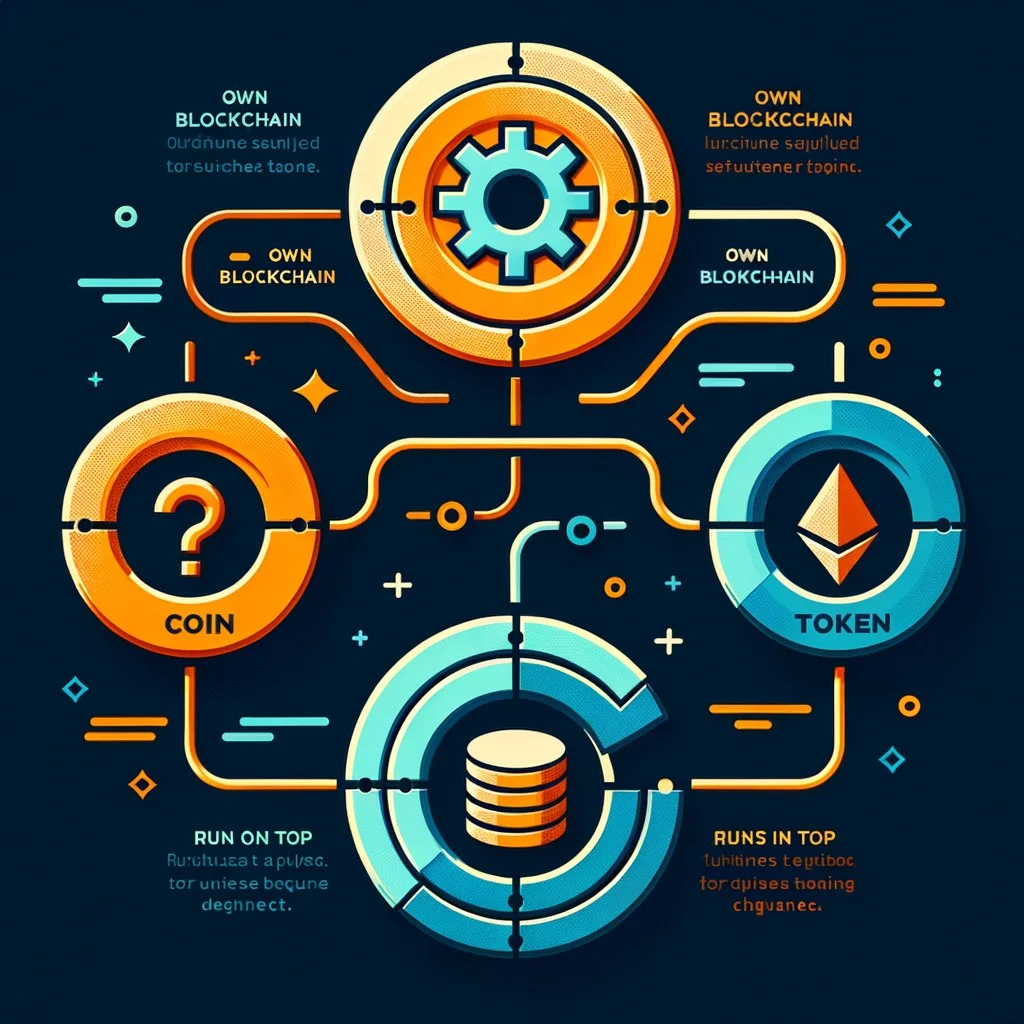
You do not need to memorize every coin or token. You just need a method for figuring it out when you encounter something new. The decision tree below is the same one I run through whenever a new asset crosses my screen.
In practice, the fastest check is Q2. If the asset has a contract address that looks like 0x... on Ethereum, or a similar program address on Solana, it is a token. Coins do not have contract addresses. BTC does not have a contract address. ETH does not have one either, despite being on Ethereum, because it is the chain's native coin, not a token deployed on the chain. The only exception is WETH, which is the ERC-20 token version of ETH and does have a contract address.
You can verify any asset by searching for it on a block explorer. On Ethereum, you would use Etherscan. On BNB Chain, BscScan. On Solana, Solscan. On Tron, Tronscan. If your search returns a "Contract" page with a verified ABI and a token tracker, you are looking at a token. If your search returns a "Block" or "Transaction" page with no contract attached, the asset is the native coin.
Why It Matters: Gas Fees, Smart Contract Risk, Custody
The coin versus token distinction is not academic. It has real consequences for how you trade, how you store assets, and how exposed you are to certain kinds of risk. Three areas matter most.
Gas fees. Tokens cannot pay for their own transaction fees. To move a token, you must hold the host chain's coin in the same wallet. If your wallet contains 10,000 USDT on Ethereum but zero ETH, you cannot send a single USDT. The transaction will not even broadcast. This is the single most common mistake new users make. The fix is always the same: top up a small amount of the host coin. For Ethereum that is ETH, for BNB Chain that is BNB, for Solana that is SOL, for Tron that is TRX. Our breakdown of gas fees walks through how to estimate the right buffer for each chain.
Smart contract risk. Coins are secured by the consensus of their network. Bitcoin has been hardened by sixteen years of attempted attacks against billions of dollars of value. ETH has a similar but shorter track record. Tokens, on the other hand, are only as safe as the smart contract that defines them. A token contract can have bugs, can have admin functions that mint unlimited supply, can have blacklist functions that freeze your balance. The token is not protected by the host chain, the host chain is just a substrate. This is why tokenomics and contract audits matter so much for any token you are not just trading short-term.
Custody and supply controls. Some token contracts include features that fundamentally change the custody guarantee. Centralized stablecoins like USDC and USDT can freeze any address by adding it to a blacklist inside the contract. This has happened in practice, notably to addresses sanctioned by OFAC. Coins cannot do this. There is no admin key on Bitcoin that can freeze your BTC. There is no central party on Ethereum that can confiscate your ETH. Once you understand that tokens often have admin functions and coins generally do not, you start to see why "not your keys, not your coins" has a more subtle second layer: even with your own keys, a token contract's admin can still affect your balance. Many serious projects use a token locker to credibly remove these controls, which is one of the markers responsible teams use to build trust.
Common Misconceptions
The coin vs token boundary gets blurred in everyday speech, in press articles, and even in some exchange interfaces. A few of the most common misunderstandings are worth clearing up explicitly.
"All altcoins are tokens." Wrong. "Altcoin" is just shorthand for any cryptocurrency that is not Bitcoin. Litecoin (LTC), Bitcoin Cash (BCH), Dogecoin (DOGE), Monero (XMR), Cardano (ADA), and Solana (SOL) are all altcoins, and they are all coins, not tokens. They each have their own blockchain. The word "altcoin" tells you nothing about whether something is a coin or a token, only that it is not BTC.
"Stablecoins are coins." Almost always wrong. Despite the name, the major stablecoins (USDT, USDC, DAI, FDUSD) are tokens, not coins. They are deployed as smart contracts on Ethereum, Tron, Solana, BNB Chain, and many other host chains. They take the word "coin" from their economic role (a stable unit of currency) but technically they are tokens. The only widely used stablecoin that was implemented as its own coin on its own chain was the original Diem/Libra project from Meta, which never launched in production.
"BNB is a token." This is sometimes true and sometimes false, depending on which chain you mean. BNB was originally launched in 2017 as an ERC-20 token on Ethereum. In 2019 it migrated to become the native coin of Binance Chain (later BNB Beacon Chain), and today it is also the native coin of BNB Smart Chain, where it pays gas fees. On its own chain BNB is a coin. The ERC-20 version that used to exist on Ethereum is no longer in active use. So when someone asks "is BNB a coin or a token?", the modern answer is: it is a coin on BNB Chain.
"Bitcoin Cash and Litecoin are Bitcoin tokens." No. BCH and LTC each forked from Bitcoin's codebase but run their own independent blockchains with their own miners, their own block times, and their own rules. They are coins on separate networks, not tokens issued on top of Bitcoin. Bitcoin's base layer does not natively support tokens at all (with niche exceptions like Ordinals and Runes inscriptions, which are a different topic).
"If it is on a centralized exchange, it must be a coin." No. Exchanges list both coins and tokens side by side. The fact that USDT is on Binance does not make it a coin. The fact that ETH is on Binance does not make it a token. Listing status has nothing to do with the technical category of an asset.
Why It Is Cheaper and Easier to Create a Token
The asymmetry between coins and tokens explains why ninety-nine percent of new crypto assets launched in any given year are tokens. Creating a coin means launching a blockchain. You need a consensus algorithm, a network of nodes, a peer-to-peer protocol, an incentive structure for validators or miners, a fee market, a wallet ecosystem, and very likely a security audit at the protocol layer. Even with modern frameworks like Cosmos SDK or Substrate, launching a meaningful new layer-1 chain is a months-long engineering effort plus an ongoing operational commitment to keep validators online.
Creating a token is a different category of project entirely. You write a contract that inherits from a well-known ERC-20 (or BEP-20, SPL, TRC-20) template, you tweak the supply, name, and symbol, you deploy it through a tool like Remix or Foundry, you pay the gas fee, and you are done. Many memecoin launchpads have reduced this to a literal one-click experience. The host chain provides everything: security, finality, wallet support, explorer integration, and a fee market. Your token piggybacks on all of it for free.
This is good and bad. Good, because it lowers the barrier for legitimate projects to experiment with new tokenomic designs without reinventing the wheel. Bad, because it lowers the barrier equally for scams, honeypots, and zero-effort copies. Anything you can do in five minutes will attract people who only want to spend five minutes. Understanding this asymmetry is half of any reasonable due diligence checklist on a new asset: ask yourself whether the team built only a token, or whether they actually built infrastructure underneath it. Our tokenomics deep dive shows how to read the supply schedule and unlock structure to separate serious projects from quick deployments.
Frequently Asked Questions
Is USDT a coin or a token?
USDT is a token, not a coin, regardless of which chain you hold it on. It exists as an ERC-20 token on Ethereum, a TRC-20 token on Tron, a BEP-20 token on BNB Chain, and an SPL token on Solana. Each version is a separate smart contract on the respective host chain. To send USDT you always need a small balance of the host chain's native coin (ETH, TRX, BNB, or SOL) to pay gas fees. The "coin" in stablecoin refers to its monetary role, not its technical implementation.
Is BNB a coin or a token?
BNB is a coin on BNB Chain (formerly Binance Smart Chain). It is the native asset that pays for gas fees and secures the network through staking. BNB started in 2017 as an ERC-20 token on Ethereum but migrated to its own chain in 2019. Today the canonical BNB is a coin, not a token. You can still find bridged versions of BNB as tokens on other chains, but the primary asset is a coin on BNB Chain.
Can a token become a coin?
Yes, this transition is called a mainnet swap or token migration. A project launches initially as a token on Ethereum or another host chain (often to bootstrap liquidity quickly), and later launches its own blockchain where the asset becomes the native coin. Holders of the original token swap it for the new coin at a fixed ratio. BNB, Tron's TRX, EOS, and many others started as ERC-20 tokens and transitioned to native coins on their own chains. The reverse is rare but possible, where a coin gets wrapped as a token on a different chain.
Which is better to invest in: coins or tokens?
Neither category is inherently better. Coins like BTC and ETH have stronger network-level security guarantees and no smart contract admin risk, but their issuance and use cases are fixed by protocol design. Tokens offer much more flexibility in design (governance, utility, stablecoins, NFTs) but carry smart contract risk and often admin keys that can affect holders. Most diversified portfolios contain both. A coin like BTC for store-of-value exposure, a coin like ETH for smart contract platform exposure, and tokens for specific protocol or sector exposure. Always evaluate each asset on its own merits, not on the coin-or-token label.
Why are tokens cheaper to create than coins?
Tokens reuse all the infrastructure of the host chain (security, consensus, wallets, explorers, fee market), so the only cost is writing and deploying a smart contract. Deploying an ERC-20 on Ethereum costs a few dollars to a few hundred dollars in gas. Deploying an SPL token on Solana costs a fraction of a cent. Creating a coin, by contrast, requires building and running an entire blockchain, which involves engineering work, validator coordination, security audits at the protocol layer, and ongoing operational costs. The cost asymmetry is roughly four to six orders of magnitude, which is why thousands of new tokens launch every day while only a handful of new coins emerge per year.
Are NFTs tokens or coins?
NFTs are tokens. Specifically, they are non-fungible tokens, usually implemented under the ERC-721 or ERC-1155 standards on Ethereum and analogous standards on other chains. Each NFT is a unique entry inside a smart contract, with its own token ID and metadata. NFTs cannot be coins because they are unique rather than interchangeable, which is the opposite of how a currency works. A coin must be fungible. One BTC is identical to any other BTC. One CryptoPunk is not identical to any other CryptoPunk.
Can I send a token without holding the host coin?
In the default case, no. To send any token you need a small balance of the host chain's coin to pay gas. There are some workarounds. Account abstraction wallets on Ethereum allow paymaster contracts to sponsor gas fees in tokens. Some exchanges offer "gasless" withdrawals where they cover the fee internally. On Tron, certain stablecoin transfers have been subsidized at the network level at various points. But assume by default that holding a token without any host coin will leave your funds stuck until you fund the wallet with the appropriate gas asset.
Is Ripple (XRP) a coin or a token?
XRP is the native coin of the XRP Ledger, a standalone blockchain operated through a consensus protocol distinct from proof-of-work or proof-of-stake. It pays for transaction fees on the XRP Ledger and is used to bridge currencies in payment use cases. XRP is a coin, not a token.
What is the difference between a token and an altcoin?
"Altcoin" is a market category meaning any cryptocurrency that is not Bitcoin. It includes both coins (like ETH, SOL, ADA) and tokens (like UNI, LINK, SHIB). "Token" is a technical category meaning a digital asset that lives inside a smart contract on a host blockchain. The two terms overlap but are not interchangeable. ETH is an altcoin and a coin. SHIB is an altcoin and a token. BTC is neither an altcoin nor a token, it is the original coin.
Conclusion
The coin vs token distinction is one of those small definitions that quietly shapes a huge part of how you operate in crypto. A coin is the native currency of a blockchain, baked into the protocol, secured by miners or validators, and used to pay for the network's own resources. A token is an asset created through a smart contract on top of a host chain, governed by code that anyone can read, and dependent on the host chain for security and fee settlement. Coins are kitchens, tokens are dishes.
Once that mental model clicks, a lot of other questions become trivial. Why does a wallet full of USDT need ETH to move funds? Because USDT is a token and ETH is the host coin. Why can a token be frozen by the issuer but a coin cannot? Because the token contract has admin functions and the coin has no equivalent layer. Why does the same brand of asset exist as four different versions on four different chains? Because each chain hosts its own separate contract. Why are there millions of tokens but only a few hundred meaningful coins? Because launching a token takes five minutes and launching a coin takes months.
Use the decision tree in this guide whenever you encounter a new asset. Check the explorer, look for a contract address, see what pays for its gas, and ask whether it has its own chain or is just renting space on someone else's. That five-second check will save you from wrong-network transfers, stuck withdrawals, and a long list of preventable mistakes. The distinction is small in words, but it is the foundation that everything else in crypto, from tokenomics to gas fees to stablecoins, is built on top of.