How to Use GMX: Perpetual Trading on Arbitrum (2026)
— By Tony Rabbit in Tutorials

Learn how to trade perpetuals on GMX on Arbitrum. A step-by-step tutorial covering leverage, fees, GLP and how to open and manage positions safely.
How to Use GMX for Perpetual Trading on Arbitrum - Complete Tutorial 2026
Learning how to use GMX for perpetual trading on Arbitrum gives you access to one of the most innovative decentralized derivatives platforms in crypto. GMX pioneered the oracle-based perpetual exchange model, offering zero price impact trades, up to 100x leverage, and real yield for liquidity providers - all on the fast and affordable Arbitrum network. This comprehensive GMX perpetual trading tutorial walks you through setup, trading strategies, and earning passive income through GMX's unique liquidity model in 2026.
What Is GMX and Why It Stands Out for Perpetual Trading
GMX is a decentralized perpetual exchange that takes a fundamentally different approach compared to orderbook-based platforms like dYdX. Instead of matching buyers and sellers, GMX uses a shared liquidity pool model where traders trade against a pool of assets called GLP (on v1) or GM pools (on v2). Prices are determined by Chainlink oracles rather than by orderbook dynamics, which means your trades have zero price impact regardless of size.
This oracle-based model offers several unique advantages. Large traders can execute million-dollar positions without moving the market. There is no slippage on entry or exit. And the spread is tight and predictable because it is set by the protocol rather than by market maker behavior. For traders who need reliable execution on large positions, GMX on Arbitrum is often the preferred venue.
GMX launched on Arbitrum in September 2021 and has since expanded to Avalanche. The protocol has generated over $250 million in fees for liquidity providers and stakers, making it one of the highest revenue-generating protocols in all of DeFi. This "real yield" model - where fees come from actual trading activity rather than token emissions - has made GMX a cornerstone of the Arbitrum DeFi ecosystem.
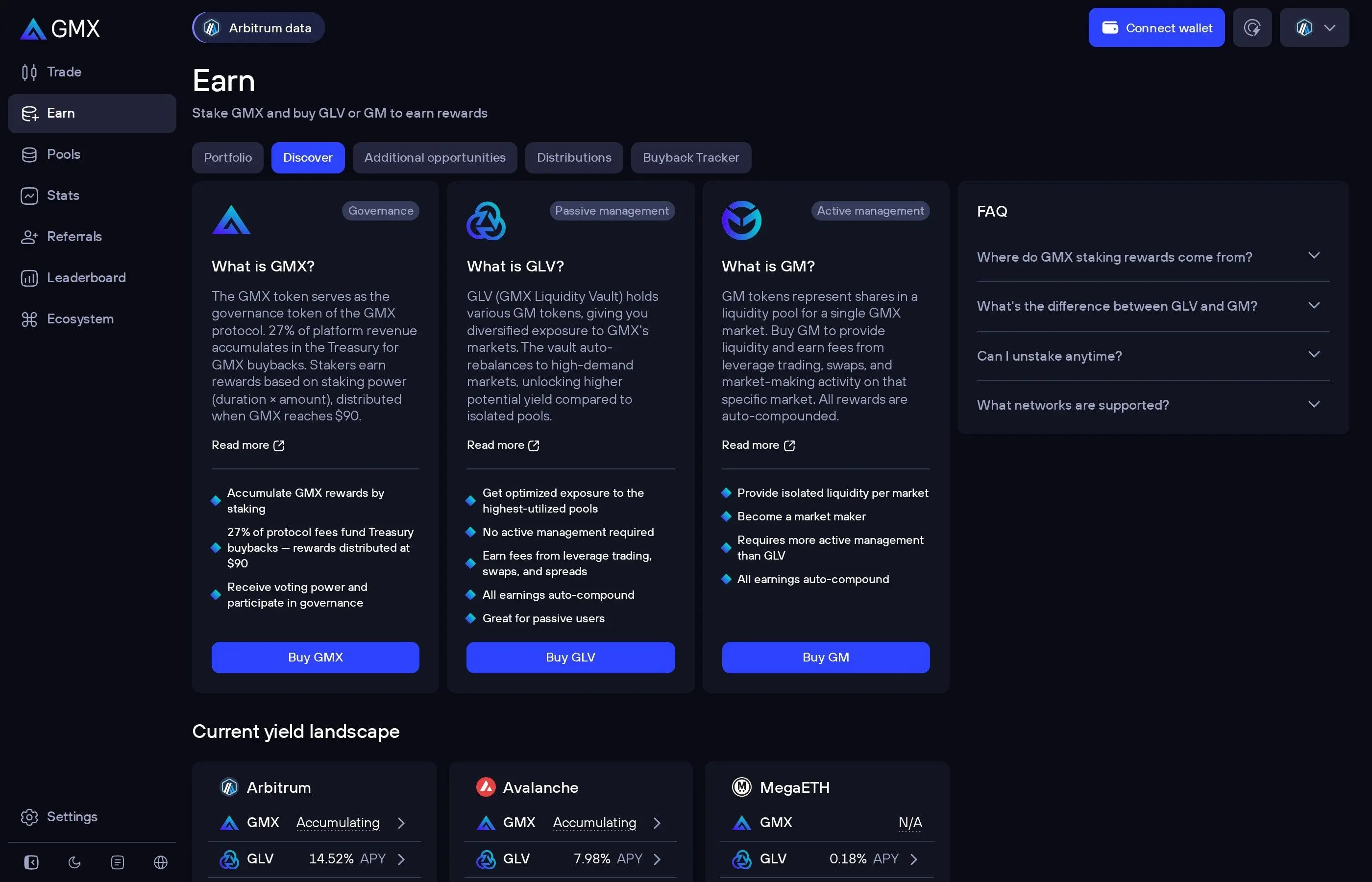
GMX v2 introduced isolated GM liquidity pools for each trading pair, replacing the shared GLP model. This gives liquidity providers more control over their risk exposure and enables the protocol to list more trading pairs. GMX v2 supports over 30 trading pairs including majors, altcoins, and even forex pairs.
How GMX Perpetual Trading Works - The Oracle Model
Understanding GMX's unique architecture helps you appreciate both its advantages and limitations. When you open a position on GMX, you are not trading against another person - you are trading against the liquidity pool. The pool acts as the counterparty to every trade, taking the opposite side of your position.
Prices on GMX are sourced from Chainlink decentralized oracles combined with fast price feeds from major centralized exchanges. This dual-oracle system provides accurate, manipulation-resistant pricing. When you submit a market order, the transaction is executed at the oracle price after a short delay (about 1-2 seconds), preventing front-running and MEV exploitation.
The zero price impact feature means that whether you are opening a $1,000 position or a $1,000,000 position, you get the same entry price. This is impossible on orderbook exchanges where large orders move the market. However, GMX does charge a spread that varies based on the open interest balance between longs and shorts - when there are significantly more longs than shorts, the spread for new longs increases to balance the pool's exposure.
Funding rates on GMX work similarly to other perpetual exchanges. The dominant side (longs or shorts) pays the minority side, with rates updating hourly. The borrow fee is an additional cost charged to all open positions based on the utilization rate of the pool's assets.
Step-by-Step Guide to Trading Perpetuals on GMX
Getting started with GMX perpetual trading on Arbitrum is straightforward. Follow these steps to place your first leveraged trade.
Step 1 - Bridge Assets to Arbitrum
Before using GMX, you need funds on Arbitrum. If your assets are on Ethereum mainnet, use the official Arbitrum Bridge at bridge.arbitrum.io or a faster bridge like Synapse or Stargate. You will need ETH on Arbitrum for gas fees (typically under $0.10 per transaction) and USDC, ETH, or other supported tokens for trading collateral.
Step 2 - Connect to the GMX Interface
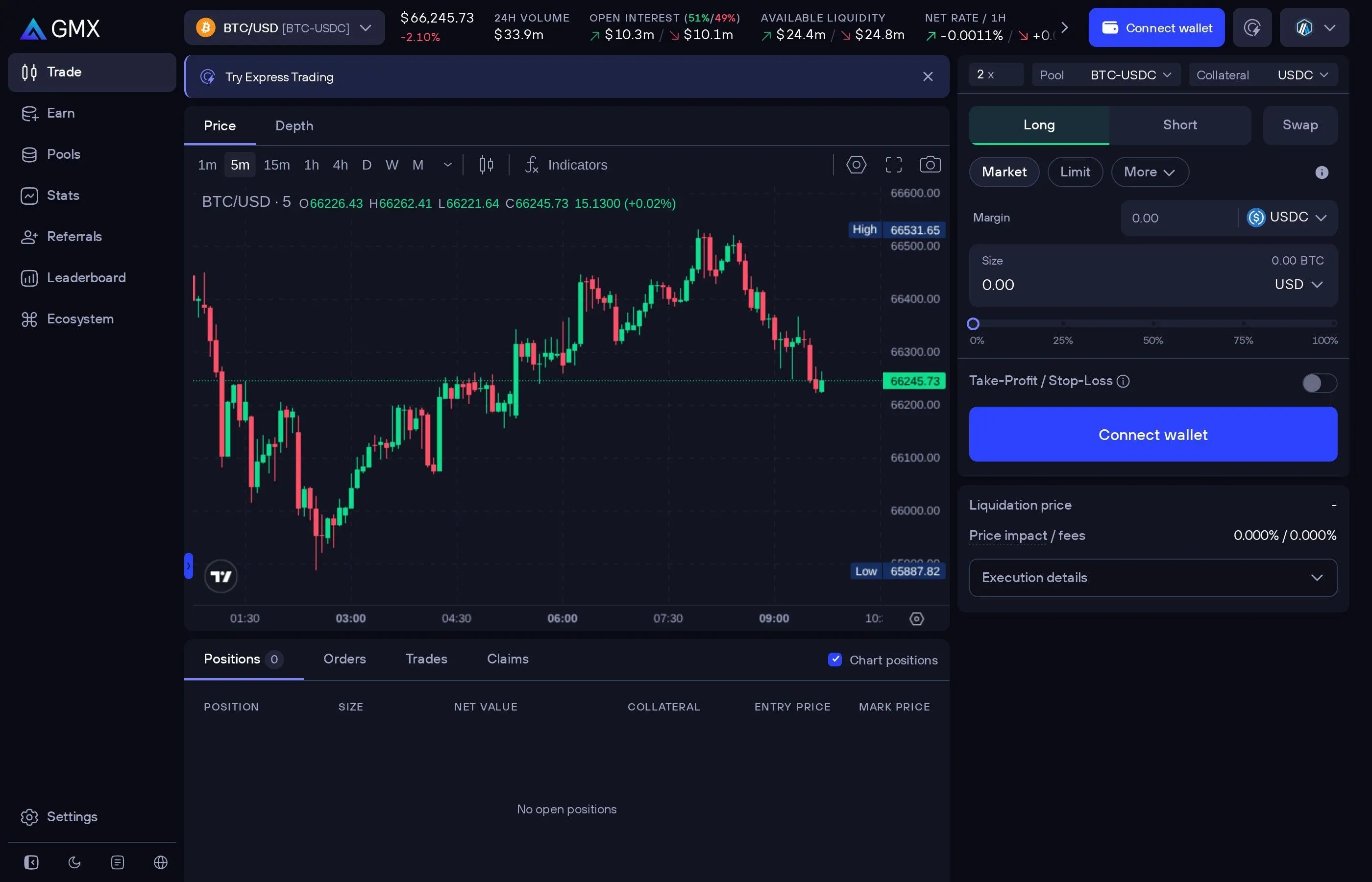
Navigate to app.gmx.io and click "Connect Wallet." Select your wallet provider and ensure you are connected to the Arbitrum network. The interface will display your wallet balance and the available trading pairs.
Step 3 - Choose Your Trading Pair and Direction
Select your desired trading pair from the market selector on the left side. Popular options include ETH/USD, BTC/USD, SOL/USD, ARB/USD, and LINK/USD. Click "Long" if you expect the price to rise or "Short" if you expect it to fall.
Step 4 - Set Your Collateral and Leverage
Choose your collateral token - for longs, you can use the asset itself (like ETH for an ETH/USD long) or USDC. For shorts, you typically use USDC or USDT as collateral. Set your leverage using the slider, from 1.1x up to 100x. The interface will show your position size, liquidation price, and fees before you confirm.
Step 5 - Review and Execute Your Trade
Review all details carefully - entry price, liquidation price, fees, and position size. Click "Confirm Long" or "Confirm Short" and approve the transaction in your wallet. The trade will execute within 1-2 seconds after the oracle price is confirmed. Your open position will appear in the positions panel at the bottom of the screen.
Step 6 - Manage Your Position
Once your position is open, you can add or remove collateral, increase position size, set stop-loss and take-profit orders, or close partially. Click on your open position to access these management options. Always monitor your liquidation price and maintain a safe margin buffer.
Pro Tip
Use ETH as collateral for ETH longs instead of USDC. This way, if ETH rises, both your position profit and your collateral value increase. Conversely, for shorts, always use stablecoins as collateral to avoid your collateral losing value at the same time as your position.
Core Features of GMX on Arbitrum
Zero Price Impact Trades
GMX's flagship feature is zero price impact execution. Because trades are settled at oracle prices rather than through an orderbook, your order size does not affect the execution price. A $100 trade and a $5,000,000 trade receive the same price. This makes GMX particularly attractive for institutional traders and whales who need reliable execution without market impact.
GM Pools - Earn Real Yield as a Liquidity Provider
GMX v2's GM pools allow you to provide liquidity and earn fees from trading activity. Each GM pool consists of a long token (like ETH), a short token (like USDC), and an index token. When traders lose, the pool profits. When traders win, the pool pays out. Historically, GMX traders have been net losers, resulting in consistent positive returns for liquidity providers averaging 15-30% APR.
Limit Orders and Advanced Order Types
GMX supports market orders, limit orders, stop-loss orders, and take-profit orders. Limit orders execute at your specified price or better when the oracle price reaches your target. Stop-loss and take-profit orders protect your positions automatically. All order types benefit from the same zero-impact execution model.
Multi-Collateral Support
Unlike some perpetual exchanges that only accept USDC collateral, GMX allows you to use various tokens as margin. For long positions, you can collateralize with ETH, BTC, or other supported tokens. This eliminates the need to sell your holdings before trading and creates natural delta exposure on your collateral.
Advanced GMX Trading Strategies for Arbitrum
Delta-Neutral GM Pool Farming
To earn GM pool yields without directional exposure, deposit into a GM pool and simultaneously short the long token on GMX or another exchange. This hedges your exposure to price movements while collecting trading fees and incentive rewards. The net yield after hedging costs can still be 10-20% APR depending on market conditions.
Funding Rate Harvesting
When the funding rate heavily favors one side, you can take the opposite position to collect funding payments. For example, during extreme bullish sentiment, shorts receive funding from longs. Combined with a spot hedge, this becomes a profitable delta-neutral strategy. Monitor the open interest imbalance to identify the best opportunities.
Swing Trading with Zero Impact
GMX's zero price impact is ideal for swing traders who need to enter and exit large positions cleanly. Build a thesis using technical or fundamental analysis, then execute your entire position at the oracle price without worrying about slippage. This is particularly valuable for altcoin perpetuals where orderbook depth on other platforms may be thin.
For Traders
Leverage the zero price impact for large position entries. Use ETH collateral for longs to double your exposure. Start with low leverage (3-5x) and scale up as you understand borrow rates and liquidation mechanics.
For Yield Seekers
Provide liquidity to GM pools for 15-30% APR real yield. Stake GMX tokens for esGMX rewards plus fee sharing. Consider delta-neutral strategies to earn pool yields without directional risk.
GMX Fee Structure and Trading Costs on Arbitrum
GMX's fee structure is slightly higher than orderbook-based exchanges for the open/close fee, but the zero price impact can offset this for larger trades. The borrow fee is an ongoing cost for holding positions and increases when pool utilization is high. Gas fees on Arbitrum are negligible - typically under $0.10 per transaction, making it economical for frequent traders.
GMX vs dYdX vs Hyperliquid - Perpetual Trading Comparison
Security Considerations for GMX on Arbitrum
GMX has maintained an excellent security track record since its launch. The protocol's smart contracts have been audited by ABDK Consulting, Guardian Audits, and other reputable firms. The v2 contracts underwent extensive auditing before deployment and have been operating securely since launch.
Oracle risk is the primary concern specific to GMX's model. Because trades execute at oracle prices, any manipulation or failure of the Chainlink oracle system could result in incorrect prices. GMX mitigates this with a median price approach using multiple oracle sources and price deviation checks that pause trading if prices diverge significantly from expected ranges.
Counterparty risk exists for GM pool providers. If traders collectively have a winning period, the pool loses money. While historically traders have been net losers on GMX, extended winning periods can reduce pool value. Liquidity providers should monitor their pool performance regularly and understand that they are essentially acting as the house in a casino analogy.
Warning
GMX offers up to 100x leverage, which means a 1% adverse price move can liquidate your entire position. High leverage should only be used by experienced traders with strict risk management protocols. Most professional traders on GMX use 3-10x leverage for the majority of their positions.
Common Mistakes to Avoid on GMX
1. Using maximum leverage. 100x leverage is available but almost never appropriate. Even a tiny price wick can liquidate a 100x position. Most successful GMX traders use 3-10x leverage consistently.
2. Ignoring borrow fees on long holds. Borrow fees accumulate hourly. For swing trades held for days or weeks, these fees can significantly eat into your profits. Calculate your expected borrow cost before entering a position and factor it into your risk-reward ratio.
3. Not understanding oracle execution. GMX orders execute at the oracle price after a 1-2 second delay, not at the price you see when you click. In volatile markets, this can result in slightly different execution than expected. Use limit orders for precise entry points.
4. Providing liquidity without understanding directionality. GM pools give you exposure to the underlying assets. If ETH drops 50%, your ETH/USDC GM position will lose value from the ETH component even if trading fees are positive. Understand your directional exposure before providing liquidity.
5. Not bridging enough ETH for gas. While Arbitrum gas is cheap, you still need ETH to pay for it. Running out of ETH for gas while needing to close a leveraged position is a stressful situation. Keep at least $5-10 worth of ETH on Arbitrum at all times.
6. Forgetting about the spread adjustment. When open interest is imbalanced, GMX adjusts the spread for new positions. Opening a long when there are already many more longs than shorts will cost more in spread. Check the current open interest balance before trading.
Frequently Asked Questions About GMX Perpetual Trading
What makes GMX different from other perpetual DEXs?
GMX uses an oracle-based pricing model instead of an orderbook. This provides zero price impact trades, meaning your order size does not affect the execution price. This is fundamentally different from dYdX or Hyperliquid where large orders can create slippage. GMX also shares real trading fees with liquidity providers and token stakers.
How much can I earn providing liquidity on GMX?
GM pool liquidity providers on GMX have historically earned 15-30% APR from trading fees, borrowing fees, and incentive rewards. Returns vary based on trading volume, market conditions, and whether traders are net profitable or unprofitable. Higher volume periods generally produce higher yields for LPs.
Do I need ETH to use GMX on Arbitrum?
Yes, you need a small amount of ETH on Arbitrum for gas fees. However, gas costs on Arbitrum are very low - typically under $0.10 per transaction. Having $5-10 worth of ETH is sufficient for dozens of trades.
Is 100x leverage on GMX safe?
At 100x leverage, a 1% adverse price move will liquidate your position. This is extremely risky and not recommended for most traders. Professional traders typically use 3-10x leverage. The 100x option exists for very specific, short-term scalping strategies with tight stop-losses.
Can I use GMX without KYC?
Yes. GMX is fully decentralized and does not require any KYC or identity verification. You only need a compatible Ethereum wallet connected to the Arbitrum network to start trading.
What is the difference between GMX v1 and v2?
GMX v1 uses a shared liquidity pool (GLP) that contains multiple assets. GMX v2 introduced isolated GM pools for each trading pair, giving liquidity providers more control over their exposure. V2 also added more trading pairs, improved fee structures, and better risk management. Most new activity is on v2.
How do oracle prices work on GMX?
GMX uses Chainlink decentralized oracles combined with fast price feeds from major exchanges. When you submit an order, it executes at the oracle price after a 1-2 second delay. This prevents front-running and ensures fair pricing for all traders regardless of order size.
Related Tutorials and Next Steps
Expand your DeFi trading knowledge with these complementary guides that work well alongside your GMX trading strategy.