How to Use Curve Finance: Stablecoin Swaps, Pools and Slippage Guide (2026)
— By Tony Rabbit in Tutorials
Learn how to use Curve Finance for stablecoin swaps, pool selection, routing checks, and low-slippage execution, plus the main LP and smart contract risks.
Intent check: This page is the practical Curve tutorial for swaps, pools, and execution. If you want the underlying explanation of Curve as a stable-asset AMM and how CRV and veCRV fit in, read What Is Curve Finance?.
How to Use Curve Finance for Stablecoin Swaps - Complete Tutorial 2026
Learning how to use Curve Finance for stablecoin swaps is essential for any DeFi user who values capital efficiency in 2026. Curve Finance is the undisputed king of stablecoin trading - its specialized AMM design offers minimal slippage and the lowest fees available for swapping between pegged assets like USDC, USDT, DAI, and FRAX. This comprehensive Curve Finance stablecoin swap tutorial covers everything from basic swaps to advanced liquidity provision strategies, helping you save money and earn yield on the most important DEX in decentralized finance.
What Is Curve Finance and Why It Dominates Stablecoin Swaps
Curve Finance is a decentralized exchange specifically optimized for trading assets that should have similar values - stablecoins pegged to the dollar, wrapped versions of the same asset (like ETH and stETH), or synthetic tokens tracking the same underlying. While general-purpose DEXs like Uniswap use a constant product formula (x*y=k), Curve uses a specialized StableSwap invariant that concentrates liquidity around the peg price, dramatically reducing slippage for like-asset trades.
To understand why this matters, consider swapping $100,000 of USDC to USDT. On Uniswap, you might receive $99,700 due to price impact. On Curve, you would receive approximately $99,960. That $260 difference adds up enormously for traders, protocols, and DAOs that regularly move large stablecoin amounts. This efficiency is why Curve handles the majority of on-chain stablecoin volume.
Founded by Michael Egorov in 2020, Curve has grown into one of DeFi's most critical infrastructure protocols. Its liquidity pools underpin everything from liquid staking tokens to algorithmic stablecoins. The protocol's veCRV governance model - where users lock CRV tokens for voting power - has spawned an entire ecosystem of protocols competing for influence over Curve's reward emissions, known as the "Curve Wars."
Curve's StableSwap algorithm is the gold standard for pegged-asset trading. The bonding curve stays nearly flat around the 1:1 ratio, meaning you can swap millions of dollars with minimal price impact. This is why major protocols like Lido, Frax, and MakerDAO all maintain deep Curve pools for their tokens.
How Curve Finance StableSwap Technology Works
Curve's technical innovation lies in its bonding curve mathematics. Traditional AMMs spread liquidity across the entire price range from zero to infinity. For assets that should trade at the same price, this is wildly inefficient - most of the liquidity sits at prices that never get used.
Curve's StableSwap invariant is a blend of the constant product formula (like Uniswap) and the constant sum formula (which would be x+y=k). By tuning the amplification parameter (known as "A"), the curve concentrates liquidity tightly around the 1:1 price ratio while still allowing the market to clear at extreme prices if assets depeg. A higher amplification parameter means tighter concentration around the peg, while a lower value makes the curve behave more like Uniswap.
For non-pegged asset pairs, Curve introduced the CryptoSwap algorithm (used in Curve v2 pools). These pools handle volatile assets like ETH/USDT or BTC/ETH by dynamically re-pegging liquidity around the current market price. This allows Curve to compete with Uniswap even for volatile pair trading, though the protocol's core strength remains pegged assets.
Step-by-Step Guide to Swapping Stablecoins on Curve Finance
Making your first stablecoin swap on Curve Finance takes just a few clicks. Follow these steps for the most efficient stablecoin trading experience in DeFi.
Step 1 - Access the Curve Finance Interface
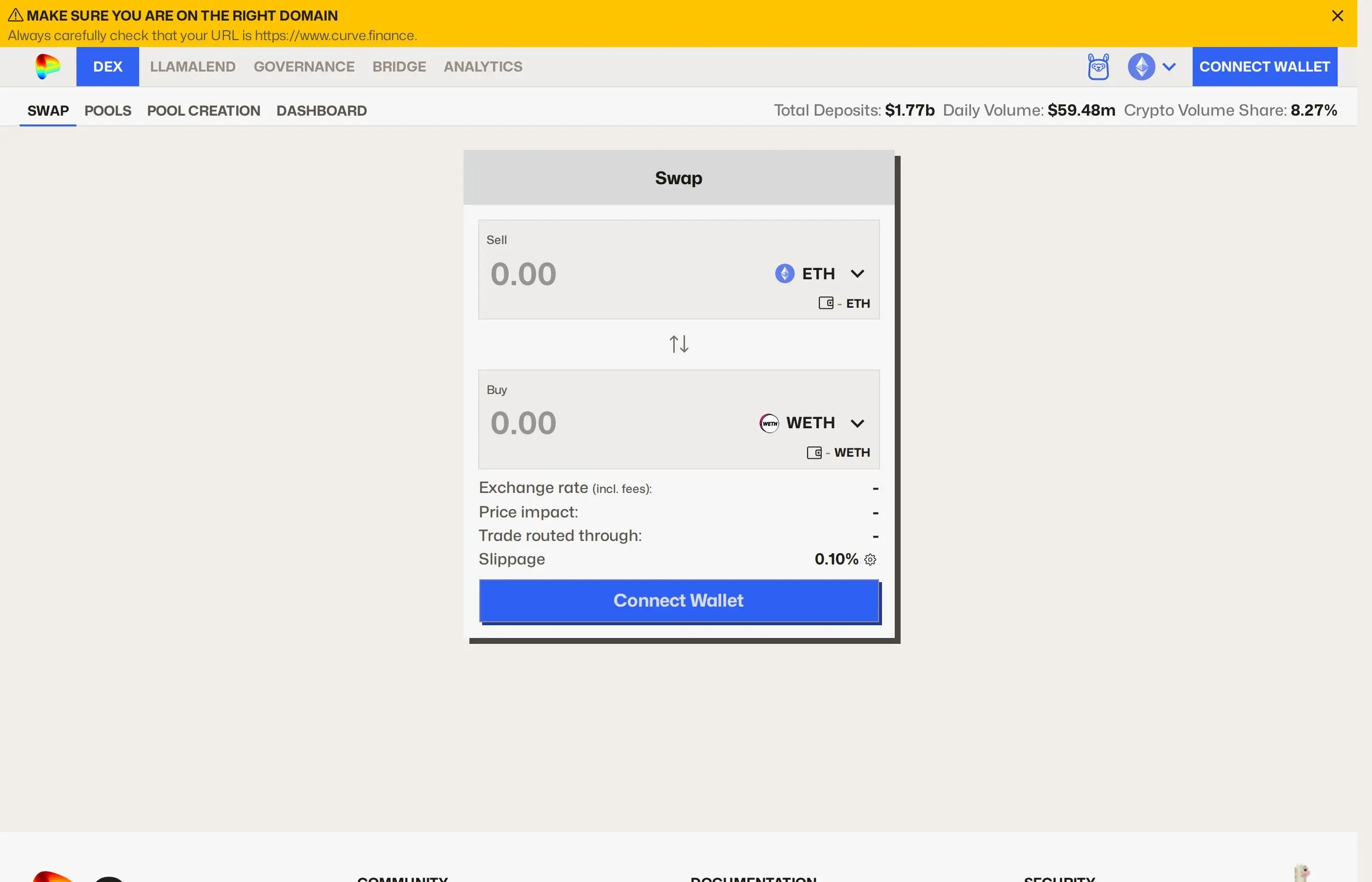
Navigate to curve.fi in your browser. The Curve interface has been redesigned multiple times and now features a much cleaner layout compared to the original. Click "Connect Wallet" in the top right corner and select your wallet - MetaMask, WalletConnect, Coinbase Wallet, and Rabby are all supported.
Step 2 - Select Your Network
Curve operates on Ethereum mainnet, Arbitrum, Optimism, Polygon, Avalanche, Base, and many other chains. Select your preferred network from the dropdown. For the cheapest stablecoin swaps, Layer 2 networks like Arbitrum or Base offer the same pool depth as mainnet with gas fees under $0.10.
Step 3 - Navigate to the Swap Interface
Click the "Swap" tab in the main navigation. The swap interface shows input and output token selectors, an amount field, and routing information. Select your input stablecoin (for example USDC) and your desired output stablecoin (for example USDT).
Step 4 - Enter Your Swap Amount and Review Details
Type the amount you want to swap. Curve will display the expected output, the exchange rate, the price impact, and the fee. For typical stablecoin swaps, the exchange rate should be very close to 1:1 and price impact should be near 0% for amounts under $1 million. Review these numbers before proceeding.
Step 5 - Approve and Execute the Swap
If this is your first time swapping a particular token, you will need to approve Curve's contract to spend your tokens. Click "Approve" and confirm in your wallet. Then click "Swap" and confirm the transaction. On Layer 2 networks, the swap typically completes within seconds.
Step 6 - Verify Your New Balance
Check your wallet to confirm the output tokens have arrived. The swap is atomic - both sides of the trade settle in a single transaction, so there is no risk of partial fills or failed deliveries.
Pro Tip
For large stablecoin swaps (over $100K), always compare the Curve direct swap with the Curve meta-pool route and aggregator options on 1inch or Paraswap. Sometimes routing through multiple pools yields a better rate than a single direct swap, especially for less common stablecoin pairs.
Core Features of Curve Finance for Stablecoin Users
Efficient Stablecoin Pools
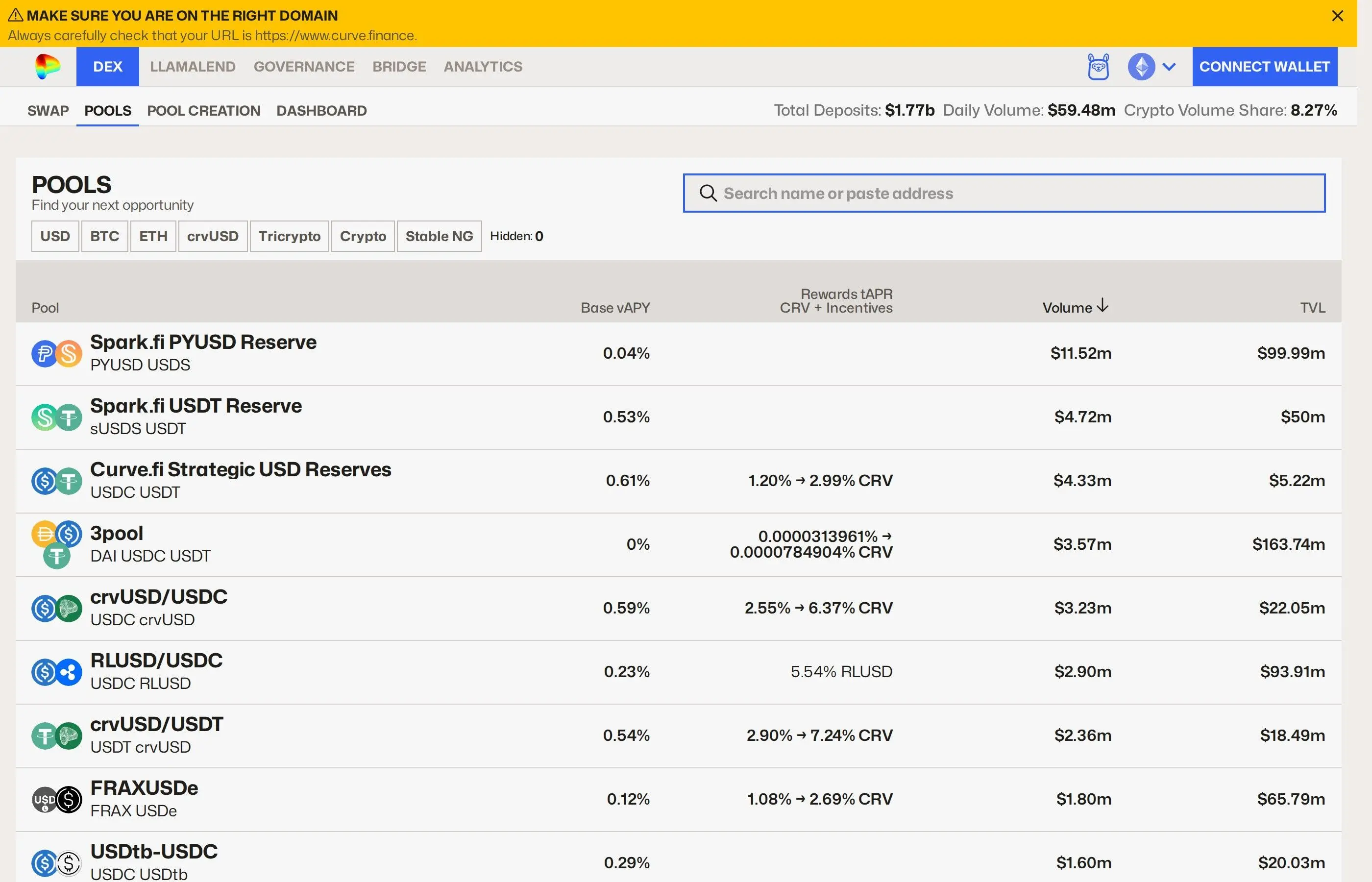
Curve's primary pools for stablecoin swaps include the 3pool (USDC/USDT/DAI), various metapools for newer stablecoins like FRAX and crvUSD, and specialized pools for non-USD stablecoins. The 3pool is the deepest stablecoin liquidity pool in all of DeFi, enabling massive trades with minimal slippage. Each pool is optimized with specific amplification parameters tuned for its particular assets.
crvUSD - Curve's Native Stablecoin
Curve launched its own stablecoin, crvUSD, which uses a novel soft-liquidation mechanism called LLAMMA (Lending-Liquidating AMM Algorithm). Unlike traditional CDP stablecoins where liquidation is sudden and complete, crvUSD gradually converts your collateral to crvUSD as prices decline and converts back as prices recover. This creates a smoother experience for borrowers and is available with ETH, wBTC, wstETH, and other collateral types.
Cross-Chain Stablecoin Routing
Curve pools exist across 14+ EVM chains, giving you options for finding the best rates and lowest gas costs. The protocol's consistent interface across chains means you can use the same workflow on Ethereum, Arbitrum, Optimism, or Polygon. Some aggregators also route through Curve pools on different chains to find optimal pricing.
Gauge Rewards and CRV Incentives
Liquidity providers in Curve pools earn trading fees plus CRV token rewards distributed through the gauge system. The amount of CRV rewards each pool receives is determined by weekly governance votes from veCRV holders. This mechanism drives the "Curve Wars" where protocols compete to direct rewards toward their pools, creating additional incentives for liquidity providers.
Advanced Strategies for Curve Finance Power Users
Beyond simple swaps, Curve offers sophisticated strategies for maximizing your returns in the stablecoin ecosystem.
Liquidity Provision for Passive Yield
Depositing stablecoins into Curve pools earns you a share of trading fees. The base APR from fees alone typically ranges from 0.5-3% depending on the pool and trading volume. On top of this, many pools receive CRV gauge rewards that can boost total yields to 5-15% APR. To provide liquidity, navigate to the Pools section, select your target pool, click "Deposit," and choose to add one or multiple tokens. Curve allows single-sided deposits, meaning you can add only USDC to a multi-token pool.
veCRV Locking for Boosted Rewards
Locking CRV tokens as veCRV (vote-escrowed CRV) provides three benefits - boosted liquidity mining rewards (up to 2.5x), voting power to direct CRV emissions to specific pools, and a share of protocol trading fees. The longer you lock, the more veCRV you receive, with the maximum lock period being 4 years. Active DeFi participants often lock CRV through protocols like Convex Finance or Yearn, which aggregate veCRV power for better rewards.
Stablecoin Arbitrage Between Pools
When a stablecoin temporarily depegs slightly in one Curve pool but maintains its peg in another, there is an arbitrage opportunity. For example, if crvUSD is trading at $0.998 in one pool and $1.001 in another, buying in the first and selling in the second captures the spread. These opportunities are highly competitive and often captured by MEV bots, but manual arbitrage can still work during volatile market conditions.
Swap Users
Use Curve whenever you need to exchange stablecoins. Even small savings of 0.1-0.3% per swap add up over time. Compare rates across pools and chains for the best deal. Layer 2 deployments offer the same efficiency with near-zero gas costs.
Yield Farmers
Provide liquidity to earn trading fees plus CRV rewards. Lock CRV as veCRV for boosted yields. Consider using Convex or Yearn for automatic CRV harvesting and compounding. Focus on pools with stable gauge weights for consistent returns.
Curve Finance Fee Structure for Stablecoin Swaps
Curve's fee structure is one of the most competitive in DeFi, which is a primary reason for its dominance in stablecoin trading.
StableSwap pools typically charge 0.01-0.04% per swap - substantially less than Uniswap's 0.05-0.3%. Half of this fee goes to liquidity providers and half to the Curve DAO (distributed to veCRV holders). Deposit and withdrawal fees are zero for balanced operations, with a small fee applied when single-sided deposits or withdrawals create pool imbalance. Gas costs vary by chain - Ethereum mainnet can cost $5-20 per swap, while Layer 2 networks typically cost under $0.10.
Curve Finance vs Uniswap vs 1inch - DEX Comparison for Stablecoins
Security Considerations When Using Curve Finance
Curve Finance has a long track record in DeFi, but understanding its security profile is important for making informed decisions.
In July 2023, Curve experienced a significant exploit when a vulnerability in the Vyper compiler affected several pools, resulting in approximately $70 million in losses. The protocol recovered, the affected pools were redeployed with patched contracts, and additional audits were conducted. This event highlights that even the most established protocols carry smart contract risk.
Pool-specific risks exist beyond protocol-level security. When you provide liquidity to a pool containing a particular stablecoin, you take on the risk of that stablecoin depegging. If you are in a pool with USDC, USDT, and DAI, and one of those stablecoins loses its peg, you will end up holding more of the depegged token due to how AMMs work. This is a form of impermanent loss specific to stablecoin pools.
Governance security is another consideration. The veCRV system concentrates significant power in the hands of large CRV holders. Convex Finance alone controls over 40% of all veCRV, which gives it enormous influence over which pools receive rewards. While this has not led to malicious outcomes, it represents a centralization risk in the governance layer.
Warning
When providing liquidity to Curve pools, you are exposed to the risk of any individual token in the pool losing its peg. Diversify across pools with different stablecoin compositions to mitigate this risk. Avoid pools containing experimental or unproven stablecoins unless you understand and accept the additional risk.
Common Mistakes to Avoid on Curve Finance
Even experienced DeFi users make errors on Curve. Avoid these pitfalls to protect your capital and maximize efficiency.
1. Swapping on Ethereum mainnet for small amounts. Gas fees on Ethereum can be $5-20 per swap. For amounts under $5,000, use Curve on Arbitrum, Base, or Optimism where gas costs are under $0.10. The pools have sufficient depth for most traders.
2. Ignoring pool composition risk. Not all stablecoins are created equal. A pool might offer higher yields precisely because it contains a riskier stablecoin. Research every token in a pool before providing liquidity. Check depeg history, backing mechanisms, and issuer reputation.
3. Not understanding imbalanced deposits. When you deposit a single token into a multi-token pool, Curve internally swaps to balance. This creates a small swap fee cost. For large deposits, providing tokens in proportion to the pool's current ratios minimizes this cost.
4. Forgetting to claim rewards. CRV rewards do not auto-compound. You need to periodically claim your CRV tokens from the Curve interface or use a yield optimizer like Convex or Yearn that auto-harvests and compounds for you.
5. Chasing the highest APR without research. Pools with extremely high APRs (30%+) often contain risky or new tokens. The high yield is compensation for risk. Stick to established pools with proven assets unless you have done thorough due diligence on the experimental tokens.
6. Not comparing aggregator routes. For some swap pairs, routing through 1inch or Paraswap might give you a better rate than direct Curve usage, because the aggregator can split your trade across multiple pools. Always compare before executing large swaps.
Frequently Asked Questions About Curve Finance Stablecoin Swaps
Why is Curve Finance better than Uniswap for stablecoin swaps?
Curve uses a specialized StableSwap algorithm that concentrates liquidity around the 1:1 price ratio for pegged assets. This results in dramatically lower slippage compared to Uniswap's general-purpose constant product formula. For a $100,000 stablecoin swap, you might save $50-300 using Curve instead of Uniswap.
What stablecoins can I swap on Curve Finance?
Curve supports virtually every major stablecoin including USDC, USDT, DAI, FRAX, crvUSD, LUSD, TUSD, sUSD, and many more. It also supports pegged asset pairs like stETH/ETH, wBTC/renBTC, and various liquid staking tokens. The full list varies by chain.
What is the cheapest chain to use Curve Finance?
Arbitrum, Base, and Optimism offer the lowest gas costs for Curve swaps - typically under $0.10 per transaction. Polygon is also inexpensive. Ethereum mainnet is the most expensive but has the deepest liquidity for very large trades.
Can I earn yield by providing liquidity on Curve?
Yes. Liquidity providers earn trading fees (0.01-0.04% per swap, split with the DAO) plus CRV token rewards on gauge-eligible pools. Total yields for stablecoin pools typically range from 3-15% APR depending on the pool, gauge weight, and whether you use veCRV boost.
What is veCRV and why does it matter?
veCRV (vote-escrowed CRV) is obtained by locking CRV tokens for up to 4 years. It grants three benefits: boosted CRV rewards on your liquidity positions (up to 2.5x), voting power to direct CRV emissions to specific pools, and a share of protocol trading fees. The veCRV system is central to Curve's governance and incentive structure.
Is Curve Finance safe after the 2023 exploit?
The 2023 exploit was caused by a vulnerability in the Vyper compiler, not in Curve's design logic. Affected pools were redeployed with patched contracts. Curve has since undergone additional audits and security reviews. The protocol remains one of the most used in DeFi, but all smart contract interactions carry inherent risk.
What is crvUSD and how does it work?
crvUSD is Curve's native stablecoin. It uses a novel soft-liquidation mechanism called LLAMMA that gradually converts your collateral as prices drop, rather than executing a sudden full liquidation. This creates a smoother borrowing experience. You can mint crvUSD using ETH, wBTC, wstETH, and other approved collateral types.
Do I need to provide both tokens when adding liquidity?
No. Curve supports
Related Guides
- How to Use Raydium on Solana: Swaps, Liquidity Pools and CLMM Guide (2026)
- What Is Curve Finance? Stablecoin AMM, veCRV and CRV Token Explained (2026)
- Liquidity Pool Economics: Fees, Slippage and Impermanent Loss
- How to Use STON.fi on TON Safely: Swaps, Liquidity, and Slippage Guide (2026)
- How to Use DeDust on TON Safely: Swaps, Pools, and Routing Guide (2026)