How to Use MEVX: MEV Protection Trading Tutorial (2026)
— By Tony Rabbit in Tutorials

Learn how to use MEVX for MEV-protected trading: avoid sandwich attacks and frontrunning. A step-by-step tutorial to trade safely in 2026.
How to Use MEVX MEV Protection Trading - Complete Tutorial 2026
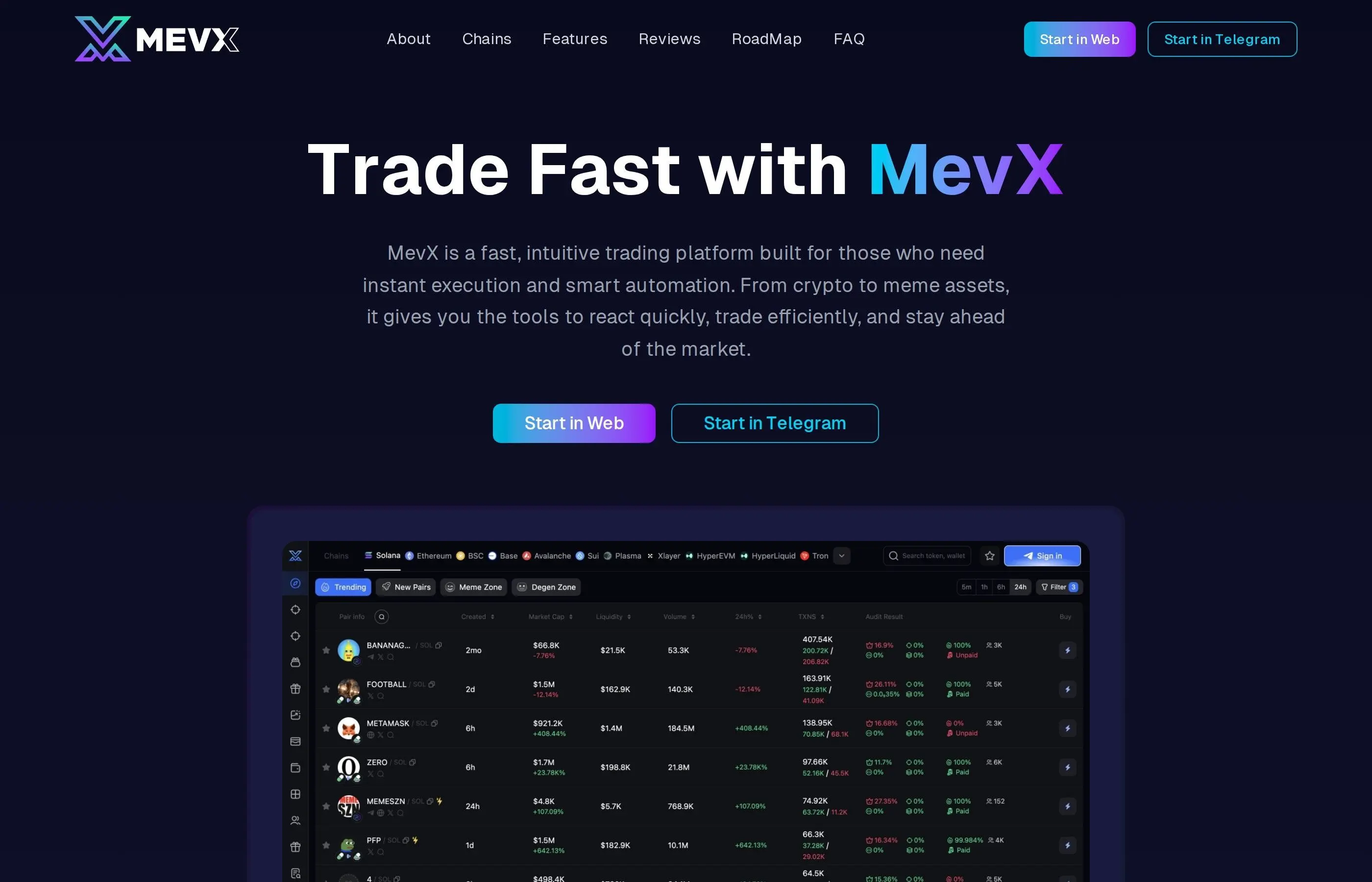
Understanding how to use MEVX MEV protection trading is critical for any DeFi trader who wants to stop losing money to invisible bots on every swap. MEV (Maximal Extractable Value) attacks cost traders billions of dollars annually through sandwich attacks, frontrunning, and backrunning - and most victims never even realize it is happening. MEVX is a multi-chain trading platform built from the ground up to protect your trades using Jito bundles on Solana and Flashbots Protect on Ethereum, ensuring you get the price you expect without being exploited by automated extraction bots.
What Is MEV and Why Should You Care?
MEV stands for Maximal Extractable Value - the profit that can be extracted from blockchain users by reordering, inserting, or censoring transactions within a block. In practical terms, MEV is the money that bots steal from you every time you make a swap on a decentralized exchange.
When you submit a swap on Uniswap, Jupiter, or any DEX, your transaction enters a public waiting area (the mempool on Ethereum, or validator visibility on Solana). Bots monitor this 24/7, analyzing every pending transaction to calculate how to profit from it.
The most common attack is the sandwich attack. A bot buys the same token just before your transaction (frontrun), driving the price up. Your transaction then executes at this inflated price. The bot immediately sells after (backrun), pocketing the difference. You get fewer tokens than expected, and the bot profits - all within a single block.
Beyond sandwiches, MEV includes frontrunning, backrunning, and liquidation sniping. On Ethereum alone, MEV bots extracted over $1.4 billion in 2025.
Think of MEV like this: imagine placing a bet at a racetrack, but someone with inside access sees your bet ticket, places their own bet first to move the odds, and then profits from the shift your bet caused. That is essentially what sandwich attacks do to your DeFi trades - and they happen thousands of times per day across major blockchains.
How MEVX Protects Your Trades
MEVX uses different protection mechanisms depending on which blockchain you are trading on, because MEV works differently on each chain.
Solana Protection: Jito Bundles
On Solana, MEVX routes transactions through Jito's block engine. Instead of submitting to the public pool, MEVX bundles your transaction and sends it directly to Jito-connected validators with a small tip. The bundle executes atomically - no bot can insert transactions before or after yours, making sandwich attacks impossible. The tip (typically 0.0001-0.005 SOL) is a fraction of what you would lose to MEV bots without protection.
Ethereum Protection: Flashbots Protect
On Ethereum, MEVX integrates with Flashbots Protect. Instead of broadcasting to the public mempool, MEVX sends your transaction to a private pool maintained by Flashbots. Only ethical block builders can see it, and they include it without MEV extraction. Your swap executes at the expected price without bot interference.
Step-by-Step: Getting Started with MEVX
Step 1 - Connect Your Wallet
Visit MEVX and connect your wallet. The platform supports Phantom, Solflare, and Backpack for Solana, plus MetaMask, Rabby, and WalletConnect for Ethereum and EVM chains. MEVX is non-custodial - it never holds your private keys. All transactions require your explicit wallet approval.
Step 2 - Select Your Chain and Token Pair
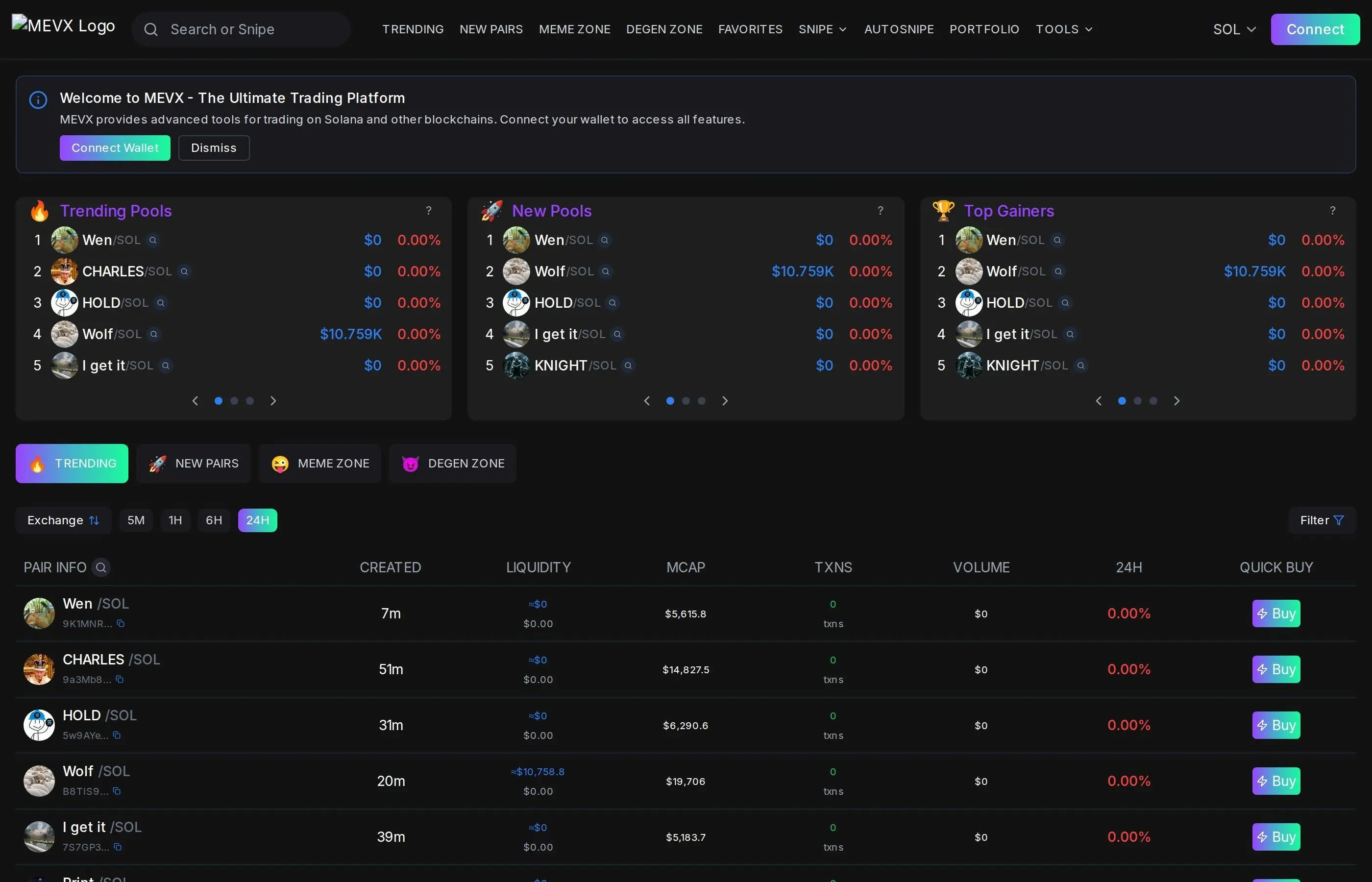
Choose which blockchain you want to trade on (Solana, Ethereum, Base, Arbitrum, or others). Then select your input token (e.g., SOL or ETH) and output token. MEVX features a token search that shows liquidity, volume, and basic safety metrics for each token. The platform's smart routing automatically finds the best price across multiple DEXs on your selected chain.
Step 3 - Review the MEV Protection Settings
Before confirming any trade, MEVX shows your protection status. On Solana, you will see the Jito bundle configuration and tip amount. On Ethereum, you will see Flashbots Protect status. You can adjust the Jito tip (higher tip = faster inclusion) or toggle between standard and protected modes. Protected mode is enabled by default - there is almost never a reason to disable it.
Step 4 - Set Slippage and Execute
Set your slippage tolerance. With MEV protection active, you can often use lower slippage than you would on unprotected DEXs, because you are not competing with sandwich bots. A 1-3% slippage is usually sufficient for most tokens. Click "Swap" and approve the transaction in your wallet. MEVX routes it through the appropriate protection layer and confirms execution.
Step 5 - Verify Your Trade
After execution, MEVX shows your trade details: exact input amount, output amount, effective price, and any fees paid. Compare the execution price to the quoted price - with MEV protection, these should be nearly identical. On an unprotected DEX, the execution price often differs by 1-5% due to MEV extraction.
Step 6 - Set Up Limit Orders or DCA
For ongoing trading, configure limit orders (buy or sell when a token reaches a specific price) or DCA schedules (dollar-cost average into a position over time). Both features execute with full MEV protection on every transaction, so even your automated trades are shielded from extraction.
Smart Routing and Price Optimization
MEVX does not just protect your trades from MEV - it also optimizes execution price through intelligent routing. When you swap tokens, the platform simultaneously queries multiple DEX protocols (Uniswap, SushiSwap, Curve, and others on Ethereum; Jupiter, Raydium, Orca on Solana) and calculates the optimal route.
For large trades, MEVX splits your order across multiple DEXs to minimize price impact. Each leg of the split trade is MEV-protected independently.
Pro Tip: For very large trades (over $50,000), consider using MEVX's limit order feature to break the trade into smaller chunks over time. Even with MEV protection, large single swaps create significant price impact on low-liquidity pairs. A series of smaller protected orders often yields better average execution.
Limit Orders and DCA Features
MEVX offers on-chain limit orders that execute automatically when your target price is reached. Unlike centralized exchange limit orders, these are fully decentralized - they execute on-chain through smart contracts when market conditions are met. Every limit order execution is MEV-protected, meaning even triggered orders cannot be sandwiched.
The DCA (Dollar-Cost Averaging) feature lets you set up recurring purchases of any token at fixed intervals (hourly, daily, weekly). Each DCA execution is individually protected. This is particularly useful for accumulating positions in volatile tokens without trying to time the market. You set the total amount, number of intervals, and MEVX handles the rest - buying a fixed amount each period with full protection.
Success: Users who enable MEV protection on MEVX report saving an average of 2-5% per trade compared to unprotected swaps on standard DEXs. On large trades, the savings can be even more significant - we have seen cases where sandwich attacks would have cost traders 8-10% of their swap value.
Advanced Strategies and Tips
Always-On Protection: Never disable MEV protection "to save on tips." The Jito tip on Solana (0.0001-0.005 SOL) or the Flashbots routing on Ethereum costs virtually nothing compared to what a single sandwich attack extracts. Protection should be your default state for every trade, no exceptions.
Slippage Optimization: With MEV protection active, you can run tighter slippage than on unprotected DEXs. On a standard DEX, you might need 5% slippage to account for bots moving the price. On MEVX, 1-2% is usually sufficient because the price will not move between your quote and execution (no frontrunning). Tighter slippage means better prices.
Large Trade Strategy: For swaps exceeding $10,000, use MEVX's time-weighted DCA to split the trade over multiple blocks. Even with MEV protection, single large trades create price impact from the AMM's bonding curve. Splitting reduces this organic price impact while each sub-trade remains fully protected.
Cross-Chain Arbitrage: Advanced traders use MEVX on multiple chains simultaneously. Price discrepancies between the same token on Ethereum vs. Arbitrum vs. Solana can be captured safely with MEV protection on each leg. MEVX's multi-chain support makes this workflow seamless from a single interface.
Monitor Your Savings: MEVX tracks how much MEV protection has saved you over time. Review this metric regularly - it quantifies the real cost of trading without protection and reinforces why MEV-protected trading should be your standard approach.
Fee Structure
MEVX vs Alternatives: Comparison
Security Considerations and Risks
While MEVX protects you from MEV extraction, there are still risks inherent to DeFi trading that no platform can eliminate:
Smart Contract Risk: MEVX routes through third-party DEX contracts (Uniswap, Jupiter, Raydium). While MEVX's own contracts are audited, underlying DEX protocols carry their own risk.
Token Risk: MEV protection ensures fair execution price but does not protect you from worthless tokens. Scam tokens and rug pulls are risks that exist independently of MEV. Always research tokens before trading.
Wallet Security: MEVX is non-custodial and never holds your funds. Use a hardware wallet for significant holdings and never share your seed phrase.
Protection Limitations: MEV protection eliminates artificial bot manipulation but cannot prevent organic price impact from market movements, low liquidity, or large trade sizes.
Network Congestion: During extreme congestion, protected transactions may take longer to land or require higher tips for timely inclusion.
Common Mistakes to Avoid
• Disabling MEV protection to "save fees" - The Jito tip or Flashbots routing cost is negligible compared to what a single sandwich attack extracts. Disabling protection to save 0.001 SOL while risking 3-5% extraction on your swap makes no mathematical sense.
• Setting excessive slippage - With MEV protection, you do not need 10-20% slippage. Bots cannot move the price before your trade, so 1-3% slippage is sufficient for most tokens. High slippage just means you accept worse prices unnecessarily.
• Assuming protection means safe tokens - MEV protection shields your execution price, not your investment thesis. A rug pull token will still rug whether you bought it with or without MEV protection. Do your own research on every token.
• Ignoring gas and tip optimization - On Ethereum, gas fees can make small trades uneconomical regardless of MEV protection. On Solana, excessively high Jito tips eat into profits. Calibrate your fee settings based on trade size and urgency.
• Trading on unprotected DEXs "out of habit" - Once you understand MEV, trading without protection is like leaving your car unlocked in a parking lot. There is no upside. Make MEVX or another MEV-protected interface your default for all trades.
Frequently Asked Questions
What exactly is a sandwich attack?
A sandwich attack is when a bot places a buy order immediately before your swap (frontrun) and a sell order immediately after (backrun). The frontrun drives the price up before you buy, and the backrun captures the profit after your trade pushes the price even higher. You end up paying more than you should, and the bot pockets the difference - all in a single block.
How much does MEV protection actually save?
Savings vary by trade size and token liquidity. Small trades on high-liquidity pairs may only save 0.1-0.5%. Large trades on low-liquidity pairs can save 3-10% or more. MEVX's dashboard tracks your cumulative savings so you can see the real impact over time.
Does MEVX work on all tokens?
Yes, MEV protection works for any token that can be traded on supported DEXs. The protection is at the transaction level, not the token level. Whether you are swapping ETH for a blue-chip DeFi token or buying a brand-new memecoin, the same Jito/Flashbots protection applies.
Is MEVX free to use?
MEVX charges a small platform fee (0.5-1%) per swap, similar to other DEX aggregators. On Solana, there is an additional Jito tip (user-configurable, typically 0.0001-0.005 SOL). On Ethereum, Flashbots Protect routing is free - no extra cost beyond standard gas fees.
Can I use MEVX with a hardware wallet?
Yes, MEVX supports hardware wallets through MetaMask (Ledger, Trezor) and WalletConnect. Your hardware wallet signs each transaction, and MEVX routes it through the appropriate protection layer. This combines the security of hardware key storage with the MEV protection of MEVX's routing.
Does MEV protection slow down my transactions?
On Solana with Jito bundles, there is virtually no speed difference - transactions land in the same block or the next one. On Ethereum with Flashbots Protect, transactions may take 1-2 blocks longer (12-24 seconds) compared to public mempool submission, because they wait for a builder who will include them without MEV extraction.
What chains does MEVX support?
MEVX supports Solana (with Jito bundle protection), Ethereum mainnet (with Flashbots Protect), and several EVM L2s including Base, Arbitrum, and Optimism. The team continues adding new chains as MEV protection infrastructure becomes available on them.
Do I need a special wallet for MEVX?
No, MEVX works with any standard wallet. On Solana, use Phantom, Solflare, or Backpack. On Ethereum and EVM chains, use MetaMask, Rabby, or any WalletConnect-compatible wallet. No special setup or configuration is required beyond a normal wallet connection.
Related Tutorials
• How to Use Axiom Solana Trading Bot - Tutorial 2026
• How to Use dYdX Perpetual Trading - Tutorial 2026
• How to Use GMX Perpetual Trading on Arbitrum - Tutorial 2026
• How to Use MetaMask Wallet - Complete Tutorial 2026
• How to Use Ledger Nano Hardware Wallet - Setup Guide 2026
• How to Use Curve Finance Stablecoin Swap - Tutorial 2026
Related Guides
- Sandwich Attacks and MEV Risks in DEX Trading
- What Is MEV in Crypto? Maximal Extractable Value Explained (2026)
- What Is a Sandwich Attack in Crypto? How MEV Worsens Your Trades (2026)
- What Is a MEV Bot: Complete Frontrunning & Sandwich Attacks Guide (2026)
- MEV Risks for Crypto Traders: How to Reduce Losses